💡 Passionate about blockchain since 2017
🌍 Global voice in institutional blockchain adoption
🎤 Speaker: Web3 - Fintech Conferences
🚀 Head of MENA https://t.co/wb58KdLnTd
Retail brings the innovation, institutions bring the scale.
Together, they’re turning restaking from an experiment into core infrastructure.
P2P.org is building the rails to power the future of finance. 🌐🔑⚡
🙏 Big thanks to @gazza_jenks and @Cointelegraph for hosting today’s AMA!
#DeFi#Staking#Restaking#Institutions#Ethereum
The technology works. That is no longer the question.
What is holding institutions back in 2026 is everything underneath it:
⟡ compliance teams interpreting the same regulation differently,
⟡ internal stakeholders who can block a deal at the last stage,
⟡ and reporting infrastructure that most institutions are still catching up to build.
Last week @P2Pvalidator hosted a live practitioner roundtable with leaders from @AMINABankGlobal , @ampli_inc, and @P2Pvalidator to examine exactly that gap.
Full post linked below 👇
p2p.org/economy/instit…
Today, @AliBoukhalfa89, our Head of Emerging Markets, joins a panel at @MENABCW on the future of the digital economy: crypto, RWAs, and payments.
Joining the discussion:
⟡ Chantal Bradford, Head of EMEA Market Sales at @coinbase
⟡ Chirag Mehta, CBO at @Hedgitmarkets
⟡ @lucybalicki, OTC Sales at @LaserDigital_
⟡ Jia-Tern (JT), Director of Strategic Partnerships and DeFi at @0xPolygonFdn
As institutional adoption accelerates across MENA, these conversations are shaping the next phase of financial markets.
Follow along for insights from the session.
We got a lot of requests to bring this back to life, and as promised, it's live now! #nodecore" target="_blank" rel="nofollow noopener">drpc.org/docs/gettingst…
If you build a mission-critical dApp, or if part of your functionality is super fragile to RPC poisoning, please use the Verification feature from dRPC via NodeCloud or NodeCore; there is no excuse not to use it, and you can't say, after yet another hack, that you were not aware of this.
. For a mission-critical application like a bridge or oracle, there's no excuse not to set it up. But they didn’t.
The framing of the recent KelpDAO and LayerZero incidents as some novel attack vector, or the work of meaningfully smarter attackers, is mostly wrong. The actual failure mode - applications trusting a single RPC endpoint to return honest data - has been discussed openly for years, by @VitalikButerin, @lomashuk, @MicahZoltu, @wagmiAlexander, @ChainLinkGod, @banteg, and many others. It is neither new nor subtle. A closely related failure happened in 2022 with the Ankr DNS hijack on Polygon and Fantom: x.com/Mudit__Gupta/s…
The point here isn't ideological. In a 24/7 market where automated systems act on RPC responses in real time, assuming one provider will always return correct data is a system-level risk. There is no T+2 window in which a human notices the error and reverses it.
When we launched dRPC, cross-verification across a permissioned set of RPC providers was the core idea. The original repo and docs are still up (although outdated since then):
-#why-use-verification" target="_blank" rel="nofollow noopener">drpc.org/docs/gettingst…
- github.com/drpcorg/drpc-s…
We used a simple quorum rather than zk-based verification, partly to test real demand before overbuilding. Two observations from that period:
1. The demand was not there. In public, everyone agreed with the thesis. In private, the responses were "we are not ready to pay more for quorum," or "yes, we could apply it to sensitive paths only, but it's not a priority."
2. The risk was real. The market is now discovering this at a cost of roughly $250M.
Because full cross-verification on every request is overkill for most workloads, we eventually shifted toward shadow checks — randomized background comparisons across providers that detect and eject unhealthy nodes before they serve meaningful traffic. This is a reasonable compromise for general workloads. It is not a substitute for quorum on sensitive paths.
So the practical rule, for anyone building infrastructure whose failure mode is user funds:
1. Use at least 3–5 independent, reliable RPC providers.
2. Do not build your load balancer on training wheels. Something like drpc.org/nodecore-open-… is open source, free, and almost certainly better than what you would build in-house. Contributing to it is a better use of time than reinventing it.
You cannot defend against every possible attack. But this particular class is avoidable at low cost, if you are willing to treat RPC as a system-level dependency rather than a commodity input. That is a reasonable bar for anything meant to serve more than a narrow circle of users.
We will update the dRPC NodeCore (drpc.org/nodecore-open-…) with strict rules for quorum on your side in the near future, stay tuned. If you have more sophisticated requirements for security, we are fully open for your requests - feel free to each me our via DM here or by email kz@drpc.org
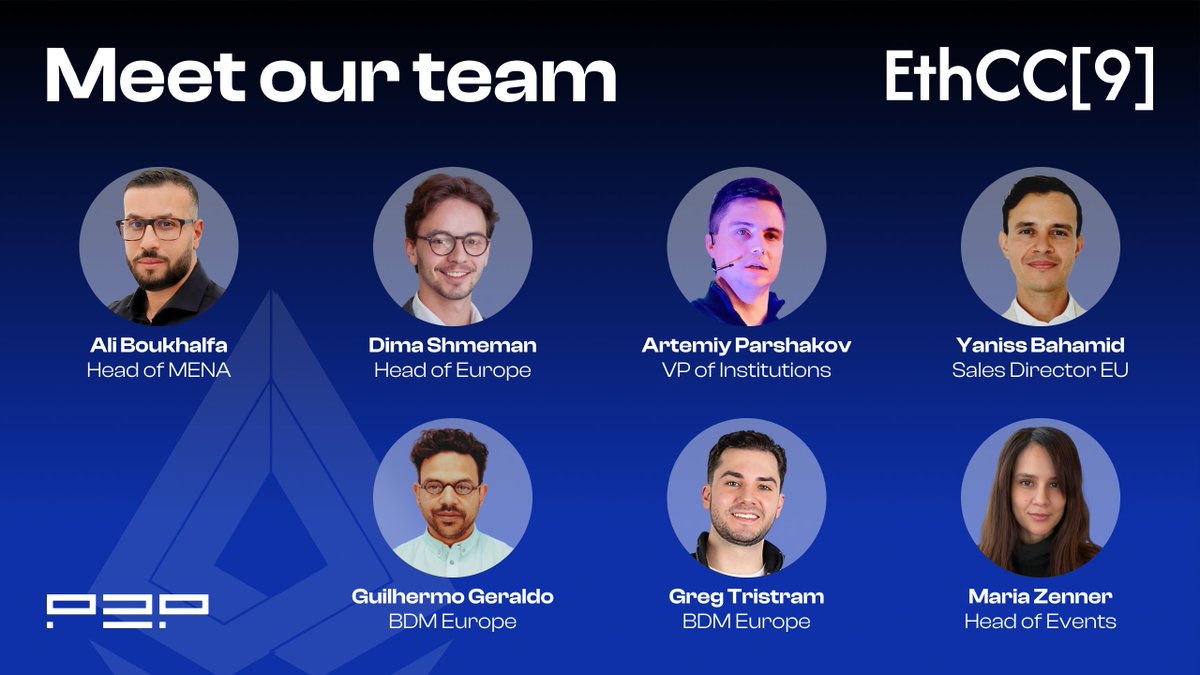
The P2P.org team will be in Cannes next week for @EthCC 9 🇫🇷. Connect with the team below and check the side events where to find us 👇
We'll be on the ground at the conference connecting with partners, clients, and the broader ecosystem across staking, infrastructure, and capital markets, continuing conversations that are shaping how digital assets integrate into the financial system.
Alongside the conference, we'll also be hosting two events:
→ The Circle, our private dinner co-hosted with @AMINABankGlobal and @FireblocksHQ
→ [Not Crypto] Art Night, alongside @1inch and @ResolvLabs, bringing together institutional players and industry leaders
If you'll be at @EthCC 9, reach out to the team on the ground to talk institutional staking:
> @parshakov2603, VP of Institutions
> @AliBoukhalfa89, Head of MENA
> @shmeman, Head of Europe
> Yaniss Bahamid, Sales Director EU
> Guillermo Geraldo, BDM Europe
> Greg Tristram, BDM Europe
> @MariaZenner_ , Head of Events
Institutional staking decisions are moving into production.
On Feb 5 at 4:30 PM CET, @AliBoukhalfa89, our Head of MENA, joins @LidoFinance for a live discussion on how modular staking is being used in practice 🧵
A new chapter begins @P2Pvalidator.
Founder @Lomashuk is returning as CEO to lead the next phase of what we’re building — beyond validators, toward full-stack institutional yield infrastructure.
This is a defining moment 🧵
In Web3, data is one of the hardest markets to build in. It’s crowded, competitive, and full of very strong players.
At the end of last summer, one of our teams — Lambda — managed to ship something truly unique: a real DeFi P&L, available via both UI and API.
Not estimates. Not “yield-like” numbers.
But an actual profit & loss view, so users can finally understand their real performance across DeFi.
We’re incredibly grateful to the partners who have already integrated this solution: @heliuslabs , @solflare , @Backpack , @SushiSwap , @utila_io , @CactusCustody , @LidoFinance — and many others.
If you’re building in Web3 and need clean, institutional-grade DeFi P&L data, feel free to reach out to @kotitkin !
A wave of commercial expansion took shape in 2025.
As regulatory clarity advanced, institutions moved from exploring stablecoins to using them in real financial workflows.
@USDC, EURC, and USYC began showing up across payments, treasury, settlement, and capital markets.
What changed wasn’t just adoption. It was confidence.
Confidence that regulated, fully reserved digital assets can operate inside the financial system.
Confidence that real-time, cross-border settlement can scale.
Confidence that assets, applications, and infrastructure can work together.
This is stablecoins moving from the edges of finance into the core.
Read more in Circle’s 2025 Year in Review: circle.com/executiveinsig…
@CantonNetwork Awesome for @jpmorgan and Great milestone for @CantonNetwork
It also prove institutions aren’t “anti-onchain” 😉
Clear settlement + Clear privacy + Clear accountability is the way to go 🚀
coindesk.com/tech/2026/01/0…#TradFi is quietly standardizing on regulated digital cash. @jpmorgan going native on @CantonNetwork is basically: “settlement money that compliance teams can live with.”
If this scales, it’s a real step toward always-on capital markets.
@lordjorx@StaniKulechov Taking the issue in reverse can help (from the buyer).
What institutions need to underwrite risk? They care about legal ownership of key assets, control of treasury/cashflows, enforceable governance, and clean disclosure.
Without that, it’s just governance risk
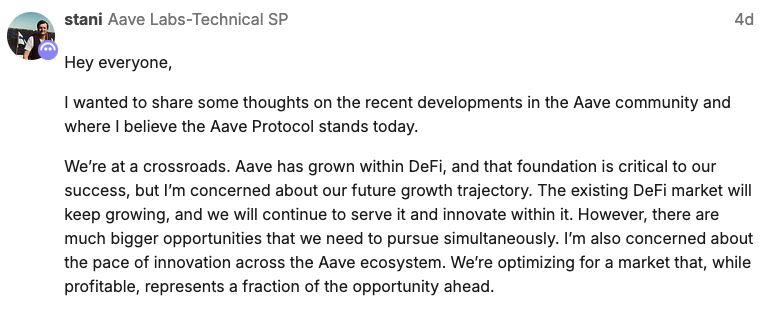
Aave is facing a $500M identity crisis.
@StaniKulechov just went public saying Aave feels "stagnant."
He believes technical updates aren't enough and that the product needs to move faster.
For him, Aave Labs should lead the way. But the main question remains there: who actually pockets the profits, the company or the DAO?
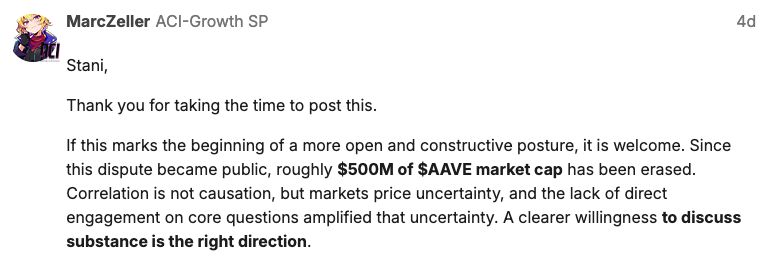
@Marczeller pointed out that this public fighting has wiped 20% off the price, losing $500 million in market cap.
Zeller is demanding a legal setup where the DAO controls everything, including the website and social media, to keep things public and transparent.
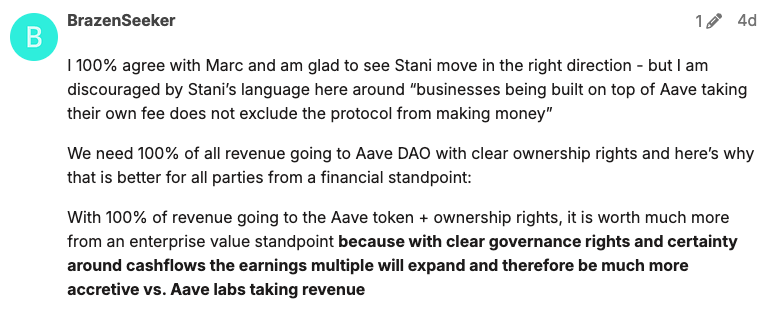
Other users, like BrazenSeeker, are even firmer:
100% of the revenue should go to the DAO. Last year, @aave generated over $100 million. If the DAO holds the money, it can reward the best teams with massive payouts based on their performance.
This uncertainty is scaring away big institutional investors. If they don't see a clear path for the money, they won't buy.
Public transparency is great, but creating constant doubt isn't. We need a clear plan, not a public ego war that sends the chart lower.
@MerlijnTrader Agree @MerlijnTrader !
With bank-level oversight, stablecoin infrastructure becomes usable at scale for settlement, liquidity, and on-chain rails.
The real shift is invisible: regulated, interoperable, and built for institutional-scale financial infrastructure.
BREAKING:
🇺🇸 Circle has received conditional approval to form a U.S. National Trust Bank.
What this actually means:
- USDC’s reserves move under federal bank-level oversight
- Custody and settlement infrastructure sits inside the U.S. banking system
- Built for institutions, not retail banking
This isn’t hype. It’s plumbing.
Stablecoins aren’t replacing banks.
They’re being wired into them.
The future of payments is on-chain and regulated
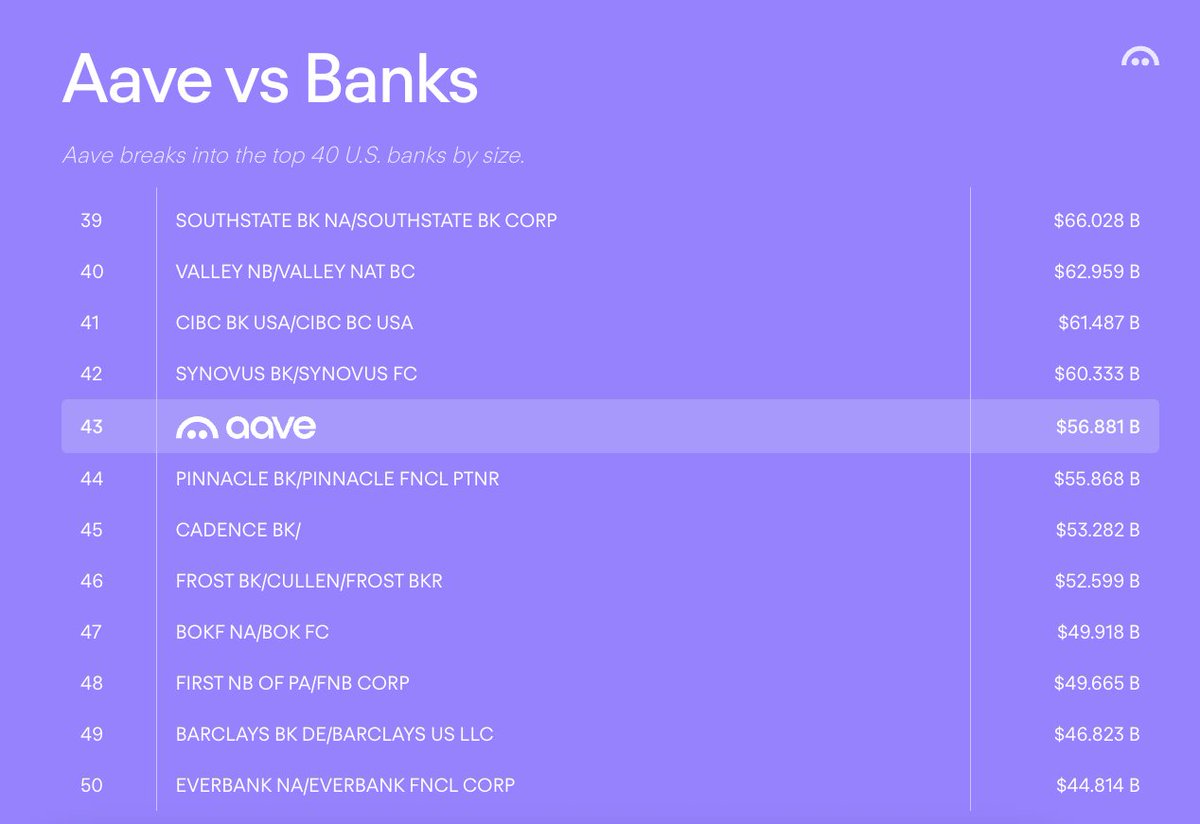
What’s striking isn’t just the comparison, it’s the signal behind it.
A protocol built on open infrastructure competing with century-old banks shows how fast financial primitives are being redefined.
This isn’t about DeFi replacing banks, the real story is efficiency + global accessibility = better adoption 🔥
Happy New Year everyone
New year = good moment to reset narratives.
2026 won’t be about hype cycles 🎯
It will be about infrastructure, trust, and sustainable adoption
📈 Bull or Bear Market, builders focusing on fundamentals will win 🏗️🔐🌍