Amy Nice

177 posts

Amy Nice banner
Amy Nice

Amy Nice

@AmyMNice

Distinguished Immigration Counsel @IFP, trying to make the immigration system we're stuck with work better

Washington, DC Katılım Mart 2024
116 Takip Edilen930 Takipçiler
Sabitlenmiş Tweet
Amy Nice
Amy Nice@AmyMNice·
This is a major rule change that Congress can disallow under the Congressional Review Act - let’s make that happen? Why are we taking steps to break the international talent pipeline to the US of A? Why don’t the new fixed periods of stay match the expected time needed to complete degrees and practical training?Inquiring questions for inquiring minds.
Hoover Institution@HooverInst

US visas issued to international students fell by roughly a third in 2025. Today, DHS finalized changes to a rule known as "Duration of Status" — a move that will help lock that decline in place. The fallout for the STEM workforce, innovation, and economic growth could be severe. A sustained one-third decline in foreign STEM graduates entering the US labor force would shrink the high-skill STEM workforce by 6.2% overall and by 11.5% at the PhD level. Over a decade, that would cut annual US GDP by $240 billion to $481 billion, comparable to losing an entire state's economy. That's the estimate from @AmyMNice, in a guest research brief for Hoover's Immigration Initiative, drawing on research she co-authored with @m_clem and @JeremyLNeufeld. Read the full brief: hoover.org/research/break…

English
17
31
176
28.7K
Amy Nice
Amy Nice@AmyMNice·
This is a major rule change that Congress can disallow under the Congressional Review Act - let’s make that happen? Why are we taking steps to break the international talent pipeline to the US of A? Why don’t the new fixed periods of stay match the expected time needed to complete degrees and practical training?Inquiring questions for inquiring minds.
Hoover Institution@HooverInst

US visas issued to international students fell by roughly a third in 2025. Today, DHS finalized changes to a rule known as "Duration of Status" — a move that will help lock that decline in place. The fallout for the STEM workforce, innovation, and economic growth could be severe. A sustained one-third decline in foreign STEM graduates entering the US labor force would shrink the high-skill STEM workforce by 6.2% overall and by 11.5% at the PhD level. Over a decade, that would cut annual US GDP by $240 billion to $481 billion, comparable to losing an entire state's economy. That's the estimate from @AmyMNice, in a guest research brief for Hoover's Immigration Initiative, drawing on research she co-authored with @m_clem and @JeremyLNeufeld. Read the full brief: hoover.org/research/break…

English
17
31
176
28.7K
Amy Nice
Amy Nice@AmyMNice·
An @IFP @matthewesche move: There's a problem, do the complex analysis to explore it, share the data in the public square that will help make progress on solving the problem. Boom!
Matt Esche@matthewesche

At @IFP, we’ve spent the past 3 years thinking about all the different ways the US government & philanthropy fund R&D. Until now, R&D funders haven’t had a systematic way to match the innovation problem to the right funding tool. We built THE ATLAS OF INNOVATION to fill that gap. atlasofinnovation.org Alongside @UChi_MSA, we’ve boiled down thousands of hours of research into a handful of questions covering how much the R&D funder knows about: - the problem they want to solve - the solution it should have - the team that should build the solution Why the Atlas matters: The US government spends close to $200 billion every year on R&D. And after the Anthropic and OpenAI IPOs, there will be hundreds of billions of dollars in new philanthropic giving. Choosing the correct funding approach to the social problems they’re trying to solve will mean the difference between success and failure. For example, NSF research grants have helped seed breakthroughs from MRI machines to search engines, but grants aren’t built to deliver the kind of industrial speed and scale that a project like Operation Warp Speed required. Picking the wrong funding approach can leave programs behind schedule, over budget, or without anything to show for all the money they spent. How we built the Atlas: 1. We began by creating a matrix of dozens of considerations that a thoughtful policymaker or funder would ideally weigh before deciding how to fund a project. 2. We looked at every major funding approach, from grants to R&D tax credits to advance market commitments, analyzing when they work well and when they fail to meet the mission. 3. We spent months deep in the weeds of contract theory and incentive design, looking at historical examples and the state-of-the-art research in innovation economics. 4. We then worked to turn that research into a tool that time-strapped policymakers and philanthropic funders could rely on at the start of an innovation funding cycle. 5. Three years later, we are launching just that: a new (and visually stunning) website to help funders decide how to best incentivize innovation. And all they have to know… is what they currently know about their innovation goal! The Atlas takes care of the rest. How to navigate the Atlas: Answer questions about your goal to find the funding approach aligned with the information you have. Each funding mechanism has its purpose for particular technologies and specific moments in development. There shouldn’t be an ARPA for every field, just like we don’t need a prize or AMC for every innovation. The Atlas helps you navigate those tradeoffs.

English
0
4
10
1K
Amy Nice
Amy Nice@AmyMNice·
Yes - from its initial enactment in 1952 to its last amendment in 2022, section 245 has been revised by Congress in 23 different laws. It’s no loophole or exception. And the initial creation of Adjustment of Status to permanent residency in the US was in the same (1952) law that created the presumption of immigrant intent and requirement of nonimmigrants to prove otherwise while _also_ saying that those same nonimmigrants could adjust status in the U.S. I for one was using the 1960 reference on this platform for discussion because it was the best shorthand for accurately representing Adjustment of Status was unequivocally broad for all noncitizens in the U.S. (except for crewmen!).
English
2
7
17
2.3K
Amy Nice
Amy Nice@AmyMNice·
@rajatsuri They had to walk it back because … under the _law_ they can’t do what their press releases and tweets said they were doing. They wanted to own the talking points, but realized they can’t own the policy itself.
English
1
1
5
239
Amy Nice
Amy Nice@AmyMNice·
USCIS has no authority to say "we are only granting adjustment of status to people who show extraordinary circumstances." They can't say this as a matter of discretion. "Adjustment of status," by definition, by law, does _not_ refer to both obtaining green card status in the US and consular processing through an immigrant visa interview. Adjustment of status is the right under the law that Congress enacted to obtain permanent resident status in the US _if_, and only if, USCIS, in its discretion, confirms you have met the regulatory requirements as USCIS itself has laid out. The regulations do not say adjustment of status is an extraordinary remedy (and cannot say that, because this view is not mentioned or supported in the statute). So, your #3 cannot be a blanket rule, policy, approach, or policy under the governing statute.
English
0
0
0
99
Morning Rain 🇺🇸
Morning Rain 🇺🇸@Morningcoldrain·
You absolutely right. USCIS can't eliminate the ability of non-citizens to adjust status to LPR. What the memo says is the following, For example, an H-1 B, O1 visa holder lives and works in the U.S. 1)Gets I-140 approved. 2)Requests a green card. 3)USCIS says: "We are not granting adjustment of status as a matter of discretion. Use the ordinary immigrant visa process instead." 4)The applicant schedules an immigrant visa interview at a U.S. embassy or consulate abroad. 5)If approved, returns to the U.S. as a permanent resident
English
3
0
2
5K
Amy Nice
Amy Nice@AmyMNice·
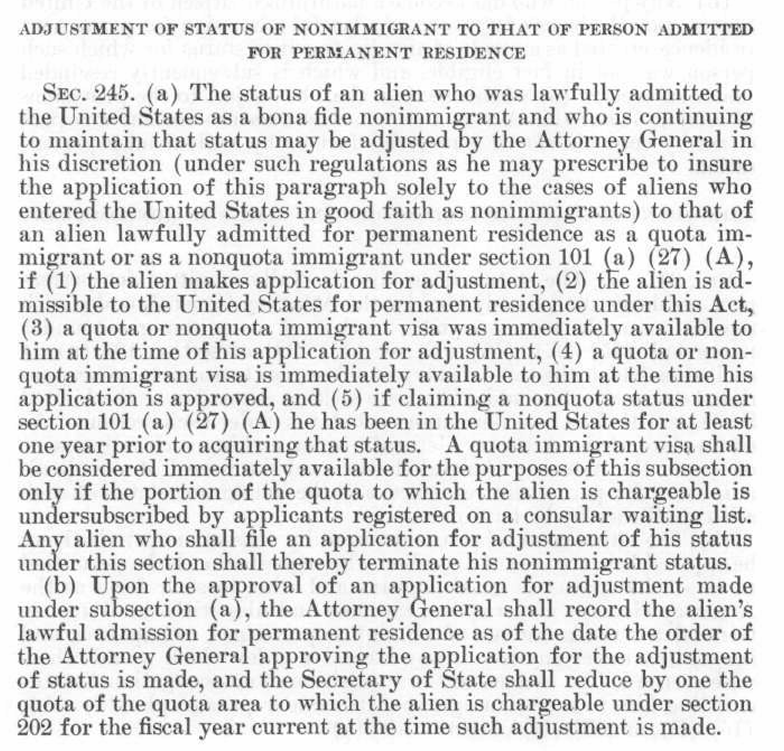
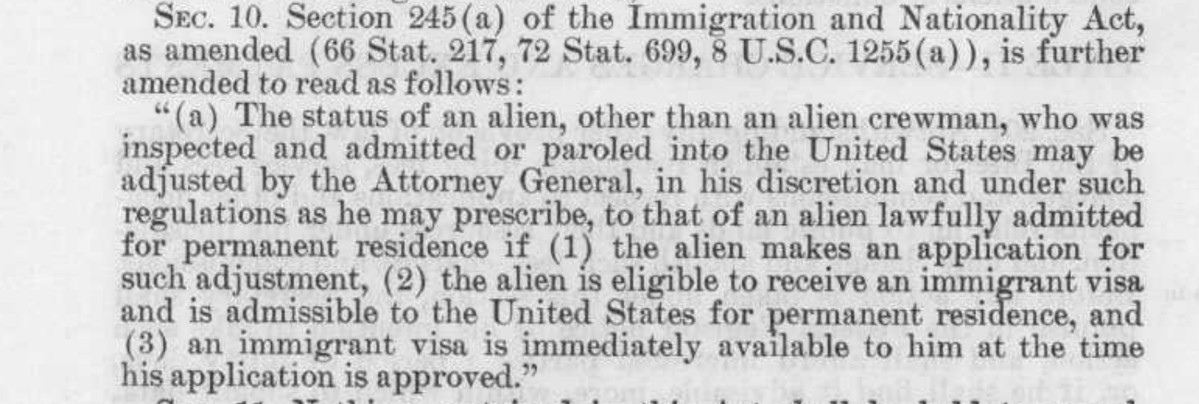
Can USCIS eliminate the ability of noncitizens to adjust status to permanent resident in the US, requiring them to return home and consular process at the American Embassy in their home country before returning to obtain green card status? Nope. Because _Congress_ said adjustment of status is available. In 1960. And since then has amended the adjustment of status law 20 times, setting new restrictions. This is not a “loophole.” Is USCIS establishing a new standard in its May 21st Policy Memo that any noncitizen must prove “extraordinary circumstances” in order to be eligible for adjustment of status to permanent resident here in the US? Well, nowhere in the Policy Memo does the agency use the term “extraordinary circumstances” - Crtl-F, it’s not there. USCIS has binding regulations that set out the requirements for adjustment of status, and if it wants to change those rules, it must comply with the Administrative Procedure Act and propose a new regulation. A Policy Memorandum cannot conflict with a law that has been on the books for 65 years. Does USCIS have discretion when it reviews applications to adjust status? Yes! Can it do through the back door what it cannot do through the front door? Nope.
Amy Nice tweet media
English
41
70
325
144.7K
Amy Nice
Amy Nice@AmyMNice·
@AttyStevenBrown @DanielDiMartino The quarter limits don’t have to lead to wastage in employment-based _if_ USCIS and DOS properly plan for Q4 when quarter limits do _not_ apply for EB. But yes seems a little early to hit the limit.
English
0
0
1
106
Steven Brown
Steven Brown@AttyStevenBrown·
@DanielDiMartino I don't disagree with you, just seems early to hit it. But USCIS "calls" DOS to get a visa number prior to approving an I-485, so it's ultimately driven by DOS.
English
2
0
4
2.4K
Steven Brown
Steven Brown@AttyStevenBrown·
I will preface with the fact that it is always good not to see wastage. That said, I am very interested to see how they managed this...At first glance, it violates the per-quarter limits in 8 USC 1151(a)(2) since we are not yet at Q4 of the FY.
Steven Brown@AttyStevenBrown

Missed in the Friday news: The Department of State announced that it has issued all EB-2 Immigrant visas chargeable to India for Fiscal Year 2026. This means no more EB-2 immigrant visas will be issued for India this year. travel.state.gov/content/travel…

English
5
6
80
40.7K
Amy Nice
Amy Nice@AmyMNice·
Basically, yes, you’ve got it : Yes the regulations have a lot of requirements and restrictions, confirming that temporary visa holders adjusting status in the US is not a loophole, and yes the agency is charged with exercising judgment and expertise to confirm when the regulatory requirements are satisfied, and yes “extraordinary circumstances” is inconsistent with the existing regulations as well as the governing statute.
English
0
0
2
15
hemtao
hemtao@instcc·
So do the regulations still allow discretion--you're just saying extraordinary circumstances is too high a bar for that discretion? I don't know the reason for the policy change, but it looks like H1-B and other visa tracks will not automatically track to green cards in the future.
English
1
0
0
21
Amy Nice
Amy Nice@AmyMNice·
You’re exactly right, the key is what the regulations allow. In this situation the regulations, like the governing statute, specifically allow temporary visa holders to adjust status to lawful permanent resident in the United States without proving “extraordinary circumstances.” The USCIS judgment about adjustment eligibility is based on a case by case compliance with those binding regulations.
English
2
0
1
40
hemtao
hemtao@instcc·
@AmyMNice I don't know what the regulations allow. That will matter.
English
1
0
0
21
Amy Nice
Amy Nice@AmyMNice·
@ThomAquinas77 @Morningcoldrain If someone is a lawful permanent resident of the U.S. with a green card they are not impacted by the new policy announcement.
English
0
1
2
262
Amy Nice
Amy Nice@AmyMNice·
It's simply not correct that the government's new policy is about dual intent or the obligation to prove nonimmigrant intent when a visa is issued and one first enters the US as a nonimmigrant. How do we know? Because the law allowing adjustment of status was enacted in 1952 in the same exact law that also created for the first time the statutory requirement to prove nonimmigrant intent. That law specifically said that individuals who were holding a nonimmigrant status could adjust to permanent residency in the US. No one is talking about dodging in-depth vetting. Of course there should be, and is, screening and vetting of all immigrants and especially those seeking to obtain the right to permanently reside in our country. The mention of removal was only because you said in your earlier post that this was about section 241 (which is the old statutory section on removal) ...
English
2
0
3
163
Janet E Conover
Janet E Conover@hilltowntrader·
The issue is "migration intent." Those applying for temp visas swear they are NOT intending to migrate and will leave. To then apply for change of status means they lied, and that is immigration fraud. Temp visas can't be used as a spring board to immigration visas, or to dodge in depth vetting. Its not about removing them. Its about enforcing existing law around 'migration intent."
English
1
0
0
98
Kristopher Micinski -- REBORN
Kristopher Micinski -- REBORN@krismicinski·
@AmyMNice @rajatsuri I think one thing is clear: it’s not obvious what is going to happen right now. Anyone who is giving absolute statements about how things might be enforced is probably wrong (not saying either of you are doing this)
English
1
0
1
22
Rajat Suri
Rajat Suri@rajatsuri·
A lot of fear and misinformation about this - but it doesn’t apply for dual intent visas like H1s and O1s so most skilled immigrants are not affected However spouses and family members of US citizens will be affected which is a big deal
Homeland Security@DHSgov

An alien who is in the U.S. temporarily and wants a Green Card must return to their home country to apply. This policy allows our immigration system to function as the law intended instead of incentivizing loopholes. The era of abusing our nation’s immigration system is over.

English
117
37
563
373.8K
Amy Nice
Amy Nice@AmyMNice·
That's just not correct - the policy shift from USCIS is absolutely about section 245 of the INA and is about noncitizens maintaining _lawful_ status who are _not_ removable. (PS the section of the law about who is removable was revised in 1996 and is now section 237.) Here's what USCIS says in its Policy Memo (full quote): "Authority • INA § 103(a)(3); 8 U.S.C. § 1103(a) • INA § 245(a); 8 U.S.C. § 1255(a)" Section 103 is about the broad authorities of the Secretary of Homeland Security, Section 245 is about adjustment of status. The section you are thinking about (now Section 237(a)(1)(C), concerning removing noncitizens who fail to comply with the conditions of their nonimmigrant classification) is _not_ at issue.
English
2
0
2
484
Janet E Conover
Janet E Conover@hilltowntrader·
Skip back four sections to the part on Visitor Visas ie Temporary ones. No one is changing 245. At issue is enforcement of 241, where short term visitors like tourist and students swear "immigration Intent' or that they have no intent to migrate and will leave at the end date of their visa. Temporary visas can not be used as a spring board to a migrant visa. That would mean they LIED on their application and that is immigration fraud.
English
1
0
1
476
Amy Nice
Amy Nice@AmyMNice·
As you say, and I fully agree, adjustment of status is _not_ automatic - I agree that adjustment is an exercise of judgment if certain conditions are met. I'm just saying that in reviewing adjustment of status applications case-by-case if certain conditions are met means that the agency identifies the conditions in binding regulations and cannot later say, without engaging in further rulemaking, that a new condition is that no adjustment of status will be granted absent "extraordinary circumstances."
English
0
0
1
413
Lia
Lia@Liaeyaa·
You are incorrect on n your reading on this. that phrase “in his discretion” is generally understood to mean the government has authority to decide case-by-case, not that adjustment of status is automatic. The key language in 8 U.S.C. §1255(a) says a person’s status “may be adjusted by the Attorney General, in his discretion …” if certain conditions are met.
English
1
0
0
433
Amy Nice
Amy Nice@AmyMNice·
In the law, that is not how "discretion" works when Congress also requires there be implementing regulations binding the federal agency in its exercise of discretion. What you say sounds logical but under the law it doesn't work that way. Here, USCIS has no regulation that establishes a requirement to show "extraordinary circumstances" in order to adjust status so the agency cannot adopt that as a new bar.
English
1
0
0
49
Hanakookie
Hanakookie@Hanakookie1·
@SpikerIsAwesome @AmyMNice By its nature discretion can’t be abused. If 100% of AOS is approved that is a discretion. If 0% are approved that is discretion. No court will take away discretion. You can check all the right boxes and get denied. That’s discretion
English
1
0
0
32
Amy Nice
Amy Nice@AmyMNice·
_Congress_ disagrees (and there's no vow). Congress said in 1952, in the _same_ law when they established the requirement for nonimmigrants to document nonimmigrant intent when obtaining temporary visas, that individuals in valid nonimmigrant status could adjust status to permanent resident in the US. Since then, Congress has revised, parsed, and fine-tuned the adjustment of status statute 23 times - instituting many restrictions. In one of those amendments, Congress _barred_ ESTA entrants from adjusting status (except for spouses of American citizens) - so don't worry, that's in the _law_ that USCIS is responsible for administering.
English
0
0
3
394
Amy Nice
Amy Nice@AmyMNice·
I agree that it's super important to try to be nuanced here, to avoid generating more fear and uncertainty (and I think you share that goal, that's what I read as the underpinning of your initial post). For sure, part of what DHS is going for here is creating as much unpredictability as possible - witness the agency's tweets saying _all_ noncitizens in the US temporarily who want a green card must return to their home country to apply but the Policy Memorandum itself _not_ saying that (presumably because USCIS knows it cannot do that). I haven't read Doug's posts or others' assessments yet, as I've been traveling, but I agree with the following, I just think we have to be precise on how to say it (because suggesting clarity where there is none is also problematic): 1/ There is nothing in the Policy Memo itself that distinguishes between temporary visa categories with statutory dual intent or not. Followup tweets from the government may suggest how the Policy Memo will be interpreted but until the agency either acts or publishes revised guidance, we won't know. Will the recognition of national interest be just like the national interest exceptions to the $100k fee which have either been zero or close to it? 2/ The _law_ on permitting adjustment of status is not tied to or limited to or preferred for temporary visa categories with dual intent. You can know this be seeing that flexible adjustment of status was established in 1960 and the _first_ time statutory dual intent was created was 1990. 3/ If you reframe thinking on "dual intent" to the need to prove nonimmigrant intent at both the time of receiving a temporary visa (in your passport) and knocking on the door to come in (admission to the US), you can see that the law has long provided and still provides that almost _every_ temporary visa holder (maybe more difficult for a tourist) has the opportunity to comply with nonimmigrant intent and later change intent. Only H-1B and L-1 visa holders by law do not have to prove nonimmigrant intent. 4/ There's lots of different opinions in the immigration bar as to the extent of dual intent for O-1As. DHS _regulation_ specifically says that an O-1A can maintain that temporary nonimmigrant status even after an I-140 Immigrant Petition has been filed or approved. But DHS regs also provide that once an O-1A applies for adjustment the individual can no longer travel on O-1A (suggesting dual intent stops?) and the State Dept's Foreign Affairs Manual is not crystal clear on O-1As. 5/ If you're sensing from the experts you're talking to that in general folks expect USCIS to take a different view in exercising judgment in adjustment of status applications by H-1Bs and O-1As, that sounds like it could happen but that doesn't mean that will create predictability or that H-1Bs and O-1As will be shielded per se unless it's announced as such - and doesn't mean the new policy is legal, a good idea, or something that can't or shouldn't be challenged. 6/ I think adjustment of status applications should continue to be filed as permitted under the law and regulations! Congress already laid out many restrictions to adjustment and if an applicant can meet all the requirements they should file - because USCIS has _no_ authority to not follow the law or its own regulations.
English
1
0
1
45
Rajat Suri
Rajat Suri@rajatsuri·
@AmyMNice Very helpful explanation, thanks Amy! FWIW I was going off Doug’s LinkedIn explanation and other immigration lawyers I spoke to as the experts. But still lots of confusion and it looks like more clarifications were issued today?
English
2
0
0
154
Amy Nice
Amy Nice@AmyMNice·
Good point to emphasize that adjustment of status is discretionary in the first instance, in accordance with whatever regs DHS promulgates under the Administrative Procedure Act. (The authority for the AG is now exercised by the Secretary of Homeland Security.) Under the law "discretion" does not equate to leniency. Instead, it means that once DHS publishes regulations on how the agency will exercise such discretion and implement all the restrictions to adjustment of status it is up to the judgment of the USCIS adjudicators (USCIS being a component agency of DHS). The controversy is about whether USCIS can announce a new _standard_ for the exercise of said discretion, a new requirement (no adjustment unless "extraordinary circumstances") without rulemaking or just choose to not adjust status - just don't exercise any judgment about whether any one qualifies and just say "no." There are already many restrictions to adjustment of status (under 245(c) of the same statute Congress has added many conditions over the years) and USCIS already has all the tools it needs to carefully review and exercise its own discretionary judgment as to who qualifies.
English
1
0
2
348
PossumActual
PossumActual@P0ssumActual·
@AmyMNice "In his discretion and under such regulations as he may prescribe" What does this mean????
English
1
0
0
304
Amy Nice
Amy Nice@AmyMNice·
First, you're exactly right that the adjustment of status is discretionary. (The authority for the AG is now exercised by the Secretary of Homeland Security.) But under the law "discretion" does not equate to leniency. Instead, it means that once DHS publishes regulations on how the agency will exercise such discretion and implement all the restrictions to adjustment of status it is up to the judgment of the USCIS adjudicators (USCIS being a component agency of DHS). The hub-bub is about whether USCIS can announce a new _standard_ for the exercise of said discretion (no adjustment unless "extraordinary circumstances") or just choose to not adjust status - just don't exercise any judgment about whether any one qualifies and just say "no." There are already many restrictions to adjustment of status (under 245(c) of the same statute Congress has added many conditions over the years) and USCIS already has all the tools it needs to carefully review and exercise its own discretionary judgment as to who qualifies.
English
0
0
3
412
Amy Nice
Amy Nice@AmyMNice·
_Congress_ that said that _all_ temporary visa holders can adjust status in the U.S., except for a noncitizen on a crewman’s visa. It has been thus for 66 years. There are various (lots) of restrictions already to it, added by 20 different laws Congress has passed since that impose guardrails and conditions to adjustment in the U.S. - and USCIS already has lots of authority to ensure people follow the rules. It’s not something announced by a particular president; there was no faltering under Obama and Biden administrations. It has been perfectly lawful since 1960 and USCIS can’t change the law. Hopefully what will happen under this administration is related solely to the proper exercise of discretion to review adjustment of status requests.
English
1
0
2
400
DianneBB
DianneBB@DianneB11513074·
@AmyMNice Visas are extended TEMPORARY guest stay only. Applicants PROMISE to go home by expiry date when they apply. If they change their mind, there is a different process for immigration. It has always been thus. Only seems to have faltered under Obama/Biden. Just going back to lawful.
English
1
0
1
451