Ana Paula Cintra

996 posts

Ana Paula Cintra banner
Ana Paula Cintra

Ana Paula Cintra

@AnaCintra24

São Paulo, Brasil Katılım Aralık 2024
126 Takip Edilen151 Takipçiler
Ana Paula Cintra
Ana Paula Cintra@AnaCintra24·
@pandaquantai Thanks for sharing but to fair why dont you Also add all those that are holding or buying of insititions . It anormal for some selling to happen . And insider sellin is very minor
English
1
0
0
29
PandaQuantAI
PandaQuantAI@pandaquantai·
🚨 insiders are DUMPING $NBIS while retail chases the +134% YTD run insider sales last 6 months: 12 trades. purchases: ZERO. 🔻 Korolenko (CIO): 58,333 shares sold (~$6.2M) 🔻 Bunina (Director): 36,761 shares sold (~$6.0M) 🔻 Volozh (CEO): 33,358 shares sold (~$3.5M) 🔻 Shtan (CTO): 13,489 shares sold (~$1.3M) 🔻 Boroditsky (CRO): 4,500 shares sold (~$720K) 🔻 Tal (General Counsel): 3,036 shares sold (~$300K) institutional exits (Q4 2025 13Fs): ❌ Orbis Allan Gray: -9.5M shares (-73.9%) ❌ Jericho Capital: -4.6M shares (-100% FULL EXIT) ❌ Two Sigma (combined): -4.6M shares (-96%+) ❌ Wells Fargo: -2.4M shares (-93.6%) ❌ Millennium Management: -2.3M shares (-95.9%) 309 institutions reduced positions. $1.9B+ in smart money exits. stock is up 684% YoY on revenue. every single C-suite officer is selling into it. not one insider buy. I called it a BUY few months ago, now it is a hold you do the math 🐼
GIF
English
2
0
3
1K
matt
matt@longinvest32·
The time to buy and accumulate is before the index does …. Soon Use this opportunity buy $NBIS
English
2
0
25
1.6K
Ana Paula Cintra
Ana Paula Cintra@AnaCintra24·
@danielisdizzy Seriously comparing this to NVDA and AMD is so out of touch with reality . Secondly always buy the laggard. No terrible advice . It’s also not just power it’s turning that power into tokens effectively and executing fast. Nebius is league a above Iren.
English
0
0
2
770
Daniel
Daniel@danielisdizzy·
$IREN is by far my favorite buy among the neo cloud companies right now. While $NBIS is up more than 180% YTD, $IREN is sitting at just +55%. The market is still massively underestimating one thing: Power. $IREN 5GW of contracted power is a real moat, and in the AI era, that matters more than almost anything else. As Jensen $NVDA said: “None of the bottlenecks like memory or chip production last longer than a couple of years. What’s different is energy. You can’t create an industry without energy. You can’t build anything without energy, and those things take a long time.” This is the real AI bottleneck. Not chips. Not memory. Energy. $IREN already has it. Those 5GW will be fully utilized. Just like $AMD eventually massively outperformed $NVDA after lagging for a long time, I believe the same setup is happening here. Right now, $IREN is lagging $NBIS. That won’t last forever. Buy the laggard.
English
51
62
856
121.4K
Ana Paula Cintra
Ana Paula Cintra@AnaCintra24·
@Sandeman52 Same boat and agree fully ! Biggest mistake I made also in 280 march . But happy to sell there is I must
English
1
0
1
252
SandemanStocks
SandemanStocks@Sandeman52·
$NBIS okay so the account that holds my $NBIS shares with covered calls tied to them is now rolled to March $280 calls. I’m done rolling. If I get called at that strike, so be it, I’m then close to $20 M. I still have an account with zero covered calls. Learn from me. Don’t sell covered calls on generational companies. Also, I don’t recommend ever selling calls if you are trying to grow your account in the millions. If you have millions, then I’d say go for it, it’s worth it….but not on companies like NBIS. I would have never gotten to where I am by messing with covered calls in my early years. I severely underestimated this company, which is crazy, because I am so bullish already. Overall, very happy today. I feel blessed. Let’s go team!!! 👏
English
34
4
326
26.7K
David Perlmutter
David Perlmutter@Muzzlebuster·
A perfect example of the price driving narratives. Everyone keeps saying that all they see is bullish posts about $MELI, but my whole feed is full of this same post rehashed in slightly different ways. I keep hearing the term "broken stock". The stock could go lower. It can go way, way lower. I'm a buyer.
Z@ZeeContrarian1

$MELI is not “the Amazon of Latin America.” It never was, and it never will be. Just repeating that label creates false expectations and lazy analysis. Mercado Libre has its own business model, its own market structure, its own risks, and its own limitations. It has nothing to do with Amazon beyond surface-level comparisons people use because it sounds catchy. This is exactly how investors get trapped in narratives. I warned about $MELI before, and it’s interesting to see how many hate messages and comments I received telling me how dumb I was when the stock was around $1,900. A lot of influencers on X even reposted my comments just to mock the idea. Now it’s funny to see how many of those same people quietly deleted their tweets. This is exactly why you should never become emotionally attached to narratives. Because valuation and price often have very little to do with each other in the short-to-medium term. Markets move on momentum, perception, positioning, and future expectations. 𝘼 𝙡𝙤𝙩 𝙤𝙛 𝙥𝙚𝙤𝙥𝙡𝙚 𝙬𝙝𝙤 𝙖𝙧𝙚 𝙨𝙢𝙖𝙧𝙩𝙚𝙧 𝙩𝙝𝙖𝙣 𝙮𝙤𝙪 𝙘𝙪𝙧𝙧𝙚𝙣𝙩𝙡𝙮 𝙗𝙚𝙡𝙞𝙚𝙫𝙚 𝙩𝙝𝙞𝙨 𝙞𝙨 𝙩𝙝𝙚 𝙘𝙤𝙧𝙧𝙚𝙘𝙩 𝙥𝙧𝙞𝙘𝙚. 𝙁𝙤𝙧 𝙩𝙝𝙚𝙢 𝙩𝙤 𝙗𝙚 𝙥𝙧𝙤𝙫𝙚𝙣 𝙬𝙧𝙤𝙣𝙜, 𝙩𝙝𝙚𝙧𝙚 𝙪𝙨𝙪𝙖𝙡𝙡𝙮 𝙝𝙖𝙨 𝙩𝙤 𝙗𝙚 𝙖 𝙘𝙖𝙩𝙖𝙡𝙮𝙨𝙩: 𝘼 𝙩𝙪𝙧𝙣𝙖𝙧𝙤𝙪𝙣𝙙. 𝘼 𝙘𝙝𝙖𝙣𝙜𝙚 𝙞𝙣 𝙚𝙭𝙥𝙚𝙘𝙩𝙖𝙩𝙞𝙤𝙣𝙨. 𝙎𝙤𝙢𝙚 𝙣𝙚𝙬 𝙞𝙣𝙛𝙤𝙧𝙢𝙖𝙩𝙞𝙤𝙣. 𝘼 𝙘𝙝𝙖𝙣𝙜𝙚 𝙞𝙣 𝙚𝙖𝙧𝙣𝙞𝙣𝙜𝙨. The fact that so many people on X still think $MELI is an obvious bargain while the stock keeps trading this poorly is, in my opinion, more of a warning sign than an encouraging sign. Because it suggests many holders still haven’t capitulated. They still believe. They still haven’t emotionally given up on the stock. Real bottoms usually come with exhaustion, apathy, forced selling, and disbelief - not confidence. You saw it before in $PYPL. You saw it before in $NOW. You see it now in $MELI. And many others. “Cheap” alone is rarely enough. Go through the history of most people currently calling $MELI a great opportunity, and you’ll notice that most of them were saying the exact same thing when it was trading at $1,900 too. Without a catalyst, without strong price action, and without a real change in trend, it’s difficult for a broken stock to suddenly recover just because people think the valuation looks attractive. Bad charts can always get worse.

English
3
0
22
2.8K
Bill 'Latency Lord' Brennan
Fede is clearly a must follow for any one interested in $nu and $meli Nice post
Fede Sandler@FedexSTi

Por qué $NU y $MELI tienen márgenes “raros” (version“for dummies”). CECL (US GAAP, $MELI) te obligan a provisionar la pérdida esperada del crédito por adelantado, antes de que ocurra. Pega directo en P&L como línea “Provisión por pérdidas crediticias” (Provision for Credit Losses), reduciendo ingreso operativo. La contrapartida es el Allowance, una cuenta de contra-activo en balance (no pasivo). ECL (Expected Credit Loss) = PD × LGD × EAD PD (Probability of Default): probabilidad de que no pague. Sale de modelos de credit scoring + data histórica de defaults por cohorte + overlays macro forward-looking. Préstamo personal brasileño prime: 3-8%. Subprime: fácil >15%. LGD (Loss Given Default): de lo que te deben al caer, qué % no recuperás. LGD 100% = perdés todo. LGD 40% = recuperás 60. EAD (Exposure at Default): cuánto te debe al momento del default. En tarjeta revolvente (revolving) = saldo + draws futuros esperados. Ejemplo con números didácticos (NO reales, el rotativo brasileño está cerca de 450% anual; uso redondos para que la matemática sea limpia): Prestás R$100 al 20% + tarjeta R$100 usada al 80%. Cálculo del ECL (multiplicás los 3): 1). Préstamo: PD 5% (cliente prime) × LGD 100% (sin garantía, asumís que si cae no recuperás nada) × EAD R$100 (saldo) = R$5 2). Tarjeta: PD 10% (más alta que el préstamo porque revolving es más riesgoso) × LGD 80% (algo recuperás vía cobranza/refinanciación) × EAD R$100 (asumiendo que no usa más línea antes de caer) = R$8 P&L arranca en −R$13 sin cobrar un solo mango. Break-even = cuántos meses de intereses necesitás para tapar el agujero del día 1. Fórmula: ECL día 1 ÷ interés mensual. Es una cuenta simplificada, en la práctica también hay que pagar costo del fondeo (lo que cuesta conseguir la plata para prestar), opex (sueldos, sistemas, cobranza), impuestos y amortización. Acá lo dejo en bruto solo para mostrar la dinámica: • Préstamo: R$5 / R$1,67 = 2,99 ≈ 3 meses • Tarjeta: R$8 / R$6,67 = 1,2 meses ¿Qué pasa si el cliente entra en mora? El crédito se deteriora y hay que rehacer la provisión hacia arriba. • En IFRS 9 $NU el crédito “salta de etapa”. Arranca en Stage 1 (sano, solo provisionás los próximos 12 meses), pero apenas hay deterioro significativo pasa a Stage 2, y si ya hay default a Stage 3. En Stage 2/3 tenés que provisionar la pérdida esperada de toda la vida del crédito (ECL vitalicia), no solo 12 meses. Eso te multiplica la provisión de golpe. • En CECL $MELI ya estabas en ECL vitalicia desde el día 1, así que no hay “salto de etapa”. Pero igual subís la PD porque el riesgo real aumentó, y eso te agranda la provisión existente. Volviendo al ejemplo: arrancaste con R$13 de provisión total (R$5 + R$8). Si el cliente entra en mora, recalculás el ECL con la nueva PD más alta (digamos 30% para el préstamo y 40% para la tarjeta, típico de un crédito ya deteriorado): • Préstamo: 30% × 100% × R$100 = R$30 • Tarjeta: 40% × 80% × R$100 = R$32 • Nuevo ECL total = R$62 (vs R$13 que ya tenías) Esa diferencia de ~R$49 la reconocés toda en ese trimestre como gasto adicional en el P&L. Por eso un trimestre con mucho deterioro de cartera puede destruir el resultado, aunque el negocio en el largo plazo siga siendo bueno. Lectura: Cuando $NU y $MELI aceleran originación, el P&L se ve feo no porque el negocio sea malo, sino porque adelantan TODA la pérdida esperada de créditos que recién empiezan a generar interés. $NU lo dice literal en sus 6-Ks: “frontloads provisions based on expected losses for the life of the credit”. Por eso mirar el margen de un solo trimestre engaña. Hay que ver: 1). Cómo rinde la cartera una vez que los créditos ya maduraron (no recién originados) 2). Pérdidas reales vs lo provisionado (cost of risk normalizado) 3). Cuánto de la cartera ya está deteriorada (Stage 2/3 en IFRS 9) El “margen comprimido” muchas veces es ruido contable por crecer rápido, no que el negocio gane menos plata de verdad. Abrazo

English
2
0
29
10.9K
Rose Celine Investments 🌹
Rose Celine Investments 🌹@realroseceline·
I bought a new stock for my portfolio today. Only the second new position I have started this entire year. It is a $3.5b small cap non tech company that I have admired for many years, but I was never able to buy it because the valuation always felt too expensive. I think one of the hardest things in investing is accepting that a great business and a great investment are not always the same thing. Sometimes the business is incredible for years while the stock itself is a terrible investment simply because expectations and valuation became disconnected from reality. Ironically my first purchase this year was $NOW, which at the time was considered one of the worst buys imaginable on this platform and I got totally killed in here. People were acting like the business completely broke overnight. A few weeks later sentiment flipped and suddenly it became a loved companies again. The fascinating part is the actual business barely changed during that period. Mostly the stock price and the narrative changed. That is one of the biggest lessons over time. Social media sentiment moves much faster than business fundamentals. Investors often confuse volatility with change. A stock declining 25% does not automatically mean the business is suddenly 25% worse. Another thing I have learned is that patience in investing looks stupid until it suddenly looks disciplined. I only bought 2 new stocks this year because truly great opportunities are actually pretty rare. Most people trade constantly because activity feels productive, but some of the best returns I have ever had came from doing almost nothing for long stretches and then acting aggressively when price, expectations, and quality finally aligned. What interests me most is not next quarter or even next year. I care far more about what this business can potentially look like 5-10 years from now. Is the moat strengthening? Are the unit economics improving? Does management allocate capital intelligently? Those questions matter infinitely more to me than whether social media currently loves or hates the stock. I no longer really share my exact buys and sells publicly the way I used to. Not because I am trying to be secretive, but because I do not want people blindly copying me without fully understanding the risks, valuation, time horizon, etc. A stock that fits my portfolio, psychology, and long term expectations may be completely wrong for someone else. I think social media has created this idea that investing is about copying and cloning instead of thinking. But real investing is much deeper than that. Two people can buy the exact same stock and have completely different outcomes because one understands what they own and the other is simply following a narrative. 🌹
English
78
4
251
45.4K
Ana Paula Cintra
Ana Paula Cintra@AnaCintra24·
@DutchInvestors I don’t know who will take someone saying they serious … not unpopular opinion just a stupid one
English
1
0
2
266
The Dutch Investors 🦁
The Dutch Investors 🦁@DutchInvestors·
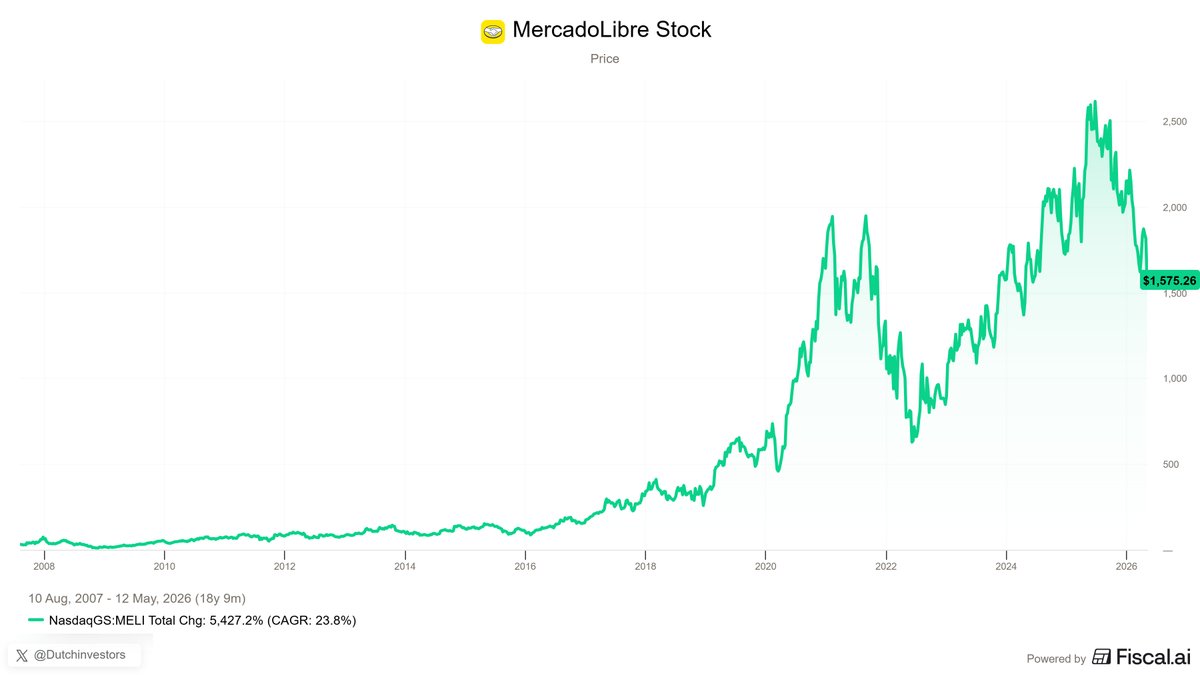
Unpopular opinion. People saying $MELI will be a 100-bagger from this point are nuts. The company is already $80 billion, mind you. The likelihood of this NOT happening is bigger than it happening. PS: It's a great company, but people, particularly so-called 'finfluencers,' hyping this stock to cover their losses, get others to agree with their thesis, and for other selfish reasons are dangerous. Invert. Always invert and think independently.
The Dutch Investors 🦁 tweet media
English
27
1
62
10.7K
Z
Z@ZeeContrarian1·
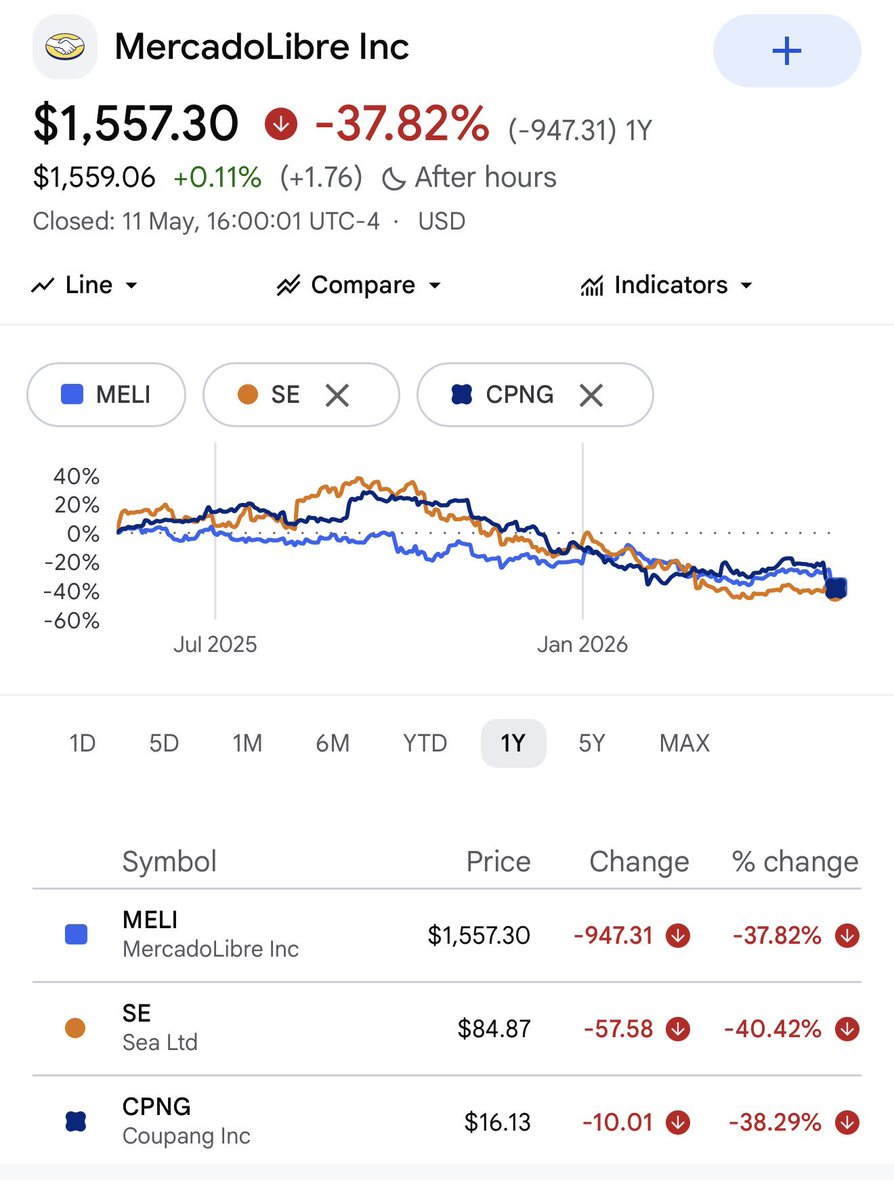
$CPNG, $SE, and $MELI, all major e-commerce and digital commerce platform companies, now share eerily similar charts and are each down roughly ~40% over the past 12 months, signaling there may be a much bigger problem with the sector than people currently understand.
Z tweet media
English
32
11
179
69.7K
Ana Paula Cintra
Ana Paula Cintra@AnaCintra24·
@ZeeContrarian1 Yeah short sighted . Sure it’s been a bad stock performance wise but the business hasn’t . Historically it’s cheaper than it’s ever been .’extending its most and growing like crazy. Using AI already and creating an ecosystem that feeds itself. Management is excellent
English
0
0
0
157
Fede Sandler
Fede Sandler@FedexSTi·
$MELI Q1’26: el mercado se enojo por la compresión de margen (operating bajó de 12.9% a 6.9% YoY) y se perdió el plot. Lo que parece deterioro es contabilidad. Lo repito como un loro. Bajo US GAAP (ASC 326 / CECL), cuando $MELI emite un préstamo nuevo tiene que provisionar el expected credit loss de por vida el día 1 (antes de cobrar un solo peso de interés). Si el credit book crece +87% YoY (a $14.6B) y el revenue +49%, las provisiones del trimestre se comen una parte desproporcionada del P&L vs. los ingresos que esos mismos préstamos van a generar a lo largo de su vida. Dos tercios de la compresión vienen literal de ahí. No es que el negocio se deteriore, es que aceleraron originación y la contabilidad cobra antes que el cliente pague. Lo asimétrico está en los cohorts. Cada tarjeta emitida arranca con pérdida contable. Recién entre el mes 12 y 18 la cohorte cruza NIMAL breakeven. Hoy ~75% del book de tarjetas en Brasil ya pasó ese punto y está en modo cobranza pura. Lo que duele en el P&L de Q1’26 es la cosecha 2026 que recién arranca a marcar pérdida, pero esa misma cosecha va a estar pagando spread durante años. Mientras más rápido emitan hoy, más feo se ve el P&L de hoy y más gordo el de 2027-2028. Es el trade-off clásico de un book de crédito que crece: pagás caja primero, cobrás P&L después. El otro tema pesimamente interpretado: la duration de personal loans en Brasil pasó de 5 a 8 meses. Sí, más riesgo, más provisión upfront. Pero contexto: los bancos tradicionales operan personal loans hasta 60 meses (Itaú) y 72 meses (Bradesco), y mis bros en $NU (donde también laburé) hoy llega a 48 meses en su Empréstimo Pessoal. $MELI a 8 meses sigue siendo de los plazos más cortos del mercado por mucha distancia. Si Selic se mueve, repricean en meses, no en años. Es duration extension con paracaídas: capturás más yield y subís ARPU sin casarte con un balance largo. Sumemos: revenue +49% (más rápido en casi 4 años), +17M nuevos active buyers en 12 meses (84M total), TPV +50%, AUM +77%, items sold en Brasil +56% (más del doble que antes del cut de free shipping threshold). NPL 90+ levemente mejor a 8.0%, allowances cubren 149% de los créditos vencidos +15 días. El mercado está cobrando la compresión de hoy y no está pagando nada por la opcionalidad de mañana. Y acá está el dato que el sell-side todavía no internaliza: $MELI está ganando share en Brasil mientras $SE acelera en su mercado más importante (GMV global de Shopee +28% YoY en Q3’25, el ritmo más rápido desde Q2’24, con Brasil absorbiendo los recursos liberados al cerrar Chile y Colombia). Aún así, $MELI elevó conversion rates 1pp YoY en Brasil (un movimiento gigante a esta escala) con NPS y market share en récords. Cuando ganás cancha mientras tu principal rival pisa el acelerador, no es momento de ahorrar capital. Es momento de double down. La factura llega en 2027-2028 en forma de operating leverage IMHO. Y ahi it rips. No es recomendacion. Yo me tomo el tiempo de tener mi propia opinion en base a hacer la tarea. Abrazo
Español
58
67
795
81.4K
Sam Badawi
Sam Badawi@Sam_Badawi·
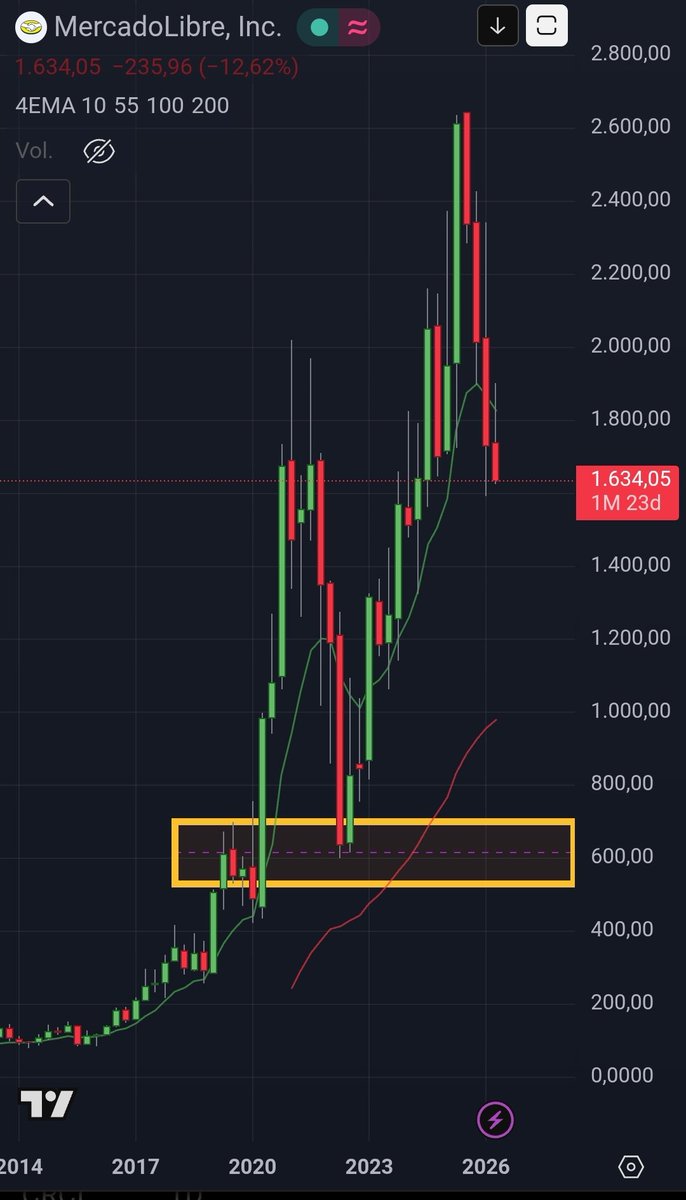
This $82B Latin American e-commerce giant fell 13% after reporting 42% YoY growth. INSANE RIGHT? Well, that’s not how the market sees it. Investors are focused on operating margin compression instead. CUT IN HALF IN ONE YEAR. It is almost unimaginable to think this company is trading at the same level it was 2 years ago. What are you going to do with your position if you own it?
Sam Badawi tweet media
English
11
1
95
10.5K
Fletcher & Draper LLP 🌐
@FedexSTi Excelente explicación. Pongo a $MELI en watchlist para comprarla precisamente en la zona fuerte de soporte en $600
Español
1
0
0
479
The Analyst
The Analyst@MMatters22596·
My biggest mistakes this year so far: 1. Scaling in on $DUOL too early 2. Not going all in on $NBIS 3. Missed $CRDO at $90 because I forgot to buy 4. Went too heavy on $JD (although I still like it) 5. Not buying more $HIMS and $OSCR at the bottom 6. Selling $CRWV too early 7. Believed in $EOSE guidance What are yours?
English
107
4
378
78.5K
Daniel Koss
Daniel Koss@daniel_koss·
Added a new 30% position today! Been obsessed with this company the entire weekend. Listened to earnings calls and industry reports. Think it can 10x easily. Haven't been this excited about the risk reward of a stock since I found $NBIS at $40. Dropped the ticker for Subs, but will share the full thesis for free tomorrow. I think it's another name that you'll soon see EVERYONE on X talking about. Just like nobody owned $OUST and now everyone loves it (rightfully so!).
English
59
10
519
114.8K
Ana Paula Cintra retweetledi
Filip
Filip@Vaiconalma_·
@DrTomsLens Wtf dude🤣 you’re so detached from reality
English
1
1
1
304
Ana Paula Cintra
Ana Paula Cintra@AnaCintra24·
@daniel_koss Daniel I’m subscribed would love to ask you in private a can you follow me . Long time nbis investor here
English
0
0
0
4
Daniel Koss
Daniel Koss@daniel_koss·
My April Performance Report: +72.9% -> everything 3rd party verified and publicly tracked. 📈 April return: +72.9% (Autopilot) 📈 YTD: +113.6% (personal portfolio) My benchmark, the Nasdaq, returned +8.9% over the same period. That means my portfolio outperformed the benchmark by more than 12x. My thoughts: April represented an amazing opportunity to “buy the dip.” But it is important to understand that the foundation for the performance was built in March. March was a rough month for most AI infrastructure, tech and growth investors. The Iran conflict spooked investors out of growth stocks. Rising oil prices, inflation fears, uncertainty around future rate cuts, and even the risk of rate hikes all presented real risks. On top of that, the conflict became ugly and destructive. There was real damage done to valuable infrastructure. The best decision I made in March was to actively manage risk. When I felt the situation was escalating, I increased my cash position to 10-20%. When I felt it was de-escalating, I bought back in. I also made a couple of good trades, like buying $KRKNF into the mining headlines. That was mentally taxing and annoying. Constantly buying, selling, buying back, trimming again, and re-entering is not fun. But it was worth it. While many investors were down a lot in March, my portfolio was mostly flat or slightly up. Instead of just reacting to headlines, I constantly monitored the real situation on the ground (or on the water). If you look at my posts and articles from March, you can see that I mainly focused on drones, missiles and ships in the Strait, and whether the situation was escalating or de-escalating. Trump headlines are bad signals and very dangerous. Then, in April, it became obvious that many stocks were completely oversold. Some of my highest expected return stocks were down 30-50%. The market was deep in extreme fear. At the same time, I expected Trump to find a way to de-escalate, and many of the metrics I tracked started to improve. So I reallocated into oversold growth and AI infrastructure stocks like $NBIS, $AEHR, $OUST, and others. That created the setup for the 70%+ return in April. Investing under Trump is both the gift of a lifetime and the most stressful thing ever. It does feel like I am aging at three times the normal speed, if I am honest😅 Since many people noticed that I timed many of the events and stock picks quite well, I started getting a lot of requests to share my portfolio, research and trades. That's something I planned to do anyway, but in the last month, I have been thinking about it, and here is what I came up with: My current plan is to split it into two products: 1) X Premium subscriptions I am currently testing X Premium subscriptions at $5/month. The goal is not to make meaningful money from X subscriptions. The goal is to create a more exclusive community, filter out bots, trolls and spam accounts, and give serious followers time to look into my trades and portfolio updates before they get copied all over X. I have already seen many accounts copy-paste my stock picks, valuation numbers and ideas, then sell them as their own. Nobody owns a stock or thesis, but sometimes I feel like it would be nice to at least mention the person who made you aware of a pick and who got you excited about a stock? The funniest part is that in some of my models I have made calculation mistakes before, and some creators copied the mistakes too 😆 2) Premium deep research on Substack The second product would be a premium deep research newsletter on Substack. For that, I want to hire full-time researchers who are true industry experts in their fields: AI infrastructure, semis, power, memory, data centers, and so on. This would be a serious, full-time effort for me. It would likely cost around $100/month, because producing this kind of research properly takes a lot of time, and I would need to pay a strong team of expert researchers. This is something I want to do long-term because I do like investing, making great returns and sharing the best ideas with you, but to be completely honest, I often get bored of it. My true passion is doing the research and learning about business strategy, technology and the future! For example, Nebius is a stock that fascinates me because I am insanely excited about Tokenomics, Jevons Paradox, platform businesses, network effects and game theory. The stock price going up a lot more is why I buy, hold and share the thesis, but it's not why I love the company. So the idea is: 🔹 Professional investors and wealthy individuals can pay for premium deep industry research. They will get high-quality research. While there are many fantastic Semi analysts on X and substack, I believe my angle of identifying where most value accrues (= stock will go up most), is quite popular among professional investors. At least that's my experience interacting with PMs so far. 🔹 X Premium would remain intentionally low-priced, most likely below $1-10/month. I want to create a more exclusive community, filter out low-quality accounts, and give serious followers time to study my trades and portfolio updates before everyone starts chasing the same stocks. I will obviously get some picks wrong. That's why I always want you to look at my ideas, picks, etc. and then make your own conclusions. What do you guys think? Would love to hear your thoughts.
Daniel Koss tweet media
English
31
2
152
65.4K
Ana Paula Cintra
Ana Paula Cintra@AnaCintra24·
@TheTechInvest Does iren make / design their own servers ? Are there any engineers in that team working together for a decade ? … vertical integration can be seen in Many aspects. In ona hand owning land and power and data center and the other in the value chain. Nebius can achieve both
English
1
0
2
769
The Tech Investor
The Tech Investor@TheTechInvest·
🚨JUST IN: $NBIS CEO ROMAN CHERNIN 1. Our $META & $MSFT deals are bare-metal. 2. The combination of our scale and our vertical Integration will let us be very successful. My comment: 1. We knew that your deals are bare-metal before $NBIS community. 2. The most used concept in $IREN business model and the community’s narrative from the CEO to FinX investors is Vertical Integration. That’s the DNA of High Margins, Scalability, RoI, Pricing Power, High Demand, Negotiating Power, Cost Control, and Predictable Execution. I bought $IREN, not $CRWV or $NBIS, because it’s the only AI Infra that meets these criteria. With all due respect, $NBIS being vertically integrated is not accurate.
The Tech Investor tweet media
The Tech Investor@TheTechInvest

🚨 Compute is the bottleneck $AMZN AWS Growth 28% $MSFT Azure Growth 40% $GOOGL Cloud Growth 63% $GOOGL CEO Sundar Pichai: Our cloud revenue would have been higher if we had more compute.

English
39
12
155
70.6K