Andreu Arenas

1.2K posts

Andreu Arenas

Andreu Arenas

@AndreuArenas

Economist | PhD @EUI_EU | Editor @nadaesgratis | Trying to answer interesting questions using data.

Barcelona. Katılım Ekim 2015
6.4K Takip Edilen1.7K Takipçiler
Sabitlenmiş Tweet
Andreu Arenas
Andreu Arenas@AndreuArenas·
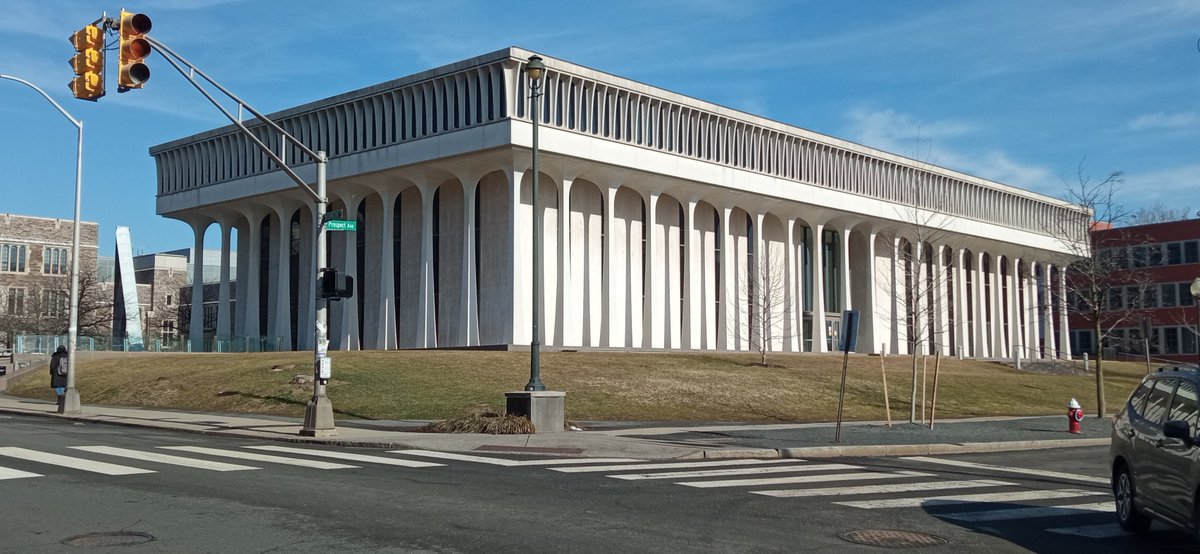
Very happy to join Princeton's @PUPolitics @BobstCenter as a Visiting Research Scholar, for a year. Excited to meet people and explore new ideas – let me know if you are around!
Andreu Arenas tweet media
English
8
2
131
0
Andreu Arenas retweetledi
Abhishek Nagaraj 🗺️
agreed! original post by @alexolegimas and @soumitrashukla9 is exactly right in highlighting the two key dimensions that shape the impact of automation on the labor market. a) number and diversity of tasks (i.e. what they call dimensionality) b) effect of increased productivity on downstream demand (what they call elasticity of consumer demand) the basic model is simple. a worker in a job has X tasks (say building widgets), and a firm hires Y workers for the same job to make a total of Z widgets. there are two broad cases : [1] AI can do all X tasks --> full displacement (this is the telephone operator example from the 1920s studied so nicely by Feigenbaum and Gross, nber.org/papers/w29580) [2] AI can do some percent of the X tasks --> workers get more productive (how much depends on what Z is and the complementarity of those tasks to the non-automated tasks) but overall labor market impact depends on 2 subcases: [2a] --> consumers only demand Z widgets. in this case, we can produce Z widgets with fewer workers, so a bunch of workers are laid off. the job remains, but with fewer, better paid workers [2b] --> because widgets are easier to produce, say the price of widget goes down, we need some bigger multiple widgets (greater than Z), so we need all Y workers (possible more), they maybe get paid more. now, there is a lot of debate on which job is in which case above (1, 2a or 2b) -- but this model is helpful in clarifying why "all jobs are doomed" narrative or the "we're all safe" narrative misses a lot of nuance. It is also helpful though in clarifying some of the assumptions and limitations of this simple theory. just to name a few: --> automation and the share of tasks targeted is exogenous. We know this is not true. Where does automation come from? is driving trucks going to be fully automated or not? --> even if you take the o-ring model mentioned in the article, job definitions are fixed in this model. what happens when like the ATM, the job is roughly still the teller, but the tasks are totally different --> what about product market competition and labor market entry? i.e. the large firms are automating away parts of the job, when a new entrant redefines the job entirely? price and product competition can come back to affect labor in important ways that the model does not take seriously. All said -- the model above (and the original essay) is very clarifying, and MUCH MUCH better than the current debate! In fact, this is exactly what I teach in my class. But there are also a LOT of questions! I think its good to be humble about how hard this question is, learn what we can from theory, history and past data, but also admit, that we are very likely to be surprised by at least some of the changes coming. /FIN.
Martha Gimbel@marthagimbel

This from @alexolegimas and @soumitrashukla9 is by far the best thing I’ve read on how to think about how AI may affect the labor market. Absolutely required reading. aleximas.substack.com/p/how-will-ai-…

English
0
6
16
3.5K
Andreu Arenas retweetledi
Eric Levitz
Eric Levitz@EricLevitz·
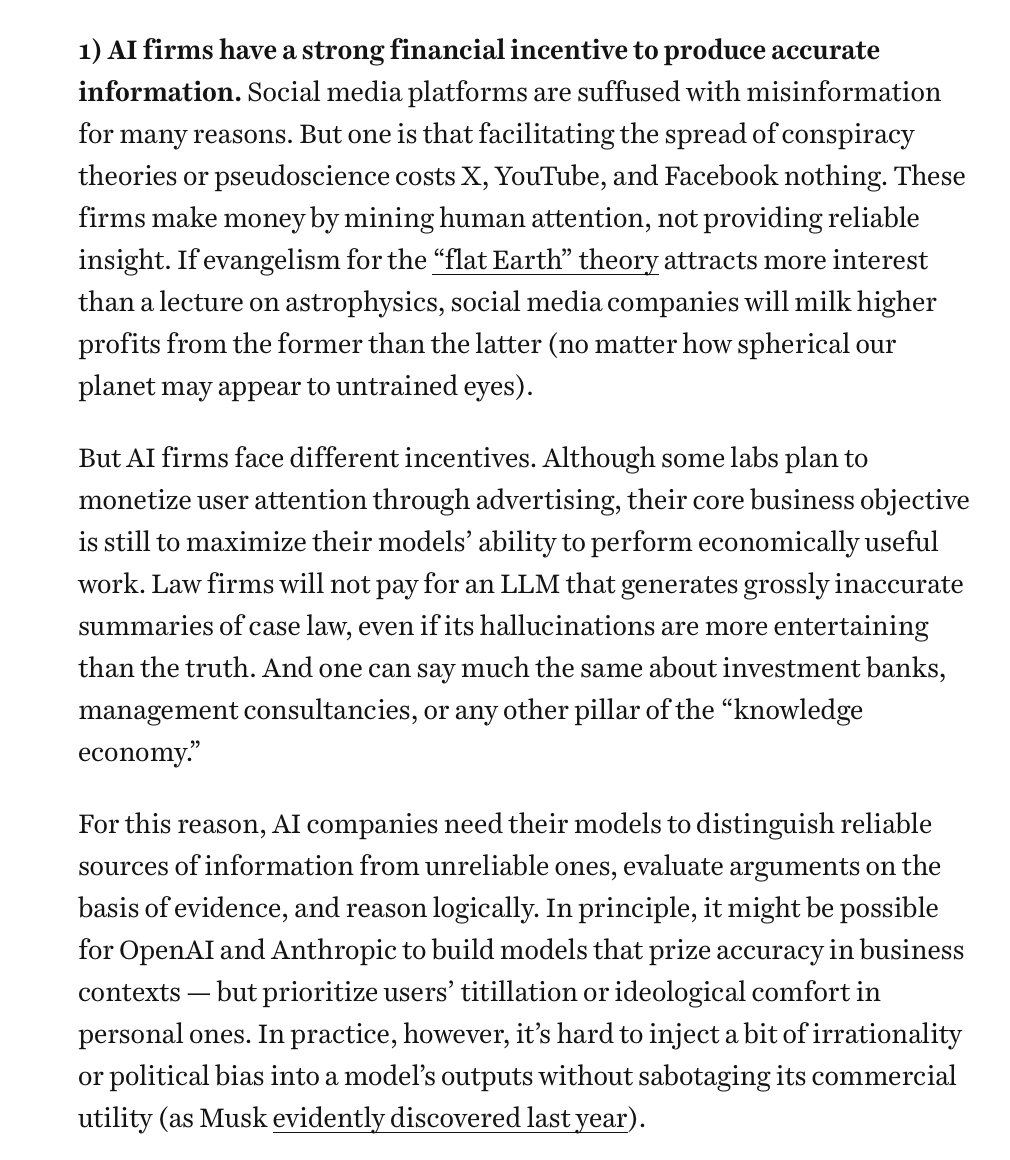
Social media undermined expert authority, democratized public debate, and steered individuals into evermore bespoke conceptions of reality. But AI could reverse these trends. As @danwilliamsphil and @dylanmatt argue, LLMs appear to be a "converging" and "technocratizing" technology -- one that increases expert influence and social consensus. This is partly because AI companies and social media firms have radically different business models: vox.com/technology/483…
Eric Levitz tweet media
English
10
31
129
35.9K
Andreu Arenas retweetledi
Samuel Hammond 🦉
Samuel Hammond 🦉@hamandcheese·
The unique thing about EA / rationalist philanthropy is that, while it has its traditional "cause areas," it is broadly steerable by better arguments. That is, if someone marshalled dispositive evidence that we're headed for an AI winter or that the technical alignment problem wasn't hard or that xyz funding strategy created more costs than benefits or that shrimp are p-zombies, EA and Rat funders would turn on a dime and fund something else. You can't say that about any other big philanthropic source.
English
17
13
297
23.5K
Andreu Arenas retweetledi
Kevin A. Bryan
Kevin A. Bryan@Afinetheorem·
Hypothesis from an interesting talk after my IFP seminar today: even if *labor demand* is ~unaffected by AI, *uncertainty for planning careers* surely is. @JerusalemDemsas's "messenger class" (academics, writers, Type A types) are most "plan your career a decade ahead" possible.
English
8
14
181
55.8K
Andreu Arenas retweetledi
Arpit Gupta
Arpit Gupta@arpitrage·
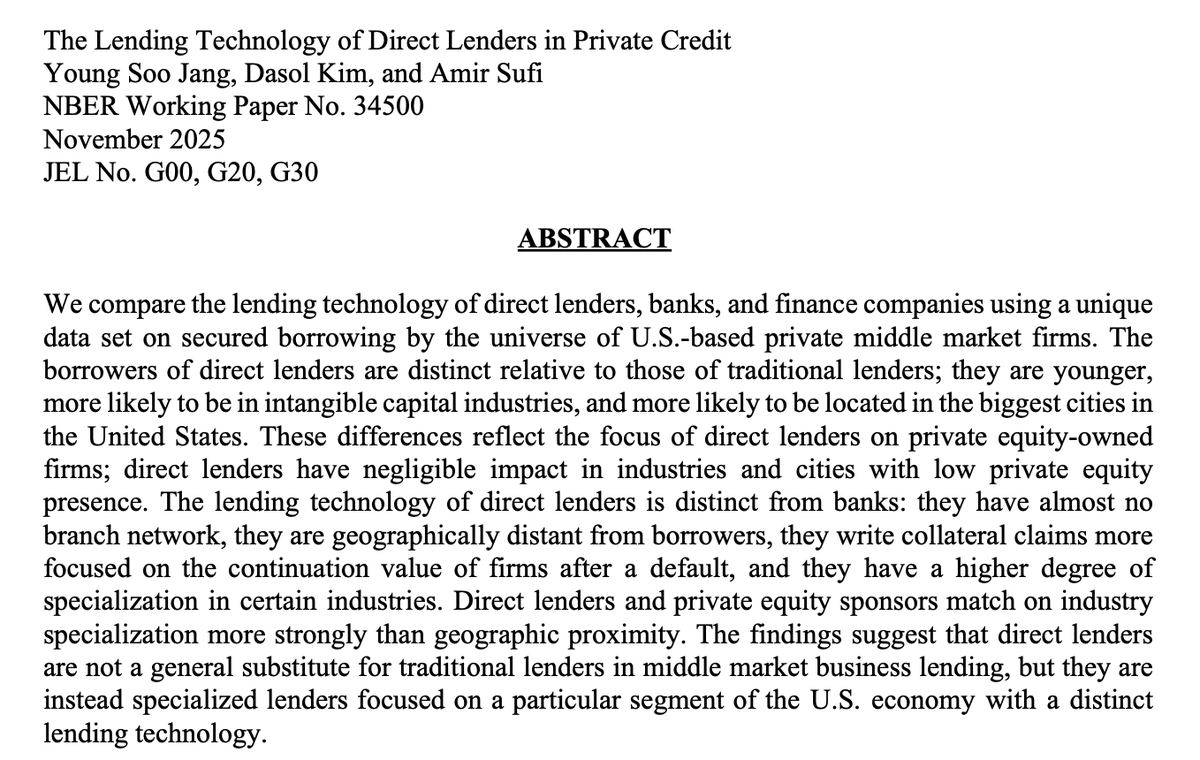
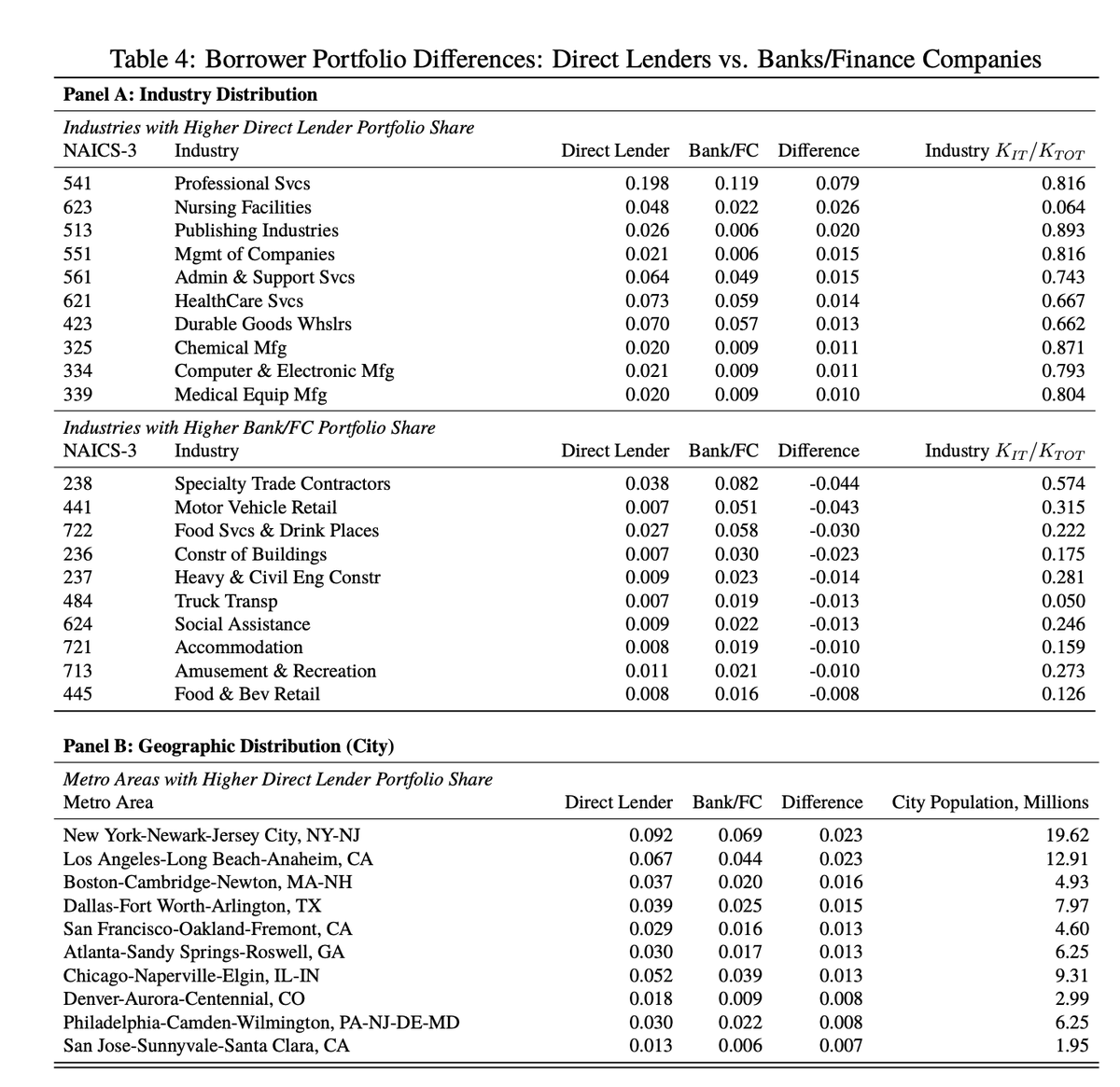
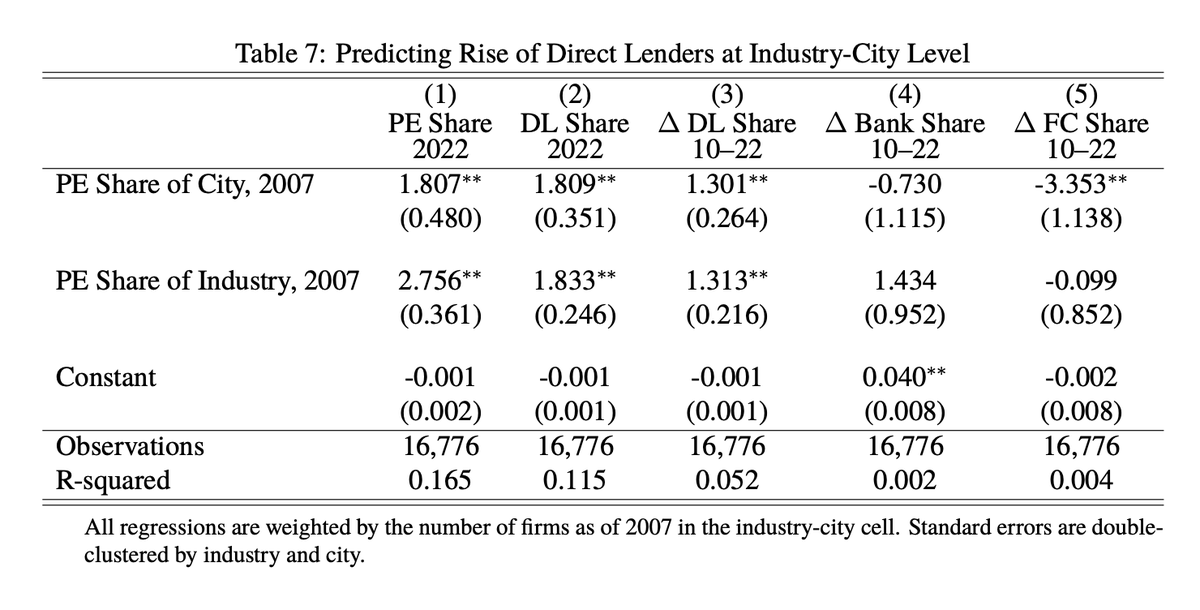
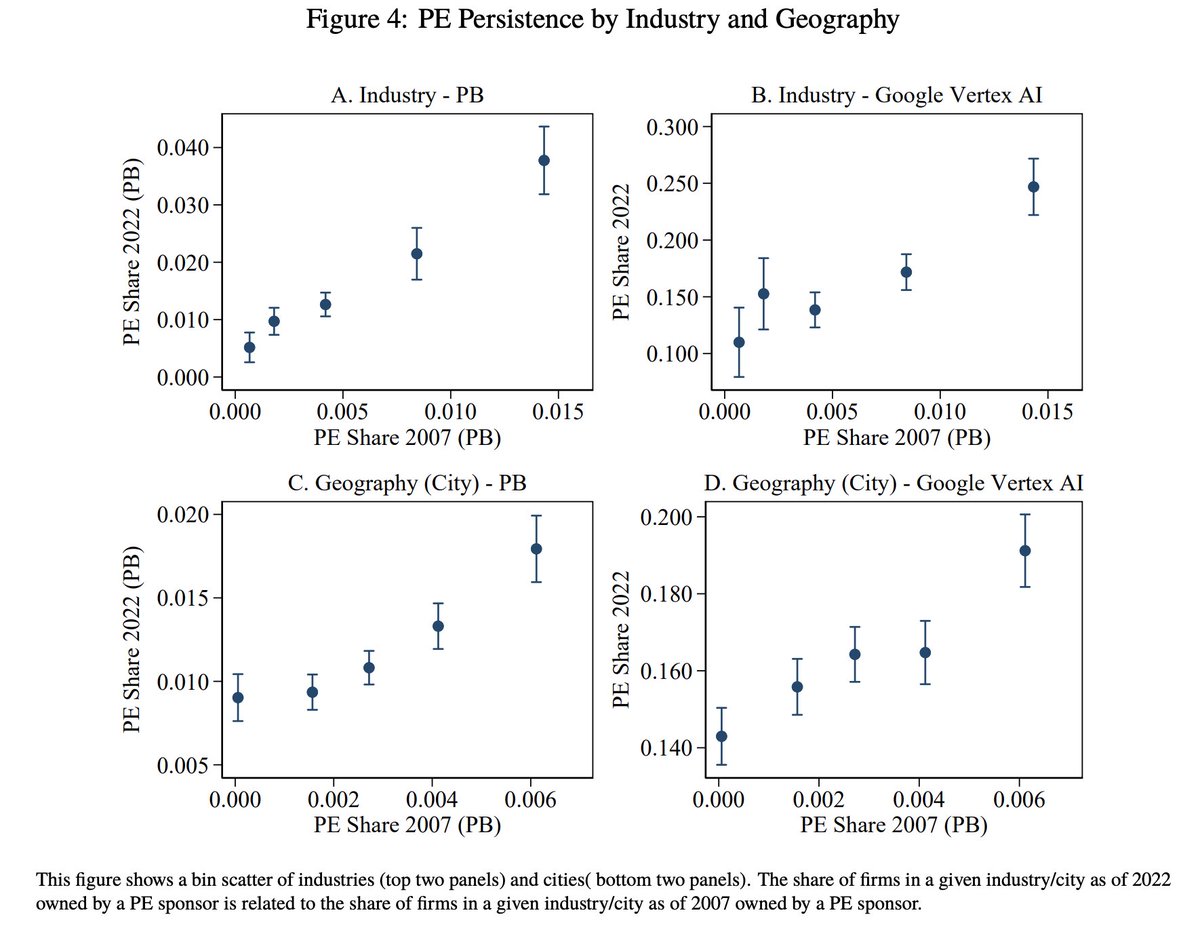
So if you *do* want to learn what private credit is, I recommend this paper by Jang, Kim, and Sufi. In terms of the mechanics; private credit takes long term capital from LPs and lends to various companies. This locked up credit limits run risk (ie SVB). But in practical terms what does that mean? There are two big differences: • Private credit lends to *intangible* asset firms • Private credit is very PE affiliated; both in terms of the sponsors, as well as who they lend to Why is that? Well, banks want to lend against collateral. So they can repossess and sell if needed. That's a lot harder in the intangible economy, ie tech firms, which don't have tangible assets. Private credit has built up the expertise to evaluate the cash flow generation of firms, and to restructure and maintain these as going concerns in a downturn. This opens up credit to a whole chunk of the economy; which is also exactly where PE firms have been moving into. So more PE activity is very closely associated with more private credit. nber.org/papers/w34500
Arpit Gupta tweet mediaArpit Gupta tweet mediaArpit Gupta tweet mediaArpit Gupta tweet media
English
14
65
356
60.8K
Andreu Arenas retweetledi
Alec Stapp
Alec Stapp@AlecStapp·
Messing up “stocks vs flows” is a common mistake people make in policy conversations. Two things that are true at the same time: 1. Institutional investors own <1% of all single-family homes in the US. 2. Institutional investors build ~8% of new single-family homes in the US (and rent them out). So as a share of the total single-family housing stock, Wall Street is a rounding error. But as a share of new builds, Wall Street plays a decent size role (though still a minority). If you care about increasing housing supply & improving access to the suburbs for renters, then banning institutional investors from owning homes would be counterproductive.
Austin Ahlman@austinahlman

Again I ask: Is the “Wall Street wants to turn single family homes into an asset class” stuff an exaggerated myth, or is it an essential plank of the abundos’ housing agenda?


English
17
85
698
35.4K
Andreu Arenas retweetledi
D. Yanagizawa-Drott
D. Yanagizawa-Drott@YanagizawaD·
We should celebrate this kind of public good provision by @GoogleResearch 🙌 It’s a private company after all. Not @ERC_Research… not @USAID… not @WorldBank… not @Sida, etc. These orgs are not investing massively into LLM-complementary projects. There’s a scenario where Africa gets left in the dust. Rich countries enter escape velocity. Because of the LLM-complementary stuff (data, infra) is in Global North. As someone who is trying to build and experiment with LLM-based solutions for social impact in places like Ghana and Kenya, the “language constraint” is massive. So, sadly, you end up building for English or French speaking populations, mostly in Urban areas.
English
1
15
117
13.5K
Andreu Arenas retweetledi
Alex Imas
Alex Imas@alexolegimas·
It is useful for citizens who lean towards either party to engage in contingent reasoning: Yes, I want to give the govt more power to do X because I agree with X, but how will the govt use that power when the other party is in charge?
Joshua Gans@joshgans

This is the kind of statement I worry about. Basically, the Pentagon apparently agrees and is doing this. But I can’t imagine this is what @DAcemogluMIT , @davidautor and Johnson mean. So what is the nuanced application of power?

English
14
26
277
216.6K
Andreu Arenas retweetledi
Carmen Villa
Carmen Villa@carmenvillaecon·
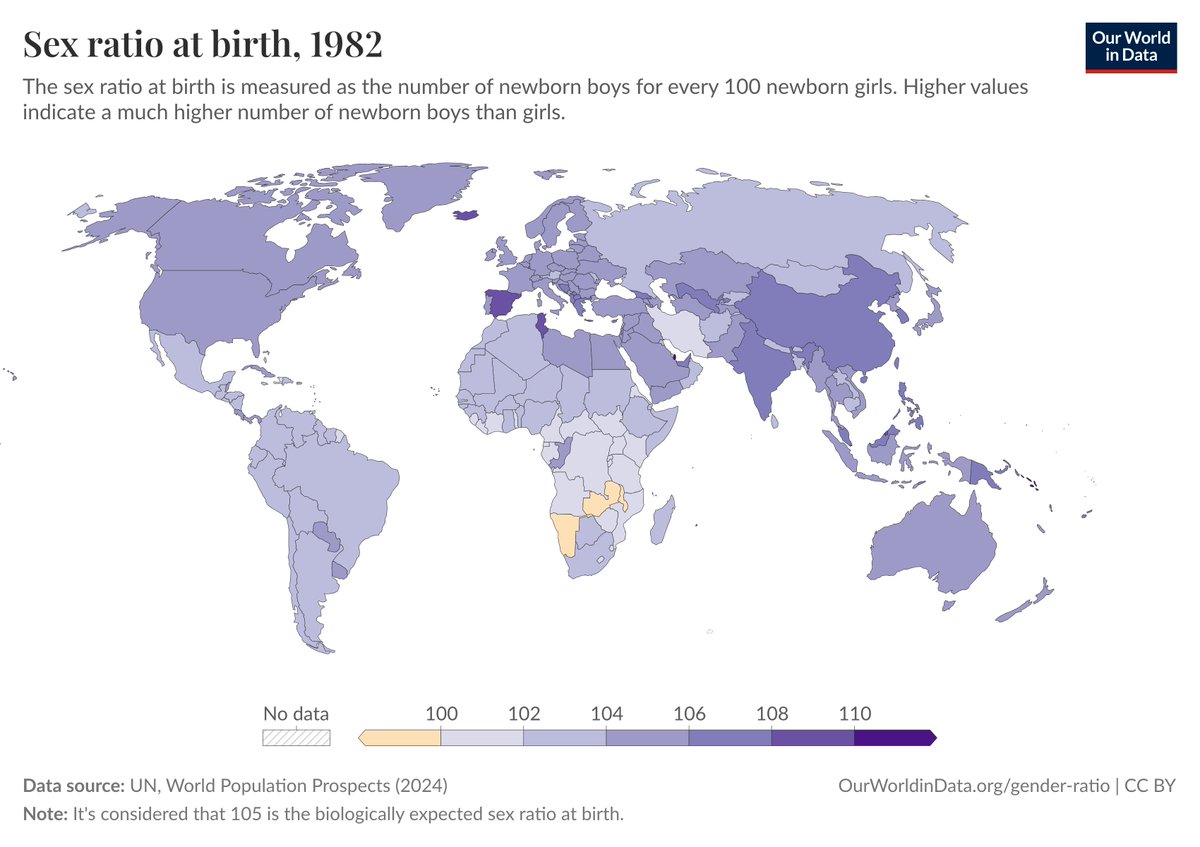
According to official birth registry data, in 1981 Spain had the highest sex ratio in the world (109 boys per 100 girls). Prior work attributed this anomaly to demographic/behavioural patterns. In a new WP, we show the high ratio is due to data errors 🧵with @manuelbagues 1/n
Carmen Villa tweet media
English
5
38
238
49.2K
Andreu Arenas retweetledi
Oriol Amat
Oriol Amat@oriolamat·
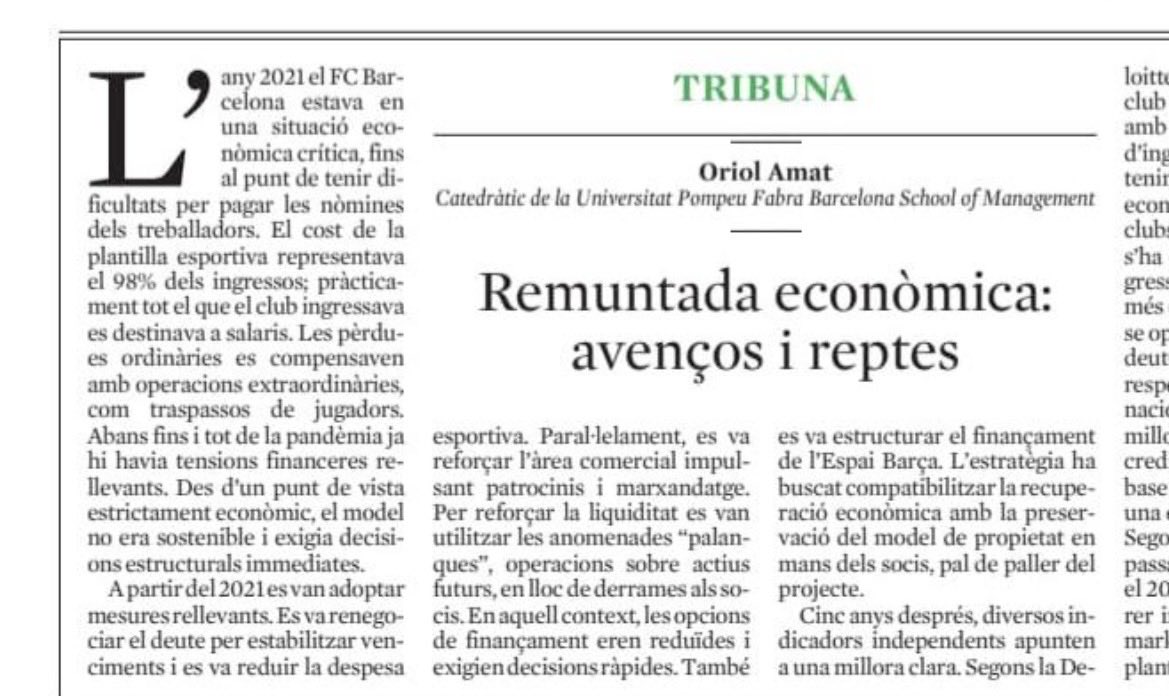
El 2021 el Barça no podia pagar nòmines i el 98% dels ingressos anaven a salaris. Era insostenible. Avui torna al podi mundial d’ingressos i ha reduït el cost esportiu fins a prop del 54%, mantenint la propietat dels socis, un model singular al món. Ara toca culminar l’Espai Barça amb disciplina i estabilitat. El futur es construeix amb solvència. Article d’avui: lavanguardia.com/deportes/fc-ba…
Oriol Amat tweet media
Català
3
437
1.1K
88.1K
Andreu Arenas retweetledi
Jason Furman
Jason Furman@jasonfurman·
How much are you willing to reduce spending on poor children to tax billionaires more? A utilitarian would raise taxes on billionaires basically to the revenue maximizing rate. IF you think billionaires are a negative externality then you would go even higher. A 🧵 .
English
39
35
229
57.9K
Andreu Arenas retweetledi
Sebastian Galiani
Sebastian Galiani@SFGaliani·
Why do cities exist? 10% of the planet’s land produces more than half of global GDP. If land is cheaper elsewhere, why don’t firms and families spread out? Because proximity creates productivity. Scale. Thick labor markets. Knowledge spillovers. Market access. But also congestion, land scarcity, and policy failures. Cities are not accidents — they are equilibrium outcomes. sebastiangaliani.substack.com/p/why-do-citie…
English
0
5
27
2.5K
Andreu Arenas retweetledi
Stefan Schubert
Stefan Schubert@StefanFSchubert·
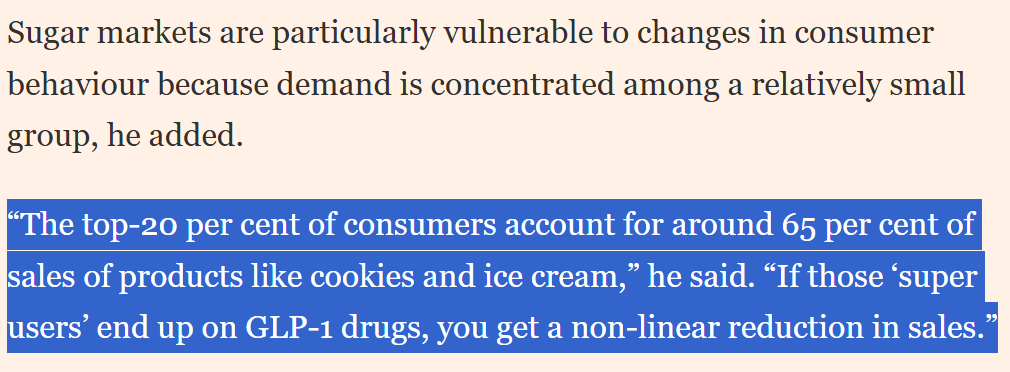
"The top-20 per cent of consumers account for around 65 per cent of sales of products like cookies and ice cream. If those 'super users' end up on GLP-1 drugs, you get a non-linear reduction in sales."
Stefan Schubert tweet media
Financial Times@FT

Sugar prices have tumbled to their lowest level in more than five years as weight-loss drugs accelerate a drop in demand by pushing consumers to ditch sweet treats in favour of protein. ft.trib.al/KSGrkUo

English
32
365
3.7K
321K
Andreu Arenas retweetledi
Sylvain Catherine
Sylvain Catherine@sc_cath·
This is a deep misunderstanding of how economics works. Economists don’t start with unrealistic assumptions to reach irrelevant conclusions. Theorists spell out the assumptions under which an idealized, stylized result can be proven—and very often that result is an irrelevance result. In finance, for instance: Modigliani–Miller (capital structure doesn’t matter), no-trade theorems (nobody trades), etc. The point isn’t the conclusion. We all know firms do optimize their capital structure (we teach how) and people trade trillions of dollars of securities every day. The “result” is really the assumptions: they tell you what has to be true for a phenomenon not to matter or not to exist—and therefore what frictions make a field interesting or a phenomenon exists. A huge share of economic research is about relaxing those assumptions and studying what changes. So when we say markets work “perfectly” under perfect competition, perfect substitutes, complete markets, and fully rational agents, we’re not claiming those conditions hold. We’re saying the literature should be built around the violation of these assumptions.
Mayukh@mayukh_panja

Economics is mostly a bullshit field of study. It is specifically for people who can do a little bit of stats and calc and want to feel smart but too dumb to study physics or math. Most economic theories are built like this: they start with an assumption about human behavior. Then without checking if the assumption is true, they will pile on layers of sloppy math on it and come to all sorts of conclusions that obviously don’t hold up in the real world. Recently a couple of economists won the Nobel Prize for being the first to realize that assumptions about human behavior must be tested and they went out and did some field work, and proved that a lot of assumptions in economic theories about how humans behave with money are well just not true. I was working at a bank for 2 years and saw firsthand that economics PhDs tend to be the dumbest. These people are completely alien to the idea of first principles thinking and treat axioms as if they were written in the Bible. Also they don’t really understand what an axiom is. Economics only exists because your average normie is easily impressed buy math and midwits in power are not scientific enough to realize that it is all voodoo and keep taking economists seriously. I don’t blame them though, at some point they hit an intelligence wall and the average economist brain is simply not equipped to have meta level thoughts about their own field of study. I guess this is one of those bullshit jobs like HR, therapy, astrology, project management that will just stay around for a while cause most humans are either mid or retarded.

English
41
91
765
59.3K