
Andrew Albertson

6K posts

Andrew Albertson banner
Andrew Albertson

Andrew Albertson

@AndrewAlbertson

Executive Director @FP4America. Formerly @USAID & @POMED. Alum @Georgetown MSFS. Always @Bengals.

Washington, DC Katılım Mayıs 2010
1.9K Takip Edilen1.7K Takipçiler
Andrew Albertson retweetledi
Chris Deluzio
Chris Deluzio@ChrisForPA·
It was your decision @SenSusanCollins as a Senator to send Americans to fight in a dumb and pointless Iraq War. You voted for it. Do you tell the kids and widows of the Iraq War dead that it was their fallen hero’s fault for enlisting?
The Maine Wire@TheMaineWire

Senator Collins responds to the scurrilous claim from Graham Platner that she sent him to "die in Iraq." "That was Platner's decision to serve. He was not drafted."

English
147
220
1.2K
71.7K
Andrew Albertson retweetledi
Council on Foreign Relations
Over the past year, we sat down with 359 Americans across 29 states to ask a simple question: What do they actually want from U.S. foreign policy? Their answers were remarkably consistent and cut across party lines. CFR Senior Fellow @RebeccaLissner explains that Americans want strong global leadership from the United States, but on their terms.
English
13
18
56
30.6K
Andrew Albertson retweetledi
NEWSMAX
NEWSMAX@NEWSMAX·
U.S. single-family house prices edged up in March, ‌but further increases are unlikely as the war with Iran pushes mortgage rates higher, dampening housing demand. bit.ly/4e4TRi9
NEWSMAX tweet media
English
3
7
26
13.6K
Andrew Albertson retweetledi
Foreign Policy for America
This Memorial Day, we reflect on service and sacrifice with powerful remarks from @SenTimKaine at our 2026 Leadership Summit.
English
0
1
0
79
Andrew Albertson retweetledi
Michael McFaul
Michael McFaul@McFaul·
The Strait of Hormuz was open and not controlled by Iran before Trump launched his war against Iran.
English
587
3.9K
19.1K
230.3K
Andrew Albertson retweetledi
Helen Toner
Helen Toner@hlntnr·
A lot of AI/tech execs have been vocal about the importance of competing with China recently. Seeing who speaks out about this new green card policy will tell us a lot about who *actually* cares about US competitiveness, and who just uses China as a pretext to oppose regulation
Andrew Ng@AndrewYNg

The new White House policy requiring green card applicants to apply from outside the US is a capricious attack on legal immigration. It will hurt families, leave us with fewer doctors, teachers and scientists, and hurt American competitiveness in AI.

English
22
79
643
109.9K
Andrew Albertson retweetledi
Rep. Jason Crow
Rep. Jason Crow@RepJasonCrow·
Republicans canceled a vote to end Trump’s Iran war. They were about to lose, so they refused to let us vote. Americans deserve to know where their leaders stand. They can’t hide forever. Accountability is coming.
English
3.1K
12.5K
30.4K
309.1K
Andrew Albertson retweetledi
Chad Scott
Chad Scott@cpscott16·
The 30-year U.S. Treasury yield hit 5.2% on May 19, its highest level since 2007, driven by inflation fears tied to Trump's Iran war and the continuing closure of the Strait of Hormuz. For Americans, that move in long term yields translates directly into higher mortgage rates on an already inaccessible housing market and more expensive consumer and business loans.
English
1
3
19
553
Andrew Albertson retweetledi
Senator Thom Tillis
Senator Thom Tillis@SenThomTillis·
The careless decision to reduce our force posture in Europe, along with moves by Pete Hegseth and his political henchmen to force out some of our finest general officers is amateur hour at best and deadly at worst. Hegseth continues to surprise and disrespect our greatest allies and some of our best military professionals with impulsive decisions not grounded in reality or good judgment. If the rumors are true that Hegseth is trying to sideline General Chris Donahue, one of our nation’s finest warfighters, by downgrading U.S. Army Europe-Africa to a 3-star command, he is taking another step down a dangerous path. A step that is not in the best interests of our nation or our servicemembers. General Donahue has dedicated his entire career to upholding the high standards and warrior ethos that Hegseth claims he is restoring to our ranks. Gen. Donahue has led Soldiers at all levels in Airborne (including Ft. Bragg’s 82nd) and Mechanized units, the 75th Ranger Regiment, and our most prestigious special operation units. He deployed over 20 times in support of Iraqi Freedom, Enduring Freedom, New Dawn, Inherent Resolve, Atlantic Resolve, Freedom’s Sentinel, European Assure, Deter and Reinforce, and in support of the Sudan crisis. Hegseth would do well to surround himself with more patriots like General Donahue and to get his henchmen, who are not qualified to carry Donahue's bag, out of the Pentagon. Keep your word, Mr. Secretary: choose meritocracy over your mediocre yes-men. notus.org/defense/pentag…
English
5.5K
2.9K
11K
1.9M
Andrew Albertson retweetledi
Chris McGuire
Chris McGuire@ChrisRMcGuire·
Very thoughtful letter from @SenatorBanks on AI strategy and how to approach talks with China. Completely agree with the below test for when cooperation is in our interest. This is exactly what led to the agreement not to use AI for nuclear launch decisions in 2024, which had been U.S. policy since 2022. "There may be limited areas where it does make sense to engage in dialogue with Chinese officials. I would recommend a simple test: if it is in America’s national interest to adopt a given AI policy unilaterally due to security concerns, even if we knew the PRC may cheat, then it is worth engaging the Chinese on the possibility of reciprocal action."
Senator Jim Banks@SenatorBanks

President Trump is right to push for an AI strategy that keeps America ahead of China while putting real guardrails in place against serious risks. As President Trump meets with Xi, AI talks with China should focus on common sense steps that make America safer, even if we have to take those steps on our own. My letter to the admin laying this out ⬇️

English
3
8
32
8.7K
Andrew Albertson retweetledi
Chris McGuire
Chris McGuire@ChrisRMcGuire·
If the United States were to sell US AI chips to China in exchange for allowing China to purchase US chipmaking tools, that could legitimately be the single worst deal in the history of negotiations. It would make the Dutch purchase of Manhattan for $24 look like an overpay.
Kristina Partsinevelos@KristinaParts

Jefferies on $NVDA in China: hopes for more chip sales could disappoint. China's priority is making its own chips and to do that they need U.S. wafer fab equipment, a bigger bottleneck than the chips. Trump could use that leverage, requiring China to buy U.S. chips to access WFE.

English
9
78
418
50.2K
Andrew Albertson retweetledi
Nicholas Burns
Nicholas Burns@RNicholasBurns·
Predictable Xi would fire a shrill blast on Taiwan. It is meant to intimidate the U.S. We shouldn’t let him and should recommit to a strong arms package for Taipei.
Nick Schifrin@nickschifrin

Chinese readout from the Xi-@POTUS meeting has posted: "Xi Jinping stressed that the Taiwan issue is the most important issue in Sino-US relations. If it is handled properly, the relationship between the two countries will remain generally stable. If it is not handled well, the two countries will collide or even conflict, pushing the entire Sino-US relationship into a very dangerous situation. "Taiwan independence" and peace in the Taiwan Strait are incompatible, and maintaining peace and stability in the Taiwan Strait is the greatest common denominator between China and the United States." news.cn/politics/leade…

English
76
59
198
42.4K
Andrew Albertson retweetledi
Chris McGuire
Chris McGuire@ChrisRMcGuire·
This is a complete own goal. It would triple the amount of AI computing power that China adds next year - before taking into account illegal smuggling. And it would divert scarce AI compute resources away from U.S. firms. This will help China close the gap with the U.S. in AI.
Reuters China@ReutersChina

Exclusive: US clears H200 chip sales to 10 China firms as Nvidia CEO looks for breakthrough reuters.com/business/retai…

English
97
434
1.5K
227.5K
Andrew Albertson retweetledi
Ryan Hass
Ryan Hass@ryanl_hass·
1/ Watching the opening statements by Trump and Xi just a moment ago was a reminder of their contrasts. Xi was scripted, focused on principles, had a binder of talking points in front of him, and expressed hope for stabilization and development of relations...(🧵).
English
15
97
775
401.1K
Andrew Albertson retweetledi
Warren Gunnels
Warren Gunnels@GunnelsWarren·
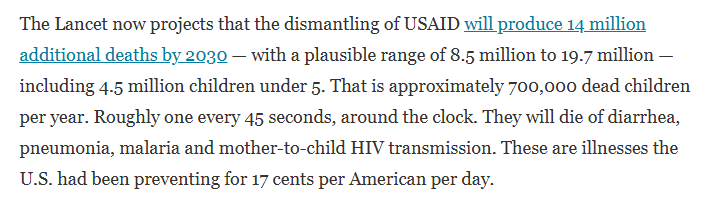
Can't stop thinking about Elon Musk, the wealthiest man alive worth $828 billion, spending $290 million to elect Trump, becoming $563 billion richer since Trump was elected and ending humanitarian aid that will lead to the deaths of 4.5 million of the poorest kids on the planet.
Warren Gunnels tweet media
English
1.2K
11.2K
31.3K
748.8K
Andrew Albertson retweetledi
Phil Gordon
Phil Gordon@PhilGordonDC·
By failing to get Iran deal ahead of Xi meeting, Trump will arrive in Beijing with an economy under strain, falling poll numbers, poor midterm prospects, key munitions depleted, military assets re-deployed from Indo-Pacific to Middle East, and humbled by a third-rate power as he confronts a first-rate one. Trump put off this summit a month ago to avoid just this scenario, and now finds himself in an ever weaker bargaining position than he was then.
English
177
516
1.9K
104K
Andrew Albertson retweetledi
Ilan Goldenberg
Ilan Goldenberg@ilangoldenberg·
Social media has accelerated the trend, but let’s be clear: the collapse of Israel’s standing in the United States didn’t just “happen” to Israel. It was the direct result of a series of catastrophic political decisions by Benjamin Netanyahu over the past decade. 1. Netanyahu chose to drag Israel directly into partisan American politics. Opposing the JCPOA was not itself unique. The Gulf states also disagreed with the deal. But Netanyahu went far beyond policy disagreement. He organized a speech before Congress behind the back of the sitting American president in order to directly confront Barack Obama and align Israel with one side of America’s political divide. That moment, ten years ago, was the beginning of the end of bipartisan consensus around the US-Israel relationship. It planted the seeds for Israel becoming a partisan issue in American politics. 2. Netanyahu chose to empower extremists like Itamar Ben-Gvir and Bezalel Smotrich in order to maintain power. He helped engineer alliances with them, brought them into the center of Israeli politics, and handed them real authority over national security and settlement policy. The images Americans now see almost daily on social media — violent settler attacks in the West Bank, Ben-Gvir celebrating with a noose cake, a Palestinian journalist emerging from prison emaciated and abused under systems overseen by Ben Gvir’s ministry and being interviewed on CNN. All of that has done enormous damage to Israel’s image. Those outcomes were not inevitable. They were the direct consequence of Netanyahu’s political choices. 3. Netanyahu chose to prolong and prosecute the Gaza war in a way that maximized devastation. After October 7, there was overwhelming sympathy for Israel in the United States. Americans broadly agreed Israel had the right to respond to Hamas’ atrocities. But the war did not need to continue for so long, nor did it need to be prosecuted this way. A year before it ended, most Israelis were prepared to support ending the war in exchange for the hostages. Netanyahu repeatedly extended it because ending the war threatened his coalition and his political survival. At the same time, he refused to seriously empower or work with alternative Palestinian leadership that could replace Hamas. So Israel fought a devastating war while ensuring Hamas would still remain part of Gaza’s future afterward. The images coming out of Gaza more than anything else have transformed global and American opinion. Had the war ended earlier after Israel had achieved what military objectives it realistically could, Israel would not be facing anything close to this level of backlash today. 4. Netanyahu played a major role in pushing the United States toward war with Iran. That war is deeply unpopular in the United States. It directly cuts against what Donald Trump promised much of his own political base, namely, avoiding getting bogged down in another Middle East war with no clear strategic rationale and no plan for how to win. It has dramatically driven up oil prices, and will have long term direct economic impacts that Americans will feel every day. And now, just as the JCPOA fight a decade ago began the fracturing of Democrats on Israel, this Iran war is beginning to fracturing of conservatives. It will take time but you already see it.  So no — this is not fundamentally about social media. It is not simply a mysterious surge of antisemitism, a lack of hasbara, or genius social media of Iran and Qatar. And it is not primarily the result of advocacy groups or messaging campaigns. At its core, what we are witnessing is the cumulative consequence of a series of disastrous decisions by Benjamin Netanyahu — decisions that have been bad for Israelis, bad for Palestinians, bad for the United States, and bad for the broader Middle East.
60 Minutes@60Minutes

According to a Pew survey published last month, 60% of U.S. adults viewed Israel unfavorably, up nearly 20 points in four years. Israeli Prime Minister Benjamin Netanyahu says the rise of social media is a major reason for this decline. cbsn.ws/4eErybc

English
171
432
1.4K
226.8K