Anthony Wanger

4.9K posts

Anthony Wanger banner
Anthony Wanger

Anthony Wanger

@AnthonyWanger

3X Founder in Data Centers and Digital Infrastructure markets. Personal account.

United States Katılım Ağustos 2011
678 Takip Edilen1.9K Takipçiler
Anthony Wanger retweetledi

Richard Meyer
Richard Meyer@RichardMeyerDC·
Epoch AI, which assiduously collects and analyzes data centers for machine learning, shows that many more gigawatt-scale AI facilities are on the way.
Richard Meyer tweet media
English
2
14
64
9.1K
Anthony Wanger retweetledi
nomadfuturist
nomadfuturist@nomadfuturist·
The data center industry is being rewritten in real time. On the latest @NomadFuturist Podcast, Peter Gross explores AI-driven infrastructure, power strain, and why the industry is facing a structural reset — not gradual change. 🎧 Listen: hubs.li/Q04g5K6_0
nomadfuturist tweet media
English
0
1
1
15
Anthony Wanger retweetledi
Steve Everley
Steve Everley@saeverley·
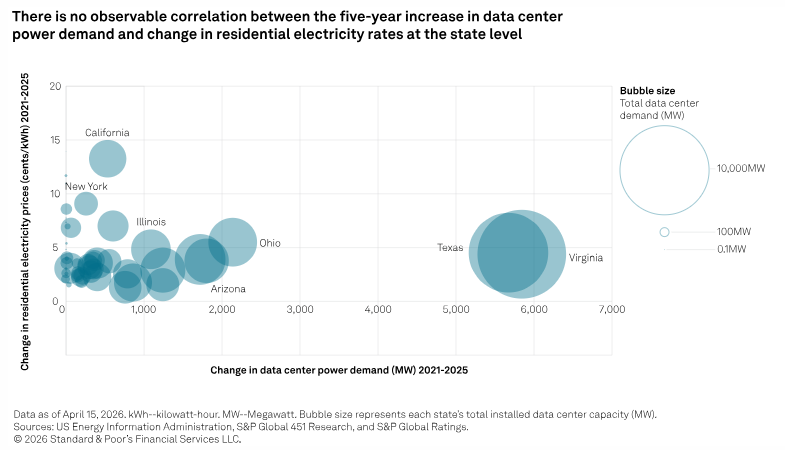
"Data center expansion is not currently the predominant driver of increased electricity prices in U.S. states" spglobal.com/ratings/en/reg…
Steve Everley tweet media
English
22
100
519
80.3K
Anthony Wanger retweetledi
Small Cap Snipa
Small Cap Snipa@SmallCapSnipa·
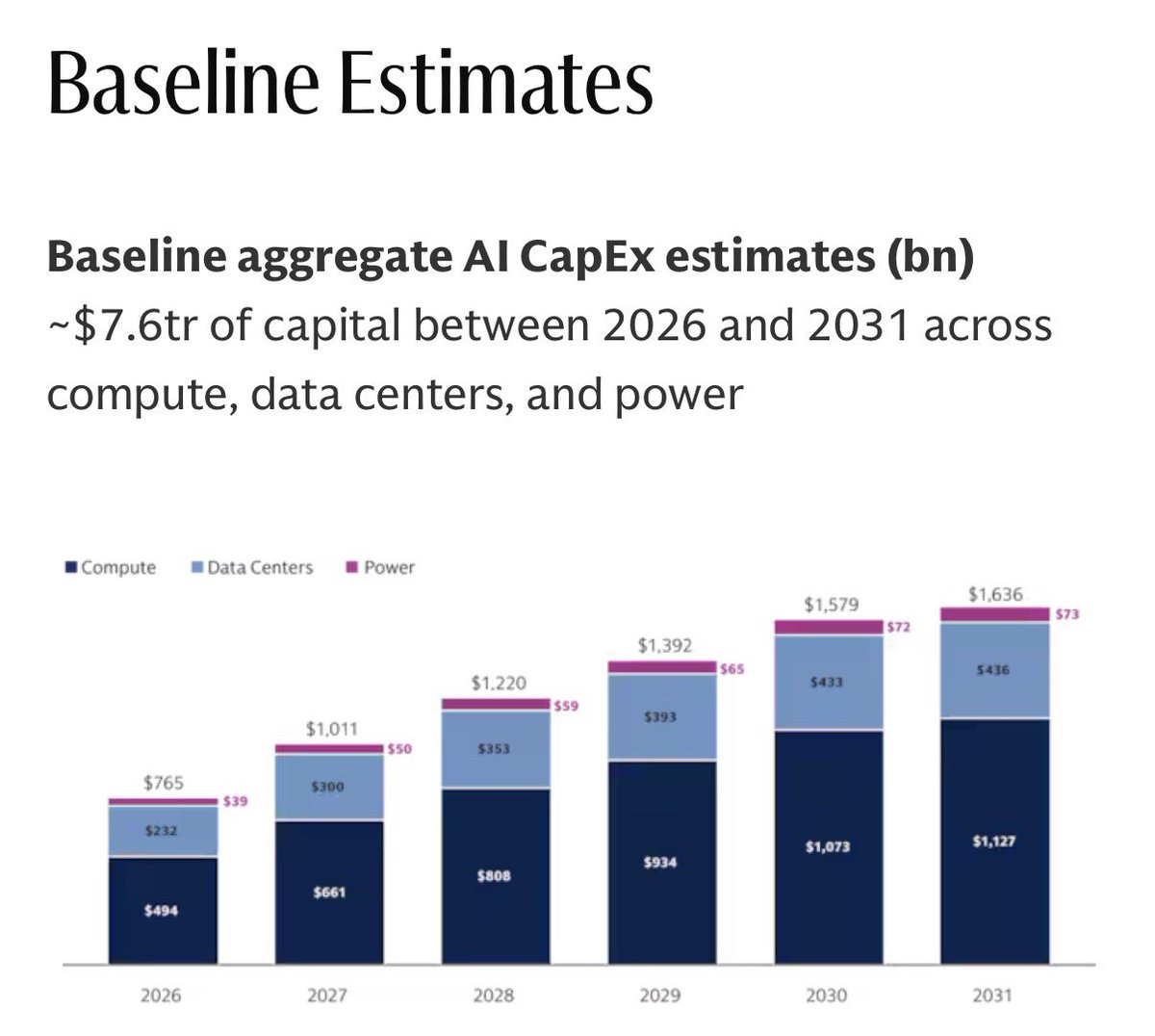
GOLDMAN SACHS PROJECTS $7.6 TRILLION IN AI CAPEX BY 2031 • Compute • Data Centers • Power
Small Cap Snipa tweet media
English
15
24
207
22.7K
Anthony Wanger retweetledi
⚡️David Blackmon⚡️
⚡️David Blackmon⚡️@EnergyAbsurdity·
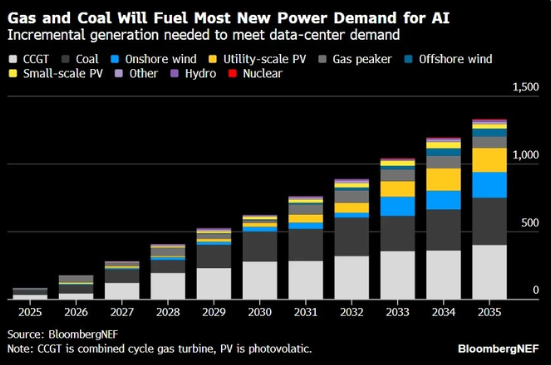
🚨BloombergNEF just dropped a reality check on AI's power needs: Gas and coal will fuel most new generation for data centers through 2035. No green fairy dust here, just hard numbers on incremental generation required. CCGT and coal dominate the stacked bars, renewables and nuclear barely move the needle. AI will run on natural gas and coal for the foreseeable future. But here’s where the rubber meets the (slow-moving) regulatory road: Where do all the CCGTs come from? •Major manufacturers (GE Vernova, Siemens Energy, Mitsubishi) are booked solid with 4–5+ year backlogs. GE alone is at ~100 GW and growing; new orders are already slipping into 2029–2030. •Data-center hyperscalers are paying non-refundable deposits years in advance just to hold a slot. Supply chain can’t scale fast enough. Where does all that new coal generation come from? •U.S. permitting and EPA rules have made new coal plants virtually impossible for over a decade. •Strict emissions standards, carbon-capture mandates that don’t exist at scale, endless lawsuits, and local opposition = de facto moratorium. Retirements continue while new builds are DOA. Can the U.S. compete with China in the AI race without a sea change in permitting & policy? •China added the equivalent of the entire U.S. power grid in just four years, including massive new coal and gas capacity with lightning-fast approvals. •Beijing’s “AI-Energy” strategy treats power as national security. America’s grid is aging, interconnection queues are years long, and bureaucracy is the real bottleneck. •Without radical permitting reform, China is structurally positioned to pull ahead on the energy foundation that powers AI compute. The BNEF chart doesn’t lie. The question is whether U.S. policy will let us actually build what the chart demands. As always, Energy reality trumps green rhetoric. AI supremacy depends on it. #AI #DataCenters #CCGT #NaturalGas #Coal #energyreality
⚡️David Blackmon⚡️ tweet media
English
7
25
113
10.4K
Anthony Wanger retweetledi
Nick Gerli
Nick Gerli@nickgerli1·
Homebuyer demand remained near record lows to close out April. With Reventure's buyer demand index downshifting to 9/100 this month. For comparison: a 50/100 is "normal", and the current readings are near the lowest on record. Suggesting that the spring 2026 season will continue to be a difficult one for sellers and buyers. Lower prices is the quickest and fastest way out of this prolonged housing depression. Markets where prices have fallen are seeing an improvement in demand; everywhere else is still stagnating. To track the demand metrics in your market, download our app and search your ZIP: reventure.app/mobile
Nick Gerli tweet media
English
14
30
184
17.3K
Anthony Wanger retweetledi
Wasteland Capital
Wasteland Capital@ecommerceshares·
The $GOOG numbers were absolutely MIND-BLOWING. Revenue +22%. Cloud +63% (WTF???) up from +48% in Q4, with record margin at 33% despite huge capex. Search accelerated yet again to +19%. The opposite of dead! Total Op margin at 36.1% (+200bps) = staying lean! Just STUNNING. 🤯
Wasteland Capital tweet media
English
73
240
2.2K
200.7K
Anthony Wanger retweetledi
Stephanie Link
Stephanie Link@Stephanie_Link·
$AMZN AWS Growth 28% $MSFT Azure Growth 40% $GOOGL Cloud Growth 63% Powerful tailwinds for: semis, power cos, data centers alive infra, grid. 2nd inning.
English
12
119
1.3K
72.9K
Anthony Wanger retweetledi
The Transcript
The Transcript@TheTranscript_·
$META CFO ups the capex: "We anticipate 2026 capital expenditures, including principal payments on finance leases, to be in the range of $125-145 billion, increased from our prior range of $115-135 billion. This reflects our expectations for higher component pricing this year and, to a lesser extent, additional data center costs to support future year capacity."
The Transcript tweet media
English
1
9
38
29.7K
Anthony Wanger retweetledi
Aniruddh Mohan
Aniruddh Mohan@aniruddh_mohan·
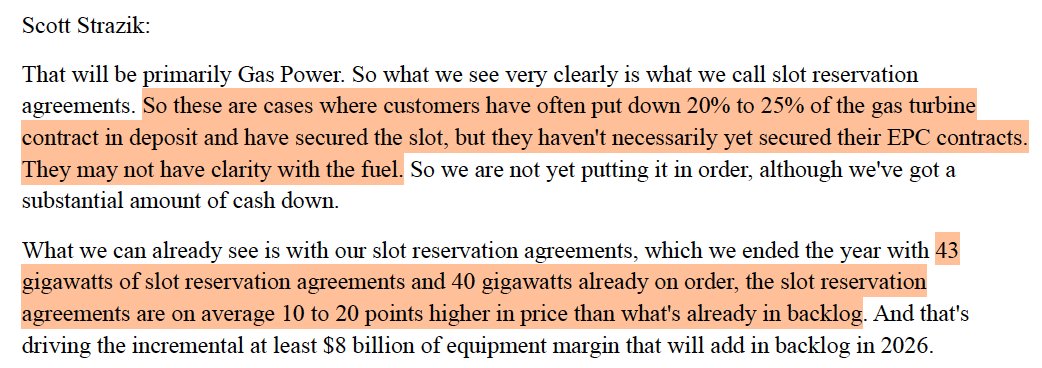
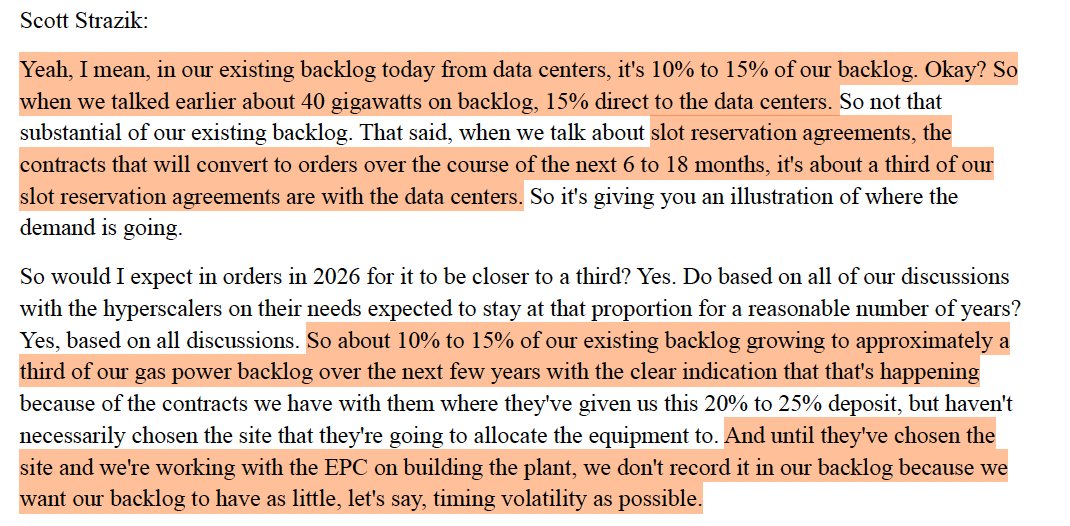
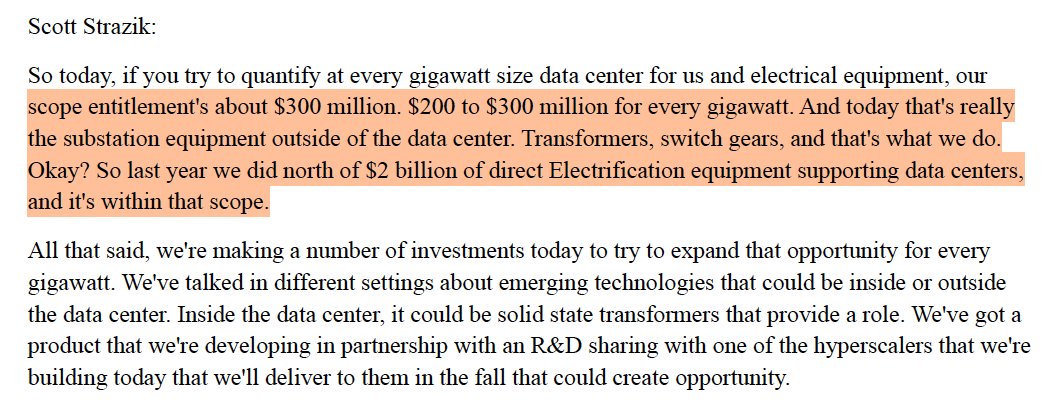
Interesting numbers here in this interview of GE Vernova's CEO on gas turbine reservations >> orders - Ended 2025 with 43 GW of "slot reservations" (33% direct to data centers), 40 GW already on order (15% direct to data centers) - Customers putting down 20-25% deposits on reservations but don't have EPC/fuel secured (next bottleneck!) so not yet 'orders' - Reservations now through to 2031! Can't get shipped though until 2029, shipping 4 GW/quarter - Converting from Reservation to Order taking 6-18 months because of EPC/fuel issues - GE can build 20 GW/yr simple cycle now, up to 24 GW/yr by 2028, adding more shifts + capacity in SC plant, France - Note 24GW/yr simple cycle could theoretically equate to about 35 GW of NGCC/yr from GEV alone - 50% of gas commitments are in the U.S. - GEV also doing great business outside of turbines on switchgear, transformers, substation equipment - $200-300M for every 1 GW of data center load just on that
Aniruddh Mohan tweet mediaAniruddh Mohan tweet mediaAniruddh Mohan tweet mediaAniruddh Mohan tweet media
English
6
54
255
40.8K
Anthony Wanger retweetledi
DCD
DCD@dcdnews·
Officials in Virginia's Prince William County drop support for QTS/Compass' Digital Gateway data center project dlvr.it/TS3Crl
English
0
1
0
161
Anthony Wanger retweetledi
Shanu Mathew
Shanu Mathew@ShanuMathew93·
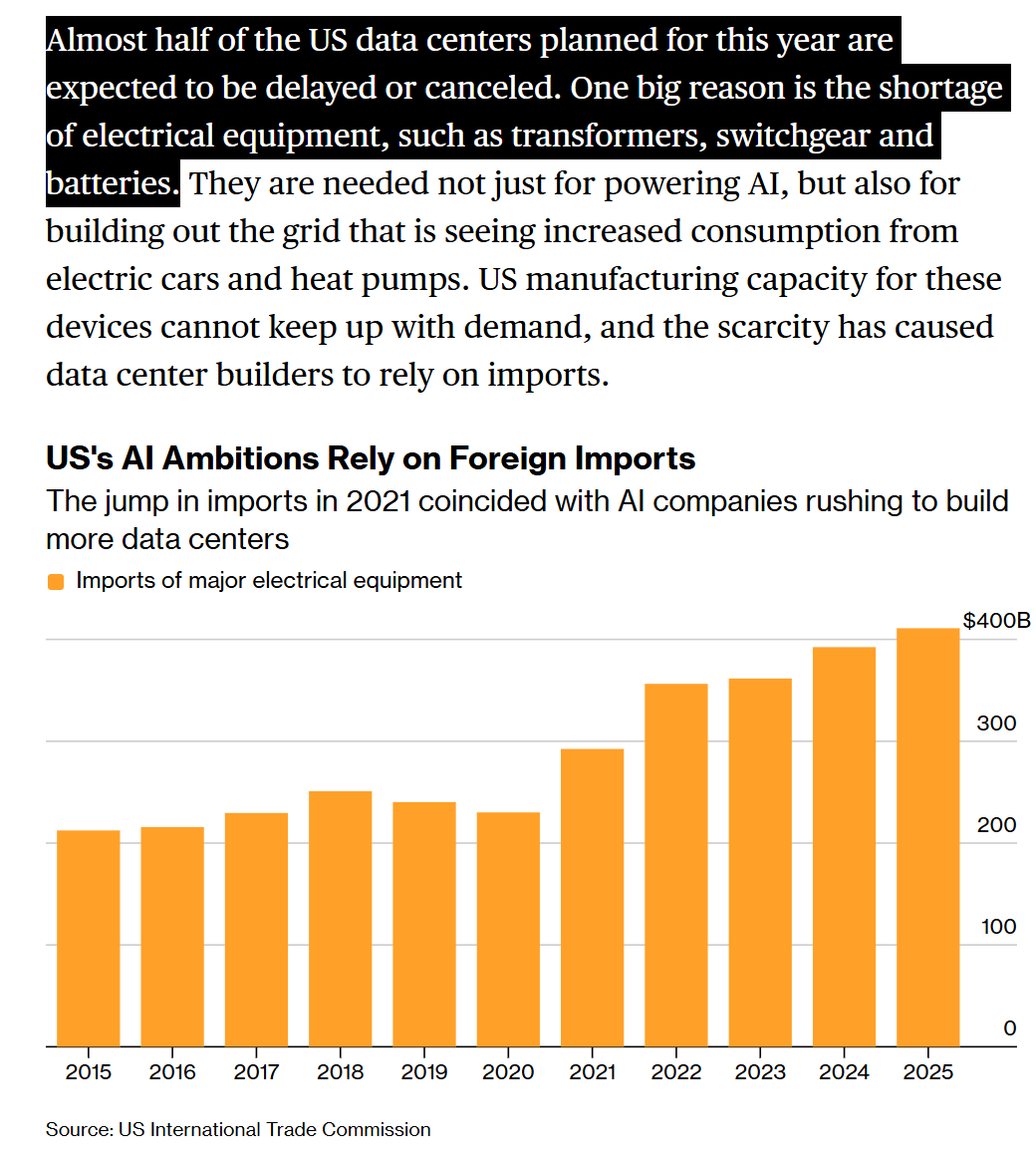
Nearly half of US data centers planned for this year are expected to be delayed or canceled. Not a capital availability or chip problem. It's transformers and electrical equipment. Lead times have gone from 24 months to five years. The big four are spending $650B+ in 2026 alone but can't actually source the gear domestically. So we must buy from China. Ironic that the country the US has to beat in AI is also the country supplying the parts to build it.
Shanu Mathew tweet media
English
24
222
774
215.4K
Anthony Wanger retweetledi
Today in History
Today in History@TodayinHistory·
Today in 1969, the internet was born! The Advanced Research Projects Agency awarded a contract to build a world wide web to BBN Technologies.
Today in History tweet media
English
32
375
1.3K
73.8K
Anthony Wanger retweetledi
Dan Nystedt
Dan Nystedt@dnystedt·
TSMC is now eying up to 12 fabs for Arizona, and an accelerated timetable is prompting more Taiwan partners to invest in the USA as well, DigiTimes reports, citing unnamed sources. Visa applications have surged for workers from TSMC suppliers, incl. Mega Union, UIS, Marketech, CYH Tech, C Sun Mfg, more. US tax incentives, other government support, legal, tax, education, are helping build a ‘Mini-Hsinchu’ in the Arizona desert. Hsinchu has long been considered Taiwan’s Silicon Valley. $TSM $INTC $SSNLF #Samsung #Arizona #semiconductors digitimes.com.tw/tech/dt/n/shwn…
English
9
57
278
45K
Anthony Wanger
Anthony Wanger@AnthonyWanger·
Outstanding thread- “The U.S. grid problem is partly a utilization and orchestration problem vs. purely a buildout problem.” Peak Demand is an issue 1% of the year.
Shanu Mathew@ShanuMathew93

Three reports dropped in the last two weeks. All three land on the same thesis - the U.S. grid problem is partly a utilization and orchestration problem vs. purely a buildout problem. Shout out @TheBrattleGroup @FERC @energy_said @BrianJanous @CarolineBGolin @Stphn_Lacey Brattle calcs that better use of existing infrastructure could unlock the equivalent of 100 GW of capacity (per the podcast's characterization of the findings) and save consumers $110-170B over a decade (similar to reports by Duke, Camus, etc.). FERC's 2025 State of the Markets shows scarcity already clearing in prices. PJM capacity auctions hit the cap twice and still fell 6.5 GW short of reliability requirements. Wholesale electricity prices rose 25% YoY. 50 GW of data centers now in service. Thunder Said Energy quantifies the operator side. A 2-3 year grid delay halves (-50%!) a data center's NPV. Flexible operation during the top 1% of grid-stress hours costs only ~6% of NPV. The math strongly favors accepting curtail-ability over sitting in the interconnection queue. And the Open Circuit podcast with Brian Janous (Cloverleaf, ex-Microsoft) and Caroline Golin (NRG, ex-Google) puts it in operational terms. 60-80 GW of mega-projects have been announced with zero binding customer offtake. The workforce to build them at the pace required doesn't exist. And the regulatory structures to value flexible alternatives barely exist either. Six overlapping themes across all four sources: 1) Load growth is real but "bankable load" is smaller than "headline load." AEP cut its 2032 forecast by 6.1 GW (15%) after filtering speculative data center demand. 2) The bridge power gap is the central tension. Hyperscalers plan on 18-24 month cycles. Utility infrastructure takes 5-10 years. DERs and flexibility tools deploy in 1-5 years. That timeline match is the whole value proposition. 3) Capacity scarcity is clearing in prices now. PJM and MISO auctions are repricing. 17 generating units (1.1 GW) canceled retirements after PJM's record auction. First beneficiaries of tightness are existing plants. 4) Gas is dominating the reliability fast lane. Regular interconnection queues are still 74% solar/storage. But in expedited and reliability-priority programs, gas runs 68-75% of selections across SPP, MISO, and PJM. Gas queue capacity rose 87% YoY. 5) Flexibility evidence is building from multiple directions. Google has 1 GW of flexible DC load. Emerald AI cut power 30% in 40 seconds in a UK trial. FERC documented a crypto facility going from 200+ MW to near zero on high-price days. But no one has yet gotten faster grid access because they agreed to be curtailable (yet!). 6) A binding constraint is market design. VPPs lack capacity value in most resource plans. PJM doesn't allow aggregated VPPs to participate in its capacity auction. ERCOT has no aggregated VPP price signal beyond energy.

English
0
0
1
39
Anthony Wanger retweetledi
tae kim
tae kim@firstadopter·
Need more cooling every AI server generation
tae kim tweet media
English
2
4
26
4.3K
Anthony Wanger retweetledi
Wccftech
Wccftech@wccftech·
TSMC's Arizona fabs are so overbooked that customers are already reserving capacity that hasn't even been built yet. wccftech.com/tsmc-arizona-f…
English
2
9
37
2.7K