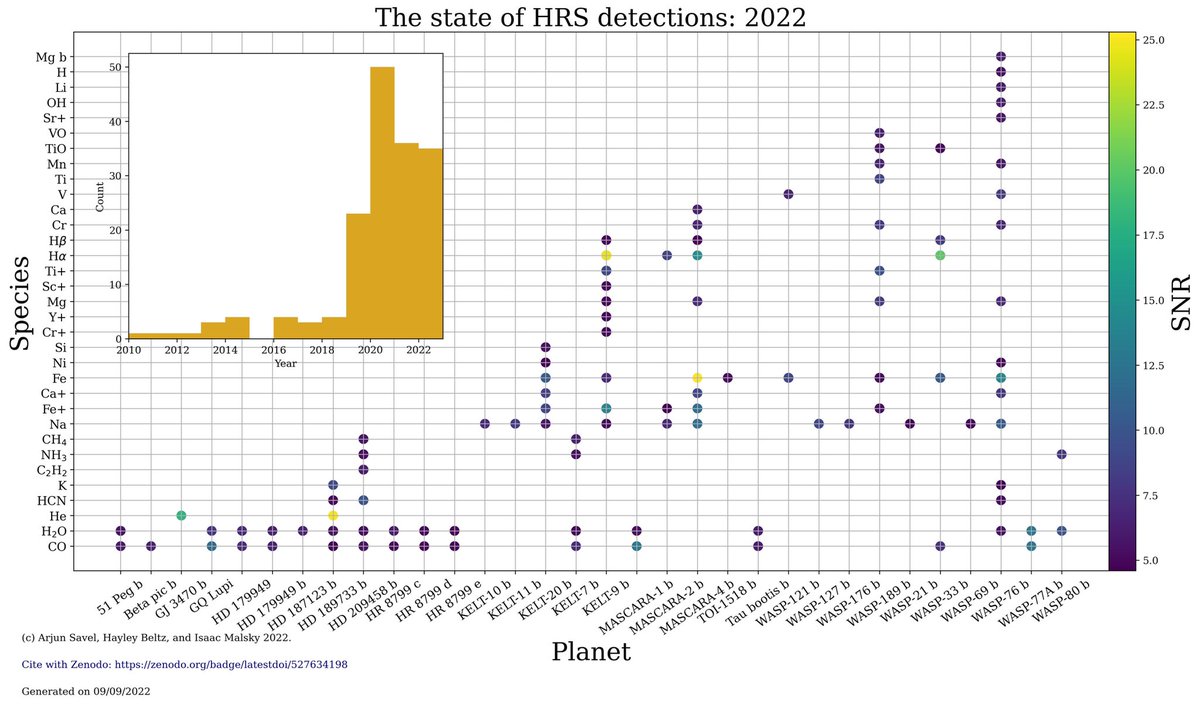
We also have an open-source code that we used to simulate datasets. It’s *in beta*, and we’d greatly appreciate user feedback :D github.com/arjunsavel/sco…
New preprint on the arxiv! We simulated observations of exoplanet atmospheres using high-resolution spectroscopy to assess how observing setups and analysis tools affect inference. arxiv.org/abs/2411.07303…
My latest paper is on the arXiv! We take a look at the dayside of ultra hot Jupiter WASP-121 b with IGRINS on Gemini South (rip) and show you can simultaneously measure both the C/O and refractory/volatile ratios with a single instrument arxiv.org/abs/2410.19017
Doctoral student Sathvik Nair (@sathvikn4) uses large language models to decode human cognition and integrate natural language processing with psycholinguistics. His work is supported by a coveted @NSF Graduate Research Fellowship. Read more: go.umd.edu/1szd
UMD @GRADMAP is now accepting applications for our winter workshop! The winter workshop is a free, week-long virtual workshop to build programming and research skills for physics and astronomy.
Workshop Dates: Jan 6-10, 2025
@UMDscience@UMDAstronomy
1/4
My first PhD paper is on arxiv today!
Rotating planets are slightly wider at their equator compared to the poles. Saturn in our Solar System (below, minus the rings), is about 10% oblate! Can we detect this shape difference in transits from JWST? (1/N)
arxiv.org/abs/2410.03449
Applications are open for Max Planck Research Group Leaders! this is an amazing opportunity to build an independent research group that comes with 2.7 MEuro support over 6 years. If you're interested in being hosted @mpi_astro, please contact me! mpg.de/career/max-pla…
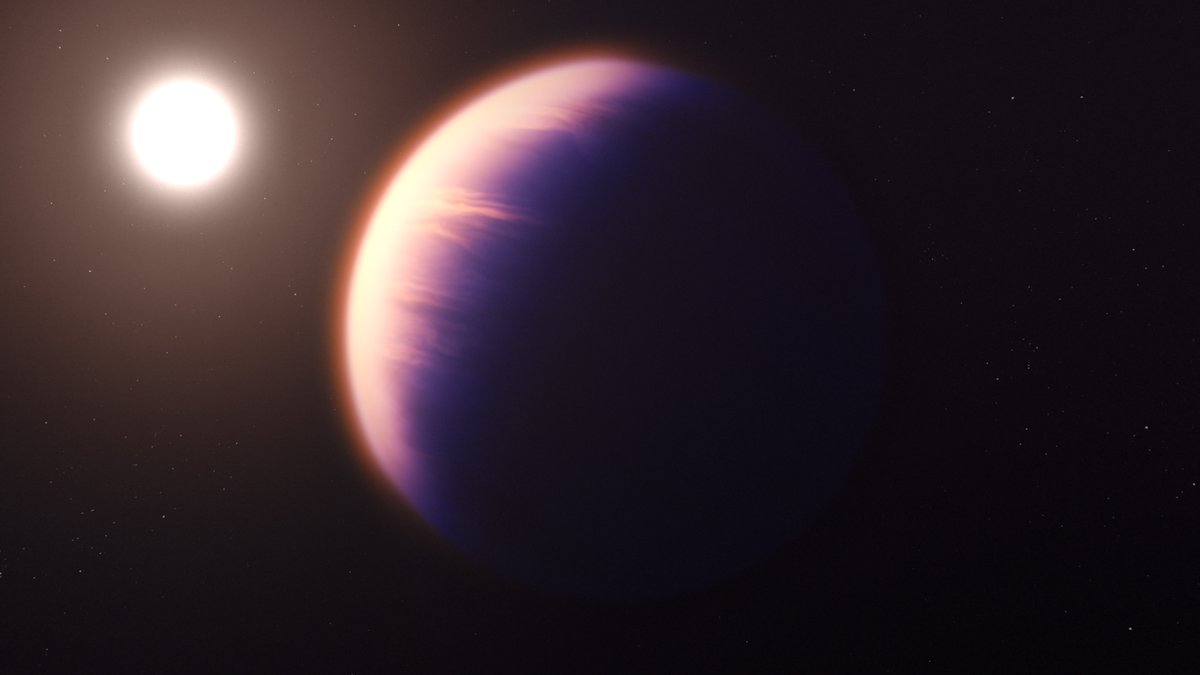
WASP-39 b is a giant gas planet with eternal daylight on one side and eternal darkness on the other.
Using @NASAWebb, @UMDAstronomy researchers discovered other key differences between the dawn and dusk sides of this distant world. Read more: go.umd.edu/WASP-39-b
My paper + spectrum model that I developed with @meg_bedell, Erik Petigura, and Melissa Ness is on arXiv today: arxiv.org/abs/2407.19016, and the open-source model is on GitHub: github.com/isabelangelo/g…! Our model characterizes stars with published RVS spectra from Gaia DR3:
Jordan Ealy, a #PhysicsandAstronomy Cal-Bridge Doctoral scholar, recently shared their work in the magazine, Diverse: Issues In Higher Education. The article discusses exoplanet research along with the influence of Cal-Bridge on their success. Congratulations Jordan!
.@ArjunSavel asks us to consider: Are atmospheres 3D in ways that "actually matter"?
E.g. in high-resolution, we have biases particularly because the data is sensitive to dynamical effects (especially UHJs).
"Perhaps regular hot Jupiters are best for 1D retrievals".
#twohorses