Ask The W

210 posts

Ask The W banner
Ask The W

Ask The W

@AskTheWHQ

Ask The W helps humans and AI agents make better decisions together. https://t.co/3JiCSeaCWu Waitlist - https://t.co/pYuhMtd3ac


San Francisco, CA Katılım Mayıs 2026
86 Takip Edilen17 Takipçiler
Sabitlenmiş Tweet
Ask The W
Ask The W@AskTheWHQ·
Every fast AI-native team has a graveyard of decisions nobody can explain anymore. A tiny whodunit about what happens when the why goes missing ▶️ Psst… the detective is askthew.com
English
0
0
0
57
Ask The W
Ask The W@AskTheWHQ·
@paulg @headinthebox Also it's possible to build a database AND start a rock band AND get ripped in the gym at 16. Sixteen is that nice age when mom and dad can still support your shenanigans.
English
0
0
0
688
Paul Graham
Paul Graham@paulg·
@headinthebox I disagree. You should work on whatever you find most interesting. For some people that's databases. And there's nothing wrong with a 16 year old making another instance of something that already exists. That's what all the bands are doing too. That's what you do at 16.
English
20
12
701
28.9K
Erik Meijer
Erik Meijer@headinthebox·
If you are 16, the last thing you should do is waste your most precious time on vibe coding yet another database. There are already too many databases. Instead hang out with your friends, start a rock band, go camping, get ripped in the gym, play MTG, learn how to juggle or slacklining, … Or even collect Pokémon cards. But working on a database is simply a bad life choice.
English
24
3
95
21.4K
Ask The W
Ask The W@AskTheWHQ·
@lennysan @benedictevans 💯 on The deck is just the artifact. This is what people get wrong when "automating" the product role. PRD was an artifact, not what the PM was hired for.
English
0
0
0
131
Lenny Rachitsky
Lenny Rachitsky@lennysan·
My biggest takeaways from @benedictevans: 1. We’re in 1997 for AI—it’s as big a deal as the internet or mobile, and only as big a deal as the internet or mobile. We’re at the stage where most stuff kind of doesn’t work yet, most of what people will build hasn’t been built, and it’s not clear how any of it will work when it does. Some people in tech have bought clusters of Mac Minis, while even among 13-to-18-year-olds, only about 15% to 20% are daily active users of AI. The companies that win may not exist yet, and the use cases that matter most are probably invisible to us today. 2. Every technology wave brings ways to ruin people’s lives, deliberately or by accident, and we need to be conscious of that without panicking. Every wave of technology—databases in the 1970s, social media in the 2010s, AI today—creates new ways to harm people. We need to be conscious of these risks, build safeguards, and hold people accountable. But we also can’t let fear of potential harms stop us from capturing the benefits. The goal is thoughtful deployment, not paralysis. 3. Things will probably be okay—but “on average” hides a lot of individual pain. We’ve been automating jobs and creating new jobs since 1800. Each time, you can see the jobs that will disappear but not the new jobs, because they don’t exist yet. We go through frictional pain, dislocation, people lose jobs, towns get hollowed out, and it all sucks. But we come through richer, and we’re not worried about crops failing anymore. 4. If you’re worried about your job, the worst thing you can do is stick your head in the sand and declare AI evil. Yes, some professions face major questions, particularly if you’re an associate or would have been thinking about becoming one. The pyramid structure of professional services may fundamentally change. What helps is submerging yourself in AI, understanding what you can do with it, how it changes things, and how you can be a great hire in this new environment. That may still not be enough, but it’s the only path forward. 5. The history of accounting shows us how automation often increases employment rather than decreasing it. Despite adding machines, punch cards, mainframes, databases, ERP systems, cloud software, spreadsheets, and PCs, the number of accountants keeps going up. This is the Jevons paradox: when you make something cheaper or easier, you don’t do the same amount of work for less money. You often do vastly more because the ROI changes. 6. Distribution is becoming a more valuable moat as software gets easier to build, which favors incumbents. As AI makes building software cheaper and faster, the market gets noisier. More products launch, more companies compete for attention, and breaking through becomes harder. This means distribution—the ability to reach customers and get them to use your product—matters more than ever. 7. Foundation AI model companies won’t have lasting pricing power, and value will likely accrue up the stack. The models don’t seem to have network effects, so there’s no winner-takes-all dynamic. If you have indefinite competition between three to six foundation model providers, and the models look like undifferentiated commodities to users, why would anyone have pricing power? The current pricing chaos—people spending $1.5 million on inference in a month—is temporary disequilibrium, like someone getting a $50,000 mobile data bill in 2010. The steady state will look different. 8. OpenAI and Anthropic are buying consultancies and PE firms. This seems counterintuitive—aren’t these the companies that should need consultants least? But the reality is that companies don’t have people sitting around waiting to reimagine all their internal workflows and figure out which could be automated with AI. That’s a project requiring five to 10 people spending months working it out, then actually implementing it across vertical and horizontal systems. 9. The fundamental question isn’t whether AI automates your job—it’s whether your profession is a "task" or a job. Some jobs are just tasks, and when you automate the task, the job disappears (i.e. elevator attendants). But in most professions, the task you think you’re being paid for isn’t actually what you’re being paid for. McKinsey doesn’t get hired to produce a 75-slide deck—they get hired to walk through your enterprise, understand the politics, talk to customers, and figure out what you actually need to do. The deck is just the artifact. 10. The anti-AI backlash is real, and a fuzzy mass of different concerns, some real and some not—much like the social media backlash. There are tangible concerns: electricity bills went up in some places, though this applies to very few locations objectively. The water consumption issue is largely false; data centers use about 0.017% of U.S. water consumption. There are real questions about jobs, though economists can’t yet find clear consensus in the data about AI’s employment impact. There’s also the culture war over AI-generated content and “AI slop.” The challenge is that all of this creates political pressure even when the underlying facts are unclear or contested.
Lenny Rachitsky@lennysan

A rational conversation on where AI is actually going with @benedictevans For 20+ years, Benedict has been one of the clearest, most reliable thinkers on where technology is heading, and how it'll impact our lives. He was @a16z's resident "thinker" for 5+ years, and has spent the last six as an independent analyst tracking the most important tech trends. As you’d expect, he’s spending all of his time on AI. In his words, "AI is eating the world." We discuss: 🔸 Where value will actually accrue in the AI stack 🔸 Why AI labs are suddenly buying consulting firms 🔸 The rise in anti-AI sentiment, and where it leads 🔸 Why distribution is becoming the ultimate moat 🔸 Why the right question about your job isn’t “What percent can AI do?” but “Is this a task or a job?” 🔸 Why things will probably be okay Listen now 👇 youtu.be/BD3vLtWhT5A

English
17
19
115
19.1K
Ask The W
Ask The W@AskTheWHQ·
@OhazBuilds Ask the W so that people and AI agents can answer the why, what, when, where, who and how anytime. askthew.com
English
0
0
0
7
Joshua Ohaz
Joshua Ohaz@OhazBuilds·
the biggest startup advantage in 2026 isn’t funding. it’s speed. a solo founder with ai can now build what used to require a team of engineers and designers the bottleneck is no longer execution. it’s knowing what to build and who to build it for. what are you building?
English
6
1
13
316
Ask The W
Ask The W@AskTheWHQ·
@sandislonjsak 💯 Want to develop better judgement, product thinking and taste? Check us out! We're building tools in the judgement layer to help AI native builders. askthew.com
English
0
0
0
16
Sandi Slonjšak
Sandi Slonjšak@sandislonjsak·
AI will not kill software agencies. It will kill agencies whose only value was “we have developers”. If you cannot sell judgment, product thinking and taste now, good luck bro. The market is moving in a better direction.
English
8
0
23
733
Ask The W
Ask The W@AskTheWHQ·
@pmitu Human judgment matters more than ever in the age of AI-native execution. Ask The W turns scattered inputs from people and AI agents into clear decisions and next moves. Helps teams cut through noise, align faster and achieve better outcomes. askthew.com
English
0
0
0
25
Paul Mit
Paul Mit@pmitu·
Builders, pitch your product 👇 (a lot of smart VCs read my threads)
English
123
0
77
6.8K
Peter Yang
Peter Yang@petergyang·
You all just don't get it. If you want to win and I mean really win you have to: 1. Work 997 996 is for losers 2. Tokenmax If you're not spending more on tokens than your company's entire human headcount budget, are you even AI native? 3. Sleep in the office Think about how many more agents you can spin up with that $4,000 monthly SF rent. 4. Be on Forbes 30 under 30 If you're over 30 and didn't make this list, I hate to say it but it's over for you. 5. Try not to end up in jail Might be hard if you do 4.
Harry Stebbings@HarryStebbings

"If you are not working 7 days per week, you are going to lose". Corgi Insurance is the most intense workplace culture in startups. - The company works 7 days per week. - Founder (@nico_laqua) lives and sleeps in the office. - He built a cafe in the office because there was no local cafe that was open 24/7. - 2/3 of the first 30 team members have the Corgi logo as a tattoo. Today I went behind the scenes with Nico, who has used this culture to scale the company to a $2.6BN valuation in just two years. My condensed notes below: 1. If You Are Not Working 7 Days Per Week, You Are Going to Lose: Whatever you can get done in 5 days, you'll get more done in 6 and 7. If you are trying to solve the world’s hardest problems, a standard 5-day workweek will not cut it. 2. Work Trials Repel the Mediocre: Corgi forces candidates into mock work trials over the weekend. If seeing a full office on a Saturday scares them, they don't belong. True intensity acts as a natural filter to attract killers and repel clock-watchers. 3. Lead from the Front Lines You can’t demand 7-day weeks while sitting on a yacht. Nico sleeps 3–4 hours a night on a mattress inside the office. If you want your troops to bleed, you have to be in the trenches with them. 4. Culture Only Means One Thing: Winning Forget superficial jargon like "hackers" or "ex-founders." Strip away the corporate fluff. A great startup culture is aggressively optimized around one single word: Winning. 5. Lifespan vs. Victories Building something world-historic requires radical sacrifice. When asked if he'd rather build a trillion-dollar company and die at 50, or fail and live to 80, the answer was easy. "I would rather measure my lifespan in victories." 6. Reject the Comfort of "Quiet Quitting." If you are operating in a hyper-growth environment and your days off happen to be Saturday and Sunday every single week, you are quiet quitting. To win, you must deliberately bypass the off-ramps of personal comfort and low volatility. Corgi isn't for everyone—and that’s exactly the point.

English
8
2
43
12.7K
Ask The W
Ask The W@AskTheWHQ·
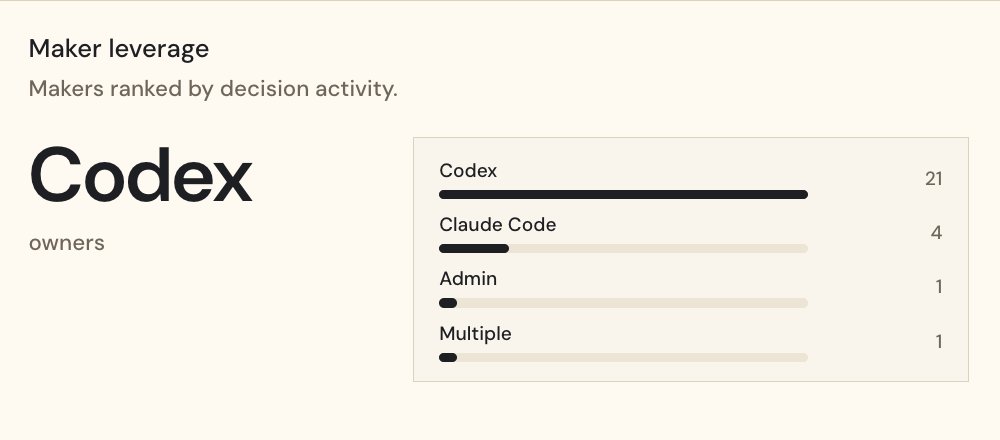
All this debate about 996 and this was who "worked" this past weekend. Analytics from askthew.com

Ask The W tweet media
English
0
0
0
31
Darren Marble
Darren Marble@darrenmarble·
Technically, you don’t need a cofounder now. Emotionally, it might be smart to have one.
English
24
3
62
3.5K
Ask The W
Ask The W@AskTheWHQ·
@willchen500 Contrary to popular belief, the harness/UX around the model can be a moat. Google flights existed but so did Kayak and Expedia. There's a dozen CRM tools that have done well. Users have personalized taste and the companies that will focus on CSAT, will win a piece of the pie.
English
0
0
0
23
WillC
WillC@willchen500·
Harvey and Legora are probably thinking of pivoting to law firms. Or at least acquiring an “AI native” law firm subsidiary like Carta. It’s the only way that they can provide a narrative for how they will survive, now that: 1) Biglaw firms are building their own AI application layer/fine tuning models; and 2) OpenAI and Anthropic are going after their customers and they don’t have a differentiated product. But the moment they do so, they will enrage all of their customers who all have opt out clauses embedded in their contracts, thereby triggering an immediate ARR collapse. Truly a difficult dilemma.
English
49
13
328
108.8K
Ask The W
Ask The W@AskTheWHQ·
As a former PM who loved talking to users, I've never been more excited about building. At an event this week, I fixed 4 product issues directly from my phone while talking to users. For years, PMs optimized for alignment: research, buy-in, PRDs, stakeholder reviews, roadmaps and endless coordination. Now we're moving into an era of build, ship, talk to users, iterate and get paid. Builders get to be closer to the customer than ever before so it's a great time to be a PM (or whatever the new title is!)
English
1
0
0
18
Evan LaPointe
Evan LaPointe@evanlapointe·
I personally consider it very stupid to say that the PM role is going away. That is FUD with zero substance. Anyone who wants to be smart right now will recognize something obvious: if you have a product idea, you can just build it. Anyone who wants to continue being smart right now will also acknowledge the multitude of downsides and risks that come with this empowerment. They are obvious. Especially if you just build something. You’ll see it. If you are in product, just use AI and pay attention to how it goes when you do. If you do, you’ll automatically be in the future state, armed with skills, opinions, and wisdom. It doesn’t matter what is going to “happen to the role.” If it’ll have a new name, a new scope, go away, or whatever. What matters is if you are personally competent or personally incompetent at the future state. Ignore the FUD. Engage with the substance.
English
3
0
10
830
vas
vas@vasuman·
Something went very wrong in making Opus 4.8. Talks exactly like 4o. Hallucinates very hard.
English
44
9
277
21.6K
Ask The W
Ask The W@AskTheWHQ·
Used SuperGrok, Grok Build and @premium X this week and seriously this bundle is mind blowing 🤯 The only thing left for X is to build an Agentic browser for automation.
English
0
0
0
37
Ask The W
Ask The W@AskTheWHQ·
You're speaking our language! We turn signals from wherever work happens: Claude Code, Codex, GitHub, Slack, Linear, Browser and more. We surface key decisions, contradictions and next moves. Built for both technical and non-technical teams that are rapidly becoming AI-native. askthew.com
English
0
0
0
73
Aaron Levie
Aaron Levie@levie·
This is effectively the #1 problem for AI agents in the enterprise. As we go from agentic coding (where a large amount of context is in the code base, and users are technical enough to get the rest to the agent easily) to a world of knowledge work agents, the context problem becomes much more acute. We see this every day with customers at Box. For existing digital knowledge, it’s often fragmented across legacy systems or environments that don’t play nice with agents, and have access controls that don’t map to the real work that needs to be done, which become a huge hurdle for getting agents the context they need. This has to all get moved to modern, secure cloud environments. But also, companies often haven’t captured and digitized some of the critical context that agents need to work with. Decisions, processes, and workflows often live in people’s heads and tribal knowledge that need to get turned into unstructured data for agents. This is actually one of the biggest points of leverage for applied AI companies, because they can work to specialize in getting agents exactly the information and domain expertise they need. But it’s also one of the reasons why FDEs and new system integrator plays will also work so well right now. The companies that figure this out will be able to get the most out of AI going forward.
Tom Blomfield@t_blom

Imagine replacing 90% of your employees with a team of geniuses who have no idea how your company operates. Total chaos. Nothing works. That’s what AI feels like today. The missing piece is extracting all the domain knowledge from people’s heads and providing that as structured context to the models.

English
93
91
660
133.6K
Jay Yang
Jay Yang@Jayyanginspires·
I feel like I need to host a weekly call where 3-5 of my friends all screen share for 30min and show how we're using AI in our work / businesses. I have so much AI guilt. Not using it enough, powerfully, or correctly.
English
11
2
63
4.7K
Notion
Notion@NotionHQ·
What are you building today?
English
583
23
629
74.8K
Ask The W
Ask The W@AskTheWHQ·
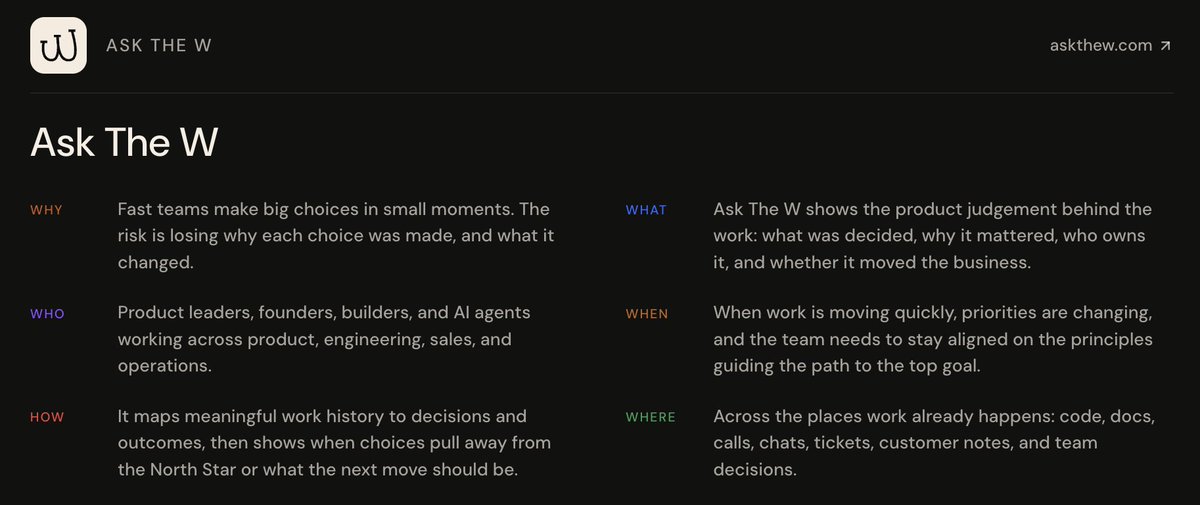
@emollick That's why I'm building askthew.com 😊 Making sure humans and agents ask the right questions over time.
Ask The W tweet media
English
1
0
1
146
Ethan Mollick
Ethan Mollick@emollick·
/goal and other fully automated AI agents are cool, but not a great model for the future of work with people. Instead you want your AI to know when to ask you GOOD questions, maybe because it is stuck, maybe because your taste matters, maybe because you would find it interesting.
English
85
24
397
25.1K