Sabitlenmiş Tweet

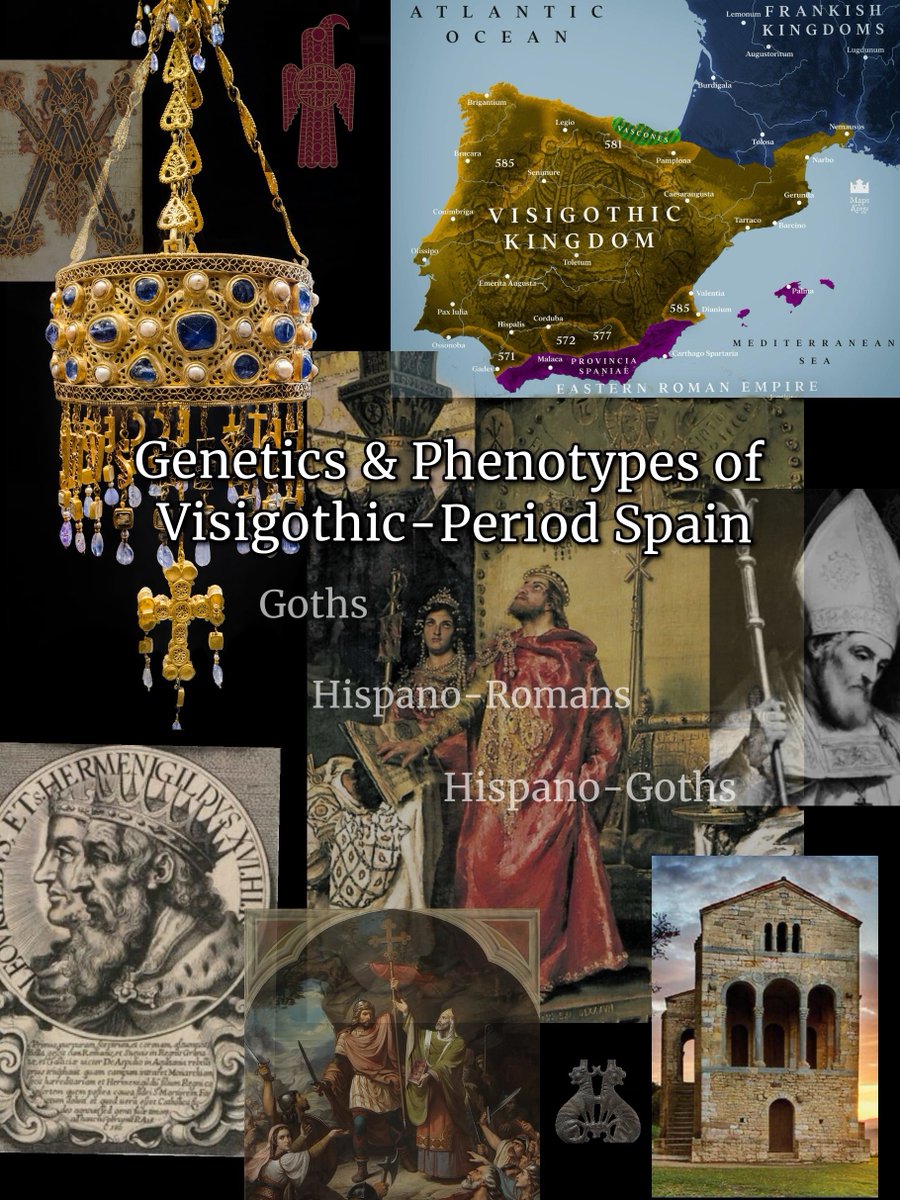
In this post, I explore the genetics and predicted phenotypes/traits of three populations present in the Iberian Peninsula during the period of Visigothic rule — the Visigoths, the Hispano-Goths of Northern Spain (Catalunya), and the Hispano-Romans of Southern Spain (Granada).
I have utilized publicly-available sample data from sources like Vahaduo and aDNAXP. I have also utilized qpAdm admixture & trait results that were compiled and shared by Andrei Kharchenko.
*Note that phenotypic/trait data was only available for a number of these aDNA samples (5/9 Visigoths, 1/5 Hispano-Goths, and 4/11 Hispano-Romans).
I understand that these are loaded terms that carry a great deal of historical sociocultural and sociopolitical baggage; so, to clarify what these terms are denoting [in this specific context], please note the following:
•Visigoths — The [predominantly genetically non-local] samples found at a mid-6th century Visigothic burial site in Girona.
•Hispano-Goths — Visigothic-period (mid-7th century) local samples from a Visigothic burial site in Catalunya.
—These samples are from an important period in the timeline, as they come following King Reccared’s conversion of Visigothic Kingdom and after the Kingdom’s subsequent adoption of the Lex Visigothorum (a set of universal laws for all subjects, which formally eroded the legal and institutional separation of the Visigoths and Iberians). Gothic genetic introgression is evident in these samples.
•Hispano-Romans — Visigothic-period (early-6th century) local samples found in Granada.
—The dating for these samples precedes the aforementioned Visigothic legal/institutional reforms and are genetically distinct unto themselves [even in relation to modern mainland Iberians, as they show much stronger levels of southern drift — surpassing even modern Canary Islanders in MENA orientation.] No clear Visigothic genetic introgression is evident in these samples.
English