Aurera Capital

391 posts

Aurera Capital banner
Aurera Capital

Aurera Capital

@AureraCapital

Aurera Capital | Independent equities & macro research.

Katılım Ocak 2026
473 Takip Edilen261 Takipçiler
Sabitlenmiş Tweet
Aurera Capital
Aurera Capital@AureraCapital·
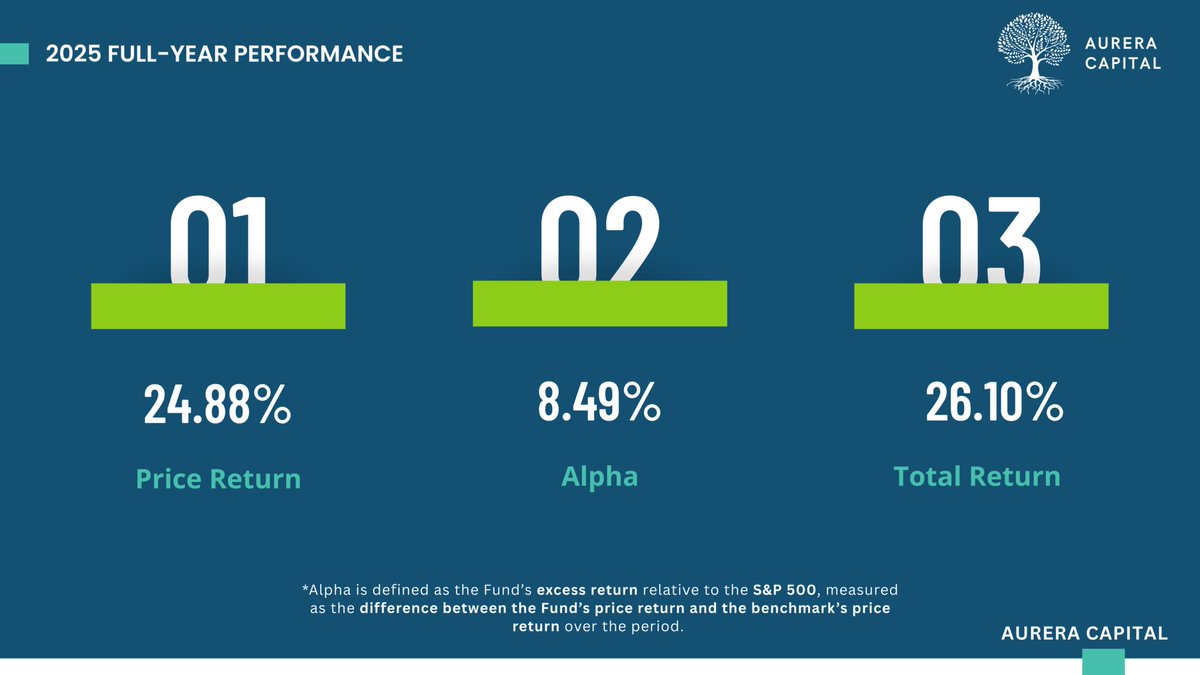
1/4 - Aurera Global Equities Fund — 2025 full-year: +24.88% price return vs the S&P 500 (benchmark) + 16.39%. That's 8.49% of outperformance, delivered with a concentrated 15-position book. The Fund's +26.10% total return represents price appreciation plus dividends.
Aurera Capital tweet media
English
1
0
13
1.4K
Aurera Capital
Aurera Capital@AureraCapital·
This week's edition of Aurera's View is titled "Constraints Beneath the Surface." We highlighted how U.S. equities continued to rally, but not because the macro backdrop became easier. Instead, investors rewarded companies with strong earnings delivery, clearer AI payback and resilient fundamentals, while still looking through oil volatility, Middle East uncertainty, and a more complicated Fed backdrop. In Kenya, the picture remained weaker, with all three major indices closing lower, as inflation accelerated, and Treasury bill demand weakened. The Finance Bill 2026 added another layer of uncertainty. Our global trade idea for the week is Uber Technologies (NYSE:UBER), ahead of earnings. The thesis is that a beat on earnings and constructive commentary on autonomous vehicles could support the market's view of Uber as the long term distribution layer of robotaxi operators. Our Kenya trade idea remains the banking basket of Equity Group, KCB Group, and Absa Bank Kenya, with a higher allocation of Equity Group. This week, we are watching three key themes: 1. Progress around the Strait of Hormuz and its impact on oil and shipping 2. AI earnings from AMD and Palantir 3. Kenya's proposed tax measures and their effect on sentiment. For our full newsletter, find it attached below: aurera.beehiiv.com/?utm_source=au…
English
0
0
1
56
Aurera Capital
Aurera Capital@AureraCapital·
$UBER is one of the most compelling AV plays in the market, because it may become the default platform through which robotaxis are launched, scaled and monetised. We started investing in Uber at the beginning of 2025, and it now represents a substantial allocation in our portfolio. The core of our thesis is that most AV companies may be strong at building autonomous driving technology, but few are capable of acquiring millions of customers, and expanding into multiple cities. Uber has already spent more than a decade building this infrastructure, and the market often forgets just how difficult this was. The company has to subsidise rides, fight competitors city by city, attract drivers through financial incentives, deal with regulators, build consumer trust, and expand into new markets long before it reached sustained profitability. AV companies may face an even tougher version of that journey. Even after spending substantial amounts on autonomous technology and fleet development, they would still need to win customers, create demand, and operate across multiple markets. That is why we think many AV players may not want take on the extra burden of building a consumer marketplace from scratch. After years of investment, they will need a faster route to revenue generation, and Uber already has the platform, user base, and operating infrastructure to give them that distribution. This is where Uber's value could become increasingly hard to ignore. This is why we think Uber's AV partnerships are more strategically important than the market currently appreciates. The pace of partnership announcements should not be viewed as just PR. Given Uber's scale, customer base, brand, nuanced data and negotiating power, we would expect many of these agreements to include commercial protections that make Uber a preferred or guaranteed partner across certain markets or number of years. In our view, Uber's AV monetisation opportunity likely comes through two main channels: 1. Revenue Share - Uber continues to take a percentage of each ride, with economics varying by AV partner, geography and fleet structure. 2. Servicing Support - Uber would likely offer servicing support where an AV needs operational assistance rather than major repairs. Our base case is not that Uber becomes asset-heavy across the entire AV system. We see Uber more likely to contribute data, routing intelligence, and safety insights to help AV manufacturers improve their product. Even with that, what we find interesting is Uber's investment into Lucid. Uber has continued investing more into $LCID alongside the Saudi Government, which is a major Uber investor. We see this an indication that Uber wants to own the luxury and executive AV fleet over time. In that scenario, Uber Black would eventually become a majority owned Uber segment rather than a partner led one like Uber X. If that happens, Uber Black could become a structurally higher-margin part of the mobility business, because Uber would capture more of the revenue rather than sharing it with a fleet partner. The bigger point that is under appreciated is that consumers are unlikely to care substantially about whether their robotaxi is made by Waymo, Tesla, Baidu, or someone else. They will care about how fast the car arrives, how safe the ride is, and how reasonable the price and experience are. That is Uber's advantage. From our model, we have an FY26 price target of $85 for $UBER. Looking further out, as the margin impact from AVs becomes clearer, we see a path to $200 by FY30, implying approximately 162% upside from current levels, or an annualised return of around 21.7%. Overall, the market looks at AVs as disrupting Uber. We see AVs making Uber more valuable.
English
3
1
35
1.7K
Aurera Capital
Aurera Capital@AureraCapital·
You're definitely asking the right questions here. We started investing in $UBER at the beginning of 2025, and now it accounts for a substantial allocation in our portfolio. Our thesis is that Uber can become the default go to platform for AV companies looking to launch, scale, and monetise robotaxis across major markets. Uber already has the customer base, brand recognition, operational infrastructure, and geographic footprint, to remain the main ride-hailing platform. Most companies underestimate how much capital and how many years of losses Uber had before reaching profitability, from subsidising rides, defending against competitors, onboarding drivers, and expanding city by city. AV manufacturers may be faced by an even more difficult backdrop, given how many AV providers are trying to enter the market at once. After spending substantially on AV development and fleet capex, many of these companies would not want to absorb the full burden of marketing, customer acquisition, and local market expansion. They would require a direct route to demand and revenue generation. This is where we see Uber's value to them coming from. This likely explains the pace and scale of Uber's AV partnerships. Our assumption is that these are not just PR announcements. Given Uber's scale and negotiating power, we would expect many of these partnerships to include contractual safeguards that make Uber the preferred or guaranteed partner for a number of years. With AVs we see Uber generating revenue through two primary ways: 1. Revenue Share - They would continue with the standard revenue share structure, although it would likely vary by partnership. 2. Maintenance & Servicing - This is where Uber plays a role in operational issues when an AV encounters a problem, provided it's not a major defect. On the capex question, our base case is not that Uber becomes asset-heavy across the entire AV system. We see Uber more likely to contribute data, routing intelligence, and safety insights to help AV manufacturers improve their product. That said, what we find interesting is Uber's investment into Lucid. Uber has continued investing more into $LCID alongside the Saudi Government, which is a major Uber investor. We see this an indication that Uber wants to own the luxury and executive AV fleet over time. In that scenario, Uber Black would eventually become a majority owned Uber segment rather than a partner led one like Uber X. If that happens, Uber Black could become a structurally higher-margin part of the mobility business, because Uber would capture more of the revenue rather than sharing them with a fleet partner. Overall, we remain constructive on Uber because we think the TAM is substantial, and because most consumers will care more about getting from point A to point B, safely, efficiently and at the lowest practical wait time, compared to who the AV provider is. From our own valuation model, we have a price target of $85 for $UBER for FY26. Looking further out, as the margin impact of AVs becomes more visible, we see this rising to $200 by FY30, implying a return of ~162% from current prices or an annualised return of approximately 21.7%.
English
1
1
4
493
Jonah Lupton
Jonah Lupton@JonahLupton·
Let's talk about $UBER because it's been on my mind alot recently... I'm assuming others are also debating these questions in their spare time 😏 Last weekend I took a Waymo and it was a wonderful experience so it's fair to say I'm a big believer in robotaxis as the future of ridesharing. Right now it feels like Waymo is the leader in robotaxis but they only have ~3,000 cars (ie AVs) on the road doing ~500,000 rides per week. Tesla might be next but they have less than 150 cars (ie cybercabs) on the road doing less than 1,500 rides per week. $UBER currently has 1.5M human drivers (just in the US) but nothing in terms of robotaxis other than partnerships with Waymo and AVride (owned by $NBIS) however both options are very limited... Austin & Atlanta for Waymo... and Dallas for AVride. I do think it's possible that Waymo dumps $UBER in the future and just uses their own app in every market... however I could be wrong and maybe it goes the other way because $UBER does have 200M global customers which is massive distribution for any AV ridesharing service that wants scale. fwiw, $UBER currently does 200-250M rides per week which is 400-500x more than Waymo... however Waymo just raised capital at $126B valuation while $UBER currently trades at $153B valuation. I know some people think Waymo will be the winner but kind of crazy it's already worth 80% of $UBER with just 3,000 cars on the road vs $UBER with 1.5M US drivers and another 4M+ drivers outside the US. Over the past ~12 months $UBER has announced 15+ partnerships with different brands and OEMs including Lucid, Rivian, Nissan, Pony, Zoox, Nuro, Oro, WeRide, Baidu, Wayve, Volkswagon, May Mobility, Momenta, Mercedes and probably a few more that I'm forgetting about. I don't think we need to debate that $UBER already has massive distribution but my question is around these 15+ partnerships. Sure it's lots of constant PR which might sound good but we have very limited details... which of these AV companies has technology that is good enough to compete and scale? Putting tens or hundreds of thousands of AVs on the road in the coming years will be extremely expensive and capital intensive. I'm sure Baidu and Mercedes could handle the upfront capex but I don't know about these other brands. So who is covering the capex? the brand? uber? or do they split it? With the capex in mind, what does the rev share look like for these partnerships? Will it be the same across the board or does every partnership have different economics? For instance, let's say Pony.ai can't afford the upfront capex themselves, do they split it with $UBER? or does $UBER cover 2/3 of the capex but then they own 80% of the rev share? Let's say Baidu and Mercedes can afford the capex themselves and they want to go that route... does that mean $UBER just handles distribution & logistics but only gets to keep 1/3 of the rev share? Obviously I'm just making up numbers and scenarios because we don't have much else to go on. Would you prefer $UBER stay asset light and just collect a 1/3 toll like they do now? or do you want $UBER to leverage up the balance sheet to become asset heavy in order to get a bigger rev share % ? and here comes the monkey wrench in all of this... what if $UBER enables anyone with an AV (similar to what $TSLA might do)... to put their car onto the $UBER network in order to generate some extra income while they're working, sleeping or just not using the car? This would allow $UBER to stay asset light and maybe collect a higher % of the rev share since the car owner might be very happy just collecting 40% of the revenues since it's extra income for them not including the accelerated depreciation. I'd love to know how others are thinking about this... especially $UBER shareholders... what do you think is the right business/economics model going forward? and do you want them in the capex business in order to get a bigger rev share? I am very curious to see how this all plays out in the coming years. NFA. DYOR. **We have a tiny $UBER position at @FirstWaveFund because I think the valuation is attractive when you consider 200M customers with the potential to be the robotaxi leader... but I still have lots of concerns about what their strategy looks like going forward and what % of the ridesharing market they lose to Waymo and Tesla and if the TAM can grow big enough for all three companies to be winners? Best case for $UBER is the TAM keeps growing and even as they lose market share the economics for robotaxis are meaningfullly better than a human focused ridesharing network.
Jonah Lupton@JonahLupton

Some of you know that I launched a hedge fund several months ago (early November). We run a long/short strategy, focused on owning the 20-40 growth stocks that we believe have the most upside over the next 2-3 years... this means they need to have great fundamentals, strong management teams, compelling valuations, and multiple catalysts that we can identify and track accordingly. It's been a rough few months for many growth investors (we also took some pain)... thankfully we were averaging down into our core positions but we've still seen some red months and it has not been enjoyable. I'm not a fan of losing money. Stepping back... I've never had more conviction in my process or my portfolio than I do right now... especially with some of my favorite stocks down 20-40% from their September/October/November highs despite strong Q4 earnings reports, strong CY2026 guidance and extremely compelling valuations. With that said, here are our top 10 positions in alphabetical order: $APP $CPNG $CRDO $HIMS $HROW $SKHYNIX $IREN $NBIS $RDDT $TMDX I believe all of these stocks are trading at meaningfully higher prices in 2-3 years which remains my focus for generating outsized long-term returns. Enjoy the rest of your day 😊 NFA. DYOR. ** @FirstWaveFund owns all of the stocks mentioned in this post.

English
38
3
103
41.8K
Aurera Capital retweetledi
Pivot Point Investing
Pivot Point Investing@P_Earns24·
My take on each of the Mag7 stocks: $MSFT - Most bearish narrative $META - Best value relative to growth $AMZN - Highest conviction bet $GOOG - Most fairly valued $NVDA - Most asymmetric bet $TSLA - Most expensive (By A LOT) $AAPL - Safest bet/lowest upside
English
9
7
97
11.4K
Aurera Capital
Aurera Capital@AureraCapital·
Our largest single stock name is $META, currently at 16.5% of the portfolio. The reason we are extremely constructive on the stock is that we think the market is still overly focused on Meta's AI spending, without appreciating the revenue and earnings growth that spend can create. Following the release of Q1 results, we updated our price target to $805. For the year, we now see Meta generating $247.9 billion in revenue, representing 23.35% YoY growth, and a diluted EPS of $29.12, up 23.87% YoY. The core of our thesis is that AI is already improving the quality of Meta's adverting business. Better ad targeting should lead to stronger returns on ad spend for advertisers, which then supports higher ad budgets, stronger pricing, and continued revenue growth. We saw early evidence of this in the latest results where, Family of Apps ad impressions increased 19% YoY, average price per ad rose 12% YoY, and revenue increased 33% YoY. At the current price of around $612, our $805 price target implies upside of approximately $31.5%, which is why Meta is now our largest name. $AMZN was previously our biggest allocation, but after earnings yesterday, we trimmed and took profits following a 21% gain for the year, reallocating part of those profits into Meta.
English
1
0
0
172
Evan | Investments
Evan | Investments@NotA_Bull·
What is the single biggest position in your entire portfolio? No ETFs, stocks only.
English
259
2
108
24.9K
Aurera Capital
Aurera Capital@AureraCapital·
These two are the names we are most constructive on this year, but if we had to pick one to hold for the next 10 years, we would go with $AMZN Amazon has several business lines that continue compounding steadily. Online Stores, Physical Stores, Third-Party Seller Services, Advertising, and Subscriptions, are all set to compound steadily over the next 10 years. But the two business segments we are most constructive on are AWS, and increasingly, Amazon Leo. AWS is the core of our long term thesis. If AWS compounds at a roughly 17% CAGR over the next decade, the segment alone could be generating roughly $619 billion in annual revenue by 2036. If Amazon maintains an operating margin close to the current 35.4%, AWS alone could produce $219 billion in operating income. Applying a 30.5x multiple, which is still below where Amazon trades today, would imply a value of around $6.7 trillion for AWS alone. That is why AWS is such a major part of our Amazon thesis. AWS could potentially be one of the most valuable business segments in the world over the next 10 years. The segment that may not be spoken enough about is Amazon Leo, their satellite internet business. After the recent Delta Air Lines partnership, where Amazon Leo is expected to become the in flight internet provider for 500 aircraft starting in 2028, we see a clear new growth avenue opening up. If Amazon taken an enterprise first route, it could use AWS as the customer acquisition channel and turn Leo into a major enterprise driven revenue stream. So overall, our 10 year pick is $AMZN That said, $META is still close. If Meta can successfully commercialise and rollout what we have called Meta Consumer Intelligence AI, a platform that becomes the go to AI tool for enterprises, marketers, founders, and creators making product and marketing decisions, then Meta has a real chance of becoming our preferred 10 year pick.
English
1
0
0
49
Parkev Tatevosian, CFA
Parkev Tatevosian, CFA@Bhupend25569930·
If you had to pick ONE stock to hold for the next 10 years… which are you choosing? $META or $AMZN
Parkev Tatevosian, CFA tweet mediaParkev Tatevosian, CFA tweet media
English
56
27
152
33.2K
Aurera Capital
Aurera Capital@AureraCapital·
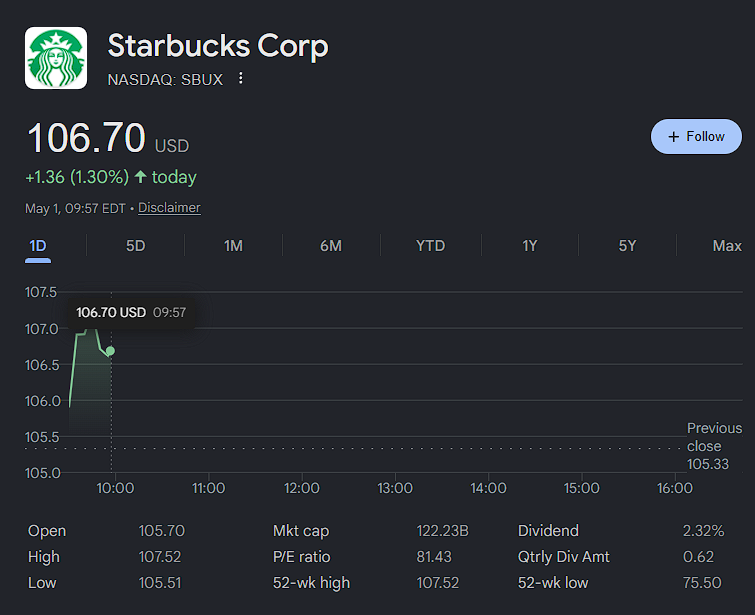
This is a great catch and we think you've framed it exceptionally. $SBUX calling a $9 coffee an "affordable premium experience" is definitely their way of defending premiumization at a time when consumers are much more conscious of value. Beauty brands like L'Oreal have shown that even in tougher economic periods, people still buy small luxuries because they want something that feels premium without being completely out of reach. This could be the opportunity for Starbucks if they execute on operations as you've argued. Overall, exceptional take @noisetoalpha
English
1
0
0
22
NoiseToAlpha
NoiseToAlpha@noisetoalpha·
$SBUX calling a $9 coffee an “affordable premium experience” says a lot about the brand reset. It is Starbucks trying to defend premiumization at a time when consumers are much more sensitive to value. The bet is simple: people will still pay for small indulgences if the product feels special enough. The risk is also simple: if the experience feels slow, inconsistent, or too transactional, $9 stops feeling premium and starts feeling like inflation. That is the real test for $SBUX. Not whether consumers can afford the occasional expensive drink. Whether Starbucks can make the experience feel worth the price again.
NoiseToAlpha tweet media
English
2
0
1
28
Aurera Capital
Aurera Capital@AureraCapital·
The quarter was exceptional, and in our view, a strong indication of what investors should expect moving forward. Where we are more cautious is on the possible impact this memory shortage could have on Apple's own product cycle. The key product to watch, in our view, is the MacBook Neo. We see it as a major driver of sales for Apple moving forward, and potentially the largest product contributor to growth if demand comes through as expected. This is especially important because the largest sales window is likely to be this quarter, ahead of the new academic year in the fall. If Apple faces supply constraints during that period, it may not fully realise the potential of the MacBook Neo on both its top and bottom line.
English
2
0
1
50
Shay Boloor
Shay Boloor@StockSavvyShay·
$AAPL said “memory costs will drive an increasing impact” on the business beyond the June quarter. Apple is one of $MU largest customers and $SNDK benefits from the broader NAND pricing power Apple just validated.
Shay Boloor tweet mediaShay Boloor tweet media
English
31
87
757
69.1K
Aurera Capital
Aurera Capital@AureraCapital·
In our view, $META should not focus on building more apps. The bigger opportunity is to build one standalone AI product. We see this product being Meta Consumer Intelligence AI, a platform that helps companies make better product and marketing decisions. The business would be build around what meta understands better than anyone else, which is how consumers behave, what they engage with, what they share, what they follow, and how trends form across their Family of Apps (Instagram, Facebook, Whatsapp etc.) If they use the data in an aggregated and privacy safe way, this could become less like a regular chatbot and more like a mix of McKinsey consumer insights, Bloomberg Terminal, ChatGPT, and Nielsen. A product team could ask what colours, packaging, price points, or features are gaining traction in a category. A marketing team could ask which creator groups, or campaign message are like to work best. A brand could ask "What are the best event promotions we should use to launch a premium smoothie brand in New York?" The target audience would be broad and likely sit across three main segments: 1. Individual Users - This could include marketers, founders, and creators, and consumer analysts who want better insight consumer behaviour, product trends, and campaign positioning. 2. Team (Small-Medium Business Seats) - This would likely include e-commerce businesses, DTC brands, and startup product teams, that need sharper intelligence on what customers want and how best to reach them. 3. Enterprise Accounts - This could include large retailers, MFCG companies, fashion brands, beauty businesses, media companies, and consultancies, needing detailed consumer intelligence across markets, customer segments, and categories. The TAM would be meaningful as it sits at the intersection of AI software, consumer insights, product analytics, and marketing software. A reasonable base could be a $15 billion to $25 billion ARR opportunity, with further upside if Meta becomes the default consumer intelligence layer for brands. We think this will likely succeed as Meta has the consumer attention and the behavioural signals. What it needs is a product that allows it to monetise this intelligence outside of their ad business. Overall, this is our take and what would be an alternative and successful AI product for Meta.
English
0
0
1
175
Investing.com
Investing.com@Investingcom·
*META LOOKING TO DEVELOP MANY NEW APPS USING AI: WSJ *ZUCKERBERG SAID WAS "TRAJECTORY CHANGE" IN AD BUSINESS: WSJ $META
Investing.com tweet media
English
16
26
281
22.9K
Aurera Capital retweetledi
Wealthmatica
Wealthmatica@wealthmatica·
Bill Ackman might double-down on Uber and Meta… “Actually, I think the companies you mentioned are very cheap stocks today … very bullish the economy, and there are businesses available at cheap prices.” $UBER $META
English
9
9
270
72.8K
Aurera Capital
Aurera Capital@AureraCapital·
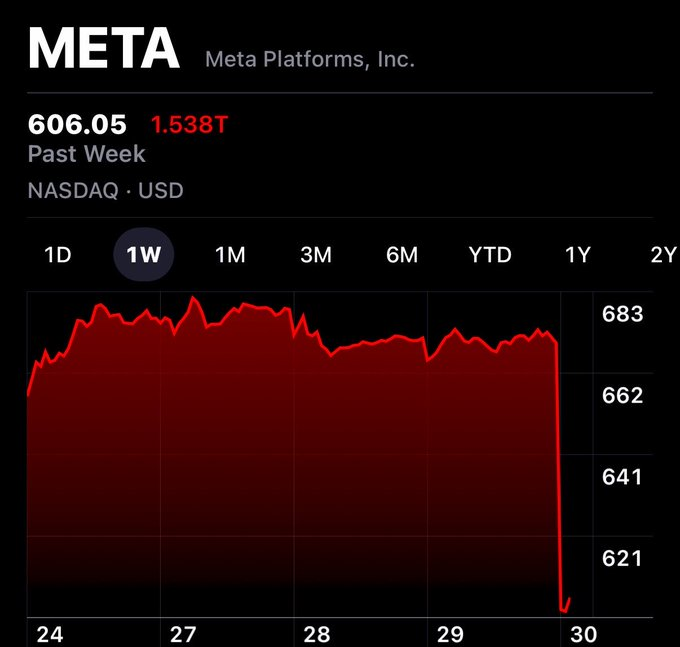
Our largest name in the portfolio, $META, reported earnings after the bell yesterday. It was an exceptional quarter, with some of the strongest operating numbers the business has delivered in years. However, the stock fell as markets focused on the increase in CapEx guidance rather the strength of the underlying business. Highlights from the quarter: • Revenue was $56.31 billion, an increase of 33% YoY • Ad impressions delivered across Family of Apps increased 19% YoY • Average price per ad increased 12% YoY Meta expects Q2 2026 total revenue to be in the range of $58 billion to $61 billion. 2026 capital expenditures, are now expected to be between $125 billion and $145 billion, up from the prior range of $115 billion to $135 billion. The markets's concern around CapEx is understandable, but we see the reaction as excessive. Meta lost around $160 billion in market cap following a $10 billion increase in CapEx guidance, despite delivering an exceptional quarter. Family of Apps ad impressions growing 19% with average price per ad increasing 12%, is a clear sign that Meta is not only displaying more ads, but advertisers are also willing to pay more for those ads. We see that as a clear reflection of improving ad targeting, stronger conversion outcomes, and early evidence that Meta is already seeing returns on its AI investment across ad targeting, and monetisation. What stands out most to us, however, is the revenue guidance. Using the midpoint of Q2 guidance, Meta would be broadly in line with our full year revenue forecast of $247.89 billion if that run rate were sustained through the year. However, if Meta reaches the upper end of guidance at $61 billion and sustained that growth rate, we estimate full year revenue could reach $254.97 billion. That would represent an increase of $7.08 billion versus our base case. Applying our net profit margin assumptions, that would add approximately $0.83 to diluted EPS, bringing our estimated diluted EPS to $29.68. On that basis, our price target would rise to $824. With the current share price at $616, that implies upside of approximately 33.77%. This is why we remain especially constructive on the stock. The market is focused on higher CapEx, but the operating data suggests Meta's AI investments are already enhancing their ad engine. Meta is now set to see more impressions, higher ad pricing, improved revenue growth, and better earnings.
English
0
0
1
102
Aurera Capital
Aurera Capital@AureraCapital·
Rarely do we see an unjustified selloff following earnings, but this looks like one of those cases where the market reaction does not reflect the true underlying picture. $META losing around $160 billion in market cap because of increasing CapEx by just $10 billion, despite having an exceptional quarter is what makes this uniquely unjustified. How you note Family of Apps ad impressions grew 19%, while average price per ad increased 12% shows that Meta is not only displaying more ads but also that advertisers are also willing to pay more for those ads. We see that as a clear reflection that ad targeting is improving, and early evidence that Meta is already seeing returns on its AI investment across ad targeting and ranking What stands out most, however, is the guidance. Using the midpoint of Q2 revenue guidance, between $58 billion and $61 billion, Meta would be broadly in line with our full year revenue forecast of $247.89 billion if that run-rate were sustained through the year. However, if Meta reaches the top end of guidance at $61 billion, and sustains that growth rate, we estimate full year revenue could reach $254.97 billion. That would represent an increase of $7.08 billion versus our base case. Applying our net profit margin assumptions, that would add roughly $0.83 to diluted EPS, bringing our estimated diluted EPS to $29.68. On that basis, our price target would rise to $824. With the current share price of $616, that implies upside of approximately 33.77%. This is why we remain especially constructive on the stock. The market is focusing on higher CapEx, but the operating data suggests that Meta's AI investments are already enhancing their ad engine.
English
1
0
1
127
Shay Boloor
Shay Boloor@StockSavvyShay·
Absolutely wild that $META lost $160B in market cap after raising CapEx by just $10B even though the business posted some of its strongest growth metrics in years: • Fastest revenue growth in ~5 years at 33% YoY • Ad impressions grew 19% & Ad pricing grew 12% (rare combo) • Reels time spent rose 10% from Instagram ranking improvements • Q2 guidance came in stronger than expected at up to 28% growth • Updated ad models drove a 6% boost in landing page view conversions • Facebook video time rose more than 8% (largest sequential gain in 4 years) • WhatsApp monetization is scaling with Family of Apps “Other” revenue up 74% YoY
Shay Boloor tweet media
English
131
162
1.5K
191.3K
Aurera Capital
Aurera Capital@AureraCapital·
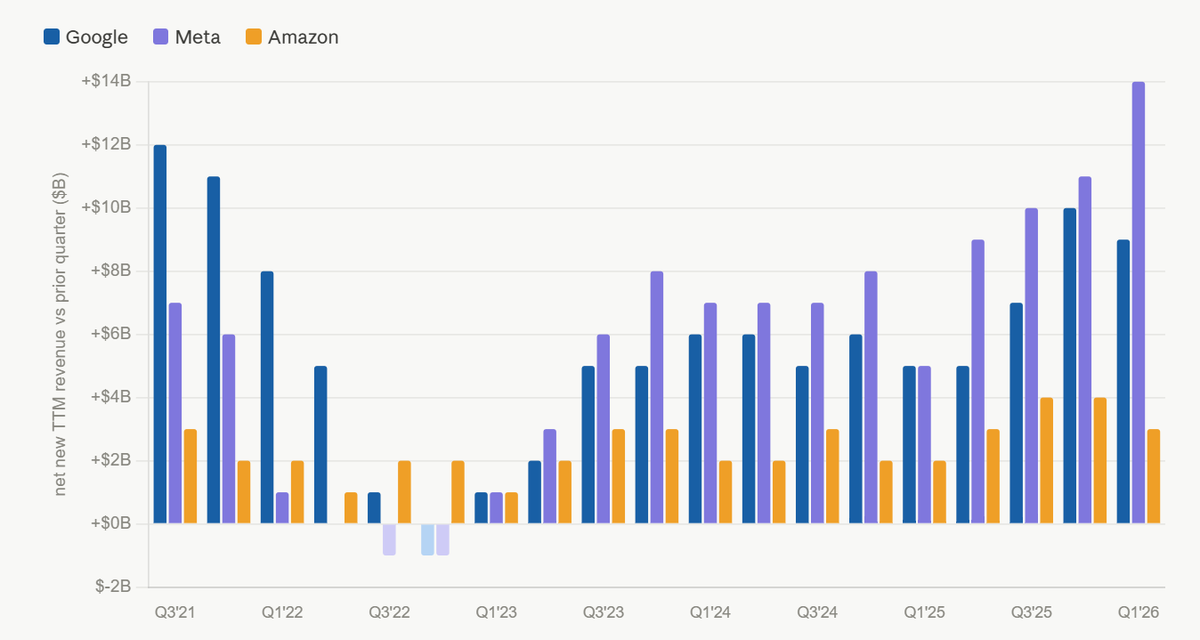
Meta's record incremental net advertising revenue additions, suggest that the ad platform is becoming materially more efficient. This shows that $META is not only showing more ads to more users, it is also extracting more value from each advertising surface. With ad impressions growing strongly and average price per ad also rising, the business is showing that they have stronger advertising demand, and better monetisation. This suggests that advertisers are seeing better conversion outcomes on Meta's platforms which makes them more willing to spend. It also increasingly validates Meta's AI investments across targeting and ad ranking. Overall, Meta is showing more ads, pricing them better, and helping advertisings generate higher returns. This is exactly what makes us so constructive on the stock and enables us to add more into the weakness.
English
0
0
1
282
Daniel Pronk
Daniel Pronk@PronkDaniel·
$META incremental net advertising revenue additions hit an all time high, by far, into a seasonally weak quarter (Q1). They also increased ad revenue significantly more than $GOOG and $AMZN. Incredible.
Daniel Pronk tweet media
English
8
12
209
16.4K
Aurera Capital
Aurera Capital@AureraCapital·
Completely agree. The market definitely gave $SOFI an overextended valuation five years ago, but today the setup looks very different. Same share price, yet a much larger member base, and a more mature operating model. Based on our valuation model, the stock trades at a forward P/E of roughly 20x, which shows the substantial growth opportunity still available. Listening to their CEO, the key reason they did not raise guidance was the removal of two expected rate cuts from their assumptions. Should the Middle East conflict reach a relative resolution, inflation readings continue to soften, and the confirmation of a Fed Chair who leans more dovish, even one rate cut later in the year could be meaningfully beneficial for the stock. Overall, $SOFI looks like a great business trading at a substantial discount to its future earnings power.
English
2
0
7
4.7K
Shay Boloor
Shay Boloor@StockSavvyShay·
$SOFI five years ago: • $16/share • 1.5M members with ~$260M gross profit run-rate $SOFI today: • $16/share • 14.7M members with ~$2.4B gross profit run-rate Same price. Very different business.
Shay Boloor tweet media
English
228
271
3.2K
481K
Aurera Capital
Aurera Capital@AureraCapital·
This is a really strong add by $UBER This kind of cross-selling is exactly what makes the platform so powerful. By encouraging existing users to spend more across the ecosystem, Uber can grow revenue without needing to rely solely on acquiring new customers. Overall, this looks like a strong move. If adoption is meaningful, it could materially increase Uber Eats revenue and would push us to revise our FY26 Delivery Revenue estimate, which currently stands at $21.0 billion.
English
0
0
0
133
Wall St Engine
Wall St Engine@wallstengine·
Now you can get coffee during your $UBER ride Uber is launching a new feature called “Eats for the Way” where Uber Black riders can add coffee, tea, or a snack after confirming their ride. The driver picks it up on the way. Launching in the coming weeks in: Atlanta Austin Los Angeles Philadelphia San Diego San Francisco Honestly not a bad idea.
English
15
10
216
40.7K
Aurera Capital
Aurera Capital@AureraCapital·
Major congratulations to @BillAckman and the entire Pershing Square team. This is a major milestone and one many of us have been waiting to see. Bill Ackman continues to show why he is a generational investor, and why he looks increasingly likely to be viewed as a modern day Warren Buffet. His investment philosophy has clearly become more nuanced, and more disciplined. We are particularly interested to see how Pershing Square's strategy around Howard Hughes Holding Inc. (NYSE:HHH) develops, especially given its potential use as a platform for generating a more reliable income stream, in a way that mirrors how Berkshire Hathaway used its insurance operations and float to support long term capital allocation. Overall, huge congratulations to a man who has uniquely inspired our firm and shaped the way many investors think about concentrated, high conviction investing. $PSUS $PS $HHH $BRK.B
English
0
0
5
330
Aurera Capital
Aurera Capital@AureraCapital·
Completely agree. SoFi is executing remarkably well, and the Q1 numbers show a company that is growing across the areas that matter most: revenue, members, products, and profitability. The next key factor is the platform flywheel. If SoFi can continue lowering customer acquisition costs through more cross-selling, while also increasing its member base, then the stock is setup to rally from here. $SOFI
English
0
0
4
1.6K
Anthony Noto
Anthony Noto@anthonynoto·
2026 is shaping up to be a great year with a strong Q1 leading the way. We set new records and delivered: 👉 $1.1 billion in adjusted net revenue up 41% year over year with 31% EBITDA margins 👉  1.1 million new members 👉  1.8 million new products These strong results reflect our relentless focus each and every day to bring the best products, best experience and best value to our members and clients. Thank you for trusting @SoFi to get your money right. t.co/JmT0SRhoU3
English
166
118
1.3K
213.7K
Aurera Capital
Aurera Capital@AureraCapital·
$SOFI stock at $16.15 is compelling. This is because of the substantial growth across multiple operating gauges: Members +35%, Products +39%, Originations +68%, and EBITDA +62%. If SoFi can continue lowering customer acquisition costs through deeper cross selling, while still increasing members, then the stock is definitely set to outperform from here.
English
0
0
2
475
WOLF
WOLF@WOLF_Financial·
Finish this sentence $SOFI stock at $16.5 is ______
English
101
3
99
102.6K
Aurera Capital
Aurera Capital@AureraCapital·
One of the companies in the Aurera Capital 2026 Global Equities Fund, SoFi Technologies Inc. (NASDAQ:SOFI), reported Q1 earnings earlier today, with results that continued to show strong execution across the platform. $SOFI Revenue came in at $1.09bn versus estimates of $1.05bn, EPS was in line at $0.12, and adjusted EBITDA came in ahead at $0.34bn versus $0.31bn expected. The operating metrics were exceptionally strong, with SoFi adding 1.1 million new members during the quarter, taking total members to 14.7 million, up 35% YoY. The platform flywheel also continued to strengthen. Product growth accelerated from 35% in Q1 2025 to 39% this quarter, showing that cross-selling is working and that members are increasingly using SoFi for more than one financial product. Lending revenue also grew strongly, supported by higher originations across the business, with total loan origination reaching $12.2bn, up 68% YoY. Some key figures that standout are: • Members: +35% • Products: +39% • Originations: +68% • EBITDA: +62% We see this combination as being a clear indication that SoFi is growing its user base, deepening engagement, improving monetisation, and expanding profitability at the same time. The stock declined (-12.99%) because Wall Street wanted a stronger full year guidance raise after such a strong Q1, and management largely maintained FY26 guidance instead. For us, the debate is whether this reflects conservative guidance or a genuine limit to near term upside. If deposit growth and cross buying can keep lowering customer acquisition costs, today's reaction may speak more to short term expectations than long term fundamentals.
English
2
0
3
286
Donna
Donna@purplemountaing·
@AureraCapital The tech galileo is part of the reason $Sofi has retraced. Lost Chime and not making much money.
English
1
0
0
96