Austin Hobbs

18.2K posts

Austin Hobbs banner
Austin Hobbs

Austin Hobbs

@AustinDHobbs

Simul Justus et Peccator | Husband to Ashton | Assistant Pastor at Bethlehem Bible Church | Texas A&M ‘21 | RTS ’25 | Marrow Man | Natural Law Justice Warrior

West Boylston, MA Katılım Nisan 2013
2.1K Takip Edilen1.2K Takipçiler
Sabitlenmiş Tweet
Austin Hobbs
Austin Hobbs@AustinDHobbs·
Evangelista: The Bible teaches that we are saved by grace alone through faith alone in Christ alone. Our works or the quality of our faith do not save us. Nomista: OH SO YOU THINK SINNING IS OKAY?!?!?!?!
English
8
7
80
0
Austin Hobbs
Austin Hobbs@AustinDHobbs·
@Caleb_E_Keith But if pastors were REAL MEN they would die at 54 just like Calvin!
English
1
0
4
447
Caleb Keith
Caleb Keith@Caleb_E_Keith·
I want my pastor to be paid well enough that his wife does not feel obligated to work and that his children are abundantly cared for in their needs and wants. I want my pastor to have ample time off, excellent benefits, and a sabbatical when needed. Not because someone else couldn’t do the base work (I’m perfectly capable), but because his call is to be set apart for proclaiming the Gospel at all times of need. A pastor shows up for the sick, the dying, the widowed, and the poor in spirit. The Gospel must be preached in my community, and my congregation is responsible for giving one man that duty. Those of us who have studied theology apart from the public ministry of the pastorate are especially responsible for defending and caring for these men. We should not insist that their work should not be generously compensated simply because we also know and can teach the faith.
The Jolly Brawler@TheJollyBrawler

If a Pastor needs scheduled Sabbaticals, I’m not convinced he is in the right line of work. Especially given that the men in his congregation likely work much more physically and often mentally demanding jobs than the Pastorate, and would be laughed out of the factory for asking about a Sabbatical. I also know that many Elder boards force Sabbaticals as a way to care for their Pastor. This practice should be stopped. Clergy can work like men. Or they can find a new job more fitted to their strength and energy levels.

English
46
25
671
125.6K
Austin Hobbs
Austin Hobbs@AustinDHobbs·
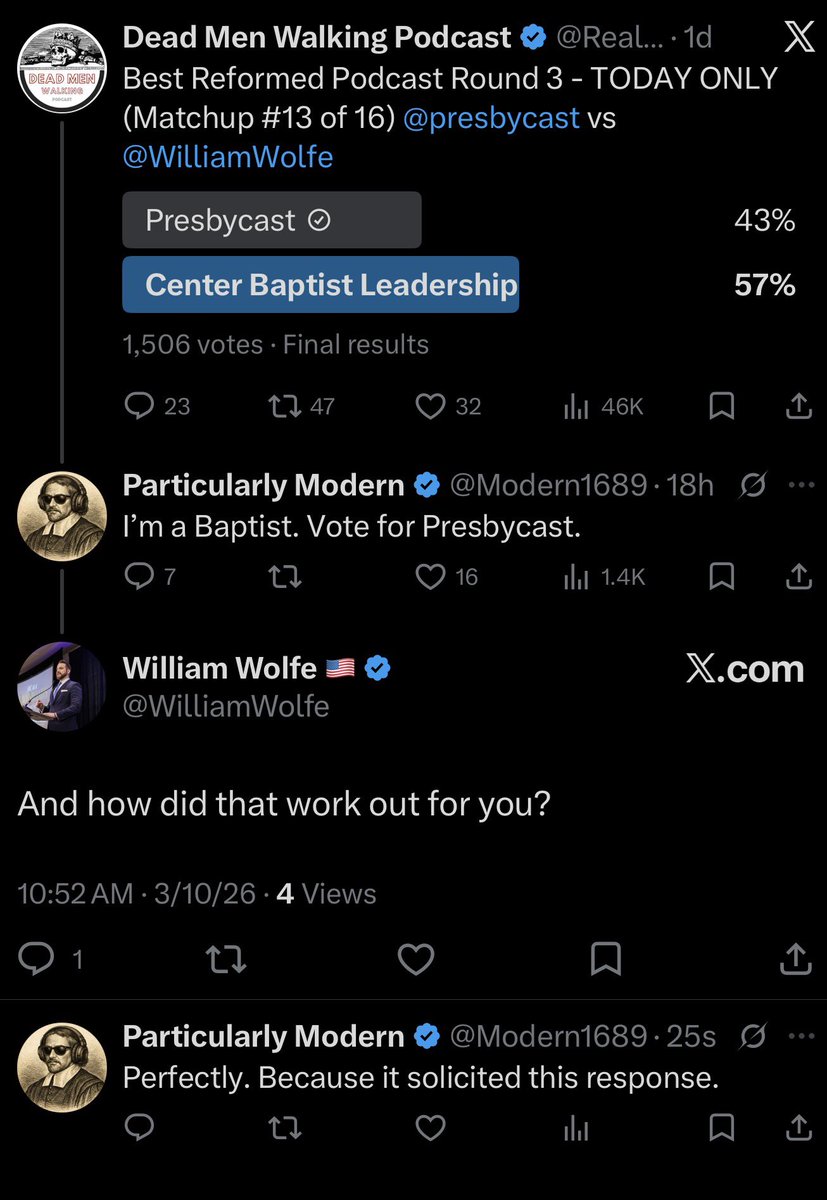
I would also add: Scandinavia, New Zealand, etc are all post-CHRISTIAN countries still riding the wave of an assumed general Christian morality. Pinker is living on borrowed capital.
The Free Press@TheFP

Does a more religious society make a better society? @SAPinker says no: Would you rather live in Afghanistan or Scandinavia? “The more religious the society, the worse the problems are.” @DouthatNYT disagrees: You can balance the best of faith and modernity. “What we should wish as Americans is to be neither Afghanistan nor Scandinavia—but to be the United States of America.”

English
1
0
1
105
Austin Hobbs
Austin Hobbs@AustinDHobbs·
@Modern1689 @KenShepherd Won’t be surprised that if in 5-10 years we find out he was some sort of operative. Way too cartoonish to be genuine.
English
0
0
1
74
Particularly Modern
Particularly Modern@Modern1689·
There’s a 57% chance arrogance is the most popular quality of Christians on X
Particularly Modern tweet media
English
9
1
31
1.9K
Austin Hobbs
Austin Hobbs@AustinDHobbs·
First mistake of lay historical theology: The silo-ing of history. Just because theologians come along and articulate doctrines and interpretations more clearly, more precisely, more comprehensively doesn’t mean they are not building off the work of others who came before them.
English
0
0
2
104
Austin Hobbs
Austin Hobbs@AustinDHobbs·
@testing521 I totally agree. We need to recover the doctrine of the inspiration of Scripture.
English
0
0
3
22
Dave the Dispy Hipster
Dave the Dispy Hipster@testing521·
@AustinDHobbs If when the prophet speaks, God speaks, then the human's meaning is God's meaning and vice versa. So, the same hermeneutics apply to the scripture as any other text.
English
1
0
8
228
Austin Hobbs
Austin Hobbs@AustinDHobbs·
On divine and human authorship of Scripture: The human author is a prophet. The prophet speaks the Word of God. When the prophet speaks, God speaks. Therefore, true literal, historical-grammatical exegesis attempts to submit to the divine author’s Word.
English
1
0
2
269
Austin Hobbs
Austin Hobbs@AustinDHobbs·
Systematic theology and biblical theology in hermeneutics: ST studies how the whole of Scripture contributes to our understanding of one part of Scripture. BT studies how this one part of Scripture makes a unique contribution to the whole of Scripture. Both are necessary.
English
3
2
19
1.1K
Austin Hobbs
Austin Hobbs@AustinDHobbs·
The old covenant was a covenant “of promise” not because it is substantially the same as the new covenant, but because it supplied the necessary details of how Christ would save His people from exile by his active and passive obedience. The new exodus results in the new covenant
English
0
0
0
56
Austin Hobbs retweetledi
Jeff Taylor
Jeff Taylor@JeffTaylorLR·
Much of the recent critique of Kline and R2K misses the level at which Kline is actually operating. His project was never a political theory. It was an exegetical architecture— an attempt to read the covenants, the canon, and redemptive history with eschatological integrity. Kline’s central concern was always the structure of Scripture: the relation of creation and consummation, the works/grace antithesis, the typological uniqueness of the Mosaic economy, and the covenantal scaffolding that holds the canon together. If you misidentify the level of his work, you will misinterpret every conclusion that flows from it. 1. Intrusion ethics is not a political maneuver; it is an exegetical necessity. Holy war, cherem, land sanctions, and the judicial presence of the Glory‑Cloud are not “civil norms” but eschatological intrusions. They belong to the typological kingdom, not the common order. Kline’s point is simple: you cannot universalize what God Himself restricted to a temporary, typological administration. 2. The Noahic covenant is not a secular charter but a stabilizing covenant for history. Genesis 9 is not “neutral.” It is non‑redemptive in structure, not in origin. It preserves the world for the unfolding of redemptive history. Kline’s distinction between Genesis 6 (proleptic, redemptive) and Genesis 9 (universal, preservative) is not an innovation—it is a recognition of covenant form and audience. The covenant with “all flesh” cannot be collapsed into the covenant with the seed. 3. Kline does not deny the moral law; he denies the re‑application of typological judicial law. The Westminster divines themselves distinguished moral law from expired judicial law. Kline simply takes that distinction seriously. “General equity” is not a backdoor for reintroducing Mosaic penology; it is the abiding natural‑law substance of the Decalogue. The critics conflate categories the Confession keeps distinct. 4. Christ’s mediatorial reign is not diminished by distinguishing common and redemptive kingdoms. Kline’s architecture preserves the universality of Christ’s rule and the eschatological nature of His kingdom. The church is the embassy of the age to come; the civil order belongs to the common grace era. This is not dualism. It is covenantal sequencing. It protects the gospel from being collapsed into civil administration. 5. Kline’s system is not a retreat from Christian influence but a protection of redemptive clarity. When theocracy is treated as a normative model, the works/grace distinction collapses, typology is flattened, and the gospel’s eschatological structure is obscured. Kline’s architecture safeguards the integrity of the new covenant by refusing to resurrect a typological order that Christ has fulfilled and retired. The irony is that Kline’s critics often accuse him of novelty while proposing a political theology that reintroduces the very typological structures the Reformed tradition said had expired. Kline’s architecture is not a departure from the Reformed tradition— it is a retrieval of its covenantal and eschatological core. If we want a political theology that is truly Reformed, it must begin where Kline began: with covenant form, canonical structure, and the eschatological architecture of Scripture. Everything else is downstream. #Kline #TwoKingdom
English
11
12
39
4.2K
Austin Hobbs
Austin Hobbs@AustinDHobbs·
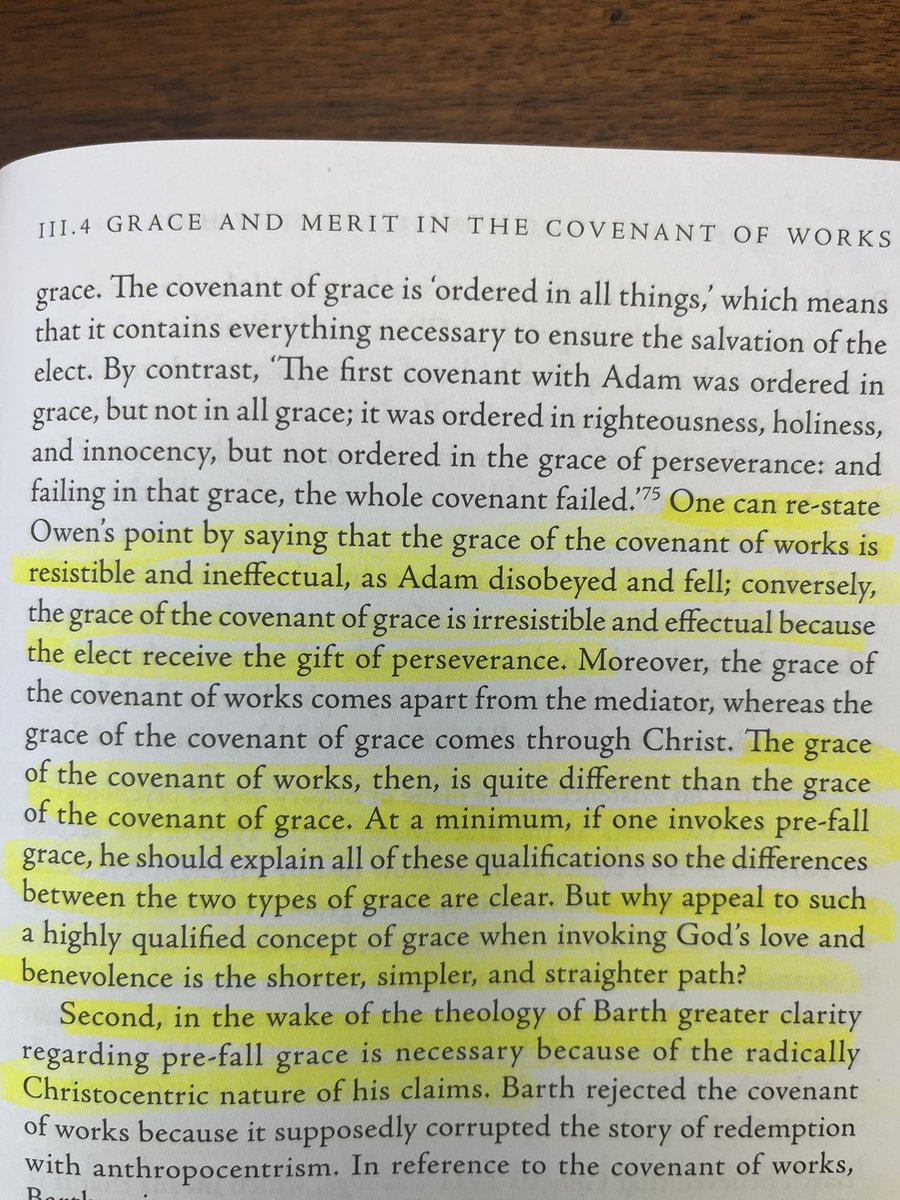
Being cute and saying there was “grace” before the fall when you mean something very different from what Paul means here is not clear. Ephesians 2:8 is the ordinary usage of grace that virtually everyone understands. Let’s be pastoral, theologically precise, and not confuse ppl.
Austin Hobbs tweet media
English
0
0
1
32
Austin Hobbs
Austin Hobbs@AustinDHobbs·
“For by grace you have been saved through faith. And this is not your own doing; it is the gift of God,” Ephesians 2:8 This is the ordinary usage of “grace.” Under the covenant of works, eternal life is by works. Under the covenant of grace, eternal life is by grace.
English
1
0
1
52
Austin Hobbs
Austin Hobbs@AustinDHobbs·
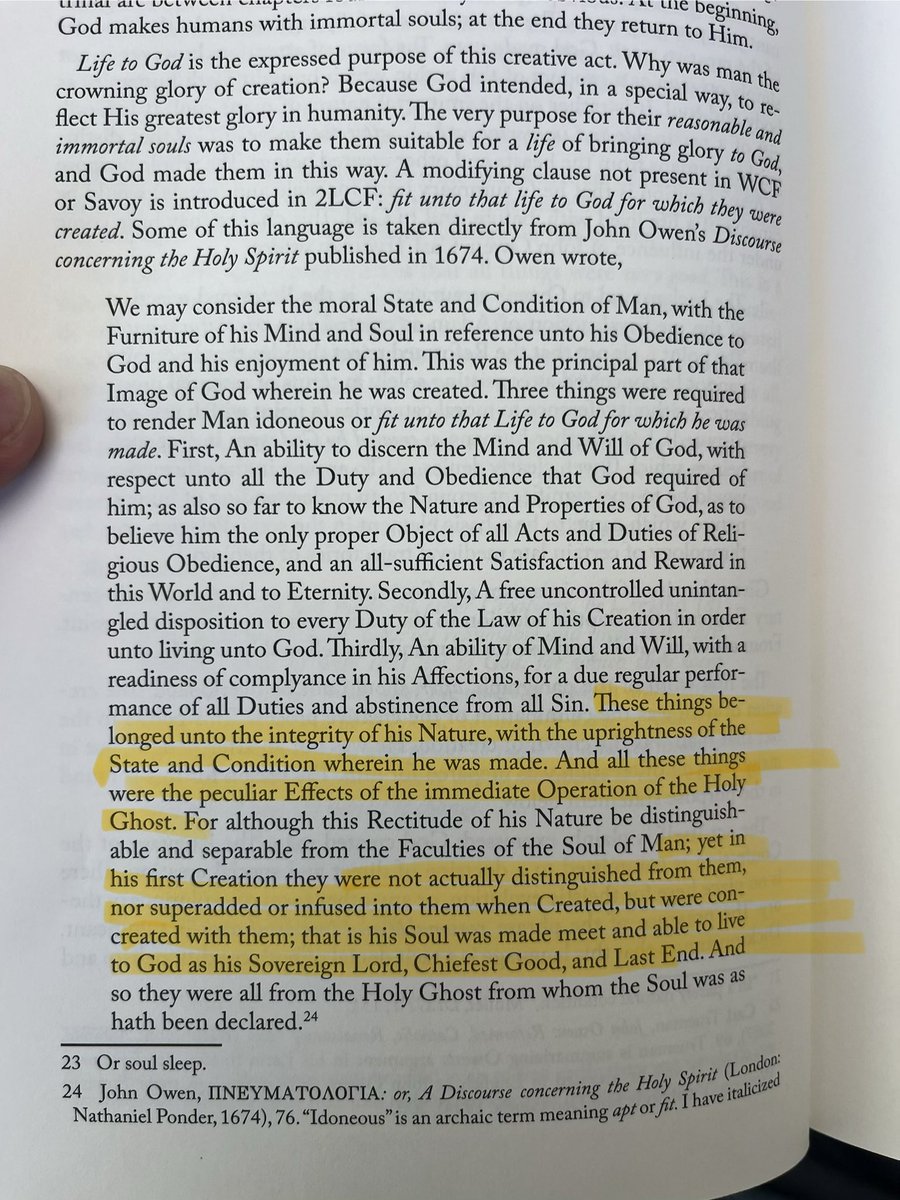
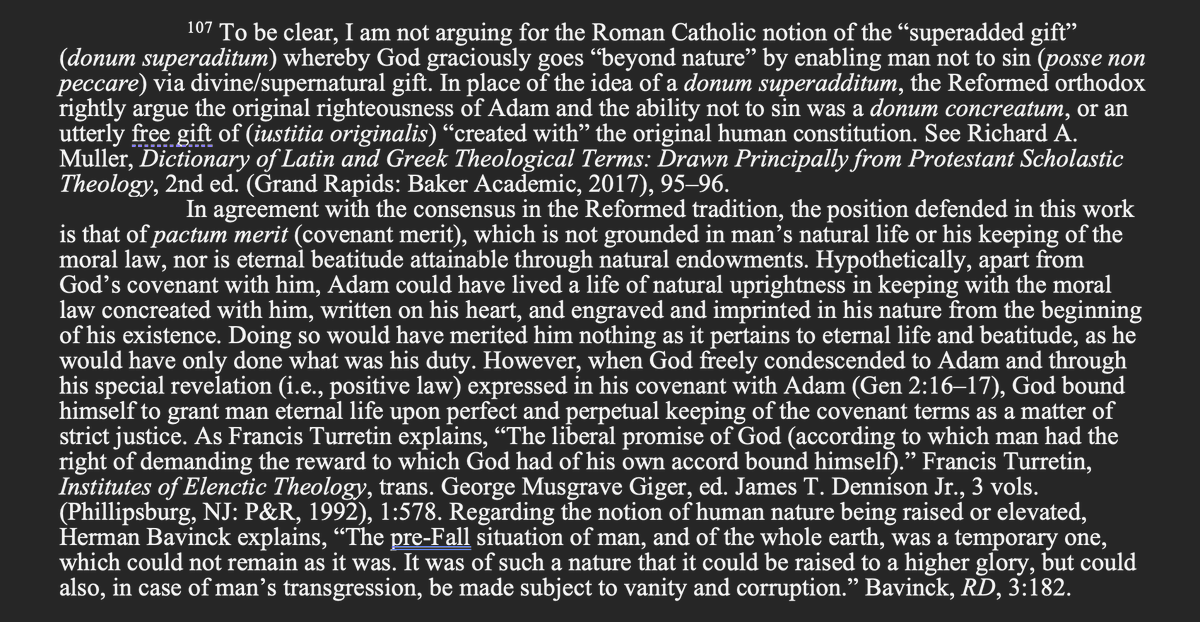
@MichaelCarlino Okay help me understand. This is Renihan’s commentary on 4.2 with an Owen quote. When Owen’s affirms that the rectitude of his nature was concreated with the faculties of his soul, he seems to deny that they were superadded or infused. He is saying this was natural to man.
Austin Hobbs tweet media
English
1
0
0
55
𝐌𝐢𝐜𝐡𝐚𝐞𝐥 𝐂𝐚𝐫𝐥𝐢𝐧𝐨 ⛪︎ 🌲
To put it different, this is why the Reformed emphasized these as concreated gifts, not meaning they are “natural,” but that they weren’t given due to a defect in human nature which needed regulated by supernatural graces. Rather, such graces are infused for man to achieve the heavenly end promised in the CoW. These gifts are lost in sin, and restored by God’s grace in Christ, only infallibly so, because the Second/Last Adam fulfilled all righteousness and kept the covenant.
English
1
0
0
39
Jonathan Ramont
Jonathan Ramont@jonathanramont·
Supernatural grace was necessary for Adam to obtain heavenly life. This claim is distinct from issues around concupiscence and original righteousness. Conflating the two has been a long standing problem in Reformed theology/historiography
English
9
8
76
6.8K
Austin Hobbs
Austin Hobbs@AustinDHobbs·
@jonathanramont @MichaelCarlino Aren’t the virtues of faith, hope, and love all components of what it means to be made after the image of God in true knowledge, righteousness, and holiness?
English
2
0
1
46
Jonathan Ramont
Jonathan Ramont@jonathanramont·
@AustinDHobbs @MichaelCarlino No, Adam needed supernatural gifts (most especially the virtues of faith, hope and love) to fulfill the covenant of works because the end of the covenant was eternal life, which is not man's natural end.
English
2
0
2
68
Austin Hobbs
Austin Hobbs@AustinDHobbs·
@jonathanramont @MichaelCarlino Okay. So no superadded grace needed to keep the covenant of works? Adam, according to his natural constitution in the image of God, in which God graciously created him, had the ability to keep the law, correct?
English
1
0
0
45
Jonathan Ramont
Jonathan Ramont@jonathanramont·
@AustinDHobbs @MichaelCarlino This is exactly the conflation of categories that I'm talking about. Affirming that Adam needed grace to obtain a supernatural end does not imply or require a need for grace to bridle natural concupiscence. We deny the latter, affirm the former
English
2
0
2
72
Austin Hobbs
Austin Hobbs@AustinDHobbs·
@MichaelCarlino @jonathanramont My concern is that what was communicated prior is that grace simply restored to Adam’s original estate, being able to sin and fall. If you could lose grace in the beginning, then you can lose it again. That’s my concern. More clarity on the distinction between nature and grace
English
1
0
0
20
𝐌𝐢𝐜𝐡𝐚𝐞𝐥 𝐂𝐚𝐫𝐥𝐢𝐧𝐨 ⛪︎ 🌲
@jonathanramont @AustinDHobbs Agreed. The promise held out to Adam was he could be confirmed forever such that he would attain eternal life and become unable to sin/fall. In the Second/Last Adam, this promise is guaranteed, hallelujah! x.com/MichaelCarlino…
𝐌𝐢𝐜𝐡𝐚𝐞𝐥 𝐂𝐚𝐫𝐥𝐢𝐧𝐨 ⛪︎ 🌲@MichaelCarlino

2.1? 1) Owen, like many of his contemporaries, held to the Reformed notion of this supernatural infusion of habits being "concreated" in Adam, against the Roman Catholic notion that apart from this gift he was unable to not sin. This is regularly a point of confusion in these debates. I try to tease that out a bit in the screenshot below, which is a fn from my dissertation on this point. 2) Adam could not remain in the state he was created. As mentioned in the screenshot below by Bavinck, he could only be raised to glory by keeping the CoW or descend into vanity by breaking the arrangement. His ability to fall from that state is rather unlike ours both because he was innocent with the possibility of falling into sin, and because he was acting as a federal representative. 3) It seems to me that you are confusing the state of integrity/creation with that of redemption and/or glorification. The reason we can't fall away is because the Second/Last Adam perfectly obeyed God and as our federal representative, grants to us the ability to not sin in an imperfect sense in the state of redemption we currently find ourselves as saints as the image of God is being restored in us via infusion of supernatural habits (Col 3:10; Eph 4:24), with the sure hope of being unable to sin, and even unable to fall once we enter the state of glory.
English
1
0
0
55
Austin Hobbs
Austin Hobbs@AustinDHobbs·
@MichaelCarlino @jonathanramont Excuse me, 4.2. I’m concerned about this comes to too closely to the Romanist superadded gift. So, would you say that God (graciously) created Adam with the ability to keep the covenant of works?
English
1
0
1
50
𝐌𝐢𝐜𝐡𝐚𝐞𝐥 𝐂𝐚𝐫𝐥𝐢𝐧𝐨 ⛪︎ 🌲
2.1? 1) Owen, like many of his contemporaries, held to the Reformed notion of this supernatural infusion of habits being "concreated" in Adam, against the Roman Catholic notion that apart from this gift he was unable to not sin. This is regularly a point of confusion in these debates. I try to tease that out a bit in the screenshot below, which is a fn from my dissertation on this point. 2) Adam could not remain in the state he was created. As mentioned in the screenshot below by Bavinck, he could only be raised to glory by keeping the CoW or descend into vanity by breaking the arrangement. His ability to fall from that state is rather unlike ours both because he was innocent with the possibility of falling into sin, and because he was acting as a federal representative. 3) It seems to me that you are confusing the state of integrity/creation with that of redemption and/or glorification. The reason we can't fall away is because the Second/Last Adam perfectly obeyed God and as our federal representative, grants to us the ability to not sin in an imperfect sense in the state of redemption we currently find ourselves as saints as the image of God is being restored in us via infusion of supernatural habits (Col 3:10; Eph 4:24), with the sure hope of being unable to sin, and even unable to fall once we enter the state of glory.
𝐌𝐢𝐜𝐡𝐚𝐞𝐥 𝐂𝐚𝐫𝐥𝐢𝐧𝐨 ⛪︎ 🌲 tweet media
English
2
0
2
150
Austin Hobbs
Austin Hobbs@AustinDHobbs·
@MichaelCarlino @jonathanramont “The gracious, supernatural aspect of the image of God was lost at the fall and is regained through regeneration and sanctification” Problematic because Adam fell from the estate wherein he was created. If he could fall, then so can we. Also contradicts 2LBCF 2.1.
English
2
0
0
73
𝐌𝐢𝐜𝐡𝐚𝐞𝐥 𝐂𝐚𝐫𝐥𝐢𝐧𝐨 ⛪︎ 🌲
@jonathanramont Yep. Otherwise the logical entailment is that man could have attained eternal life through the CoW entirely/exclusively by nature alone.
𝐌𝐢𝐜𝐡𝐚𝐞𝐥 𝐂𝐚𝐫𝐥𝐢𝐧𝐨 ⛪︎ 🌲@MichaelCarlino

"I suggest that Owen’s understanding of the image of God was consistent with the understanding of nature and grace held by many of his Reformed contemporaries. Owen believed that man requires a supernatural habit of grace to be infused into his soul by the Spirit in order for his natural faculties to operate righteously. Thus, for him, the image of God necessarily has a gracious—or supernatural—component to it. This gracious component was his primary emphasis when discussing the image of God, yet he still believed that a 'relic' of the image remained in the fallen man. This discussion is important because it sets the context for Owen’s understanding of the necessity of Spirit-infused habitual grace, and it demonstrates the connection between habitual grace and the restoration of the image of God in man. In short, Owen believed that grace restores and perfects nature such that the fallen man becomes what God intended him to be through the gracious renovation of his natural constitution... I suggest that Owen’s understanding of nature and grace with reference to the image of God in man is consistent with his Reformed contemporaries, such that the image of God in man consists naturally of a body and a soul composed of innate faculties and supernaturally of an infused habit of grace to make him upright. The natural aspect of the image of God remains after the fall. The gracious, supernatural aspect of the image of God was lost at the fall and is regained through regeneration and sanctification... The natural aspect of the image of God in man makes him a fit subject for the gracious infusion of the supernatural aspect of the image of God. Grace was concreated in Adam with his nature, and grace restores or renovates man’s fallen nature. Thus, when he discussed the image of God in man, Owen emphasized the supernatural infusion of a habit of grace both before and after the fall." ~Colin McCulloch

English
2
0
10
525
Austin Hobbs retweetledi
Samuel Sey
Samuel Sey@SlowToWrite·
The pope apparently didn't have enough of a "deep concern" to say anything about the destruction, suffering, and death that the Iranian regime inflicted on its own people, Israel, and American people in the past. But now he's deeply concerned. Uh huh.
Pope Leo XIV@Pontifex

I am following with deep concern what is happening in the Middle East and in Iran during this tumultuous time. Stability and peace are not achieved through mutual threats, nor through the use of weapons, which sow destruction, suffering, and death, but only through reasonable, sincere, and responsible dialogue.

English
38
125
1K
18.4K
Tom Hicks
Tom Hicks@TomHicks2LCF·
Please do not “empathize” with him. Yes he has a story. Yes he was probably abused as a child. His internal world is probably horrendous and pitiable. Believe me that is where all this empathy talk is going. The Left wants you to feel for pedophiles. They want you to call him a “minor attracted person.” In reality he is a child rapist. Only a wicked society “understands” and feels with those who are evil criminals. And his evil is great. Send a pastor to preach Christ to him, call him to repent, and pray with him. Then let the state execute him.
iTamara@Real___iTamara

First openly trans US lawmaker admits to horrific child sex charges involving kids as young as 3 years old. THREE YEARS OLD. Laughton faces up to 30 years in federal prison.

English
5
3
58
3.6K