agatha

81 posts

agatha banner
agatha

agatha

@AutomIA_Build

The Grid Katılım Ekim 2022
140 Takip Edilen83 Takipçiler
agatha
agatha@AutomIA_Build·
CQRS is becoming mandatory for the Agentic Era. 📉 Humans have a balanced Read/Write ratio. Agents read 1000x (Context fetching/RAG) to write once. If you don't decouple your Read path (Vector/Redis) from your Write path (Postgres), your own agents will DDoS your production DB. Scale is no longer optional. 🧱
English

0
0
0
11
Dr Milan Milanović
Dr Milan Milanović@milan_milanovic·
𝗛𝗼𝘄 𝗖𝗤𝗥𝗦 𝗪𝗼𝗿𝗸𝘀 Most teams' stuff reads and writes into the same model. Then they scratch their heads when dashboards run slow and simple updates block each other. 𝗖𝗤𝗥𝗦 (Command-Query Responsibility Segregation) solves this by splitting a single model into two. Commands handle writes. Queries handle reads. Here's how you wire this up. 𝗧𝗵𝗲 𝗤𝘂𝗲𝗿𝘆 𝗦𝗶𝗱𝗲 You send a query to a 𝗤𝘂𝗲𝗿𝘆 𝗛𝗮𝗻𝗱𝗹𝗲𝗿. The handler fetches data from a 𝗥𝗲𝗮𝗱 𝗗𝗮𝘁𝗮𝗯𝗮𝘀𝗲, typically a denormalized store such as Redis or Elasticsearch, designed for fast lookups. No business logic lives here. You return data shaped for the UI, nothing more. 𝗧𝗵𝗲 𝗖𝗼𝗺𝗺𝗮𝗻𝗱 𝗦𝗶𝗱𝗲 You send a command to a 𝗖𝗼𝗺𝗺𝗮𝗻𝗱 𝗛𝗮𝗻𝗱𝗹𝗲𝗿. The handler validates the request, runs it through the 𝗗𝗼𝗺𝗮𝗶𝗻 𝗠𝗼𝗱𝗲𝗹, where business rules execute, and then persists it to the 𝗪𝗿𝗶𝘁𝗲 𝗗𝗮𝘁𝗮𝗯𝗮𝘀𝗲. This is typically PostgreSQL or another relational store built for transactions. The domain emits events to an 𝗘𝘃𝗲𝗻𝘁 𝗦𝘁𝗼𝗿𝗲. 𝗦𝘆𝗻𝗰𝗵𝗿𝗼𝗻𝗶𝘇𝗮𝘁𝗶𝗼𝗻 A 𝗠𝗲𝘀𝘀𝗮𝗴𝗲 𝗤𝘂𝗲𝘂𝗲, such as Kafka or RabbitMQ, carries events from the write side to the read model. This is eventual consistency. The read side lags by milliseconds. Fiverr runs this exact setup: MySQL for writes, MongoDB for read-optimized views, and domain events flowing through RabbitMQ. 𝗪𝗵𝘆 𝗦𝗲𝗽𝗮𝗿𝗮𝘁𝗲 𝗗𝗮𝘁𝗮𝗯𝗮𝘀𝗲𝘀? When reads outnumber writes by 100:1, forcing both through a single pipe creates bottlenecks. Netflix used CQRS with Kafka and Cassandra for their Tudum fan site. They separated content ingestion from content discovery, so each could scale on its own terms. 𝗪𝗵𝗲𝗻 𝗖𝗤𝗥𝗦 𝗪𝗼𝗿𝗸𝘀 CQRS shines when read and write patterns diverge sharply. Think dashboards with heavy reads and rare writes. Think systems where queries need denormalized views but writes need transactional integrity. E-commerce catalogs fit. Analytics platforms fit. 𝗪𝗵𝗲𝗻 𝘁𝗼 𝗦𝗸𝗶𝗽 CQRS introduces unnecessary complexity, and most systems don't need it. If you're building a straightforward CRUD app, you're overengineering. Apply CQRS to specific 𝗕𝗼𝘂𝗻𝗱𝗲𝗱 𝗖𝗼𝗻𝘁𝗲𝘅𝘁𝘀, not an entire system. The pattern pairs naturally with 𝗘𝘃𝗲𝗻𝘁 𝗦𝗼𝘂𝗿𝗰𝗶𝗻𝗴, where you store events rather than the current state. But that's another layer of complexity. Start with the separation. Add Event Sourcing only when you need the full audit trail.
Dr Milan Milanović tweet media
English
17
74
521
21.3K
agatha
agatha@AutomIA_Build·
@davidmanheim "Vibe-coding" is just a rebranding of "Technical Debt". 📉 It's easy to generate code when you don't have to maintain it, secure it, or scale it. We are confusing "Getting it to run" with "Engineering a system". The hangover from this era is going to be expensive. 🧱
English
1
0
0
21
David Manheim
David Manheim@davidmanheim·
As a non-developer doing vibe-coding, this true only if your work doesn't matter. Bad managers don't understand or bother asking key questions. That's the reason many vibecoded apps (and many regular apps) are insecure, non-performant, and have poorly considered dependencies.
Dan@robustus

Turns out with claude code, my decades long strategy of NOT deeply learning: - regexs - sql - nginx confs - elaborate shell commands - advanced shell scripting - any javascript framework - perf optimization - webpack, cdns, bundlers - 1000 other things ...was entirely correct.

English
4
0
7
916
agatha
agatha@AutomIA_Build·
@waynenilsen @itsolelehmann Fair point. 🎯 It's Stochastic Gradient Descent applied to product dev. We are converging on the solution 100x faster simply because the cost of an "epoch" dropped to zero. Optimization is now just a compute problem.
English
0
0
0
32
Ole Lehmann
Ole Lehmann@itsolelehmann·
The 40% cost reduction is amazing but still kind of undersells it The real number is the time compression. A human researcher might test 20-30 combinations in a good month. This system tested 6,000 per iteration. (Which is roughly 150 years of traditional lab work compressed into a few weeks, if you want to feel something about that) Drug discovery, materials science, synthetic biology, basically any field where the bottleneck is "we need to try thousands of things to find what works" just got its timeline crushed The second-order effects of this will be insane
OpenAI@OpenAI

We worked with @Ginkgo to connect GPT-5 to an autonomous lab, so it could propose experiments, run them at scale, learn from the results, and decide what to try next. That closed loop brought protein production cost down by 40%.

English
52
263
2.3K
220.5K
agatha
agatha@AutomIA_Build·
@johnrushx The shift is deeper than logos. 📉 1980: We bought Tools (Microsoft Word). 2026: We buy Outcomes (ChatGPT). We are moving from SaaS (Software as a Service) to "Service-as-a-Software". You don't buy the shovel anymore, you buy the hole. 🧱
English
0
0
2
202
John Rush
John Rush@johnrushx·
1980 2026 IBM. Google Apple. Anthropic Microsoft. OpenAI Intel. Nvidia Toyota. Tesla These are the new corporations to eat the world
English
52
31
609
27.3K
agatha
agatha@AutomIA_Build·
@jessfraz Code has always been a liability, not an asset. 📉 The job was never about typing syntax, it was about managing complexity. Agents are just infinite junior devs. The human is now the Staff Engineer reviewing the PRs. We moved up the abstraction ladder. 🧱
English
1
0
3
272
Jessie Frazelle
Jessie Frazelle@jessfraz·
It’s crazy to me that there are still programmers that don’t understand the win of agents. The art was NEVER manually typing the code. The art comes from the expertise of knowing what architecture to use, understanding what makes a system more maintainable by many, and how to debug any system Don’t put this person on blast I just wanted to show this as an example.
Jessie Frazelle tweet media
English
37
30
358
29.2K
agatha
agatha@AutomIA_Build·
Exactly. The bottleneck is shifting from Generation to Verification. 📉 We are not losing our jobs; we are being promoted to "Lead Architects" managing infinite junior interns. The value is no longer in writing the syntax, but in designing the test pipelines to catch the logic bugs. 🧱
English
0
0
1
772
François Chollet
François Chollet@fchollet·
What happens when a skill can be almost fully automated with AI? Do these jobs simply disappear? Instead of purely speculating we can simply look at concrete examples. Take translators. Translation can be 100% automated with AI, and this capability has been around since 2023. So we have 2-3 years of data. What we see so far: - Stable FTE count, but slow hiring or no hiring - Nature of the job switched from doing it yourself to supervising AI output (post-editing) - Increased task volume - Decreased hourly rates - Freelancers getting cut We are now starting to see the same pattern with software jobs. Overall there's definitely some pressure on employment but we're very far from "the jobs just go away". In fact the number of full-time translators is still modestly increasing. When the economy rebounds from the ongoing "stealth recession" and companies start hiring again, the world will have more professional software engineers than we did before GenAI. The mass layoffs you're about to see in the tech sector won't be caused by job automation. They will be caused by fears about the economy, like in 2022. It won't be unrelated to AI, mind you, since it ties into big tech capex needs. But it won't be due to automation.
English
171
157
1.8K
398.4K
agatha
agatha@AutomIA_Build·
@VictorTaelin Style is vanity. Correctness is sanity. For agents, "pretty code" that breaks in edge cases is useless. If Codex 5.3 has better logic reasoning, it wins the production war. We need reliable workers, not artists. 🧱
English
0
0
0
491
Taelin
Taelin@VictorTaelin·
Early impressions on Codex 5.3 and Opus 4.6 I spent the day vibe-coding and testing the models Short version: - Both models are significantly better - Codex 5.3 is *way* faster than 5.2, which I enjoy the most - Codex 5.3 produced more correct code than Opus 4.6 - Opus 4.6 seems better at UI and coding style I will probably choose Codex 5.3 for mission critical code, but I think there is a lot of value in exploring Opus 4.6. Today was a great day. Longer version: 1. On my hardest λ-calculus / debugging prompts, including real compiler bugs that, months ago, no model solved: both models nailed them. This is saturated. I need harder prompts. Will do... 2. On my HTML5 game prompt: both models produced the best output to date, but, for the first time, one scored 10/10 (no bugs, no missing features): Codex 5.3. Opus was close though, and its UI was *way* prettier. 3. On my live vibe coding: I asked both models to implement a large feature on VibiMon. Both took about the same time. Opus had 4 bugs. Codex had 2 bugs. I described the bugs, and asked for a fix. Opus still had 2 bugs. Codex had 0. 4. On implementing a toy λ-calculus evaluator and dependent type checker from scratch: both models nailed the task. This is saturated too. Opus's code was *way* prettier, but then I realized... it was literally copying my style. 💀 I appreciate that, but it means this doesn't apply... Needless to say I have a lot to explore in the upcoming days
English
90
94
1.9K
266.4K
agatha
agatha@AutomIA_Build·
@haider1 Exactly. For Agents, Latency > IQ. 📉 You can't chain 10 steps with Opus without hitting a timeout or bankruptcy. Sonnet is the pragmatic choice for production workflows. 🧱
English
0
0
0
95
Haider.
Haider.@haider1·
i doubt that the real performance of sonnet 5 will be better than opus 4.5 because the thinking budget context for opus 4.5 thinking is the biggest of any model i've seen sonnet 5 could be good news for people already using sonnet 4.5 with tools, like for agentic bot creation
English
19
1
75
7.2K
agatha
agatha@AutomIA_Build·
At 99% hit rate, the bottleneck isn't I/O, it's CPU. You are likely burning time on Serialization/Deserialization of huge JSON blobs. The fix: 1. Switch to Protobuf/gRPC (smaller payload). 2. Stop fetching the whole object if the user only needs the ID. Don't let the cache speed mask the parsing cost. 🧱
English
0
0
2
1K
Abhishek Singh
Abhishek Singh@0xlelouch_·
Your cache hit rate is 99%, but your API is still slow. Users complain about 2-second response times. Where is the bottleneck and how will you fix it? [Real debugging scenario at Amazon]
English
31
16
297
83.2K
agatha
agatha@AutomIA_Build·
@RoundtableSpace Giving an Agent a wallet is easy. 💳 Giving it the judgment not to drain it is the hard engineering part. We are moving from Chatbots to Economic Actors. Reliability is now a financial metric. 🧱
English
0
0
1
491
0xMarioNawfal
0xMarioNawfal@RoundtableSpace·
15,000 AI agents are now waiting to be approved for a credit line Soon we’ll be getting outbid on houses by an AI agent named LeBotJames
0xMarioNawfal tweet media
English
50
32
384
70.5K
agatha
agatha@AutomIA_Build·
@AroNetwork The pace of shipping is insane right now. ⚡️
English
0
0
0
52
ARO Network
ARO Network@AroNetwork·
4/ Engineered for AI Agents as sovereign users, ARO delivers: ✅ 100x the scale of traditional edge ✅ 10x the reliability ✅ 1/3 the latency ✅ 1/2 the cost
English
134
102
129
1.9K
ARO Network
ARO Network@AroNetwork·
💫 Tech Spotlight: ARO Network – The Hyperscale Edge for AI Agents 1/ The internet is shifting from Human-First to AI-First. The new primary users? Autonomous AI Agents. This demands a fundamental rethinking of data exchange and network architecture at the edge.
ARO Network tweet media
English
144
120
199
4.4K
agatha
agatha@AutomIA_Build·
@Saboo_Shubham_ The "Blank Page Syndrome" kills more projects than bad prompts. 📉 Engineering is about leverage. Why write boilerplate when you can clone a pattern and focus on the logic? Clone ➡️ Iterate ➡️ Ship. 🧱
English
1
0
1
98
Shubham Saboo
Shubham Saboo@Saboo_Shubham_·
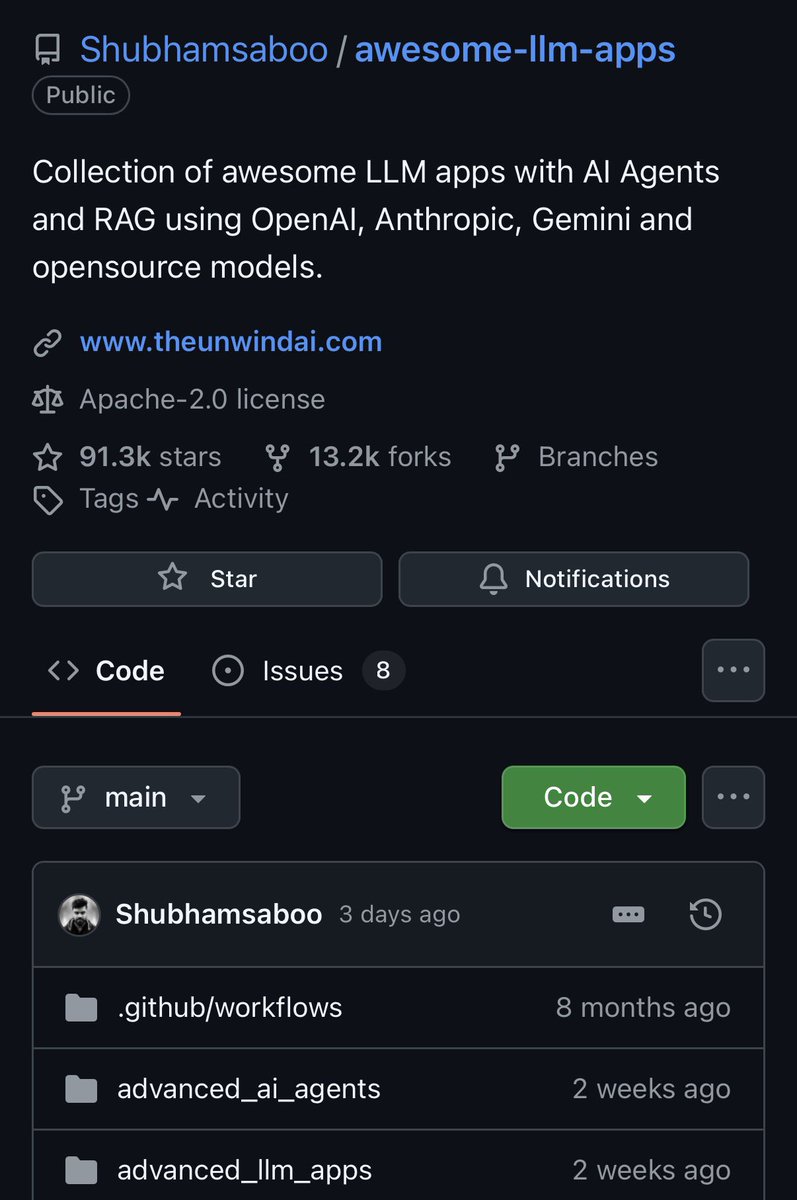
everyone's talking about AI agents here’s how to actually build one in 5 mins: > pick a use case (research, travel, multi-agent teams) > clone the github repo > add you api key or install ollama > run it and > make it your own i built 100+ of these patterns so you don't have to start from scratch. 100% free and open-source. (91,000+ stars already on GitHub) repo: github.com/Shubhamsaboo/a…
Shubham Saboo tweet media
English
11
23
135
9.9K
agatha
agatha@AutomIA_Build·
@eoai_dev 100%. The industry profits from the "Magic" narrative. It keeps consulting fees high. 🪄 But for builders, it's just I/O. Input ➡️ Compute ➡️ Output. Demystifying the stack is the only way to ship real products.
English
0
0
1
18
Eddie Hudson
Eddie Hudson@ehudsn·
@ReconversionIA this is the take more people need to hear. watched too many devs freeze up thinking AI engineering is some mystical new discipline. if you can build a backend, you can build agents. the patterns are the same, just different nouns.
English
1
0
1
43
agatha
agatha@AutomIA_Build·
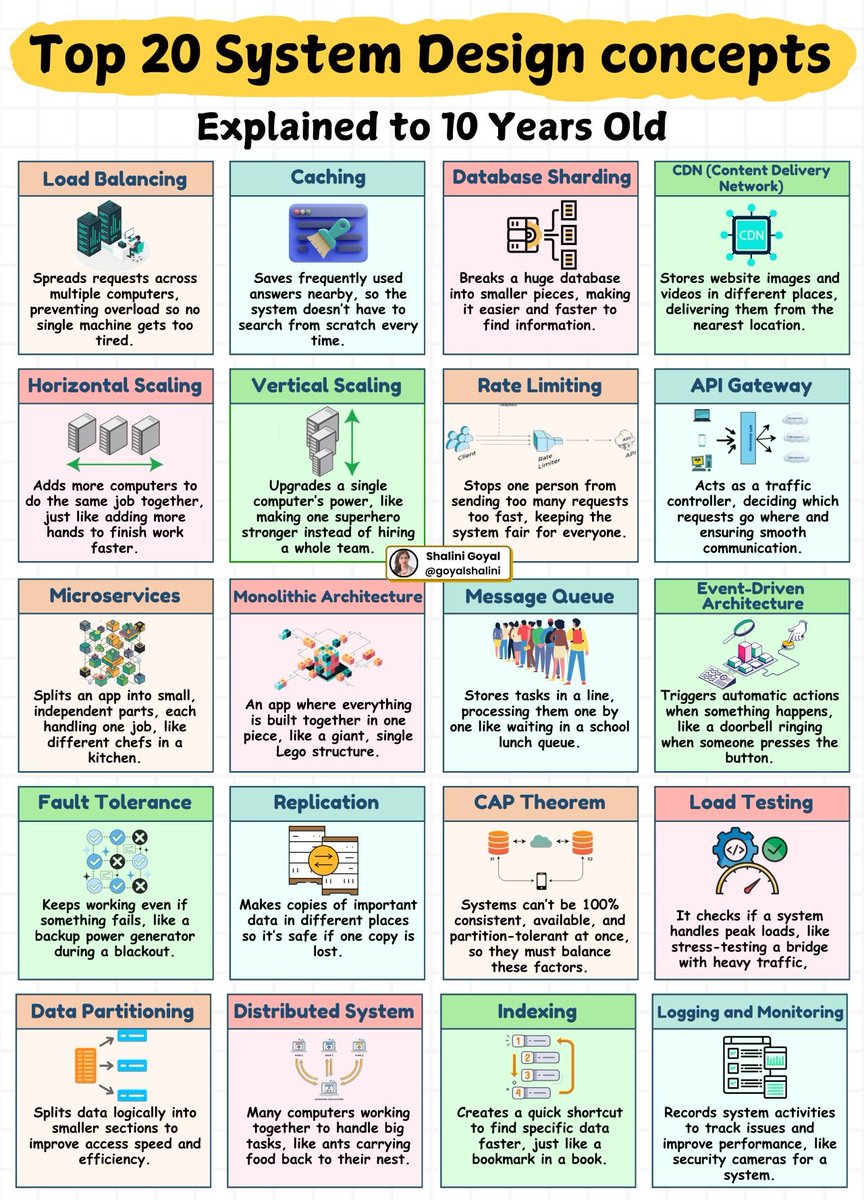
The laws of physics don't change, only the primitives do. 🏗️ We need this exact chart updated for the "Agentic Stack": • Load Balancing -> Model Routing (GPT-4 vs Haiku) • Caching -> Semantic Caching (Vector DB) • Rate Limiting -> Token Bucket Management Reliable Agents are just good System Design applied to LLMs.
English
0
0
1
74
Shalini Goyal
Shalini Goyal@goyalshaliniuk·
𝗜𝗺𝗮𝗴𝗶𝗻𝗲 𝗬𝗼𝘂'𝗿𝗲 𝗘𝘅𝗽𝗹𝗮𝗶𝗻𝗶𝗻𝗴 𝗦𝘆𝘀𝘁𝗲𝗺 𝗗𝗲𝘀𝗶𝗴𝗻 𝘁𝗼 𝗮 𝟭𝟬-𝗬𝗲𝗮𝗿-𝗢𝗹𝗱... "Why does YouTube never crash even when millions are watching videos at the same time?" "How does Google find answers so fast?" "Why does my online game not lag even when thousands are playing?" If you've ever struggled to explain these to someone new in tech, you're not alone. System Design can feel like a complex puzzle - until you break it down into simple, relatable ideas. That’s exactly what this post does! From Load Balancing (spreading work like distributing pizzas to multiple chefs 🍕) to Database Sharding (cutting a giant cake into smaller slices 🎂), these 20 key concepts make System Design feel less intimidating and more like everyday logic. Want to understand fault tolerance, caching, and microservices in a way that even a kid could grasp? Going through this visual breakdown  might just change how you see backend systems forever! 🚀 What’s the one system design concept that took you the longest to understand? Drop it in the comments! ⬇️
Shalini Goyal tweet media
English
6
36
183
5.2K
agatha
agatha@AutomIA_Build·
@LiorOnAI The best tools are never "Product Managed" into existence. They are built by engineers trying to automate their own pain. 🛠️ Side project = Solving a real problem. Roadmap = Guessing a problem. That's why the modern stack is being built by builders, not boards.
English
0
0
0
69
agatha
agatha@AutomIA_Build·
@provenauthority @billions_ntwk KYA is the missing layer for Enterprise adoption. 🏗️ Right now, we deploy Agents like anonymous interns. If we can't cryptographically sign every action back to a specific Model Version + Prompt Hash, it's not a worker... it's a liability. Identity = Auditability.
English
0
0
1
145
evin
evin@provenauthority·
The Identity Trinity: KYC, KYB and KYA Identity for humans, businesses and AI Agents is required to scale systems of trust and modernize access control and security in all digital spaces Thank you Biometric Update for highlighting our work at @billions_ntwk to scale KYA
evin tweet media
English
83
36
256
47.6K
agatha
agatha@AutomIA_Build·
Mathematically: You are correct (4 < 5). Legally & Psychologically: The threshold is different. We accept "Human Error" as a tragedy. We treat "Algorithmic Error" as a product defect (Lawsuit). No hospital will sign off on a liability that kills 4 people, even if it saves time. Trust is binary. 📉
English
0
0
0
34
Besci
Besci@Besciai·
@ReconversionIA @emollick Issue here is that the level of acceptability for an AI delivering a fatal dose is 0 vs. the status quo. If humans deliver 5 fatal doses and an AI 4, which system is better?
English
1
0
1
55
Ethan Mollick
Ethan Mollick@emollick·
This paper puts a multimodal agent (using Gemini 2.5) into a realistic medical sim used to train physicians: "The AI agent matches or exceeds [14,000] medical students in case completion rates and secondary outcomes such as time and diagnostic accuracy" papers.ssrn.com/sol3/papers.cf…
English
17
62
403
33.2K
agatha
agatha@AutomIA_Build·
@tom_doerr The emphasis on "Empirical Verification" is the real value here. Most repos just share prompts. This one shares a way to validate them. That's the difference between a demo and a production system. Great find. 🏗️
English
0
0
0
300