Ash

619 posts

Ash banner
Ash

Ash

@AxiomStrata

Humanist interested in stocks, design, tech, AI. I enjoy constructive debates, irony, and sarcasm.

Katılım Şubat 2025
618 Takip Edilen87 Takipçiler
Sabitlenmiş Tweet
Ash
Ash@AxiomStrata·
The industrial-age axiom “time is money” is breaking down. AI compresses cognitive work so dramatically that the bottleneck shifts from labor hours to judgment. If intelligence is becoming both fast and cheap, productive capacity is no longer scarce. The new axiom is “money is intelligence”: capital now buys thinking directly, collapsing the old hire-train-wait cycle. But here’s the catch - if everyone can buy the same AI, intelligence alone becomes table stakes. The real equation is money = intelligence × context × distribution. You can purchase cognitive capacity off the shelf, but you cannot buy a proprietary dataset, twenty million users, or hard-won relationships. That’s where the moat lives.
English
0
0
3
79
Ash
Ash@AxiomStrata·
@ClaudeDevs a little effort in adding release notes wouldn't hurt anyone. Unless I am the only one who still reads them...
Ash tweet media
English
0
0
0
2
Autism Capital 🧩
Autism Capital 🧩@AutismCapital·
>cop says he sees her with a phone in her right hand >she has no right hand >cop asks her to raise her hand to swear to God >absolute cinema
English
143
223
4K
319.6K
Ash
Ash@AxiomStrata·
It's fascinating to see the dunning kruger effect expressed on such a wide scale.
English
0
0
0
2
Ash
Ash@AxiomStrata·
@lennysan @danshipper Another slop. If you think that normal people will use CLI, you're dead wrong.
English
0
0
0
0
Lenny Rachitsky
Lenny Rachitsky@lennysan·
My biggest takeaways from @danshipper: 1. The future of work will happen inside Codex or Claude Code. Instead of putting AI into your SaaS tool, you’ll use your SaaS tools inside your favorite AI agents' in-app browser. Dan spends all his time in Codex now—writing documents, managing email, doing research, everything. He's using Google Docs, PostHog, and everything he needs within the agent's in-app browser. The agent can see what he’s doing, and has all of his context, so he and his agent collaborate quickly and super effectively. 2. Automation is a lie—every automation needs a human. Dan's company doubled in size this year despite being incredibly AI-forward. Why? Because in order to make automation work well, you need humans making sure everything keeps working. This is why benchmarks are misleading—they measure AI on problems we’ve already framed and can score, but there’s always a higher frame. 3. PMs will win the AI era. Marcus, a former PM who previously ran Axios’s writing product, joined Every after getting super AI-pilled. Now he runs their product Spiral, and ships faster than anyone on the team. He pairs technical knowledge with spiky product sense, deep user empathy, and an eye for what matters. Dan thinks any PM who gets really AI-native will be incredibly dangerous because the building is done for you—what matters is figuring out what to build and if it’s great. 4. Full-stack designers are becoming superheroes. Designers used to make beautiful interactions that engineers didn’t want to build or couldn’t execute properly. Now designers don’t need to hand things off; they can build it themselves. Designers are naturally creative people, and AI is the perfect tool for them because it lets them bring their vision to life without the traditional bottlenecks. 5. SaaS is not dead. In fact, Dan is bullish on SaaS stocks. When users bring their own AI (via Codex or Claude Code) to use SaaS products, the user—not the SaaS company—pays for tokens. This saves SaaS company’s margins. Since the agents need their own seats, Dan predicts that agents will create massive new demand for SaaS because there will be tons of agents using these products at high volume. 6. Every company will have one “super-agent” inside their Slack that every employee will use. Dan initially thought every employee would have their personal work agent, like a shadow AI org chart, but he’s completely flipped his view. He realized agents need humans who care about them. When someone gets tired of maintaining their personal agent, it becomes useless. The winning model is one forward-deployed engineer or AI-savvy person who maintains a company-wide agent (like Shopify’s River or Viktor), and then it trickles down to more specialized team agents as models improve and become less fiddly. 7. The AI job apocalypse is not happening, but you do need to evolve to stay relevant. Models make yesterday’s human competence cheap. But because everyone uses the same models, it all looks the same if you use it the default way; it becomes commoditized slop. Humans then take that frozen competence and use it to make something new and interesting for their specific situation. The key: “ride the models”—use them for everything you do, try new models when they drop, keep turning over rocks. 8. We will read way more AI-generated writing, and we will like it. Human writing is incredibly important for things that matter, but for internal docs, planning, and email, AI-generated is often better because most people are bad at writing strategy documents. 9. Build software for humans and agents to use together. The current model is building a CLI that an agent uses independently. Instead, you and your agent should be using the app together. This creates new design challenges—agents can make a billion requests in three seconds, so you need approval flows, inboxes that summarize what happened, logs, and easy rollback. 10. Forward-deployed engineers are the new most essential role. The big model companies have teams of people managing their internal agents, and those teams aren’t going away. It’s different from traditional software building, and certain engineers love it. As models get better, this role will evolve—you’ll be managing more agents doing more things.
Lenny Rachitsky@lennysan

Automation is a lie. CLIs are over. The SaaSpocalypse is dumb. A year ago @danshipper came on the podcast to predict where AI was heading. He was remarkably right—including the call that everyone was sleeping on Claude Code. Dan has a unique lens into where things are going because his team at @every is possibly the most AI-pilled group of people in tech. I always learn a ton talking to Dan. So I brought him back for round two. We'll score these in exactly a year: 🔸 Every company will have one “super-agent” in Slack. 🔸 Codex and Claude Code will become the new operating system for knowledge work. 🔸 The AI job apocalypse is not happening. 🔸 PMs and designers will thrive. 🔸 We will read way more AI-generated writing and we will like it. 🔸 "I would buy SaaS stocks right now." Listen now 👇 youtube.com/watch?v=4D3hDm…

English
152
239
2.1K
753.7K
Ash
Ash@AxiomStrata·
Can we tell to whoever is creating those shitty bots on Fintwit that write while impersonating the OP : "👇🏻this is my strategy is actually a shit strategy ?"
English
0
0
0
4
Ash retweetledi
Hedgie
Hedgie@HedgieMarkets·
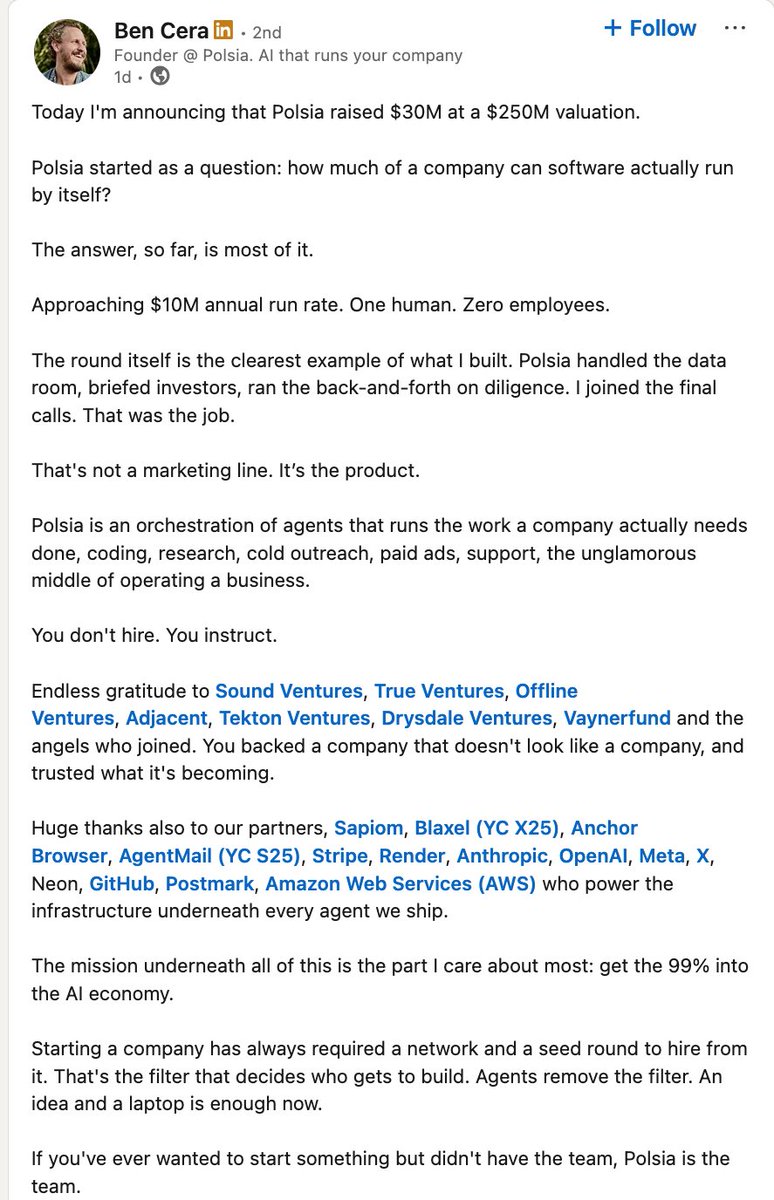
🦔A company called Polsia just raised $30 million at a $250 million valuation. The founder, Ben Cera, posted on LinkedIn yesterday that the platform runs "an orchestration of agents" handling coding, research, cold outreach, paid ads, and support, with one human and zero employees. Customers pay $50 per month plus 20% of their revenue to have Polsia build and run their businesses. The platform uses Sora 2 to generate fake user-generated videos as ads. Cera's AI agent reportedly handled the fundraising process itself. Sound Ventures, the Ashton Kutcher fund also invested in OpenAI and Anthropic, led the round. Polsia spelled backwards is "aislop." My Take I am not making fun of the founder here, he built something investors valued at $250 million and I respect the hustle. What I find genuinely funny is that the name spells "aislop" backwards and Sound Ventures still wrote the check. Either it is the best inside joke in venture capital this year or nobody noticed, and I cannot decide which option is more revealing about the state of AI investing right now. The substance underneath this story is that Polsia is an LLM wrapper running other people's businesses on top of subsidized inference, funded by the same VC firm that owns stakes in the labs supplying the tokens. The whole stack works as long as Anthropic and OpenAI keep losing money on every API call. When token prices catch up with actual unit economics, which is the same story I have been writing about all week, these wrappers get a lot harder to keep running profitably. Hedgie🤗
Hedgie tweet media
English
20
41
222
11.8K
Ash
Ash@AxiomStrata·
@Rory_Johnston But but but, what about the wedding?
English
0
0
0
162
Rory Johnston
Rory Johnston@Rory_Johnston·
“The Trump administration was preparing Friday for a fresh round of military strikes against Iran … Some members of the U.S. military and intelligence community canceled their plans for the Memorial Day weekend in anticipation of possible strike, several sources said.” 🫠
Rory Johnston tweet media
English
21
26
238
35.5K
Rhys
Rhys@RhysSullivan·
Incredibly funny to post this 8 days before laying off a bunch of people thinking AI will get you a 100x ROI
English
53
128
2.9K
379.6K
Ash
Ash@AxiomStrata·
@RhysSullivan Honestly I hope their comedy channel stays and isn't part of the layoff. I've always found it to be a great and fun idea. Some of the skits are genuinely hilarious.
English
0
0
0
2.7K
Ash retweetledi
Mo
Mo@atmoio·
tldr: ClickUp is hosting a company-wide Hunger Games where if you can figure out how the hell to make AI work you’ll win a million dollars.
Zeb Evans@DJ_CURFEW

Today we reduced headcount by 22%. The business is the strongest it's ever been. So I think it's important to be direct about what I'm seeing and why. First, I made this decision and I own it. I did it because the way to operate at the highest level of productivity is changing, and to win the future, ClickUp needs to change with it. Second, this wasn't about cutting costs. Most savings from this change will flow directly back into the people who stay. We'll be introducing million-dollar salary bands. If you create outsized impact using AI, you'll be paid outside of traditional bands. Most importantly, I have the deepest gratitude for those affected. We're doing this from a position of strength specifically so we can take care of people properly. Everyone affected receives a package aimed at honoring their contributions and easing the transition. I only see two options: wait for this to play out gradually in the market or be honest about what I'm seeing and act proactively. THE 100X ORGANIZATION The primary change is that we're restructuring around what I call 100x org. The goal is 100x output. The roles required to build at the highest level are fundamentally different than they were a year ago. Incremental improvements to existing systems won't get us there. We need new ones. That means creating enough disruption to rebuild rather than iterate on what's already broken. The common narrative is that AI makes everyone more productive. It doesn't. Many of the workflows of today, if left unchanged, create bottlenecks in AI systems. These roles will evolve. But waiting for that to happen naturally means falling behind now. The 100x org is actually heavily dependent on people - infinitely more than today. This is only possible with 10x people that have embraced and adopted new ways of working. THE BUILDERS, AGENT MANAGERS, AND FRONT-LINERS — THE BUILDERS: 10X ENGINEERS I don't think most companies have internalized what's actually happening with AI in engineering. The common narrative is that AI makes all engineers more productive. That may be true in isolation, but at an organization level - that is the farthest thing from reality. Here's what we've validated recently at ClickUp: the great engineers, the ones who can orchestrate, architect, and review, are becoming 100x engineers. They're not writing code. They're directing agents that write code. The skill is judgment. AI makes the best engineers wildly more productive, and everyone else using AI slows these engineers down. Think about it - the bottlenecks are (1) orchestration - telling AI what to do, and (2) reviewing - what AI did. Everything is leapfrogged and no longer needed. So who do you want orchestrating and reviewing code? And how do you want your best engineers to spend their time? If your best engineers are spending time reviewing other people's code, then this is inherently an inefficient bottleneck. These engineers can review their agent's code much faster than reviewing human code. The new world is about enabling your 10x engineers to become 100x. The wrong strategy is to push every engineer to use infinite tokens. Companies doing this are celebrating 500% more pull requests. But customer outcomes don't match the volume of code being generated. I call this the great reckoning of AI coding, and every company will face this soon if not already. More code is just another bottleneck to the best engineers, and ultimately to your company's impact as well. — THE BUILDERS: 10X PRODUCT MANAGERS Product management and design roles are merging. Designers that have customer focus, become more like product managers. And product managers that have intuition for UX become more like designers. The bottleneck of user research is gone. It takes us just one mention of an agent to kickoff research and analyze results. The bottleneck of product <> design iteration is also gone. The product builder iterates on their own, along with agents and skills that ensure alignment with quality and strategy. Also controversial today - I believe that the wrong strategy is to have your PMs shipping code - that just introduces another bottleneck that the best engineers will waste their time on. To be clear, PMs should be coding but they should do this in a playground to iterate, validate, and scope. That code should not go to production. Everything outside of managing systems, orchestrating AI, and reviewing output becomes a bottleneck. That's why the other roles that are critical along with these are the systems managers (to reduce bottlenecks) along with a bottleneck you can't replace - customer meeting time. — THE SYSTEM MANAGERS Ironically, the people that automate their jobs with AI will always have a job. They become owners of the AI systems - agent managers. We have many examples of these people at ClickUp. The underlying systems in which we operate are absolutely critical to get right. I think most companies are delusional to think they can iterate on existing systems and compete in this new world. You must create enough disruption so that old systems are deprecated entirely. If there's any definition for 'AI native' that's what it is. — THE FRONT-LINERS In a world that will become saturated with AI communication, the human touch will matter more than anything to customers. This is a bottleneck that you shouldn't replace - even when agents are high enough quality to do video meetings. One-on-one meeting time with customers is something that shouldn't be automated. The systems around the meetings should be - so that front-liners spend nearly 100% of their time with customers. REWARDING 100X IMPACT In a world where companies are able to do so much more with less, where does that excess money go? In our case, much of the savings in this new operating model will flow directly back to those that enabled it. We must reward people that create productivity accordingly. This aligns incentives on both sides. Plus, in a world where your best people create 100x impact, you can't afford to lose them. You should aim to retain these employees for decades. The context they have and their ability to efficiently orchestrate and review will be nearly impossible to replace. Compensation bands of today should be thrown out the door. We're introducing $1 million cash/year salary bands with a path available to nearly everyone in the company if they produce 100x impact by creating or managing AI systems. THE FUTURE Nearly every company will make changes like these. The ones that do it proactively will define what comes next. The future is not fewer people. It's different work, new roles, and better rewards for those who embrace it. We're already seeing entirely new roles emerge, like Agent Managers, that didn't exist a year ago. ClickUp is positioning to lead this shift, not just internally, but for our customers too. I've never been more certain about where we're headed.

English
110
167
3.2K
259.1K
Hedgie
Hedgie@HedgieMarkets·
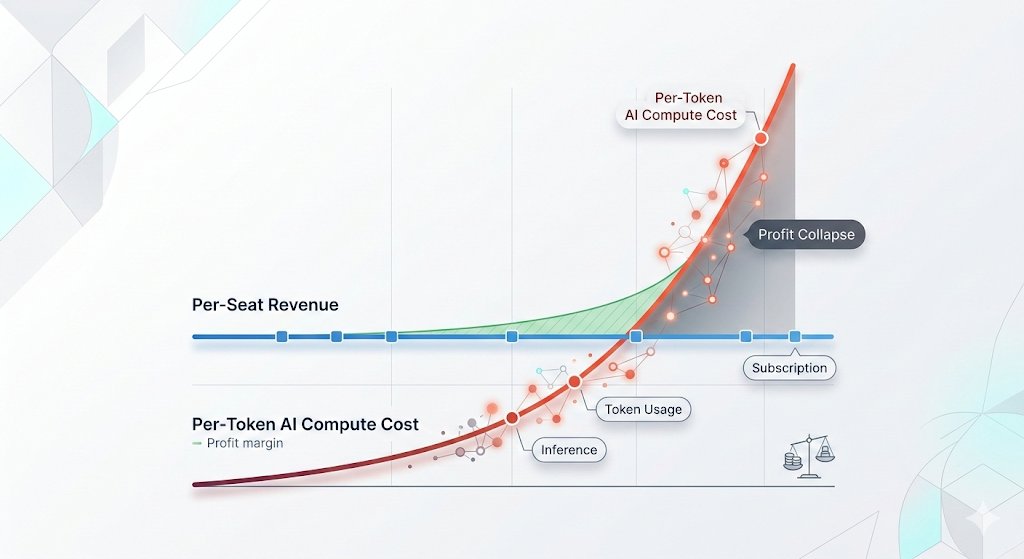
🦔Microsoft canceled its internal Claude Code licenses this week after token-based billing made the cost untenable, even for a company with effectively infinite cloud resources. Uber's CTO sent an internal memo warning the company burned through its entire 2026 AI budget in just four months. American AI software prices have jumped 20% to 37%, and GitHub (owned by Microsoft) is dropping flat-rate plans for usage-based billing across its products. My Take The AI subsidy era is ending in real time. The same company that put $13 billion into OpenAI and built the Azure infrastructure powering most of Anthropic's compute just looked at the bill from a competitor's coding tool and decided it was not worth paying. That is not a productivity failure on Anthropic's end. Token-based pricing is forcing every enterprise customer to confront the actual cost of running these models at scale, and the number turns out to be far higher than the flat-rate experiments suggested. This ties directly to my Gemini Flash post yesterday. Anthropic, OpenAI, and Google all raised effective prices in the last six months. Enterprises that built workflows assuming AI costs would keep falling are now watching annual budgets evaporate in months. Two outcomes look likely from here. Either enterprises scale back AI usage to fit budgets, which slows the revenue ramp the labs need to justify their valuations ahead of IPOs, or the labs cut prices and absorb the losses, which makes the unit economics worse at exactly the wrong moment. Both paths land in the same place, the numbers stop working, and somebody has to take the writedown. Hedgie🤗
Hedgie tweet media
English
1.1K
4K
19.9K
8.3M
Mattie Fairchild
Mattie Fairchild@Scav·
Is anyone actually still using Obsidian?
English
398
4
714
206.1K
Ash
Ash@AxiomStrata·
@adxtyahq Super, burn all those tokens to create a system that doesn't work.
English
0
0
0
232
aditya
aditya@adxtyahq·
“design a RAG pipeline for 10M docs with zero hallucination” apparently this was asked in a Google L5 interview round. came across it somewhere on the internet and honestly it’s a way more interesting system design problem than most classic distributed systems questions 1. ingest + normalize docs - remove duplicates, standardize formats, extract metadata, maintain version history 2. hybrid retrieval (BM25 + embeddings) - BM25 handles exact keyword matching while embeddings capture semantic meaning - semantic search alone usually struggles with precision at massive scale 3. ANN retrieval + reranking - ANN (Approximate nearest neighbor ) quickly pulls top candidate chunks from millions of docs - then a reranker rescoring step improves relevance by deeply comparing query vs retrieved chunks 4. source confidence scoring - every retrieved chunk gets scored based on freshness, trust level, overlap and retrieval consistency - low-confidence context should never heavily influence generation 5. constrained generation - the model is only allowed to answer using retrieved context (nothing new to be invented outside of the retrieved context) 6. citation-backed responses - every major claim links back to exact chunks, documents or timestamps 7. hallucination fallback layer - if retrieval confidence drops below a threshold: “insufficient evidence found” 8. continuous evals - run adversarial queries, retrieval recall benchmarks and hallucination tests continuously 9. caching + memory layer - cache high-frequency enterprise queries and retrieval paths (improves latency and output) 10. observability everywhere - trace retrieval paths, chunk rankings, token attribution and failure points Also at 10M docs, retrieval quality matters more than the frontier model itself.
aditya tweet media
English
86
326
2.7K
193.3K
Stock Talk
Stock Talk@stocktalkweekly·
*SPACEX OFFICIALLY FILES FOR IPO ON NASDAQ UNDER TICKER SYMBOL $SPCX *ELON MUSK TO SERVE AS CEO, CTO, AND CHAIRMAN OF THE BOARD WITH 85% VOTING CONTROL
English
31
24
357
34.8K
Ash
Ash@AxiomStrata·
@trq212 would it be possible for Claude to stop saying ridiculous things such as "The framework change is the "right" long-term primitive, but option 1 ships in an afternoon". "Afternoon" = 3 min of actual processing. Unless it's trained on some of my former colleagues 😅
English
0
0
0
10
Ash
Ash@AxiomStrata·
Me right now 🦇
Ash tweet media
English
0
0
0
5
Ash
Ash@AxiomStrata·
Gemini 3.5 is a real problem. It's a smaller model to fit on a TPU, which Google makes "think" for longer to compensate for its lack of intelligence (so more tokens, but the same processing time because it's faster), and it's sold at three times the price, which amounts to six times the price when you factor in the extra tokens. All this for mediocre performance. "Google is testing the limits of what customers are willing to pay for the API." x.com/theo/status/20… @theo
English
0
0
0
288
shirish
shirish@shiri_shh·
GOOGLE JUST SHIPPED ITS ENTIRE 2026 ROADMAP IN ONE KEYNOTE Gemini 3.5 Flash → new flagship. frontier brain, agentic, beats 3.1 pro, 4x faster Gemini 3.5 Pro → the bigger one, drops next month Gemini Omni → any input in, editable VIDEO out Gemini Spark → a personal agent that actually DOES things across your apps Daily Brief → your morning, pre-read from gmail, calendar and tasks Neural Expressive → the gemini app got a full redesign Universal Cart → one agentic cart across gemini, youtube and gmail Information Agents → search that monitors the web 24/7 FOR you Intelligent Search Box → expands as you type for real conversations Search Mini Apps → build your own dashboards inside search AI Mode → now fully running on gemini 3.5 flash Gmail Live → talk to your inbox Docs Live → write and edit docs by voice AI Inbox → gmail, organized by ai Google Keep → speak freely, it cleans it into notes Google Pics → a brand new ai image and design app Ask YouTube → search the ENTIRE youtube catalogue with answers Android XR Glasses → "intelligent eyewear," audio glasses this fall Android Halo → a live strip showing what your agent is doing Antigravity 2.0 → the agent-first dev platform, upgraded Flow + Flow Music → now standalone mobile apps
English
69
324
2.2K
196.5K
Ash
Ash@AxiomStrata·
I LOVE AI, I use it everyday. I HATE AI, for all the lazy idiots trying to sell snake oil. Before they had to do a little effort to be compelling, now they have this incredible tool.
English
0
0
0
7
Ash
Ash@AxiomStrata·
HOLY SMOKES, another god damned tweet that's way too long and that could be summarised in 2 sentences: > Andrej Karpathy warned a month ago that outsiders inevitably lose touch with frontier AI progress—and today he put his money where his mouth is by joining Anthropic’s pre-training team. His decision is the ultimate signal: with every major lab available to him, the person who arguably understands pre-training better than anyone chose Anthropic as the place where the most important work (and self-improvement loop) will happen next.
English
0
0
1
480
Milk Road AI
Milk Road AI@MilkRoadAI·
HOLY SMOKES! Andrej Karpathy warned about this a month ago and today he announced he's joining Anthropic. A month ago, Karpathy said openly that if you are outside a frontier lab, your judgment will inevitably start to drift. You lose touch with what is actually being built, how these systems work under the hood, and where the entire field is heading next. He said being inside one of the frontier labs doing really good work for some period of time might be the only way to stay genuinely connected to what is actually happening at the cutting edge. Today he acted on exactly that. Andrej Karpathy just announced he’s joining Anthropic’s pre-training team, placing him directly inside the most compute-intensive and technically demanding layer of building frontier AI models. Pre-training is where the large-scale compute runs happen, where the fundamental capabilities of a model are baked in at the deepest level and where the gap between frontier labs and everyone else is either won or lost permanently. He will also build and lead a new team focused on using Claude itself to accelerate pre-training research meaning Anthropic is now using its own models to help design and build the next generation of its models, closing the self-improvement loop that every major lab is racing to complete. The choice of Anthropic specifically is the signal worth paying attention to. Karpathy co-founded OpenAI, ran AI at Tesla for years, and spent the last two years as one of the most credible and widely followed independent voices in the entire field. He had every option available to him, OpenAI where he helped build the original research culture, Google DeepMind, xAI and he chose Anthropic. When the person who arguably understands AI pre-training better than almost anyone alive looks at the entire landscape and decides that Anthropic is where the most important work of the next few years will happen, that is not a career decision but rather a verdict on which lab is actually winning the research race right now.
Andrej Karpathy@karpathy

Personal update: I've joined Anthropic. I think the next few years at the frontier of LLMs will be especially formative. I am very excited to join the team here and get back to R&D. I remain deeply passionate about education and plan to resume my work on it in time.

English
23
60
668
229.6K
Ash
Ash@AxiomStrata·
@codevibesmatter @trq212 wait you're forgetting that MOAR tokens is good for someone. Maybe not you... :P
English
0
0
1
25
Ben Freed
Ben Freed@codevibesmatter·
@trq212 Because you shouldn't have to track progress manually like this there's tons of inherent drift. Deterministic workflows with stages, modes, gates and verifiable outputs is the way
English
9
2
65
8.2K
Thariq
Thariq@trq212·
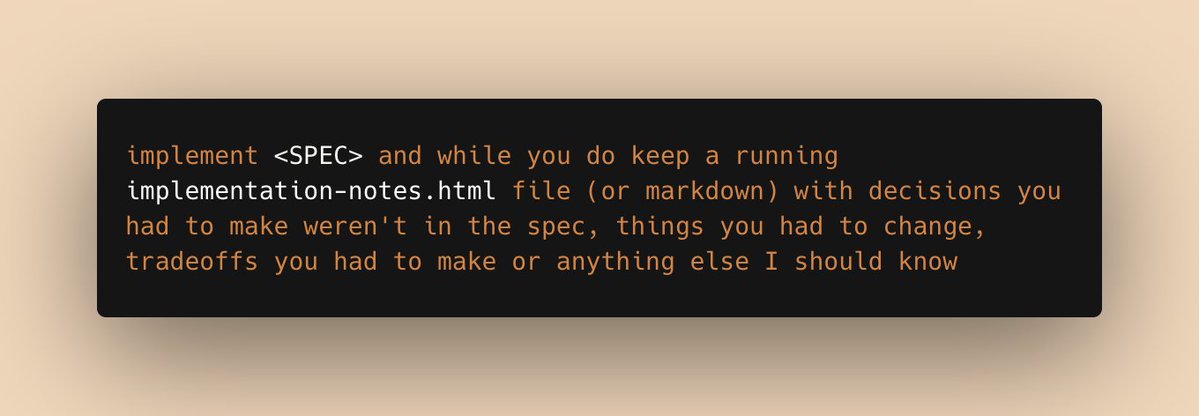
a prompt I've been using a lot recently: implement <SPEC> and while you do, keep a running implementation-notes.html file (or markdown) with decisions you had to make weren't in the spec, things you had to change, tradeoffs you had to make or anything else I should know
Thariq tweet media
English
343
580
9.7K
815.1K