

Bernie M.
2.2K posts
Bernie M.
@BM_SC_t
Racing is life. Anything before or after is just waiting.
Katılım Temmuz 2013
21 Takip Edilen15 Takipçiler

Former Wimbledon champion Markéta Vondroušová charged with refusing doping test after ‘acute stress reaction’ and could face four-year ban.
Her lawyer tells us that “we are certain that once the full context is understood, her name will be cleared.”
nytimes.com/athletic/72050…
English

“Most impressive F1 season without winning the championship?”
My girlfriend: 2025 Verstappen
Me: 2012 Alonso
My girl's gay bestfriend: 2008 or 2010 Kubica
Me:
English

@brakeboosted I agree that changing the power split is one of the methods they should use, but they will have to reduce MGU-K power to achieve that. No way they can just make the ICU's more powerful during the year.
English

@BM_SC_t If the ICE has more power to overcome the negative torque of the MGU-K against full ICE load, more power is available to accelerate the car. So it becomes less noticeable. A more ICE focused split is the best way to minimize superclipping.
English
Reducing the energy budget per lap means less emphasis on recovery, and as a product the drivers will be able to push more. So naturally lowering it, as they've done in Melbourne (7 MJ) and Suzuka (8 MJ), improves qualifying at the cost of cars getting a fair bit slower. Seconds rather than tenths. In hindsight, they could have been more aggressive in this respect.
I feel the need to clear up that lowering the MGU-K power output does not save energy. It simply redistributes how they deploy it. Instead of using a short high-power burst and tapering off aggressively, they'll have more sustained deployment. Reducing superclipping is a matter of optics not performance-oriented. So superclipping doesn't disappear in any case because harvesting is done where it is least intrusive to lap times, but reducing it is important for the viewing experience.
brakeboosted@brakeboosted
Have been saying this since the start of the season. A near 50/50 split simply doesn't work when your only meaningful energy source is braking via the MGU-K. They won't go back to what we had before, so realistically you have to start looking at something closer to a 65/35 split as the upper limit of an MGU-K-focused formula. Anything beyond that becomes unsustainable from a sporting perspective unless you introduce another recovery mechanism. Too many competing interests from manufacturers, so I highly doubt we settle on a device or mechanism to harvest energy from a secondary source. That's exactly how we ended up here in the first place. So to reduce superclipping you need more power available to accelerate the car after the MGU-K applies its negative torque at full ICE load to harvest energy. Fundamentally, it's a question of shifting the balance back toward the ICE. Simple as that. You also give the driver a bit more room to make a difference when optimal energy management is less important, which should be the priority in my opinion. That can be accomplished by decreasing the MGU-K peak power output, which is the most likely short-term solution. Alternatively, increase the ICE's power output by increasing fuel flow limits and other ICE performance restrictors. The latter is a long-term solution with a bucketload of consequences that are not feasible mid-season. You also want to avoid the cars getting much heavier in the process. I'm sure there are many other options, but I'm trying to keep in mind that these changes must be approved within the next few months in order to be ready for 2027.
English
@brakeboosted If you recuperate without or very little throttle, the car will slow down massively, which is not very beneficial.
English

Big news for Ferrari.
Ferrari has received FIA approval for their 2026 power unit upgrade under ADUO rules!
The new engine (closing the ~2% / ~25hp gap to Mercedes) is cleared to run from the Canadian GP onwards. The upgrade will be on the thermal side of the PU.
They might introduce it then or wait for the Barcelona. This will put a pressure on McLaren first. Waiting to see the news on Redbull.
Note 2-4% deficiency will allow for 1 upgrade in 2026 and 1 in 2027. More than4%, it will be 2 upgrades in 2026 and 2 in 2027.
Big step for Maranello! 🔥 #F1 #Ferrari #ADUO

English
@NobleF1 1. Go to sth like 60/40 (That would be ca. 250kw mgu-k power) => power available over more of the lap
2. Restrict recharging while on high throttle input to make it more beneficial to use ICU to maintain speed instead of superclipping.
3. 2027: Allow front axle recuperation.
English

Could an active aero rule tweak be the tool to help #F1 solve its energy management / qualifying headaches?
the-race.com/formula-1/f1-2…
English
@MattP1Gallagher Oh, please. Bearman was a long way back and it was not a sudden slowing down. Bearman should have seen that one coming miles away ... probably was looking at his dash instead of on the road.
English

That Ollie Bearman crash should be ALL the proof the FIA needs to make drastic changes to stop the insane closing speeds
English
@F1BigData Ok, but they are faster on the straight approaching 130R, and from what I've seen they take 130R at the same speed as last year ... so the actual slow down from 130R is only something like 30km/h before actual braking.
English


@brakeboosted I thought that if the system fails, the wings have to switch to corner mode by itself. Surely that doesn't mean it can take its bloody time to do that as that would be an immense security risk.
English
The Race reports, Mercedes front wing trickery was a mere miscalculation in the amount of hydraulic pressure required at high loads.
My initial assessment was correct. ✅
brakeboosted@brakeboosted
Apparently that was completely intentional and used to evade the rules. I had noted the early stoppage (jamming) motion but put it down to what seemed to be insufficient strength/pressure in the system under heavy loads. @Auto_Racer_it however reports that Mercedes are able to evade the 400 ms transition time by designing a two-phase actuator. - The first phase is quick and within the 400 ms window and triggers the control systems as a complete closure. - The secondary, slower phase is completely void of any time limit. The front wing actuator is an OSC, so rival teams have access to the designs. Ferrari has sought clarification, and the actuator will be thoroughly checked in Japan.
English
@m_lubieniecki They will just squeeze out everything between Spoon and 130R and on start/finish, but I wouldn't expect much superclipping as they can recharge afterwards.
English

Working on Suzuka now. So far, it looks like the fast run from the hairpin through Spoon to 130R will be very battery-demanding, similar to the back straight in Australia. I’m curious to see what the final straight-line mode zones will look like.
English

@Alex_Gillon I've been saying that before Shanghai. A long straight does not mean excessive super-clipping. When there's a hard braking zone at the end there's no need to. In Melbourne there's a fast left-right, which by itself doesn't give back enough energy, hence the super-clipping.
English

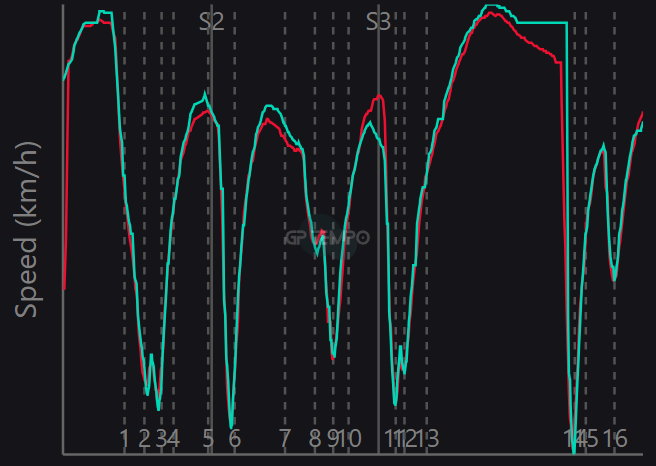
Secondly, the ‘super clipping’ that was so prevalent in Australia was hardly anywhere to be seen. It looks like turn 8 is a place where they can get ‘free’ super clipping, where they are recharging the battery instead of lifting. There was no major super clipping anywhere else
English
There were 4 weird things in the telemetry data from the F1 Chinese Grand Prix Sprint Qualifying…
#f1 #formula1 #chinesegp
English
@DRSunlocked Looks like they built a comparably high df/high drag car just like the last one. Only that high df this year doesn't give you that much in terms of laptime as last year.
English

Lando was more than six tenths behind Russell in Sprint Quali, but McLaren seem to have a great aero and chassis platform and are acing the slow sections better than everyone else.
If they manage to fix their straight-line efficiency, they could give Mercedes’ rocket ship some serious competition.
🎥: Formulytics
English
@ajbonner @GazzettaFerrari 2% on the power unit would have been more than 1.5s in Melbourne. No chance the difference was close to that.
English

@BM_SC_t @GazzettaFerrari 2% on power unit perhaps. Chassis is a beast this year.
English

🚨 | Ferrari is starting 2026 with a “transitional” ICE—an adapted, well-known 2025-era base chosen mainly to ensure reliability and comply with the new fuel rules, but with limited development headroom.
A fully new ICE architecture is already running on the dyno and could arrive before year-end if needed (otherwise aimed at 2027), potentially after Belgium or by Monza depending on ADUO-driven evaluations and the calendar.
The key challenge is managing turbo lag and sustaining energy with the new 350 kW MGU-K era. Mercedes’ advantage appears rooted in superior energy/SoC management and combustion efficiency, making Ferrari’s early deficit unsurprising.
📰 @Auto_Racer_it
English
@AvonandsomerRob Because around that time everyone suddenly had a CD burner for their PC. And everyone already had a CD-player and didn't need to get an MD-player additionally.
English

Sony Minidisc was peak Hi-Fi.
It sounded as good as CD, without the drawback of being easily-scratched.
It didn't skip as a Walkman, & you could record on your home Minidisc separate, easier than cassette tape.
It was also a perfect format for car audio systems.
Why did it fail?

English

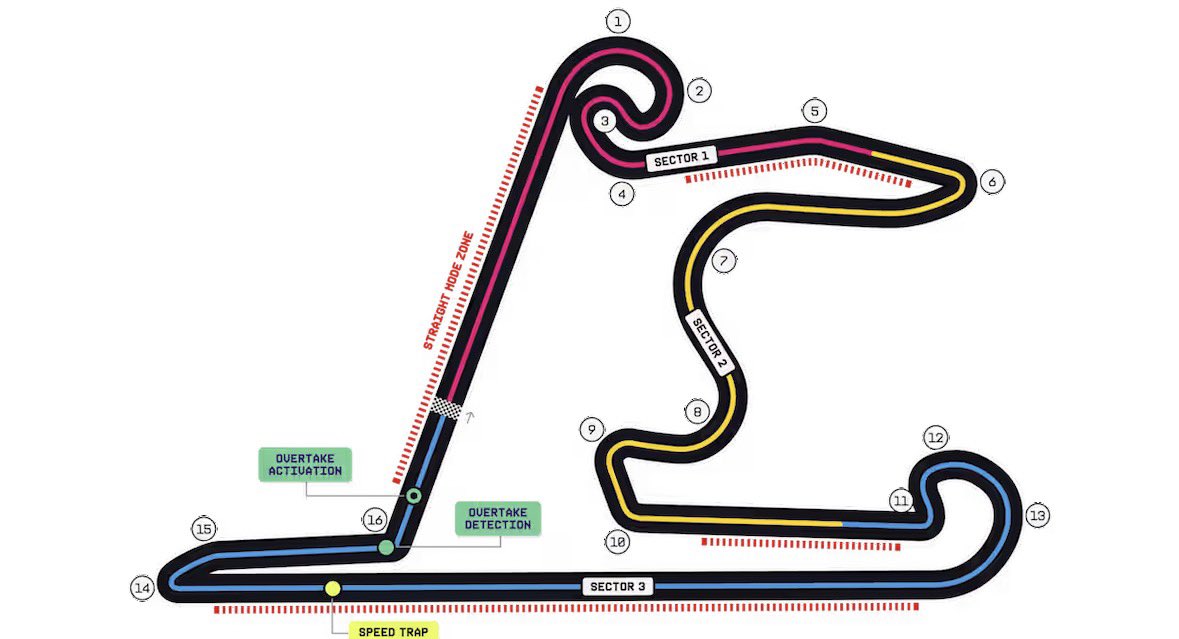
Updated map of the Shanghai circuit for the Chinese GP 🇨🇳
• 4 Straight Mode zones
• Overtake Mode detection at T16
That back straight looks daunting for these cars 😅
English
@PolePositionist Probably not at all, because there’s a hard braking point to minimum speed at the end where you can recharge enough to boost out of it afterwards. Maintaining speed will be more important on that straight imho.
English

Sooo.... at what point down the back straight will the new F1 cars start super clipping?

English