

Jesse
1.1K posts
Jesse
@Beppy617
live, love, ride ,sleep, ride again, repeat. :)
Olympia, WA Katılım Ocak 2016
44 Takip Edilen20 Takipçiler

@DovySimuMMA This army vet is a puss* instead of reporting it to the world fight back you weakling and keep it to yourself.

English



@Browns @Flash_Garrett Wild how people care so much aboht what other people are doing for whom they'll never meet or know lol.
English

@j_em_bee @MonacoJimmie @CarolynZaremba @archeohistories Dont you dare offend him with facts a reason. Thats not what these people wanna hear. 😂
English

@MonacoJimmie @CarolynZaremba @archeohistories Actually, most historians today use "CE" and "BCE" in order to avoid being Christianity-centric or Western-centric. More people live in Asia than in "the West," after all, and most people on the planet are not Christian.
English

The only known surviving example of a full-sized Roman legionary scutum, discovered in the ancient garrison city of Dura-Europos (Syria) and dating to the mid-3rd Century AD. It was discovered during excavations in early 1930s...
This object is a Roman legionary scutum, the large curved shield that defined Roman infantry warfare for centuries. Used by legionaries from roughly 1st Century BC through 3rd century AD, the scutum was designed to work as part of a system, individual protection combined with collective discipline. Its curved rectangular shape allowed soldiers to overlap shields, forming defensive formations like the famous testudo, or “tortoise,” against arrows and missiles.
The surviving example comes from Dura-Europos, a fortified Roman frontier city captured and buried during a Persian siege around 256 AD. Because the city was rapidly entombed under sand and rubble, organic materials like wood and leather, normally lost to decay, were preserved. That makes this shield uniquely valuable: most scuta were wood-based and rarely survive archaeologically.
The shield’s painted surface wasn’t decorative alone. Bold colors and symbols helped identify units, boost morale, and intimidate opponents in battle. At full size, a scutum could weigh around 20–22 pounds, turning the legionary into a moving wall rather than a lone fighter.
Roman soldiers often customized their shields, but damage from battle was expected. Scuta were treated as expendable equipment, not heirlooms, which makes this lone survivor all the more extraordinary.
Yale University Art Gallery
#archaeohistories

English

@archeohistories Bah she probably made poor choices aka spend every bit money and forgot to invest and save for the future because you can always work and or tomorrow is never promised. Now a days it I will live off SSI here in USA. Until they learn SSI is 1/3 of the income of there life style.
English
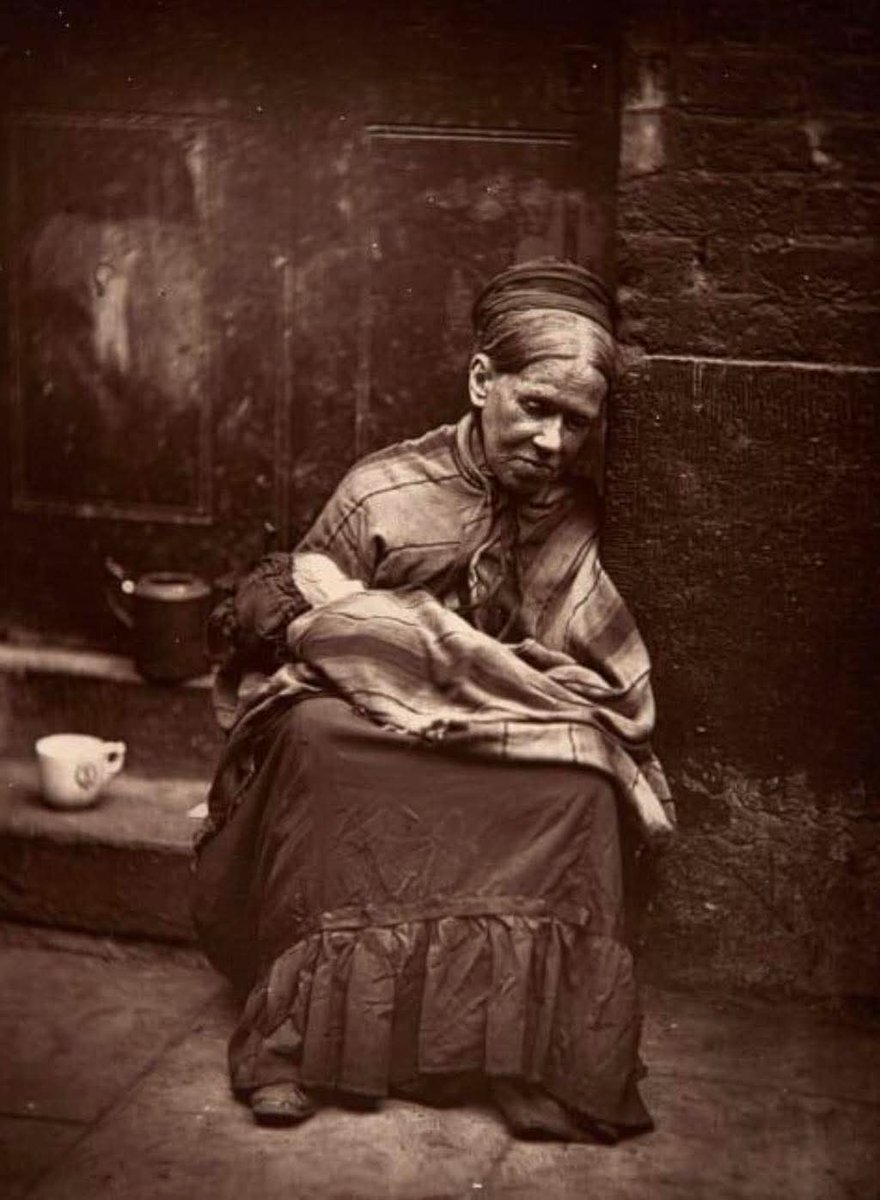
“The Crawlers”, 1877. ‘The Crawlers’ were the lowest of the British poor. This elderly widow is sitting outside a tailor’s shop, holding a baby while its mother works. She was given a cup of tea and a slice of bread daily in return.
The photograph titled “The Crawlers” was taken in 1877 and captures one of the harshest realities of Victorian poverty in London. The term “crawlers” referred to some of the most destitute people in society — often the elderly, widowed, or disabled, who were too frail to work and forced to rely on scraps of charity to survive. They were called “crawlers” because many were so weakened by hunger, disease, or age that they could only move slowly, often crawling or dragging themselves along the streets.
In this haunting image, an elderly widow sits outside a tailor’s shop, cradling an infant. The baby’s mother, likely a working-class woman struggling to make ends meet, left her child in the widow’s care while she labored inside. The widow’s payment for this exhausting responsibility was meager: a cup of tea and a slice of bread a day. Such arrangements were common, as survival for the poorest relied on fragile networks of mutual aid and the charity of others.
This photograph is more than a snapshot, it is a window into the crushing inequalities of Victorian society. While industrial Britain was generating immense wealth, many of its citizens were trapped in cycles of poverty, living day to day on the edge of survival.
Social reformers later used photographs like this as evidence to push for changes in housing, sanitation, and welfare laws, laying the groundwork for Britain’s eventual social safety nets.
© Historical Photos
#archaeohistories
English
@firespeaks13 @archeohistories You have to be kidding. Maybe its because im in Washington , but the amount of welfare here is rampant. Many people need it as they are disabled and have some other things going on in their life which is great its available to them, but I see how abused it is by able ppl daily
English

@ScottWinfieldP @KaiserGoebel @histories_arch Please tell me you're joking. This cant be an honest comment, can it? Lol
English

@KaiserGoebel @histories_arch Yet they told us that these "ancient humans" were much smaller than us, right? Buncha lying Darwinists!
English

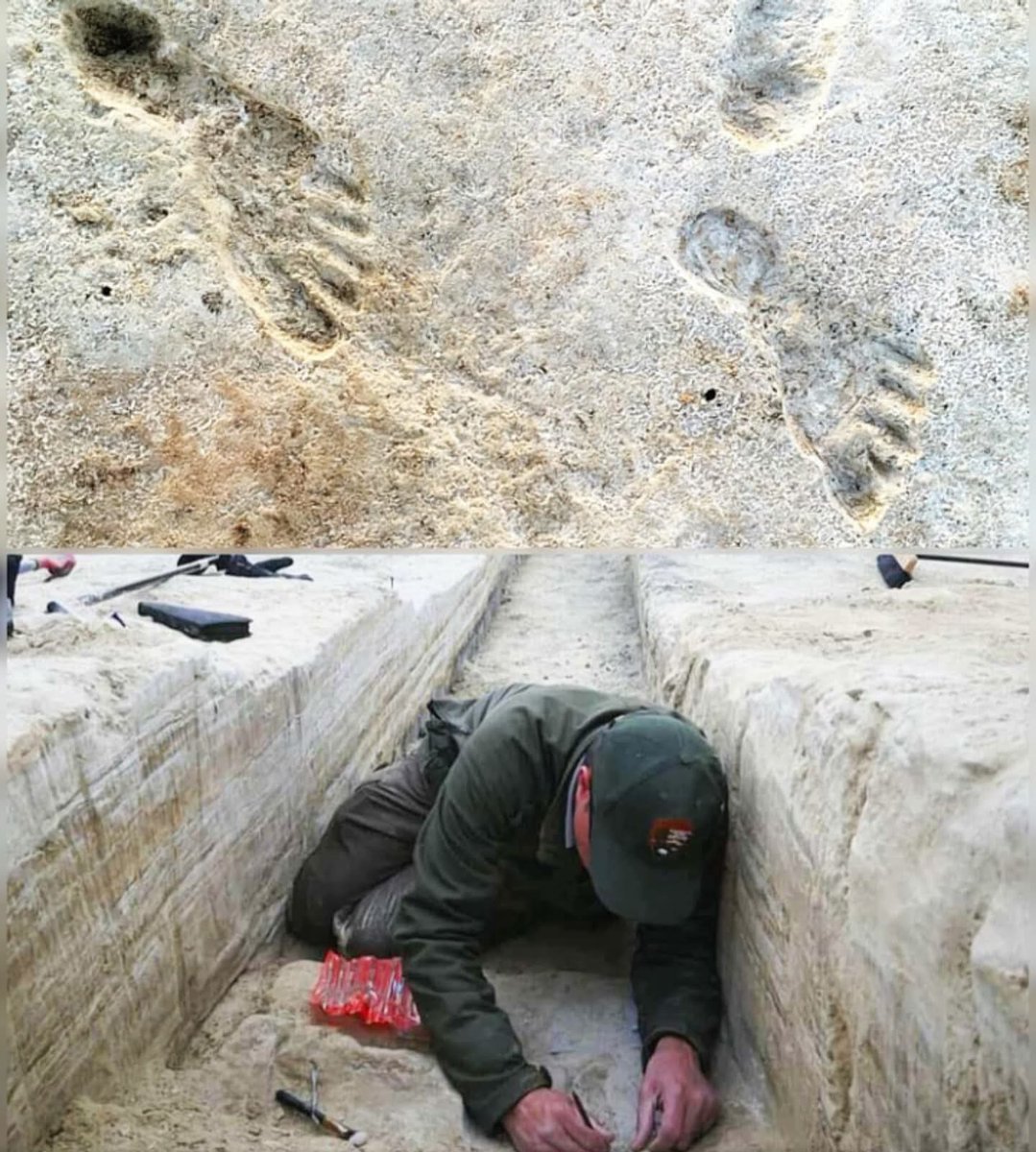
23,000 years ago humans walked across what is now White Sands National Park in southern New Mexico and their footprints are still there...
Preserved in layers of gypsum rich sediment these tracks belong to adults and children moving across a wet Ice Age lakebed while mammoths giant sloths and dire wolves roamed nearby. Some trails even show children being carried set down and picked up again snapshots of real human behavior frozen in time. In several cases human tracks intersect with megafauna prints suggesting people were not just passing through they were actively navigating a dangerous landscape.
What makes this discovery so striking is the date. At over 23,000 years old these footprints place humans in North America during the height of the last Ice Age thousands of years earlier than the long accepted timeline. Researchers dated the tracks by radiocarbon testing ancient seeds of ditch grass trapped in the sediment layers directly above and below the footprints. Multiple samples from different layers produced consistent results strengthening the reliability of the age.
The tracks survived because they were pressed into soft wet ground then rapidly buried and sealed by fine gypsum sediments before erosion could erase them.
This is not a theory built from fragments. It is direct evidence of human presence.
So the question is simple how many chapters of human history are still literally buried beneath our feet?
#archaeohistories
English
@BadgerWaffen @Witchery_Way @histories_arch Do you have proof or is this just an opinion? Honest question
English
English

@JacobLewis64526 @histories_arch Just because they made up a number for how old the earth is doesn't mean it's true. Scientists don't have all the answers. Remember when Fauci lied to us and said he was science. Man knows nothing, God knows all.
English
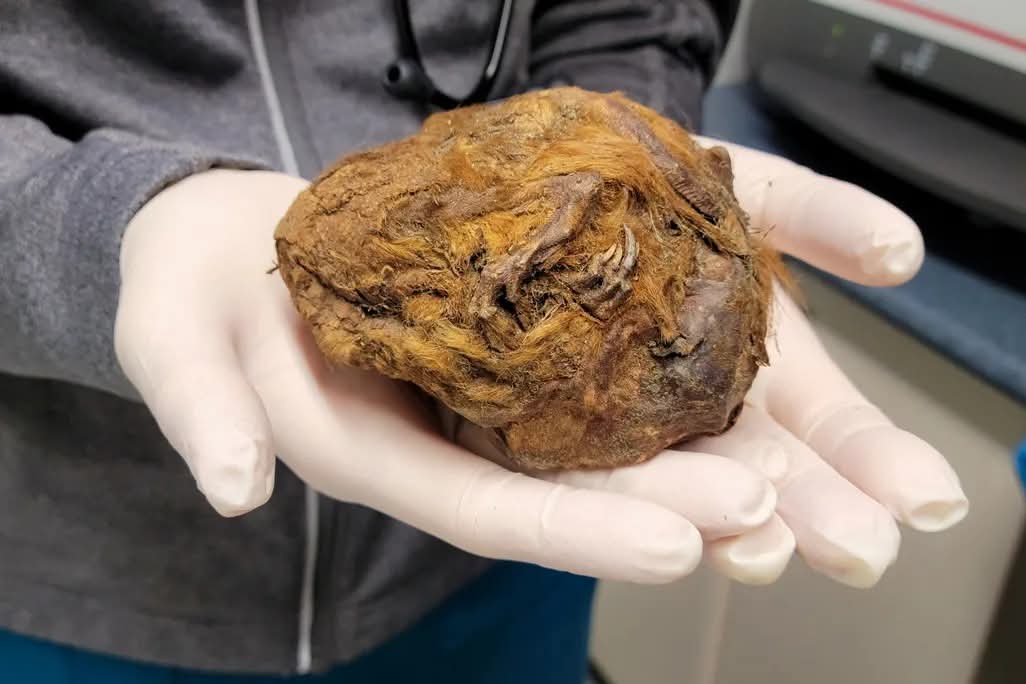
Miners working in Northern Canada in 2018 discovered a small, tannish-brown lump that appeared to be made of fossilized fur...
Now, after studying the mysterious blob, paleontologists say it’s a perfectly preserved Arctic ground squirrel that lived roughly 30,000 years ago during the Ice Age. The creature, which was curled up into a tight ball, likely died while hibernating.
At first, the furry, fossilized lump didn’t resemble much of anything. But upon closer inspection, researchers spotted the squirrel’s little feet and claws, as well as its ears and tail.
After spending several millennia in the permafrost, the squirrel’s remains were too fragile to try to unfurl. So, researchers enlisted the help of a veterinary practice with an X-ray machine. Before scanning the animal, they worried the images wouldn’t be clear; perhaps the bones’ calcium had deteriorated over such a long period of time. But their X-rays revealed a remarkably intact skeleton. Paleontologists suspect the squirrel was young, but their analyses didn’t explain how it died.
Arctic ground squirrels survived after the Ice Age and still inhabit Yukon and Alaska today. That makes them especially intriguing to scientists, who wonder if these little mammals may be able to withstand future changes to the climate, too.
#archaeohistories
English
@Lynne1119740 @JacobLewis64526 @histories_arch Nah, his point makes lerfect sense. If you dont get it, maybe just move along. Its not that difficult
English

@JacobLewis64526 @histories_arch Then your point was rather pointless
English
English
@JacobLewis64526 @histories_arch Actually the earth is 4.543 billion years old.. look up your facts before leaving comments.
English
English

@FrankMillerIII1 @archeohistories The large stones which make up the bulk of the great pyramid were quarried only a few hundred meters away
English
This stone is just one of the 2.3 million stones believed to have been cut, dragged, and lifted to construct the Great Pyramid over 5,000 years ago. The sheer number of stones involved in the pyramid's construction speaks to the monumental effort required to build such an ancient wonder of the world. Each block, some weighing several tons, was carefully shaped and moved into place, showcasing the incredible skill and organization of the workers involved.
The construction of the Great Pyramid has long been a subject of fascination and speculation. While the exact methods used remain a mystery, it is widely believed that workers employed a combination of ramps, levers, and sheer manpower to move and position these massive stones. The precision with which the stones were placed remains a testament to the advanced engineering knowledge of the ancient Egyptians.
Despite the passage of thousands of years, the Great Pyramid still stands as a symbol of human achievement and ingenuity. The remarkable feat of transporting and assembling these millions of stones continues to awe historians, architects, and visitors from around the world, solidifying the pyramid's place as one of the most impressive structures ever built.
© Reddit
#archaeohistories

English
@KittyCopacetic @Dvalways78 @archeohistories Do you try to perpetuate racism out of anything and everything always or just right now? Lol
English

@Dvalways78 @archeohistories At this angle you can really see that the Sphinx face was a black man face. I believe that they destroyed the nose because it would have been more identifiable of that fact. Just a thought.
English
A grainy photograph taken in 1864 shows a group of Japanese samurai standing in front of the Great Sphinx of Giza in Egypt. This jolting image messes with our sense of history – the traditional Japanese clothes, the ancient Egyptian monument, and the European camera just don’t seem to add up. As unexpected as this combination may be, the 161 year-old photograph highlights a pivotal moment in the history of Japan and the globalized world.
The image depicts the Second Japanese Embassy to Europe, also called the “Ikeda Mission.” Under the order of the Tokugawa shogunate, the military dictators who ruled feudal Japan, local governor Ikeda Nagaoki was sent off to Europe in 1864 in a bid to resolve a burning disagreement over the port of Yokohama.
Alongside the 27-year-old was a delegation of 36 men. As we can see in images of the men taken in Paris, many were armed with two swords – an honor that was reserved for samurai, the educated warrior class of Japan who wielded significant political power at the time.
The second half of 19th Century was a time when Japan was at an existential crossroads. European colonizers had taken control of huge swathes of Asia, as well as Africa and the Americas. To hold them at bay, Japan had been acting on a strict isolationist policy called sakoku since 17th Century that attempted to cut off the island from outsiders in a push to preserve their culture. As part of this policy, Christianity was strictly forbidden and they only traded with the Chinese and the Dutch.
The proud island of Japan had managed to stay relatively untouched by the relentless force of colonialism, but it became increasingly clear that change was knocking at their front door. Around 1853, US Commodore Matthew Perry arrived on the shores of Yokohama with a fleet of American warships and demanded that Japan open up its ports for international trade. Reluctantly, they agreed, and the coastal settlement of Yokohama quickly became a hub of foreign trade.
Japan was understandably uneasy about the growing influence outsiders had on their country and anti-foreign sentiment became inflamed. In 1863, Emperor Kōmei promoted the edict: "Revere the Emperor, Expel the Barbarians." As part of the push to take back control, Ikeda was ordered to travel to France and demand an end to the open-port status of Yokohama. Onboard a French warship, Ikeda and his crew set sail, making stops in Shanghai, India and Cairo.
When making their pitstop in Egypt, they took the time to visit the Great Pyramids of Giza. It is here, at the foot of the Sphinx, where the delegation had their picture taken by photographer Antonio Beato. After traveling through Egypt by train, expedition set sail through the Mediterranean and eventually arrived in France. Ikeda met with the French, but their demands to close the port of Yokohama were outright rejected and the mission crumbled in total failure.
Japan was eventually forced to let go and concede. In 1868, the Japanese kick-started the Meiji Restoration. Following the overthrow of the Tokugawa Shogunate, the island opened its doors to Westernization, sparking rapid modernization, industrialization, and urbanization. Amid intense social change, Japan didn’t lose its identity. Still paying attention to their tradition and culture, Japan rose to become an imperial powerhouse that started to rival the West.
Perhaps they didn’t know it at the time, but when the Ikeda Mission stood at the foot of the Sphinx in 1864 they were standing on the precipice of Japan’s contemporary history, with the world's pre-modern past behind them and the uncertain modern future ahead.
📷© Antonio Beato
© IFL Science
#archaeohistories

English
@sobyx1 @archeohistories All those papers are probably lists if friends be still needs to pardon after they broke a bunch of laws. Lol
English


On the day of Albert Einstein’s death, instead of going to Princeton hospital like other reporters, a photographer named Ralph Morse went to Einstein’s office and bribed the superintendent with a fifth of scotch to let him in. He then took these photos of Einstein’s desk mere hours after he died.
Albert Einstein died on April 18, 1955, at the age of 76. As news spread, journalists and photographers hurried to the Princeton Hospital where he had spent his final hours. But Life magazine photographer Ralph Morse thought differently. Rather than joining the crowd, he realized that Einstein’s office at Princeton University might hold a more meaningful glimpse into the scientist’s life. With a quick bribe of a bottle of scotch to the building’s superintendent, Morse gained entry and captured hauntingly intimate photographs of Einstein’s cluttered desk, shelves, and chalkboard, frozen in time only hours after the physicist’s death.
The desk was piled high with papers, journals, and notes, an image of a mind still at work. The blackboard, filled with equations, showed Einstein wrestling with his final problems. These photos became iconic not only for their historical significance but also for their poignancy, reminding the world that genius itself is often born from chaos.
Einstein once said, “If a cluttered desk is a sign of a cluttered mind, of what, then, is an empty desk a sign?” making this photograph of his workspace all the more fitting as his final portrait.
© Historical Photos
#archaeohistories

English
@DannyRHill1 @archeohistories The real issue here is that, is that desk with the computer clean, or cluttered? 😂
English

@archeohistories Thank you for the picture, it's now my desktop on pc.
English

@Doobie1959 @archeohistories Yes, he got his work done and cleaned up his desk.
He’s not just a genius, his organizational skills and emotional intelligence is off the charts too.
English
@TheJimmyHustle @brian_slei93374 @archeohistories Doesn't need to be a teacher to see how bad it is 😂
English
@brian_slei93374 @archeohistories Somewhere an English teacher read this and had a heart attack.
English
English

@Sauce04240603 @histories_arch Agreed this is a bs attempt at creating a false narrative that will explain the fact that they are actually alien ancestors or something
English
These elongated skulls date to the Paracas Necropolis period, around 2,000 years ago, discovered near Pisco in northern Paracas, Peru. Their cone-like shape wasn’t the result of disease or mutation. It was intentional, done during infancy through prolonged head shaping while the skull was still soft.
What keeps people talking are the measurements. Some independent examinations have claimed unusually large cranial capacity, heavier skull mass, and altered eye and jaw proportions. At the same time, CT scans and osteological studies classify these skulls as fully human, with the differences attributed to external shaping rather than genetic deviation or a separate population.
Hundreds of intentionally modified skulls have been recovered from Paracas burial sites, making this one of the largest concentrations of cranial deformation ever found.
So the form is deliberate. The biology is human. The unanswered part is why Paracas elites pushed this practice to such extremes.
Regional Museum of Ica, Peru
#archaeohistories

English
@issa_mum @arielhelwani It almost seemed like aj was pulling many of his punches.
English

@arielhelwani Whether Jake was running around the ring or not, AJ should still be able to finish him before r6.
The fact AJ landed 3 times to chin and couldn’t knock out says alot.
English

"Jake Paul lasted longer than 18 of Anthony Joshua's opponents, some of which were heavyweights that were 24-0, 25-0, 26-0.
There was no world where Jake Paul was going to come to Anthony Joshua, stand right in front of him, and say, let's throw down, blow for blow, even though I walk around at 207 -209 on a regular day, and you walk around at 250-260.
He deployed his strategy and he did a lot more effectively than people thought."
@nakisa_bidarian shares his thoughts on Jake Paul's game plan.
English
@TinyVyolin @arielhelwani And sadly, next time paul fights, there will be another fuck ton of people watching it. Wild to think there's far less viewership when some of the best boxers on the planet get in the ring yet so many will tune in to watch this subpar boxer because of his mouth lol.
English

@arielhelwani They're really doubling down on this narrative... What a pathetic attempt to throw mud in people's eyes "No, what you saw is not what you think you saw! Let me tell you what you saw!!!"
Bunch of scammers that defrauded absolutely every viewer and spectator
GIF
English