

Beth Hall PhD
69 posts

Beth Hall PhD
@BethHallPhD
Vision scientist by trade, multimodal by heart ❤️
San Francisco, CA Katılım Haziran 2026
317 Takip Edilen59 Takipçiler

Beth Hall PhD retweetledi

Just joined @andy_weber_tv LIVE from FOX 46 Charlotte! @Queen_City_News
We discussed how the Trump Administration is rooting out SNAP fraud, fighting for a more affordable America, and MORE.
Tune in tonight for the full conversation!

English
Beth Hall PhD retweetledi

The @DeptofWar has announced the final FY2026 cohort of Accelerate the Procurement and Fielding of Innovative Technologies (APFIT) awardees, rapidly delivering a new set of innovative technologies to the American warfighter.
With this round of awards, APFIT has now surpassed $2 billion in total awards and delivered 100+ unique capabilities to the Joint Force.
Through APFIT, the Department will continue to partner with emerging innovators and nontraditional companies to rapidly deliver mission ready technology at speed and scale.

English
Beth Hall PhD retweetledi

We're introducing Claude for Teachers: free access to premium Claude capabilities for verified K-12 educators in the US, with a library of teaching skills and a direct connection to evidence-based curricula, mapped to academic standards in all 50 states.
claude.com/solutions/teac…

English
Beth Hall PhD retweetledi
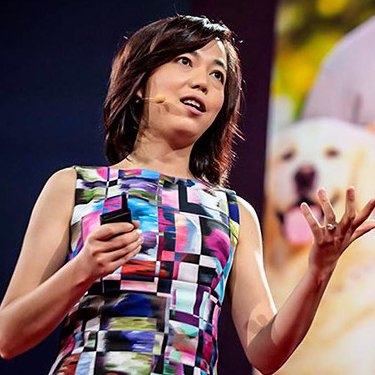
AI’s next chapter will be defined not only by technical progress, but by how responsibly and thoughtfully we bring it into the world.
I’m looking forward to be speaking on stage at Ai4 2026, Aug 4–6 in Vegas. Register here at ai4.io/register/
#Ai42026
English
Beth Hall PhD retweetledi

How do physical systems achieve collective intelligence and self-repair without a central brain?
A new paper published today in Nature Communications by my Sakana AI colleague Sebastian Risi (@risi1979), along with co-authors from IT University of Copenhagen and Autodesk Research, presents a beautiful realization of biologically inspired robotics: Smart Cellular Bricks.
The team built a system of physical 3D cubic units that can collectively infer their global shape and autonomously guide their own damage recovery using purely local interactions.
Here is a deep dive into the paper’s key contributions:
1/ Neural Cellular Automata-based Architecture:
Modular robots usually rely on central processors. This system flips that paradigm. Every block independently runs the exact same neural network on local microcontrollers. With no master plan or global coordinates, they communicate only with immediate neighbors. By passing continuous state vectors, hundreds of bricks achieve global consensus on their shape in under 3 minutes.
2/ Emergent Biological Morphogens:
How does a block know it is part of a chair, not a table? The network’s internal memory automatically learns to establish continuous gradients across the structure. This beautifully mirrors how biological morphogens give positional info to developing cells. The bricks naturally form left-right, radial, and head-to-tail axes to align their identity.
3/ Performance and Generalization:
Validated in large-scale simulations, the networks transferred seamlessly to nearly 200 physical hardware bricks, achieving a 100% convergence rate. Instead of rigid template-matching, the system infers broad categories. Even when tested on unseen variations, like an asymmetric table with five random legs, the collective correctly classified the structure.
4/ Fault Tolerance and Autonomous Damage Recovery:
Hardware fails in the real world. This system easily tolerates up to 15% module failure without losing accuracy. By predicting spatial damage directions, the cells pinpointed missing components with 95% accuracy. They actively use these local signals to guide a self-repair process, regenerating back into the intended morphology.
I believe this is a significant piece of research, bridging collective intelligence and Physical AI.
This work represents the first successful physical realization of large-scale, decentralized 3D self-recognition and damage detection. By moving away from centralized control, this architecture paves the way for highly adaptive smart materials and resilient robotics that can survive and repair themselves.
Read the full open-access paper:
nature.com/articles/s4146…
Congratulations to the team on this achievement!
Sakana AI@SakanaAILabs
We are pleased to share our latest research, now published in Nature Communications: “Smart Cellular Bricks: Physical Modules That Recognize Their Own Shape and Repair Themselves.” Blog: sakana.ai/smart-cellular… Paper: nature.com/articles/s4146… A long-running theme in our work is collective intelligence: the idea that sophisticated, robust behavior can emerge from many simple parts following local rules, with no central controller, as it does in a colony, a tissue, or a brain. We had mostly studied this in software and simulation. So this time we asked a simple question. Do the same decentralized principles hold up in the physical world, where communication is noisy and modules fail? To find out, we built a collection of simple cubic bricks. Each brick runs the same small neural network and talks only to the bricks it is physically connected to. No brick is told its position, or which shape it is part of. Yet from these purely local exchanges, the collective converges on the correct global shape, locates where modules are missing or damaged, and can even guide its own repair, inspired by how living tissue self-organizes and regenerates after injury. For us, this is a first step in a broader direction: taking the principles of collective intelligence we have studied in software and letting them emerge, decentralized and robust, in the physical world. In the future, we imagine smart materials that let structures sense and report damage on their own, and LEGO-like systems that recognize their own configuration and adapt in real time, pointing toward environments that are more robust, adaptive, and regenerative. This work is a collaboration between Sakana AI, IT University of Copenhagen and Autodesk.
English
@blakeaburge Hmmmmm. But I like a man who puts on a cute outfit.
English

Major cheat code for life: Make peace with being unimpressive to the outside world. Drive the normal car. Wear the simple clothes. Live below your means. Stay in the committed relationship. The ability to look ordinary while building an extraordinary life is wildly underrated.
English

Smartglasses are an inevitability, a new consumer-tech arms race for the last and best real estate on our bodies, writes Christopher @Mims. But what—and more important, who—are they for? on.wsj.com/4wD6p79

English


hosting a @bondhq_ launch party soon!! world cup themed 👀
requirements to attend:
> must be willing to dance on tables
invite only, dm me or comment if you want in 🕺🕺


English
@EmilyDreyfuss Yeah way above the postbac salary. Great for those post BS / BA degree who want to dip their toes in research
English

This is for an RA position, though -- the entry-level science position people get after undergrad and before PhD. This salary is above the range that academic labs pay for the same role.
“paula”@paularambles
$65k to help build the future of biology in san francisco the first experiment is whether you can survive on that
English
Beth Hall PhD retweetledi

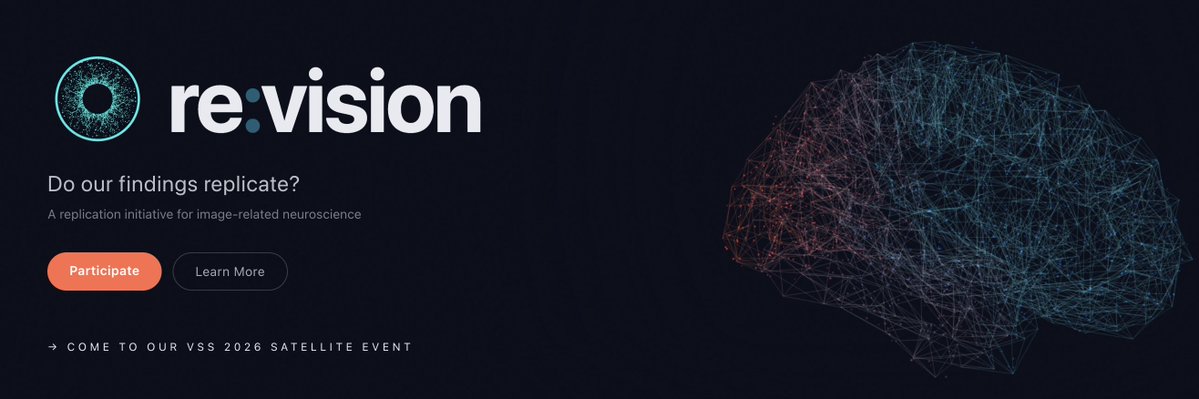
We are excited to open the re:vision initiative, a community-driven initiative for replicating and generalizing findings in visual neuroscience, based on the LAION-fMRI dataset.
re-vision-initiative.org
Why this initiative and why would you want to participate? 🧵
English
@prof_kamilov Yeah, but you know that's the best part 😅 you've got 3 frenemies for life who will always give a shit about what you have to say
English

Academia is fascinating. You spend years becoming the world’s expert on something eight people care about, and three of them disagree with you.
English


Can't believe this batch of PhD students gets to go to Seoul, Vienna, Singapore, Kyoto, San Diego, Hawaii
while the previous batch visited Gather Town, and the one before that apparently just went to New Orleans multiple times
English
Beth Hall PhD retweetledi

Humans sense the visual world with a super wide angle view (over 180 degrees!), with increasingly high resolution and precision at the center of gaze—we made a sensor interface so models can too! Proud of this work, and where it enables us to look next 😉 #neuroai
Nick Blauch@nmblauch
Machines see the world fundamentally differently from humans, and it's costing us a lot of tokens. Where machines see uniform rectangles, our brain sees a variable resolution retinal array reformatted into a magnified manifold in primary visual cortex, enabling high-resolution and wide field-of-view at minimal computational cost. In our new ICML paper, we enable the same mechanism for deep vision models. 🧵 ↓
English
Beth Hall PhD retweetledi

CCN began at Columbia in 2017. As #CCN2026 returns to NY, a special Back2NY event will feature a crowd-sourced panel discussion on how the community has grown, prior challenges, and future perspectives.
Share your experiences in the community survey: 2026.ccneuro.org/back2ny/
English
Beth Hall PhD retweetledi

Thrilled to share that I'll be joining @Stanford as an Assistant Professor of Ophthalmology and retina specialist!
My lab will open September 2026 and aims to accelerate the development of safe and effective genetic therapies.

English
Beth Hall PhD retweetledi

Priscilla Chan says rare diseases get ignored because they're too niche to make big bets on.
She explains why decentralizing the tools changes that:
"If you put the tools in that person's hands, they're gonna be able to make progress in a way if you had to focus your efforts and make big bets, you probably wouldn't.”
English