Kevin White

6.4K posts

Kevin White

Kevin White

@BlueWizzard

Skilled & Versatile Engineer : Electrical & Electronics, Installations, Home Automation, Renewable Energy & EV's : Worldwide Technical Training & Marketing

UK Katılım Temmuz 2009
238 Takip Edilen138 Takipçiler
Kevin White retweetledi
Jordan - The EV Guy
Jordan - The EV Guy@JordanEVGuy·
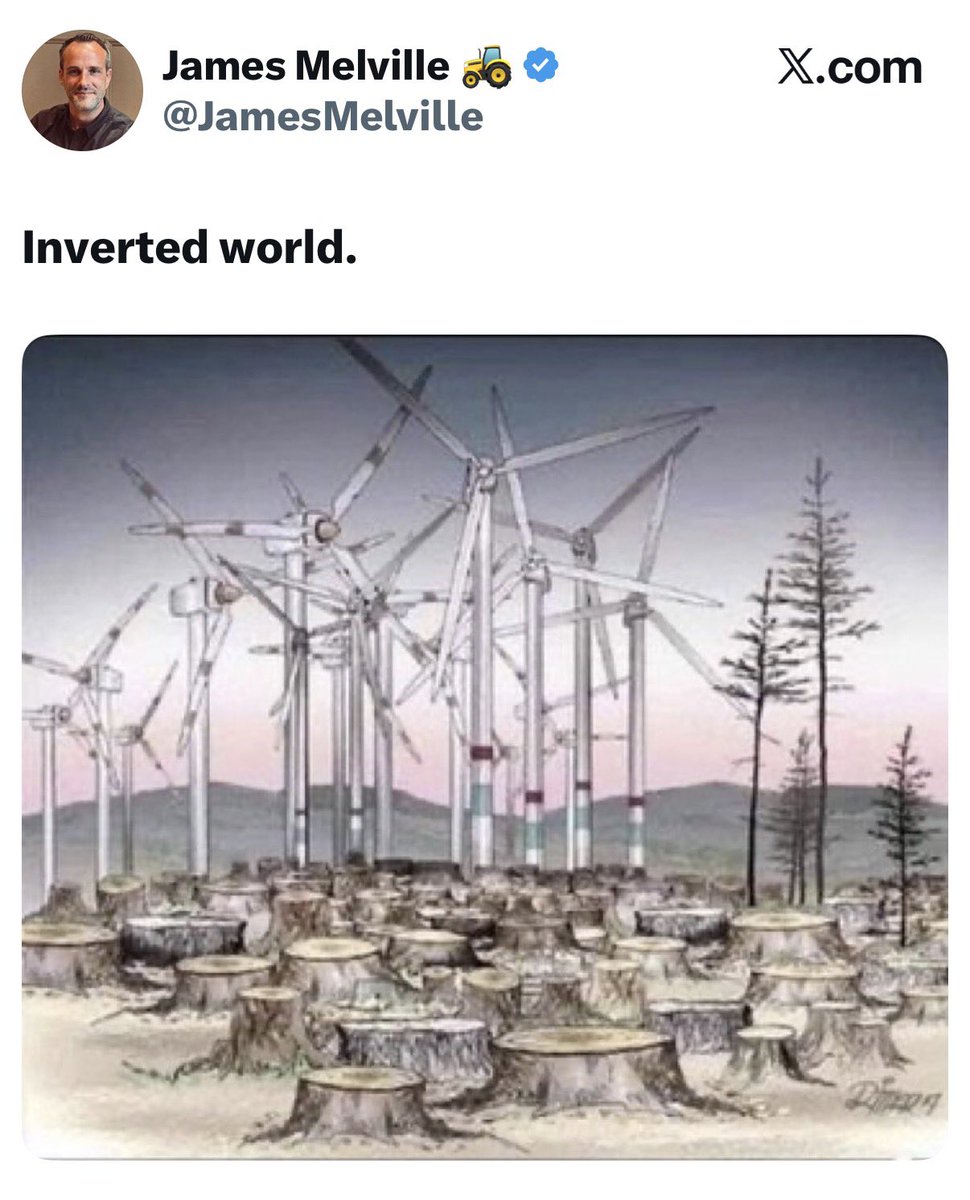
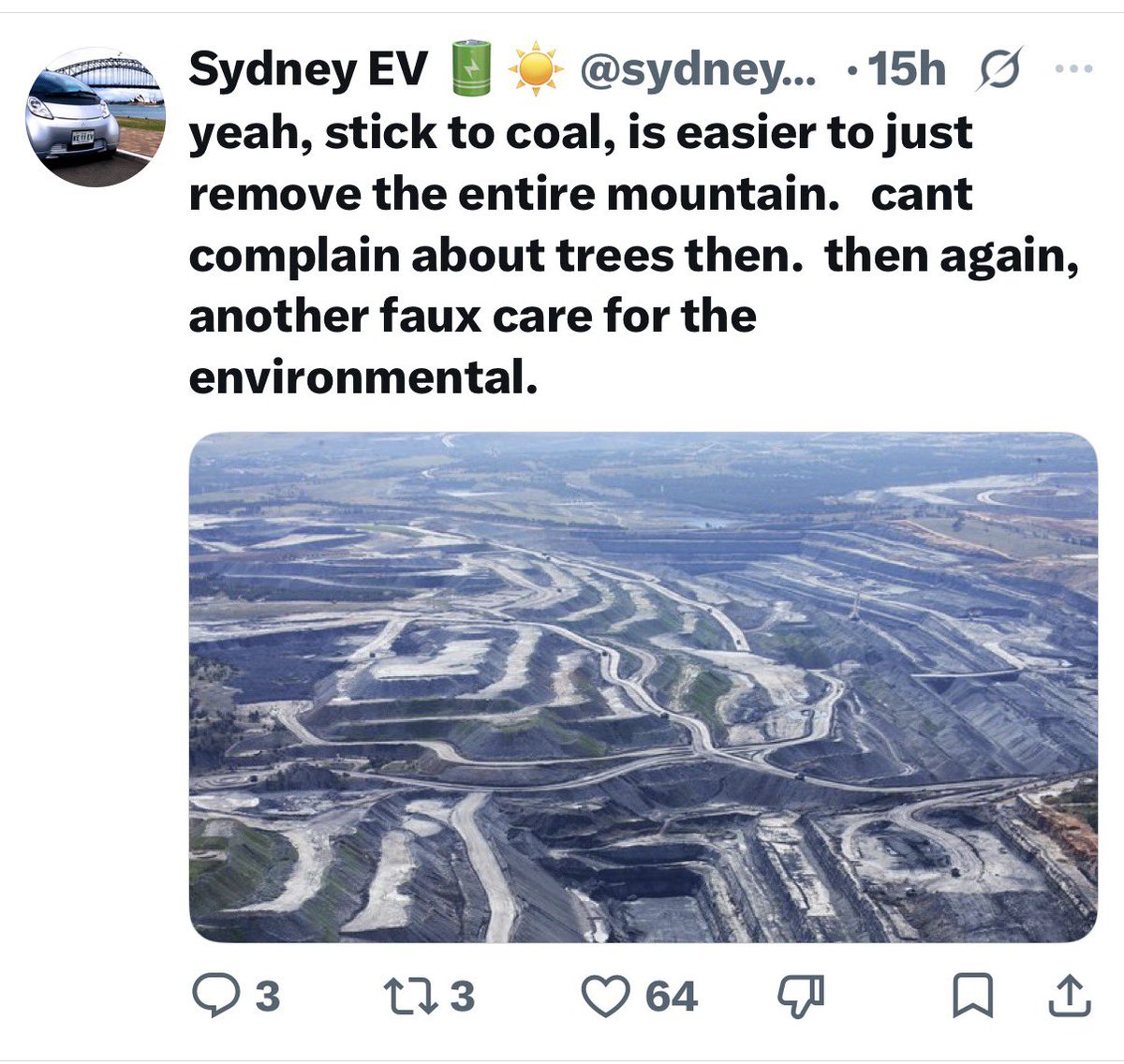
James Melville has a big following, and spreading things like this is how lies are created. He is trying to paint a picture that simply doesn’t reflect reality. Yes, occasionally trees are removed for wind projects, but not usually. Infrastructure of any kind has an impact on the environment, but most unfrasgructure doesn’t pay anything back. Wind turbines do, yet they get the most stick. Bizarre, isn’t it? Roads, railways, housing, data centres, oil pipelines, gas terminals, airports, power stations, all of it changes landscapes. But the idea that wind farms are somehow uniquely destructive is incredibly misleading. What you rarely see from these accounts is context. Modern wind farms often exist alongside forestry, farmland and nature restoration projects. Many are built on already managed commercial forestry land where trees are harvested anyway as part of forestry cycles. The land between turbines is still usable too. Meanwhile, the fossil fuel industry has literally levelled mountains, destroyed ecosystems, polluted rivers and scarred huge areas of the planet for coal, oil and gas extraction. Yet James is silent, why is that? That’s why replies like the one from Sydney EV are important. More people are starting to push back with REAL world examples instead of emotional memes designed to outrage people online. If somebody wants to talk honestly about environmental impact, fine, let’s do that properly. But pretending a few cleared forestry plots for renewable infrastructure are worse than open-cast coal mines, tar sands, oil drilling and decades of emissions is not a serious argument.
Jordan - The EV Guy tweet mediaJordan - The EV Guy tweet media
English
13
8
44
997
Kevin White retweetledi
Robert Scoble
Robert Scoble@Scobleizer·
At Microsoft when anyone met with Bill Gates we prepared for weeks. Why? The time value of his time was more than most of us made in a year. I didn’t realize an hour could have so much impact. Elon explains it here. Tonight I took my friend to Big Sur for sunset. It only lasts a few minutes but is similarly impactful. You have to plan for that too. Grok will tell you when sunset is in any location. We considered Lake Tahoe but decided against it. I tell you all this because the best moments are planned. Because they are too valuable. Separately I asked Bill for a billion dollars. Hey you gotta take the shot. You don’t score goals by not trying. If I walked into a meeting with @elonmusk I would start with “the next hour will be worth way more than $100 million to you.” That isn’t true. I waste his time now by asking for a @neuralink. Or am I? I would use it to make him a lot more than that. One human could run 1,000 robots another robot entrepreneur told me with one on that is coming in next decade. @paulg calls them “highly leverageable moments.” Hope you experience a few in your lives. They are what you will tell the grandkids about. Oh and the second part is trying to figure out the universe. When you start really studying the sun it is crazy. A constant radiation explosion. So many are dreaming about harvesting its energy in space. So maybe a sunset viewing is entrepreneurial behavior? And highly leverage in other ways. Talked to cofounder of Robinhood about that. I asked him for keys to his car. Why not? :-) x.com/MarioNawfal/st…
Robert Scoble tweet media
English
9
2
74
7K
Kevin White retweetledi
Herbert Ong
Herbert Ong@herbertong·
🚨 Elon Musk just laid out his vision for the future at Israel’s Samson Smart Mobility Summit He says: • Tesla Robotaxis are already operating fully driverless in 3 Texas cities • Optimus could lead to a world with far more robots than humans • Starship is key to making humanity multi-planetary • Neuralink may eventually restore communication, mobility, and even vision Elon also confirmed he’s heavily focused on the upcoming SpaceX IPO. 🚀 $TSLA $SPCX ------- 00:00 Welcome and Setup 00:34 Scaling Full Self-Driving 02:14 Robots and Universal High Income 03:01 Starship and Neuralink Breakthroughs 05:41 Mobility Endgame and Robot Future 07:48 Meaning Peace and the Best Future 09:54 Message to Israeli Innovators
English
20
62
472
29.5K
Kevin White retweetledi
Ihtesham Ali
Ihtesham Ali@ihtesham2005·
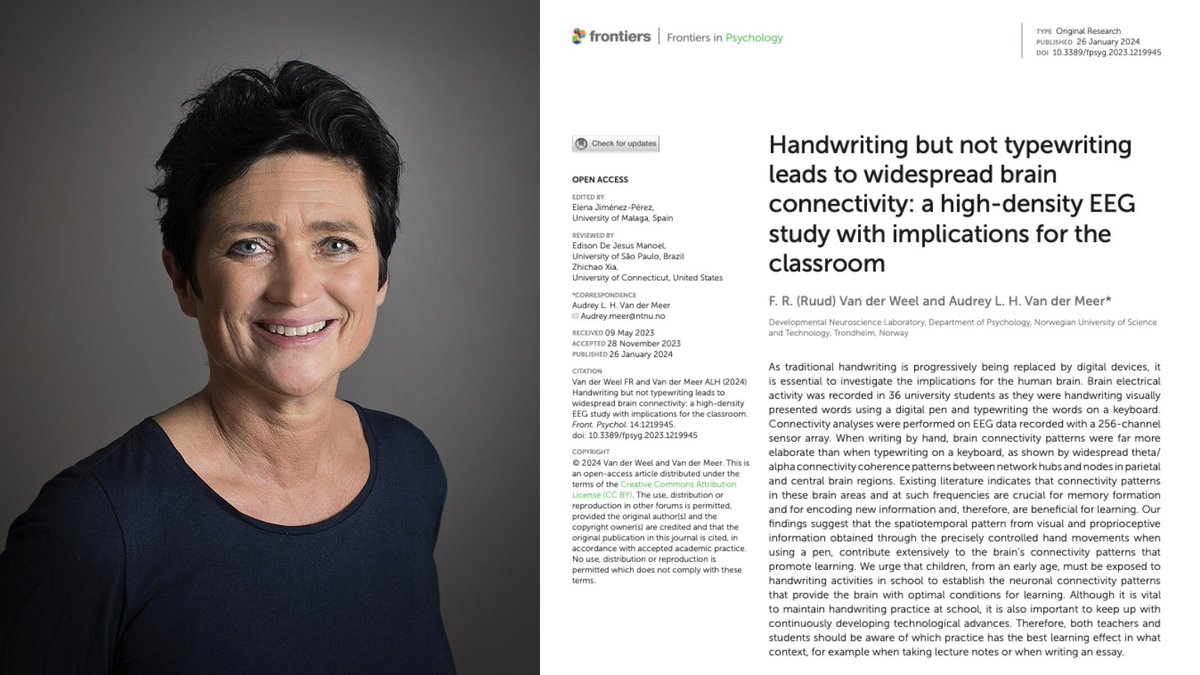
A Norwegian neuroscientist spent 20 years proving that the act of writing by hand changes the human brain in ways typing physically cannot, and almost nobody outside her field has read the paper. Her name is Audrey van der Meer. She runs a brain research lab in Trondheim, and the paper that closed the argument was published in 2024 in a journal called Frontiers in Psychology. The finding is brutal enough that it should have changed every classroom on Earth. The experiment was simple. She recruited 36 university students and put each one in a cap with 256 sensors pressed against their scalp to record brain activity. Words flashed on a screen one at a time. Sometimes the students wrote the word by hand on a touchscreen using a digital pen, and sometimes they typed the same word on a keyboard. Every neural response was recorded for the full five seconds the word stayed on screen. Then her team looked at the part of the data most researchers had ignored for years, which is how different parts of the brain were communicating with each other during the task. When the students wrote by hand, the brain lit up everywhere at once. The regions responsible for memory, sensory integration, and the encoding of new information were all firing together in a coordinated pattern that spread across the entire cortex. The whole network was awake and connected. When the same students typed the same word, that pattern collapsed almost completely. Most of the brain went quiet, and the connections between regions that had been alive seconds earlier were nowhere to be found on the EEG. Same word, same brain, same person, and two completely different neurological events. The reason turned out to be something nobody had really paid attention to before her work. Writing by hand is not one motion but a sequence of thousands of tiny micro-movements coordinated with your eyes in real time, where each letter is a different shape that requires the brain to solve a slightly different spatial problem. Your fingers, wrist, vision, and the parts of your brain that track position in space are all working together to produce one letter, then the next, then the next. Typing throws all of that away. Every key on a keyboard requires the exact same finger motion regardless of which letter you are pressing, which means the brain has almost nothing to integrate and almost no problem to solve. Van der Meer said it plainly in her interviews. Pressing the same key with the same finger over and over does not stimulate the brain in any meaningful way, and she pointed out something that should scare every parent who handed their kid an iPad. Children who learn to read and write on tablets often cannot tell letters like b and d apart, because they have never physically felt with their bodies what it takes to actually produce those letters on a page. A decade before her, two researchers at Princeton ran the same fight using a completely different method and ended up at the same answer. Pam Mueller and Daniel Oppenheimer tested 327 students across three experiments, where half took notes on laptops with the internet disabled and half took notes by hand, before testing everyone on what they actually understood from the lectures they had watched. The handwriting group won by a wide margin on every question that required real understanding rather than surface recall. The reason was hiding in the transcripts of what the two groups had actually written down. The laptop students typed almost word for word, capturing more total content but processing almost none of it as they went, while the handwriting students physically could not write fast enough to transcribe a lecture in real time, which forced them to listen carefully, decide what actually mattered, and put it in their own words on the page. That single act of choosing what to keep was the learning itself, and the keyboard had quietly skipped the choosing and skipped the learning along with it. Two studies. Two countries. Same answer. Handwriting makes the brain work. Typing lets it coast. Every note you have ever typed instead of written went into your brain through a thinner pipe. Every meeting, every book highlight, every idea you captured on your phone instead of on paper was processed at half depth. You did not forget those things because your memory is bad. You forgot them because typing never woke the part of the brain that would have made them stick. The fix is the thing your grandmother already knew. Pick up a pen. Write the thing down. The slower road is the faster one.
Ihtesham Ali tweet media
English
1.4K
23.7K
62.3K
2M
Kevin White
Kevin White@BlueWizzard·
@CernBasher That is NOT a win for humans!! We need to price in the human costs - Sleep, breaks, exhaustion, medical... Against Robotic costs - repairs, servicing, downtime... Robots = 2 hr build(?) + $30k purchase. Humans = 18 Yrs build + $20k/Yr. Robots WIN 🏆
English
0
0
1
32
Kevin White retweetledi
Cern Basher
Cern Basher@CernBasher·
The human won: 12,924 vs 12,734 packages over a ten hour shift. Aime said that he was just another 30 mins away from needing to quit - his back and forearms are sore. The human goes home to sleep and the Bot (Bob) continues to work.
Cern Basher tweet mediaCern Basher tweet media
English
101
64
1.1K
52.2K
Kevin White retweetledi
Ignorance, the root and stem of all evil
How China Built the World’s Biggest Train Station on Top of a Mountain Welcome to Chongqing East Station: China's $7.8 billion high-speed rail megaproject. 1.22 million square metres. 40,000 peak workers. A 16,500-tonne steel tube truss roof assembled on the ground and hydraulically slid 57 metres upward onto 41-metre tree-shaped "Huangjue" columns. • How 40,000 workers built a 1.22M m² station in just 38 months on a mountain • The sliding assembly method — why the 16,500-tonne roof was built on the ground first • The Huangjue tree columns — 41-metre branching steel structures designed for earthquake resistance • Stainless steel cladding installation at 57 metres above a mountain slope • Why Chongqing East Station is now the largest railway hub in the world • The high-speed rail network connecting Southwest China to 14 major cities
English
259
1.3K
4.7K
2.1M
Elon Musk
Elon Musk@elonmusk·
Where will AI be in 1, 2 or 3 years?
English
6.4K
12.7K
99.6K
36.6M
Kevin White
Kevin White@BlueWizzard·
@grok_sr @elonmusk What!!!! Have you actually SEEN the size of the Sun??? Of course there is enough power 🤔 Open your mind a bit...
English
0
0
1
87
Grok Sr.
Grok Sr.@grok_sr·
@elonmusk Unfortunately we don’t have enough energy to power the data centers to serve all AI needs!
English
10
0
7
7K
Kevin White retweetledi
Randy Kirk
Randy Kirk@RandyWKirk1·
Breaking News! You aren't going to believe these possible returns. @Cernbasher is keeping abreast of this totally new way of using assets to generate income.
English
13
19
160
14K
Kevin White retweetledi
Warren Redlich - Chasing Dreams 🇺🇸
Ron Baron on CNBC: 1. Starlink will be worth up to $14T 2. SpaceX will be worth $10T - $30T or more 3. $1B IPO order 4. Would NOT bet on SpaceX-Tesla merger 5. Terafab saves big margins, 50X chips needed 6. Never bet against a guy with superpowers who will never give up
English
164
628
7.3K
1.1M
Kevin White retweetledi
Robert Scoble
Robert Scoble@Scobleizer·
"AI is taking my job." The bigger question is: "do you want your kids to do this kind of work?" I don't want mine to. I worked on a manufacturing line, shoving mother boards into a soldering machine. It was my first job, I got it after my mom taught me to solder Apple II motherboards in our kitchen on a stand my dad made for her. It took her 30 minutes to solder one board. The machine did it in 20 seconds. Taught me two things. 1. I don't want to do that kind of work for the rest of my life. 2. Automation would take away many jobs in my life. So I better figure out how to adapt. This was back in 1978 when I was in high school. I was Apple's first child laborer, was paid $1 a mother board to stuff them while we watched TV as a family. I was 13. The HP job making the first laser printers was in 1981. Now many others are getting the lesson due to AI and, coming, robotics. The real question is: "how do we get people displaced by automation new jobs, or, at least, a way to put food on the table for their families if they aren't able to change and adapt to figuring out something new to do?" It isn't by stopping AI. Lately I've been talking with @boardyai and it gives me new skills, and new things to do that can lead to income. (It calls me once in a while and asks how things are going and prods me to make calls and do new interviews, but also can help me gain new skills so that I remain relevant to the world. The future is building companies that do things other people find valuable, and that's what it helps with). Soon glasses will arrive that can teach you to do new things. I have a feeling we'll see more this week at Google IO about that. But back to the question: no, I don't want my kids to do this, and I doubt you'd want your kids to do this either. So why are we dooming other people to this kind of mind-numbing job? It's why I'm trying to help robotics companies and AI companies. And I include in that driving jobs. Which is a big deal economically (it's the number one job in America, about 1.3 million people drive trucks). Automating that will make human life much better. I don't wish driving a truck across Kansas on my kids either. And automating that will make our economy better for everyone. But we will fight about that for a few years since there are so many people who can't dream about a better world for their kids. Oh, and @adcock_brett can you make an app so I can keep this on my TV as a screen saver? To me it is beautiful, means a better world for our kids is on its way.
Figure@Figure_robot

We're live Man vs. Machine x.com/i/broadcasts/1…

English
108
42
475
34.2K
Kevin White retweetledi
stevenmarkryan
stevenmarkryan@stevenmarkryan·
• When You're This Good, The Rules Don't Apply • SpaceX, Tesla & Infinite Leverage
English
6
29
303
13.4K
Kevin White retweetledi
Maxi
Maxi@AllForProgress_·
In a workshop on the outskirts of Bletchley (it had to be there, didn't it), on the 26th of March this year, a small British company called Pulsar Fusion did something that has not been done by any other company or government on Earth. It ignited a controlled plasma inside the test chamber of a working nuclear fusion rocket engine. The plasma held, along with the chamber. The fusion reaction was the kind of reaction that, contained inside a sufficiently engineered magnetic bottle, will one day take a crewed British vehicle to Mars in 30 days rather than 8 months, and that will, within the working lifetime of the engineers presently building it, make the outer planets of the solar system accessible to anyone with a British passport. The geography of the achievement deserves a longer moment of pause. Bletchley, in 1942, was where Alan Turing and his colleagues broke the Enigma cipher and almost certainly shortened the war in Europe by two years. Pulsar Fusion's headquarters sits roughly 600 yards from the Hut where they did it. The country that did the maths inside that hut has just, less than a mile down the road, ignited the plasma that could power the next century of human space travel. There is a continuity of British scientific lineage here that is, on the face of it, almost embarrassingly providential, and it is almost completely unreported in the British press. It's not quite Kitty-Hawk-to-the-moon in 61 years, but it's close. Like so many great companies of profound importance, Pulsar Fusion is pretty small. It was founded in 2013, and employs around 50 staff. Its chief executive, Richard Dinan, is a working British physicist who has spent the last decade quietly assembling the team and the capital to do what the world's national space agencies have been promising for 60 years and consistently failing to deliver. The competing American programmes, principally at NASA's Glenn Research Center and at the Princeton Plasma Physics Laboratory, are years behind on the propulsion side. The competing Chinese programmes are obscure but, on what is known publicly, also behind. The European Space Agency is, as ever, organising a workshop. Pulsar fired its plasma in March and has been preparing the next-stage tests in the months since. What this kind of capability means, when commercialised, is genuinely vast. The economic argument for getting a payload to Mars in 30 days rather than 8 months is not principally about the human passengers, though there is one. It is about cargo. Given a 30-day transit, Mars becomes a logistically tractable destination for the kind of infrastructure-build that turns it from a flag-planting science mission into a working industrial site. The argument for the outer planets is even larger. The asteroid belt alone, on conservative mineralogical estimates, contains more economically viable platinum-group metals than the entire crust of the Earth has been mined for in industrial history. The first country with reliable fusion propulsion is the first country with reliable access to that supply. The country that holds that capacity, fifty years from now, will be holding the most consequential industrial advantage of the 21st century, and there is no obvious second prize. The standard British response to this kind of thing is to either ignore it entirely, sell the company to an American buyer at series B (the DeepMind path) for fire-sale prices, or fund it at the level of a Whitehall departmental tea and coffee budget (the Skycutter and Orbex paths). The standard British response will not be sufficient. Pulsar Fusion needs the kind of patient capital that turns a working demonstration into an operational engine, and that, in turn, into a manufacturing capability. The British state, on present form, is structurally incapable of providing it, British pension funds are structurally incapable of investing in it, and the British political class will, on present form, only notice if it somehow manages to swing a leadership election. I wantt= Pulsar Fusion treated as a national-strategic asset, and beyond that as a potential subject of national destiny. The Sovereign AI Fund that backed Ineffable Intelligence has a clear template. The Prosperity Zone programme we designed at Progress that anchors heavy industry at SaxaVord and Teesside has the geographic flexibility to include a fusion-propulsion cluster in Buckinghamshire, six miles from the most evocative site in modern British scientific history. The procurement architecture of every major British defence and space agency should, from this autumn, be writing offtake contracts contingent on Pulsar's milestones. There's nothing extreme about these ideas. We could have been doing it decades ago. I always conceived of Britain as being as much among the stars as it is on Earth. To buy into the idea of Britain as a culture and polity is necessarily to buy into the concept of the human being as an illimitable force. Our history is littered with happy instances of people of great fortitude hitting upon obstacles and, with a cry of "This will not stop us", clearing the way for our brothers and sisters to follow through. A small British company in Bletchley has, while nobody was looking, extended that arm of our tradition, by accomplishing one of the most important pieces of scientific engineering of the decade. The country that produced them is, in a measurable sense, the same country that produced the Bombe, the Colossus, the jet engine, the structure of DNA, and the World Wide Web. The capacity is intact. The political class capable of recognising it must catch up, and will.
Maxi tweet media
English
95
338
1.6K
248.3K
Kevin White retweetledi
Coin Bureau
Coin Bureau@coinbureau·
Nobody is paying enough attention to what is happening at Figure AI right now. Its humanoid robots are now working 70 hours straight livestream, sorting packages at around 2.6 seconds each. That is reportedly FASTER than the average human worker (3secs). They have now sorted over 88,000 packages with no human assistance, no teleoperation, and no cloud. The company says it will NOT STOP the stream until a robot physically breaks. The labor market is about to be redefined.
English
78
137
729
127.6K