BuildOnROKO

102 posts

BuildOnROKO banner
BuildOnROKO

BuildOnROKO

@BuildOnRoko

TG - https://t.co/mvu4vaQz7k Discord - https://t.co/ky120zlqjP Newsletter - https://t.co/eCYPhRCeog I follow $ROKO

0, +56.75 Katılım Eylül 2025
47 Takip Edilen75 Takipçiler
Sabitlenmiş Tweet
BuildOnROKO
BuildOnROKO@BuildOnRoko·
Roko Lounge EP000 starts in ~1hr! 📅 Jan 23, 2026 🕓 4:30 PM EST ⏱ 2 full hours Hosts: @Manitcor + Helen CEO of @Selfi3nt Token-gated (ROKO: 0x6f222E04F6c53Cc688FfB0Abe7206aAc66A8FF98) Join: huddle01.app/room/jag-tnyz-… Extended vibes today — grab tokens & join! 🔥
English

1
1
7
158
BuildOnROKO retweetledi
ᚱoko Network
ᚱoko Network@RokoNetwork·
ROKO NETWORK: WHY THE PHYSICS OF TIME IS THE LAST MOAT LEFT IN CRYPTO We just deleted 6,000 lines of code. Not because we failed. Because we got smarter. The "Court" reconciliation system we built was technically elegant. It handled edge cases that appear roughly once every several months of network operation. We were engineering for ghosts. So we cut it — replaced the entire apparatus with a five-second inclusion deadline, and the network didn't just survive. It got faster, cleaner, and harder to attack. This is what real protocol maturity looks like. Not adding complexity. Knowing what to remove. But the deletion isn't the story. The story is what's underneath it — and why what Roko is building cannot be replicated by any existing L1 or L2 Extreme without tearing their architecture down to the studs. The Problem No One Wants to Name Ethereum loses over $1 billion per year to MEV. MEV — Maximal Extractable Value — is the systematic extraction of value from ordinary users by validators, searchers, and block builders who can see your transaction before it settles and reorder it to their benefit. Front-running. Sandwich attacks. Liquidation sniping. This isn't a bug they're fixing. It's a structural property of how blockchains handle time. Every EVM chain treats time as a block property. Your transaction doesn't have a timestamp — your block does. Every transaction inside that block is, by protocol definition, simultaneous. This is a fiction. A convenient lie that makes consensus easier and makes MEV possible. Roko treats that lie as the problem worth solving. The Roko Moat Is Physics Here's what we built: nanosecond-precision timestamps, assigned at the hardware level, consensus-verified across the validator network, and now — accessible directly inside smart contracts through a new pre-compile. For the first time, a Solidity contract can ask: when, exactly, did this transaction arrive? Not the block time. The transaction time. Down to the nanosecond. This sounds like a small thing. It is not a small thing. It means time-locked auctions that can't be gamed by block reordering. It means sequence integrity that is enforced not by software rules but by the physics of when photons arrived at a network node. It means a structural, hardware-grounded defense against front-running that a searcher bot cannot outmaneuver by paying a higher gas fee. Why can't Ethereum just copy this? Because they'd need to rebuild the validator coordination layer, replace the block time model, instrument hardware across a decentralized node set, and ship consensus changes through a governance process that takes years. You can't bolt nanosecond temporal ordering onto a chain that was designed without it. The assumption that time is a block property is load-bearing. Removing it requires a new foundation. We didn't add a feature. We built a different substrate. Agentic OS: The Next Layer AI agents need infrastructure built for agents, not retrofitted from infrastructure built for humans. Right now, most "AI agent" deployments run on top of general-purpose cloud compute, with key management bolted on, secret handling as an afterthought, and coordination between agents happening through API calls that were designed for SaaS integrations, not autonomous multi-agent orchestration. Roko is building the OS layer these agents actually need. Model runtimes that are substrate-aware. Secure enclaves for secret management — graduating to hardware security keys, eliminating the soft underbelly of environment variables and shared credentials. A coordination layer that lets agents negotiate, delegate, and synchronize without a human in the loop. The temporal ordering layer isn't just for DeFi. It's for agents. When you have ten autonomous agents operating across chains, across data sources, across time zones, making financial decisions in milliseconds — the question of who acted first becomes legally and financially material. You need a ground truth for sequencing that isn't dependent on which cloud region your agent is running in. That's what Roko provides. Provable, hardware-grounded sequence of events for AI systems operating at machine speed. Time as a Service The MEV protection story is the right story for crypto-native audiences. It's visceral. It's a billion-dollar problem with a name. But the larger market is simpler and bigger: enterprises need trusted timestamps. Compliance systems. Audit trails. Cross-chain settlement. High-frequency data feeds. Every system that needs to answer the question "what happened, and when?" with a result that can survive legal scrutiny. Centralized timestamp authorities exist — but they're single points of failure, single points of trust, and single points of compromise. A decentralized, hardware-anchored, cryptographically verifiable timestamp oracle is a primitive that no serious infrastructure market has yet. We call it Time as a Service. It sounds boring. It is worth building. What We're Not Doing We're not chasing Ethereum's TVL. Uniswap liquidity doesn't copy-paste to a new chain because you fork the contracts. Liquidity follows utility, and utility has to be grown, not inherited. Roko grows through unique capability. Temporal ordering that EVM chains structurally cannot provide. Agent infrastructure that general-purpose cloud cannot safely support. Timestamping primitives that no decentralized network currently offers with hardware-grade precision. We're also not building for the lowest common denominator of accessibility. The current race to make everything feel like a chatbot interface is producing systems with the security posture of a browser extension. We're building hard metal security — segmented agent architectures, hardware key management, substrate-level isolation — because the agents that will run on Roko will be making real decisions with real value at stake. The veneer approach gets people hurt. Where We Are The Court removal is done. The codebase is cleaner. The five-second deadline protocol is live. The Solidity pre-compile for nanosecond transaction timestamps is shipping. Internal agent deployments begin this week — stress-testing resource control, key management, and the slashing mechanism under worst-case conditions so we know exactly where the edges are before anyone else finds them. The investor deck is being refined around one thesis: the $1B+ MEV problem is solvable only at the physics layer, and Roko is the only network built at that layer. If you're building in the agent infrastructure space, in compliant DeFi, in cross-chain settlement, or in any domain where sequence integrity is not optional — we're worth a conversation. Time isn't just a feature. It's the foundation. — Roko Network
English
6
12
31
523
BuildOnROKO retweetledi
Manitcor
Manitcor@Manitcor·
Big players want to be able to deploy virtual orgs You can wait for them, or you can try it today.
Manitcor tweet media
English
1
3
6
142
BuildOnROKO retweetledi
Manitcor
Manitcor@Manitcor·
not your keys, not your agent
English
0
2
4
74
BuildOnROKO retweetledi
JoeM
JoeM@jmagly·
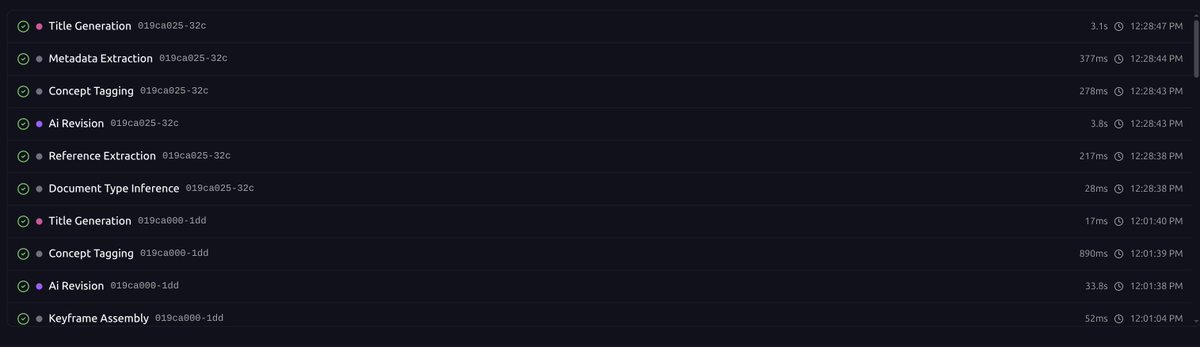
AIWG v2026.3.1 — "Discovery & Durability" Your AI agents can now search their own project artifacts. Plus forensics hardening, crash-resilient loops, and a full doc accuracy sweep. npm install -g aiwg@2026.3.1
JoeM tweet media
English
5
2
6
97
BuildOnROKO retweetledi
JoeM
JoeM@jmagly·
typing less, getting more
JoeM tweet media
English
1
1
4
42
BuildOnROKO retweetledi
shafu
shafu@shafu0x·
if you don't know what to build create x402 primitives! x402 vpn x402 storage x402 gpu x402 compute x402 file converter
English
46
33
580
48.9K
BuildOnROKO retweetledi
Cointelegraph
Cointelegraph@Cointelegraph·
🔥 INSIGHT: Vitalik Buterin said EIP-8141 could roll out within a year, aiming to fully implement account abstraction on Ethereum.
Cointelegraph tweet media
English
129
104
827
59.8K
BuildOnROKO
BuildOnROKO@BuildOnRoko·
Find all the capabilities you need in one place and try out the latest in NLP research with practical working examples.
ᚱoko Network@RokoNetwork

English
0
4
8
152
BuildOnROKO retweetledi
ᚱoko Network
ᚱoko Network@RokoNetwork·
Right now, somewhere on Ethereum, an MEV bot just extracted value from your transaction in 12 milliseconds. You'll never know exactly when it happened. Neither will anyone else. There is no verifiable record of the sequence. No trusted timestamp. No proof. And nobody seems to care. Everyone in this industry is obsessed with making AI smarter, faster, more autonomous. New models every week. New agents every day. Systems that trade, negotiate, deploy capital, and manage infrastructure without waiting for a human to approve anything. We're handing the keys to the economy to machines and congratulating ourselves for how fast they drive. But here's what keeps me up at night. Not one of these systems can prove when it did what it did. Think about what that means. Really think about it. An autonomous agent executes a trade. Another agent disputes it. A third agent was supposed to coordinate with both. Who moved first? What was the sequence? Was there collusion? Was there front-running? Nobody knows. Nobody can know. Because the temporal infrastructure underneath all of it is a patchwork of NTP servers and block timestamps with multi-second drift that nobody audits and everyone trusts by default. That is insane. You cannot audit what you cannot sequence. You cannot sequence what you cannot timestamp. You cannot timestamp what you cannot trust. Every proposal for AI safety. Every framework for AI governance. Every alignment paper. Every coordination protocol. They all assume there is a reliable layer underneath telling you what happened when. That layer does not exist. We are building it. ROKO Network testnet v3 is now running against a real atomic clock. Not a mock. Not a simulation. A shared atomic clock source with Chrony, delivering IEEE 1588 PTP-grade nanosecond synchronization at 97% time quality. We stress-tested at 4,000 transactions per minute and broke it on purpose. Found the bottleneck — our timestamping service couldn't keep pace. So we tore the architecture apart and rebuilt it synchronous from the ground up. Now if a transaction can't be cryptographically timestamped, it is rejected instantly. No gas burned. No broken state gossiped across the network. No silent corruption. It fails loud, fails clean, and fails immediately. Because when you're building the trust layer for machine civilization, "close enough" is how people get hurt. $ROKO is not just a clock. It's the full stack. Timing consensus with BFT enforcement and slashing — validators who lie about time get punished, automatically. An active integration path with TimeBeat's precision time infrastructure, bridging decentralized timing to the existing PTP ecosystem that already synchronizes telecom, finance, and power grids. And Matrix Memory — an enterprise-grade agentic data platform that ingests text, video, audio, 3D models, and PDFs, applies Whisper transcription with speaker diarization, keyframe vision analysis, dynamic embedding sets that agents can switch on the fly, federated hybrid search respecting tenancy boundaries, and W3C provenance metadata comparable to Library of Congress standards. Every piece of data timestamped. Provenance-tracked. Auditable by default. Not as an afterthought. As the foundation. The window for building this is closing and most people don't even see it. Autonomous agents are already coordinating at speeds no human can supervise. They're making decisions in microseconds across chains, across borders, across systems that were never designed to interoperate. We are sleepwalking into an economy run by machines that cannot be held accountable for their actions because we never built the infrastructure to hold them accountable in the first place. The question was never whether machines would coordinate. They already are. The question is whether anyone will be able to verify it. ROKO Network is timing infrastructure for the machine economy. Testnet is live. Investor conversations have started. And we're just getting started
ᚱoko Network tweet media
English
3
7
30
1K
BuildOnROKO retweetledi
JoeM
JoeM@jmagly·
AIWG v2026.2.14 — "Forensics & Manageability" Five major additions: - Full DFIR forensics framework - Codebase manageability tooling - 17 specialist agents + team configs - UAT testing toolkit - 8 model/prompting guides Thread 🧵
JoeM tweet media
English
5
4
9
310
BuildOnROKO retweetledi
JoeM
JoeM@jmagly·
AIWG is live — the site now updates automatically with every framework release. Full framework docs, CLI reference, quickstart guides for all 8 platforms. Link below.
JoeM tweet media
English
1
5
7
158
BuildOnROKO retweetledi
vitalik.eth
vitalik.eth@VitalikButerin·
Now, account abstraction. We have been talking about account abstraction ever since early 2016, see the original EIP-86: github.com/ethereum/EIPs/… Now, we finally have EIP-8141 ( eips.ethereum.org/EIPS/eip-8141 ), an omnibus that wraps up and solves every remaining problem that AA was intended to address (plus more). Let's talk again about what it does. The concept, "Frame Transactions", is about as simple as you can get while still being highly general purpose. A transaction is N calls, which can read each other's calldata, and which have the ability to authorize a sender and authorize a gas payer. At the protocol layer, *that's it*. Now, let's see how to use it. First, a "normal transaction from a normal account" (eg. a multisig, or an account with changeable keys, or with a quantum-resistant signature scheme). This would have two frames: * Validation (check the signature, and return using the ACCEPT opcode with flags set to signal approval of sender and of gas payment) * Execution You could have multiple execution frames, atomic operations (eg. approve then spend) become trivial now. If the account does not exist yet, then you prepend another frame, "Deployment", which calls a proxy to create the contract (EIP-7997 ethereum-magicians.org/t/eip-7997-det… is good for this, as it would also let the contract address reliably be consistent across chains). Now, suppose you want to pay gas in RAI. You use a paymaster contract, which is a special-purpose onchain DEX that provides the ETH in real time. The tx frames are: * Deployment [if needed] * Validation (ACCEPT approves sender only, not gas payment) * Paymaster validation (paymaster checks that the immediate next op sends enough RAI to the paymaster and that the final op exists) * Send RAI to the paymaster * Execution [can be multiple] * Paymaster refunds unused RAI, and converts to ETH Basically the same thing that is done in existing sponsored transactions mechanisms, but with no intermediaries required (!!!!). Intermediary minimization is a core principle of non-ugly cypherpunk ethereum: maximize what you can do even if all the world's infrastructure except the ethereum chain itself goes down. Now, privacy protocols. Two strategies here. First, we can have a paymaster contract, which checks for a valid ZK-SNARK and pays for gas if it sees one. Second, we could add 2D nonces (see docs.erc4337.io/core-standards… ), which allow an individual account to function as a privacy protocol, and receive txs in parallel from many users. Basically, the mechanism is extremely flexible, and solves for all the use cases. But is it safe? At the onchain level, yes, obviously so: a tx is only valid to include if it contains a validation frame that returns ACCEPT with the flag to pay gas. The more challenging question is at the mempool level. If a tx contains a first frame which calls into 10000 accounts and rejects if any of them have different values, this cannot be broadcasted safely. But all of the examples above can. There is a similar notion here to "standard transactions" in bitcoin, where the chain itself only enforces a very limited set of rules, but there are more rules at the mempool layer. There are specific rulesets (eg. "validation frame must come before execution frames, and cannot call out to outside contracts") that are known to be safe, but are limited. For paymasters, there has been deep thought about a staking mechanism to limit DoS attacks in a very general-purpose way. Realistically, when 8141 is rolled out, the mempool rules will be very conservative, and there will be a second optional more aggressive mempool. The former will expand over time. For privacy protocol users, this means that we can completely remove "public broadcasters" that are the source of massive UX pain in railgun/PP/TC, and replace them with a general-purpose public mempool. For quantum-resistant signatures, we also have to solve one more problem: efficiency. Here's are posts about the ideas we have for that: firefly.social/post/lens/1gfe… firefly.social/post/x/2027405… AA is also highly complementary with FOCIL: FOCIL ensures rapid inclusion guarantees for transactions, and AA ensures that all of the more complex operations people want to make actually can be made directly as first-class transactions. Another interesting topic is EOA compatibility in 8141. This is being discussed, in principle it is possible, so all accounts incl existing ones can be put into the same framework and gain the ability to do batch operations, transaction sponsorship, etc, all as first-class transactions that fully benefit from FOCIL. Finally, after over a decade of research and refinement of these techniques, this all looks possible to make happen within a year (Hegota fork). firefly.social/post/bsky/qmaj…
English
316
408
2.4K
283.8K
BuildOnROKO
BuildOnROKO@BuildOnRoko·
The magic in AI apps is the data. Treat it well.
BuildOnROKO tweet media
English
0
5
8
105
BuildOnROKO retweetledi
JoeM
JoeM@jmagly·
AIWG v2026.2.12 — "Doc Sync & Accelerate" Two new commands: one finds and fixes doc drift automatically, the other takes a project idea to construction-ready in a single run. npm install -g aiwg@2026.2.12 🧵
JoeM tweet media
English
4
2
5
152
BuildOnROKO
BuildOnROKO@BuildOnRoko·
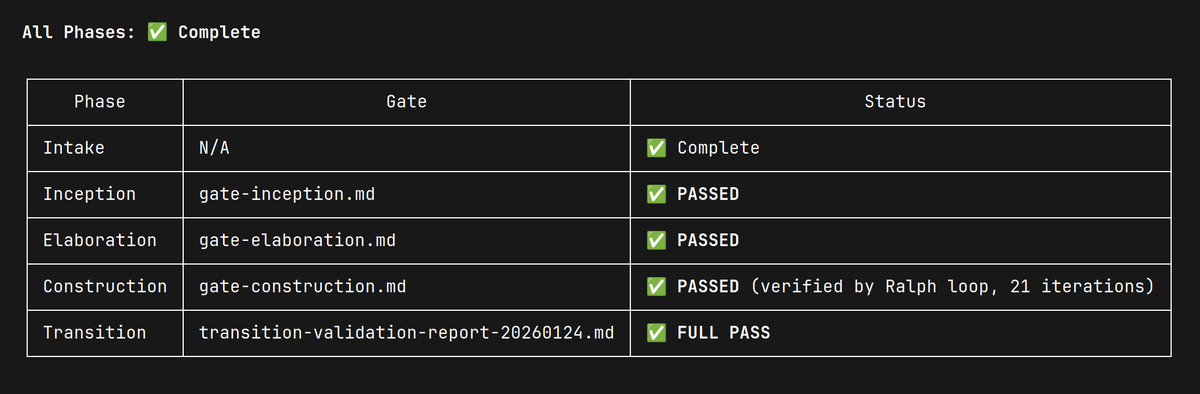
AIWG tracks and know when all stages of a large project have been fully completed
BuildOnROKO tweet media
English
1
4
10
76