
Michael Bush retweetledi
Michael Bush
827 posts

Michael Bush
@CALLMikeBush
I have been thinking about technology in education in general and language learning in particular since 1975 and actually doing it since 1980.
Orem, Utah Katılım Haziran 2012
309 Takip Edilen265 Takipçiler
Michael Bush retweetledi

Bring me a drink, today it means ok, here is the refrigerator.
Soon it will be anything.
For all.
No lines, robots will be so inexpensive that YOU will own dozens.
Les costly than the device you likely are riding this on.
English
Michael Bush retweetledi

Elon Musk just asked the one question that collapses the entire AI narrative.
Musk: “The output of chips is growing pretty much exponentially, but the output of electricity is flat.”
Every major tech company is racing for compute.
Hundreds of billions committed. Trillion-dollar buildouts announced. GPU orders so large they were unthinkable three years ago.
Not one of them can tell you where the electricity is coming from.
Musk: “If you’re putting data centers anywhere except China, where are you going to get your electricity? Especially as you scale.”
He already knows the answer.
Musk: “Everywhere outside of China, it’s more or less flat.”
Demand is exponential. Supply is a flatline.
That is not a gap. That is a wall.
The West is building the most energy-hungry technology in human history on a power grid that hasn’t meaningfully grown in decades.
Musk: “China has a rapid increase in electrical output.”
One country saw this coming. The rest are still writing press releases.
The AI race won’t be decided by who builds the best model. It will be decided by who bothered to build the power plants.
Right now only one country is doing both.
Musk: “How are you going to turn the chips on?”
Billions of dollars in silicon. The most advanced processors ever engineered. Architectures that think faster than the human brain can follow.
All of it dead weight without a grid to run it on.
Musk: “Magical power sources?”
Three words that collapsed a trillion dollars of assumptions.
Everyone is debating which AI is smartest. Almost nobody is asking if the infrastructure exists to run any of them at scale.
Intelligence without energy is just a thought that never wakes up.
The future won’t be written in code. It will be written in watts.
English
Michael Bush retweetledi

@XFreeze Simply awesome
🌋🌋 Deep₿lueCrypto 🌋🌋@DeepBlueCrypto
@shaunmmaguire @elonmusk @xai @DOGE @neuralink @ArthurMacwaters @teslaownersSV Elon Musk — "Starship is the largest flying object ever made." "This thing will be over 5,000 tons of weight on liftoff… This is much heavier than any aircraft, by far… It's got more than twice the thrust of a Saturn V."
English
Michael Bush retweetledi

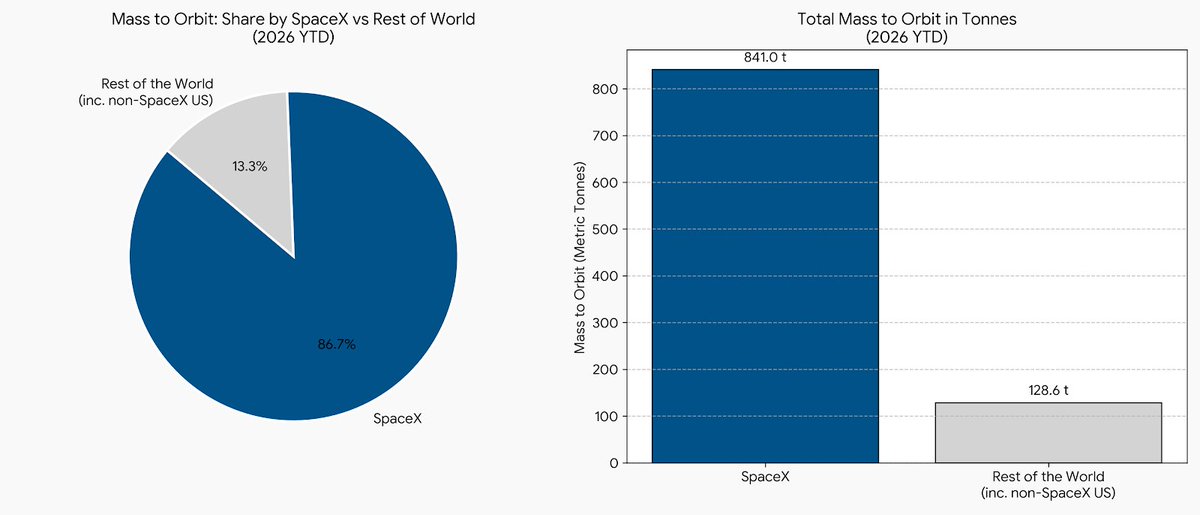
SpaceX is absolutely dominating the entire planet in orbital mass
As of 2026:
• Total Global Mass to Orbit: ~969.6 metric tonnes
• SpaceX: ~841.0 tonnes (86.7%)
• Rest of the World: ~128.6 tonnes (13.3%)
SpaceX alone has launched over 86% of all mass to orbit this year till date
No one else is even close or even all of them combined
English
Michael Bush retweetledi
Michael Bush retweetledi
107 year old Civil War veteran visiting an Air Force base, 1955.
In one life has seen so much it must have been in comprehensible.
This is why I have curated and saved 100s of 1000s of media from our great past.
His context is more vital than ever in the Age Or Amnesia.
English
Michael Bush retweetledi
Michael Bush retweetledi
Elon Musk just described how the entire government operates in a single sentence.
Musk: “Paying people to do nothing doesn’t make sense.”
Then he told a Milton Friedman story that should terrify every bureaucrat on the payroll.
Friedman watched workers digging ditches with shovels.
He suggested they use excavators instead.
Someone pushed back.
“But then we’re going to lose a lot of jobs.”
Musk: “Friedman says, well, in that case, why don’t you have them use teaspoons?”
One sentence.
That’s all it took to gut the entire logic of modern government.
The teaspoon is not a punchline.
It is the actual policy.
Every agency that would cease to exist if it actually solved the problem it was created for.
Every department that measures success by headcount instead of output.
Every approval that routes through nine desks before someone can say yes.
Teaspoons.
The system doesn’t want excavators.
Excavators finish the job.
And a finished job is the one thing the system can’t afford.
So it hands you a teaspoon. Calls it a career. Gives you a pension for never asking why the ditch took forty years.
But this isn’t about laziness.
It’s about control.
A person digging with a teaspoon doesn’t have time to build something better.
Doesn’t have the energy to question the plan.
Doesn’t have a thought left to ask if the ditch even needed digging.
Busy people don’t ask dangerous questions.
That’s the point.
The economy doesn’t run on productivity.
It runs on the appearance of productivity.
Millions of people sit at desks right now doing work a single script could replace by morning.
They know it.
Their managers know it.
The people who sign their budgets know it.
But the teaspoon stays in their hand.
Because the moment you hand someone an excavator, they finish by noon.
And a person with a free afternoon starts thinking. Starts building. Starts wondering why they needed permission to dig in the first place.
That’s the thing the system can’t survive.
Not unemployment.
Free time.
Musk didn’t tell a joke on Rogan.
He described the longest con in modern governance.
Keep them digging.
Keep them busy.
Keep the teaspoon in their hand so they never look up long enough to see the ditch was pointless from the start.
Friedman told that story sixty years ago.
He meant it as a warning.
The system heard every word.
It just made sure everyone kept calling it a joke so no one would recognize it as a confession.
English
Michael Bush retweetledi

Regarding the OpenAI case, the judge & jury never actually ruled on the merits of the case, just on a calendar technicality.
There is no question to anyone following the case in detail that Altman & Brockman did in fact enrich themselves by stealing a charity. The only question is WHEN they did it!
I will be filing an appeal with the Ninth Circuit, because creating a precedent to loot charities is incredibly destructive to charitable giving in America.
OpenAI was founded to benefit all of humanity.
English
Michael Bush retweetledi

Michael Bush retweetledi
Most airlines are partnering with @Starlink.
The others will have terrible WiFi and lose customers as a result.
Clay Travis@ClayTravis
I don’t understand why every airline in America — public and private — doesn’t have @Starlink. It’s incredible. You can make FaceTime calls with better reception anywhere in the world 35k feet up in air than most reception on ground. WiFi on planes is infuriatingly bad. Still.
English
Michael Bush retweetledi
Michael Bush retweetledi

In 1943, the U.S. Navy rejected Grace Hopper for being too old, too thin, and a woman.
So she went on to help invent modern programming anyway.
And eventually became a Rear Admiral.
Grace Hopper was 37 years old with a PhD in mathematics from Yale when she tried to join the Navy during World War II.
The military told her no.
She was over the age limit.
Underweight.
And women weren’t expected to work with advanced military technology.
Grace refused to accept that answer.
She found another path into the Navy through the WAVES program and was assigned to work on the Harvard Mark I computer in 1944.
At the time, computers were enormous mechanical machines that filled entire rooms.
The Mark I weighed five tons, contained hundreds of thousands of moving parts, and sounded more like a factory than a computer.
Very few people fully understood it.
Grace Hopper did.
But her biggest breakthrough came afterward.
In the 1940s and early 1950s, programming meant writing endless strings of machine code — instructions only computers could understand.
Grace thought the whole idea was backwards.
Why should humans have to speak the computer’s language?
Why not teach computers to understand ours?
Most experts dismissed the idea as impossible.
Computers could process numbers, they said.
Not words.
Not English.
Grace ignored them.
In 1952, she created one of the world’s first compilers — a program capable of translating human-readable instructions into machine code automatically.
It changed computing forever.
Later, she helped develop COBOL, a programming language designed to use plain English commands instead of cryptic symbols.
Traditional programmers mocked it for being “too simple.”
But COBOL spread everywhere.
And decades later, it still quietly runs much of the world’s financial infrastructure.
Even today, COBOL systems still process:
• ATM transactions
• credit card payments
• airline reservations
• government systems
• trillions of dollars moving through banks every day
The digital world most people rely on was built partly on Grace Hopper’s ideas.
She also became famous for making complicated concepts easy to understand.
To explain computer speed, she carried around tiny pieces of wire exactly 11.8 inches long — the distance light travels in one nanosecond.
She’d hand them to military officials and say:
“This is a nanosecond.”
Then she’d explain why delays in computer systems mattered.
Grace had a rare gift:
She made invisible technology feel real to ordinary people.
In 1947, her team found an actual moth trapped inside a computer relay while debugging a malfunction.
Grace taped it into the logbook.
That story helped popularize the term “computer bug.”
She stayed in the Navy for decades and was repeatedly recalled from retirement because her expertise was too valuable to lose.
When she finally retired in 1986, she was 79 years old — the oldest active-duty commissioned officer in the U.S. Navy at the time.
By then, she was Rear Admiral Grace Hopper.
Not the woman they once rejected.
The woman they eventually couldn’t function without.
Grace Hopper died in 1992.
But her work still lives quietly inside the systems people use every day.
Every ATM withdrawal.
Every credit card swipe.
Every readable programming language.
Every modern computer system designed for humans instead of machines.
All of it carries pieces of her thinking.
She was told computers were too complicated for women.
She was told machines could never understand English.
She was told she was too old to serve.
She proved all of them wrong.
Grace Hopper didn’t just help program computers.
She helped program the future.
“The most dangerous phrase in the language is:
‘We’ve always done it this way.’”
Grace Hopper spent her entire life refusing to do things the old way.

English
Michael Bush retweetledi
I took all the money I had and purchased this computer.
I endured endless parades of folks telling me the standard “it’s a toy”, “you wasted your money”.
Well my Commodore 64 made me $12,000 in 1982.
And it made sure I never worked for ANYONE again.
So don’t listen to me.

English
Michael Bush retweetledi

Brazil is leading the way in sustainable road construction by repurposing sugarcane waste into high-performance asphalt.
After sugar and ethanol are extracted from sugarcane, the leftover fibrous pulp (called bagasse) is typically burned to generate energy. This process produces around three million tons of bagasse ash every year. Instead of discarding this ash as waste, researchers have developed an innovative way to use it in road building.
The ash is rich in silica and serves as an excellent replacement for traditional stone dust in asphalt mixtures. Studies show that adding 5% to 30% sugarcane bagasse ash creates pavements that are significantly stronger, more durable, and better able to withstand heavy traffic and Brazil’s challenging tropical climate.
Early trials on highways have demonstrated that these eco-friendly roads perform better and last longer than conventional asphalt, while also reducing environmental impact by recycling agricultural waste.
This pioneering approach not only helps manage massive amounts of industrial by-product but also offers a scalable, cost-effective solution for building more sustainable infrastructure.

English
Michael Bush retweetledi

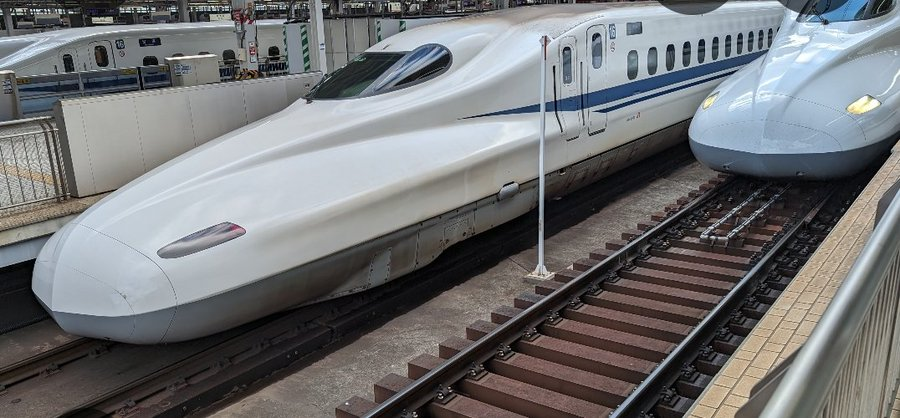
I was on a train in Tokyo. We stopped between stations. Announcement in Japanese, then in English: "We apologize for the delay. We will resume shortly."
The delay was maybe 3 minutes. Not a big deal.
When the train started moving again, another announcement: "We sincerely apologize for the delay. We were stopped for 3 minutes and 20 seconds. This is unacceptable. Thank you for your patience."
Three minutes and twenty seconds. They measured it exactly. And called it unacceptable.
When I got off at my stop, there were station staff on the platform bowing and handing out delay certificates.
I took one out of curiosity. It was an official document stating that the train had been delayed by 3 minutes and 20 seconds, signed and stamped.
The staff member said in English "for your employer. So they know the delay was not your fault."
I said I'm a tourist, I don't need it. He looked confused. "But the delay affected you. You deserve an apology."
Three minutes. They were treating a three-minute delay like a major incident.
Later I mentioned this to a Japanese friend. They said "oh yes, delay certificates are normal. Trains are supposed to be exactly on time. If they are late, they must apologize."
I said three minutes isn't late, it's nothing. My friend said "in Japan, three minutes is late. On time means on time. Not approximately on time."
They said the train company probably investigated why there was a 3-minute delay. "They will find the cause and fix it so it doesn't happen again."
I kept the certificate. It's framed in my apartment now. A reminder that somewhere in the world, people care about three minutes.
© 6IX.
@BSAT_Properties
English
Michael Bush retweetledi
Boom! Scientists Discovered a Hidden Superhighway Inside You That Might Finally Explain Why Acupuncture Actually Works!
How tattooed skin biopsies proved something over 4,000 years old.
Buckle up…research just dropped a bombshell that is rewriting the human anatomy textbook and high fiving ancient healers at the same time!
Deep inside your body lies an enormous, previously overlooked network called the interstitium. It is a vast, fluid filled web that acts like a secret third circulatory system alongside your blood vessels and lymphatics. It is not just empty space between tissues.
It is a dynamic, interconnected superhighway made of collagen bundles suspended in a shimmering hyaluronic acid gel that soaks up water and lets fluids, cells, and molecules flow slowly but surely throughout your entire body, from skin to muscles to organs and back again.
For over a century, scientists saw these spaces as isolated little pockets. But groundbreaking work starting in 2018 by pathologists revealed the jaw dropping truth: it is one giant, continuous network.
When researchers examined tattooed skin biopsies, the ink particles had boldly marched from the skin deep into the fascia below, traveling through the interstitium in ways that made scientists say, That was not supposed to happen!
Here is where it gets truly electrifying.
This hidden highway might finally give Western medicine the biological proof it has been craving for acupuncture and Traditional Chinese Medicine.
For 4000 years, TCM has described chi flowing along 12 specific meridians. Acupuncture needles target precise points along those lines.
Skeptics have long asked for hard science. Now they have it.
Studies, including tracer injections and dye experiments in living volunteers, show that when you inject dye into an acupuncture point, it does not just sit there or race through veins.
It flows exactly along the traditional meridian pathways through the interstitial spaces between muscles, heading straight toward the heart. The dye follows the interstitium like a GPS guided river.
Rebecca Wells, one of the lead scientists, sums it up perfectly:
“I actually do think that the interstitium could be the link between Eastern and Western medicine”.
The implications are massive and mind blowing.
Cancer cells may hitch rides on this network to metastasize.
It could explain autoimmune flare ups where gut particles travel to distant organs.
It might even unlock better treatments for Type 2 diabetes by revealing how interstitial cells influence healthy fat production during weight gain.
This is not just a cool anatomy fact. It is a paradigm shift that could reshape pain management, chronic disease treatment, and how we think about the body as a whole.
Evolutionarily speaking, similar fluid systems appear in ancient creatures going back hundreds of millions of years.
The interstitium is not new. It has been with us since the dawn of multicellular life. We are only now catching up.
This discovery is pure science magic: ancient wisdom validated by cutting edge research, turning what looked like disconnected puzzle pieces into one breathtaking picture of how our bodies really work.
When reading this, be sure to send condolences to the “debunkers” that stole this 4,000 year old empirical science from your health. They were wrong.
Dive into the actual research papers:
The groundbreaking discovery of the interstitium: nature.com/articles/s4159…
The study on continuity of interstitial spaces across the body: nature.com/articles/s4200…
Research visualizing fluorescent dye migration along acupuncture meridians: pmc.ncbi.nlm.nih.gov/articles/PMC80…
Your body just got a whole lot more awesome. The future of medicine is flowing through the interstitium right now, and it is going to be legendary!

English
Michael Bush retweetledi