Sabitlenmiş Tweet

Captain Chronic and the Big Brown Stain
There's a tale I tell sometimes, when I have an audience and more than a few beers in me.
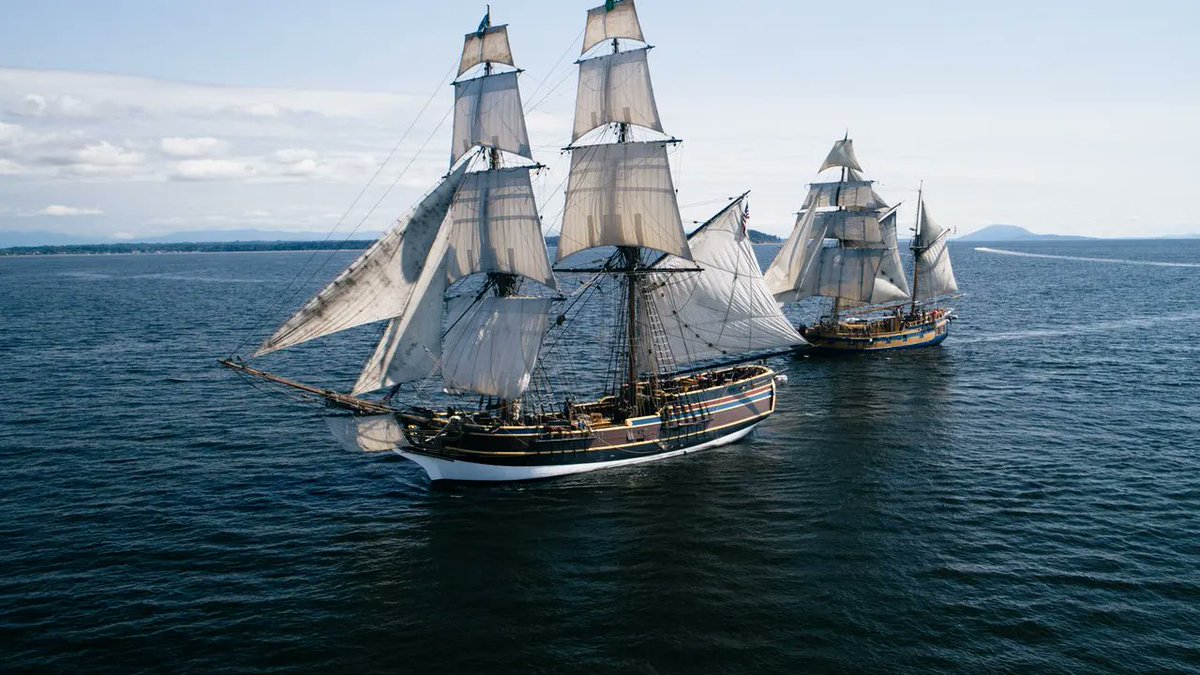
It happened when I was a young sailor on a tallship called the Lady Washington.
The Lady is a reproduction of an American merchant brig that was built sometime in the 1750s in Boston. She was a successful privateer in the Revolution, and then an unsuccessful merchantman who attempted to open trade into the Pacific.
She's the state ship of Washington state, and she was the first woman I ever truly loved.
The story goes:
A statute of limitations ago, when the Lady was in port in Ventura, California, our engineer discovered a problem.
The Lady's a sailing ship, yes, but when the wind is slack and we've got places to be, we scoot her around with her single-screw engine, a big honkin' Detroit diesel that had been salvaged from a World War II torpedo boat. Thus, we have an engine, and an engine room, and engine problems.
The Lady, you see, was sinking.
Our engineer at the time, a man named Roscoe with too-long legs and a too-long neck that overall gave one the impression of a camel, reported to the Captain and crew that there was a hole near the screw that was pouring water into the bilge at an uncomfortable rate.
Water is supposed to stay outside the boat, you see, but with boats there's always a bit sneaking in here and there. The water collects in the bottom, an area called the bilge, and we pump it out regularly using an automatic bilge pump system.
The water wasn't quite coming in fast enough to overwhelm the pumps, we just had to run the pumps more often, but enough leaks like that and we'd have a problem.
In addition to that, the engine was badly in need of an oil change.
Big honkin' Detroit diesels like ours required a LOT of oil. Buckets and buckets of it.
Roscoe wasn't a brilliant man. A good enough wrench-turner, but not wise in the ways of the sea.
My favorite memory of him was when I was cleaning salt-scale off the rails and decks and I overheard the first mate, a very warm-but-stern fatherly figure of a man, telling camel-like Roscoe to go below and fix the sewer pipes. "The toilets are all backed up and we need to be able to use the head!"
Roscoe got a very serious look, and said "You know what you're asking me to do, right?"
The diaphragm pump. It was always the damned diaphragm pump. A little too much toilet paper or, God forbid, a... feminine product... was enough to stick the damn thing fast and build unholy amounts of pressure behind it. A pressurized pipe full of the discharges of a dozen or more large men on a protein-rich diet.
The mate, of course, insisted, and Roscoe went below through the engine room hatch with the air of a man ascending the gallows.
A few minutes later I heard an audible BANG! from below, and a stream of curses that should have peeled the paint.
Roscoe himself emerged a few minutes later, wet with something gray-brown and slimy, his eyes burning the color of hatred.
As Roscoe disappeared into the main hold to dump all of the ship's hot water over himself in the shower, the Mate asked me to take my rag and bucket down into the engine room to clean up.
"You know what you're asking me to do, right?" I asked him, in serious tones.
The Mate laughed. I went below.
The whitewashed walls were splattered gray-brown all around, with shreds of white fibrous toilet tissue, and something I desperately hoped was not corn.
The smell was incredible.
And there was a clean spot on the opposite wall from the pump, in the perfect silhouette of poor Roscoe.
Perhaps it was out of pity for the man that the Captain did not immediately order Roscoe to crawl through the bilge to fix the leak by the engine screw.
Thus, did Roscoe instead bend his energies to changing the oil.
I should mention our Captain. He was an imposing man, rail-thin but tall and broad-shouldered. Windblown white hair, bushy eyebrows, and piercing gray eyes. He had a short temper and was rather distant with the men most of the time. Scuttlebutt around the ship had somehow picked up the fact that the Captain had, upon being hired by the company, pissed hot for cannabis.
Captain Chronic, we called him. I have completely forgotten his real name, I can't think of him by any name but Chronic.
Following the oil change, four five-gallon buckets of dirty sludgy black oil were chained up in the corner of the engine room, awaiting disposal once we were out of California, where disposal of anything the local eco-terrorist government dislikes is an expensive and difficult process.
The weather in Ventura turned fitful, and the water churned during one of our afternoon excursions. We took on around forty passengers and gave them a nice three-hour sailing tour 'round the waterbreak and then out into waters that looked "like a fuckin' washing machine" by the words of our Captain.
I remember holding on for dear life in the tops as we were trying to furl the sails on our return to the dock. The rigging will try to throw you right off into the water if you let it, especially when the water is high and the wind is whipping the surface into a froth.
I didn't hear about The Disaster until we were back in port.
The chain had come loose, and the nearly twenty gallons of dirty oil had sloshed right into the engine room bilge.
This was a potentially VERY expensive problem.
Let me tell you some things about the EPA.
I remember getting a very stern lecture from First Mate one day as I was painting a wooden rail with thick marine-grade yellow paint. The head of my foam brush had come off, and splatted into the water between our boat and the dock. The Mate saw it happen, and told me in no uncertain terms that not a *drop* of that paint was to escape our boat into the water, as the EPA "has eyes everywhere here in California" and would happily crawl right up our assholes and serve a fine worth several tens of thousands of dollars direct to our kidneys for even an infraction so minor as a paintbrush.
A crime worth far more than my job. I had to go fish the brush out with a net. "Try not to be seen!" they said.
The EPA is a boogeyman to every sailor that sails in Commiefornian waters.
And we were now a miniature Exxon-Valdiz waiting to happen.
Roscoe, on discovering the oil in the bilge, first cut the float switch that activated the bilge pump and then, cap in hand, shamefacedly told the Captain what had happened.
We were now sinking without a bilge pump.
The Captain's face was a quiet mask of rage, there on the quarterdeck. "You'd better lay forward, lad." said the Mate. Roscoe retreated toward the fore looking once again like a condemned man.
We couldn't pump the bilge, because that would spill oil into ecologist-protected waters and probably destroy the company financially with kidney-fines. We couldn't *not* pump the bilge, because we were damned well sinking.
The Purser was put to work that evening, calling around to waste disposal companies, trying to find someone -- ANYONE -- who would pump out our bilge and dispose of the oil-tainted seawater.
As it turns out, because of Byzantine California regulations regarding waste disposal, the sorts of specialists we needed were either unavailable, booked out for weeks, or were *staggeringly* expensive. "Oil-tainted seawater" falls neatly between the cracks of more ordinary things, like mere dirty seawater, or dirty oil, or oil-tainted freshwater, and put us into a strange category that nobody who charged mere mortal prices was willing to touch.
As in all things involving regulatory strangulation, the only solution was crime.
The next day, we transited from Ventura to Oxnard, where we would stay only three days. After Oxnard, our itinerary put us all the way up to San Francisco, a longer transit that gave us an excuse to pass beyond the 12-mile boundary of US territory, into international waters.
There we would reactivate our bilge pump, and hope nobody noticed us flushing out the boat while leaving a thin trail of black sludge.
And so, we arrived in Oxnard, slowly sinking but generally confident that we wouldn't actually go under in the next three days.
Oxnard is a tiny, tiny marina dominated by a substantial Coast Guard station.
The Coasties had very politely made space for us at the only dock large enough to take the Lady -- the one directly out front of the damn station.
For reasons we hardly dared whisper to each other, this made us rather uncomfortable. From the deck of the Lady, we could see people walking back and forth in the radar room that towered over our boat. They couldn't have had a better view of everything we were doing. Out of superstition, or perhaps paranoia, we quashed any talk among us about oil in the bilge.
The second part of the disaster struck in the small hours of the morning, around five.
The Captain was woken up in his cabin by the terrifying sound of the other bilge pump. The emergency pump which runs on its own automatic switch!
The Captain rushed out on deck and in the moonlit morning was able to see a dark brown stain spreading from the aft quarters of our ship.
Nobody with eyes could possibly mistake where the oil was coming from.
The Captain ran to the ship's bell, and rang it stridently. This was our fire alarm signal, and the crew (thinking it a surprise drill) sprang to action.
As per the station bill, my job was to grab a fire extinguisher and also to break out life vests in case it was necessary to abandon ship. I watched, useless, as the hose teams rolled out the hoses and charged them with water from the pump. The Captain then emerged, white hair flying in the wind, carrying two giant gallon-sized bottles of yellow lemon-scented Dawn dish soap.
He proceeded to dump the soap into the oil-browned water, and directed the hose teams to churn the water with their streams.
I was... confused. I had no idea what was going on. The hoses were frothing the water into a shit-brown foam that looked somehow worse than the mere oil that had been blackening our bilge.
I had to ask.
"Captain... why are we doing this?"
The Captain spun to face me, his gray eyes wide, his white windblown hair standing on end, he said, "the EPA -- they'll GET ya for oil, but they don't know WHAT to do about SUDS!"
The sun rose on a ruined marina. Brown foamy scummy suds everywhere, sticking to the sides of expensive boats. Foot-tall bergs of poo-froth drifting to and fro, befouling the white paint of the Coast Guard cutter with its imposing 30mm cannon.
And it had all happened directly under the eye of the actual fucking Coast Guard of the United States.
That day was a very normal day, yes sir, totally routine, as we started doing normal chores around the ship like cleaning and stowing lines and ignoring the horrible brown disaster all around us. At about eight that morning, a uniformed USCG member walked down to us and, standing at the bottom of our gangplank, very politely asked if he could see our captain.
Our cook, a binge-drinking beanpole with a head too large for his shoulders, answered the man's request by going down into the aft quarters to rouse the Captain.
The Captain soon strode onto deck, his back straight and shoulders back, the air of an emperor addressing an unruly court. He *leaned* over the top of the gangplank and, as rudely as he could manage, barked a single word, "WHAT?"
The crew, one and all, continued their work as normal. But I could tell by the tension in the air that every one of us was straining our ears to hear exactly what was said, beat for beat.
"Oh! Well, see, we know you're new here in Oxnard and we don't often see ships like this one, so we wanted to give you guys a tour of the Coast Guard station!"
The Captain's entire attitude changed direction with the Mach-speed of a cracking whip, and with sudden forced joviality he said "A tour! Let's do it, everyone, EVERYONE, we're going to go on a TOUR! Let's GO!"
And so we... went on a tour of the Coast Guard station?
It was a nice tour! They've got some really nice boats!
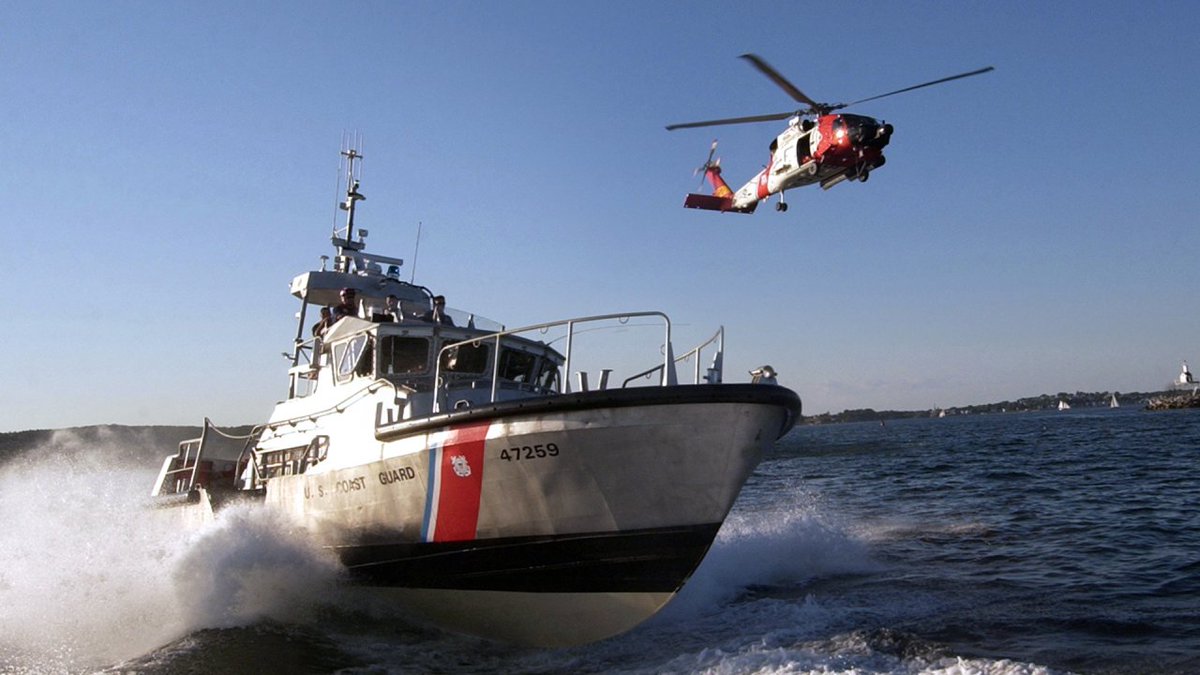
There's this brushed-steel twin-screw monster that they use for sea rescue ops, it's got a big box up top that acts as both a float (to prevent capsizing) and as a mount for various antennae and their radar. Basically a tiny tug, a hot rod compared to our Lady. And of course we got to admire their cutter from a distance, an interdictor ship meant for running down smugglers and other criminals, some significant fraction of the size of a naval frigate, with an actual cannon turret near the bow.
And of course, we got to see the operations room.
With its giant bay windows.
The ones that look directly down at the Lady, where one could hardly miss any activity that might be going on anywhere on our boat.
I spotted the Bosun standing by one of those windows, staring down at the Lady, shaking his head.
I sidled up to him and said, "Bosun, there's no way they didn't see--"
"I know," he said, flatly.
"I mean... they *had* to have--"
"Shut up."
I shut up.
Later we were back down at the docks, and the Captain was chatting with the station's chief engineer. The crew had marched through the tour obediently, quietly, forcing smiles and trying to seem interested in all the cool USCG shit, while wondering when the shiny bracelets and the arrest warrant were going to come out.
The Captain, to the visible shock and horror of all of us, at one point *pointed to the brown sludge* that was currently slopping against the docks, and said, "So hey, what do you do about shit like this?"
Jaws dropped, and were hastily picked back up.
And then the engineer -- the Coastie guy giving us the tour! -- he looked uncomfortable.
He said, "Well, we had a meeting about it this morning. See, when it's like this, we can't really pick it up with our oil-absorber pads? In fact, there's not really anything we CAN do about this. And none of us can afford trouble with the EPA, so we've decided to ignore the weird oil stuff, pretend it doesn't exist, and hope nobody thinks it was us."
The Captain, of course, had to say "No kidding? Hell, that's what WE do, TOO!"
And that's the story of Captain Chronic and his Big Brown Stain.
English