IG 200

170 posts

IG 200 banner
IG 200

IG 200

@CPDDOUGH

Katılım Aralık 2023
114 Takip Edilen41 Takipçiler
IG 200
IG 200@CPDDOUGH·
@DeepSailCapital the private guys are slow moving. they raised funds for this thing x so they are going to buy it. also possibly dumb. seems odd conclusion but last few years have taught me they operate with blinders on.
English
1
0
1
172
Deep Sail Capital
Deep Sail Capital@DeepSailCapital·
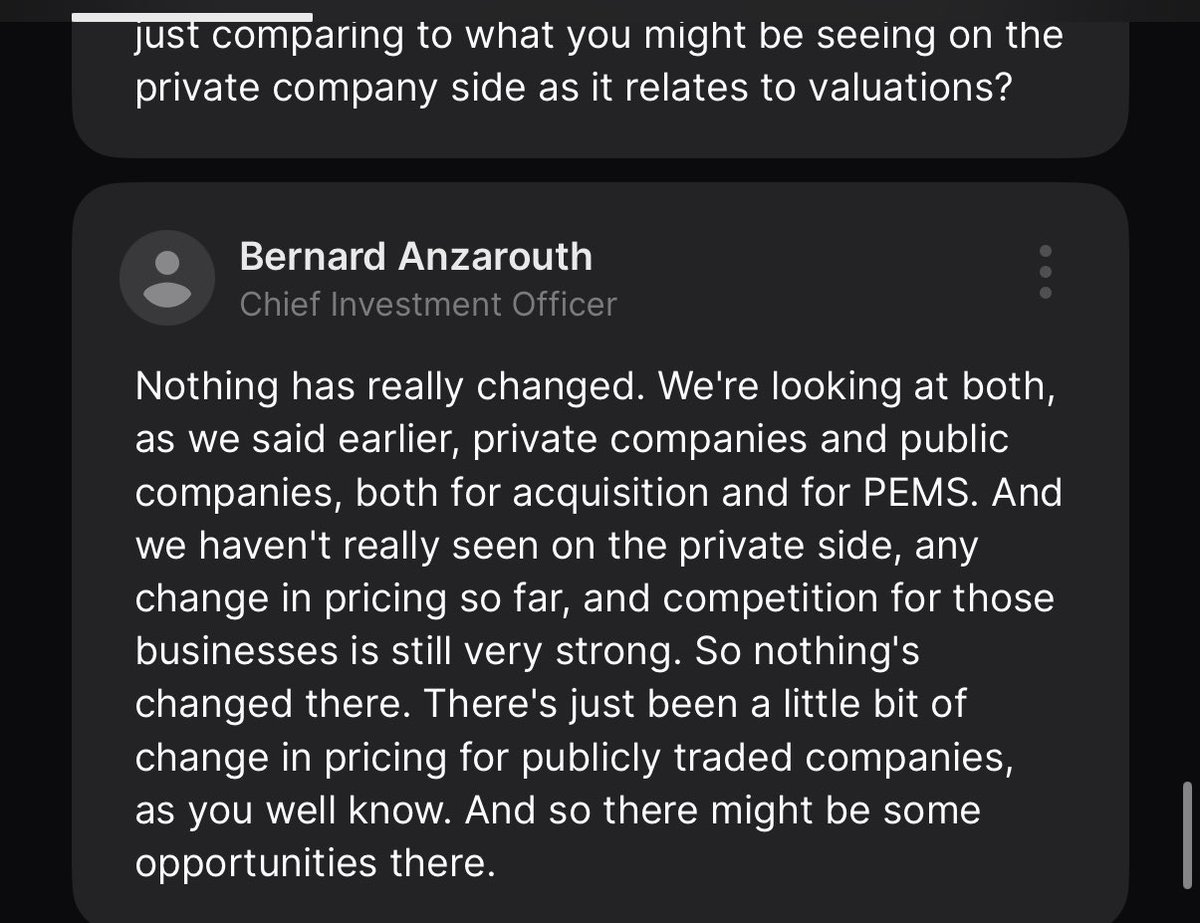
$CSU - Chief Investment Officer: No change in private market valuations in VMS. Competition for these businesses is still very strong. Either public markets are wrong or private markets are wrong.
Deep Sail Capital tweet media
English
4
2
40
7.4K
IG 200
IG 200@CPDDOUGH·
@ExcessDefaults how do they feel about their pe platform rollover equity
English
0
0
0
491
ExcessDefaults
ExcessDefaults@ExcessDefaults·
Cliffwater discussion on dentist forum getting spicy - v interesting bc all between a sizable group that all hold position in it.
English
9
0
23
14.6K
IG 200
IG 200@CPDDOUGH·
@HighyieldHarry Fully agree. My broader concern is that everything that PE tries to do in hopes of commanding that mid teens multiple (or frankly “professionalizing” period) also breaks the company/ebitda. Wasn’t an accident that the world stopped doing this for 10yrs after the early 2000s.
English
0
0
1
67
High Yield Harry
High Yield Harry@HighyieldHarry·
@CPDDOUGH Think it’s a hot potato game in terms of platform multiples. Once it gets to mid teens or high teens EV/EBITDA it breaks.
English
1
0
4
346
High Yield Harry
High Yield Harry@HighyieldHarry·
One of the things I've been spending a lot of time on is how private equity consolidation of more sensitive industries (pet care, healthcare, funeral services) can really hurt consumers, especially at their most vulnerable. We've all seen the research about what PE involvement does to hospitals. I think at some point a lot of finance professionals need to have a talk to God moment about what type of businesses they want to be a part of or invest in. I certainly have. It's certainly become clear to me there's some pockets PE/corporate consolidators shouldn't be involved in and I think consumers don't want corporate/PE ownership in their backyard for everything. That tide is here and it's going to be advancing further. Obviously, the below needs to be included as a risk factor, but if it doesn't make you feel anything then that's not a great sign of the type of character you have? If you want to call me names or whatever, or do forest in the trees type stuff like this, please do so, but I'm going to be spending the rest of my life on this. My mission is building a big resource hub that shows which businesses are PE/Corp backed so locals can steer towards more care-oriented mom-and-pop options. And I would never monetize it. It's a public good resource. I'll include it below to show where we're at so far.
Covfefe Anon@CovfefeAnon

"I'll pretend to be retarded so I can pretend to be OUTRAGED" Decreasing deaths in the future does indeed result in less revenue for funeral home services

English
21
7
174
43.5K
IG 200
IG 200@CPDDOUGH·
@ACapitalLP Fair point! And I probably believe them if they started 5 years ago. But whatever they were forced to roll might not be doing too hot.
English
0
0
1
89
IG 200
IG 200@CPDDOUGH·
@ACapitalLP Serious question, any of these hvac roll-ups going well? I keep hearing about people doing this but mkt down 3yrs in a row and platforms supposedly having a tough go as a result.
English
0
0
1
250
IG 200
IG 200@CPDDOUGH·
@junkbondinvest @AcaciaCap Sponsors want to delay and are willing to throw good money after bad in most situations 1x (almost never 2x). Unclear if delusional or just want to delay for marketing purposes.
English
0
0
0
36
junkbondinvestor
junkbondinvestor@junkbondinvest·
@AcaciaCap Depends on how big of a check but imo no sponsor is going to write anything meaningful, if at all Don’t disagree on talking pieces
English
2
0
2
229
junkbondinvestor
junkbondinvestor@junkbondinvest·
Every month someone publishes a higher default forecast. > Fitch: 5.8% actual > Morgan Stanley: 8% > UBS: 15% worst case Every month someone in the industry calls it irresponsible.
junkbondinvestor tweet media
English
13
30
191
18.6K
IG 200
IG 200@CPDDOUGH·
@kieranwgoodwin TSLX has been high risk (or high coupon anyway) for years without issues. They should get theirs at some point. But has been dangerous to bet against them.
English
0
0
0
350
Kieran Goodwin
Kieran Goodwin@kieranwgoodwin·
BDC Software Exposure A HF friend of mine had his analyst go through the 10-K's of the top 22 public BDCs. The analyst used Pitchbook and Claude to categorize every loan by industry. According to their findings, $OTF had highest software exposure 55% by Pitchbook and 65% by Claude .. not surprising at all. But 2nd biggest exposure to software was $TSLX at 46% by Pitchbook and 57% by Claude .. pretty surprising. Do your own work but transparency is coming to PC one way or another. I don't have positions in either $OTF or $TSLX.
English
14
6
112
35.4K
IG 200
IG 200@CPDDOUGH·
@MrMojoRisinX And sorry i should clarify. WHILE MARKED AT PAR.
English
0
0
0
38
IG 200
IG 200@CPDDOUGH·
@MrMojoRisinX Great thoughts but one important distinction. Going to PIK does not in fact need to change the marks. Plenty of examples in the LMM/MM BDCs where see you new PIK/maturity extension/etc for years without default. Happens with bigger names at times too.
English
1
0
2
697
Mojo
Mojo@MrMojoRisinX·
This is a work in process (call it a journal entry), but this is where my head is at re private equity, private credit, and whether or not there will be an actual recognizable cycle... If you are looking for a trading implication, it is early from my perch, it is selective, and it is not an asset class call. More on that here: x.com/MrMojoRisinX/s… Nobody Is Lying. That's the Problem: The debate over private market marks gets framed as a question of accuracy. That is the wrong frame. The real question is who has the standing, the incentive, and the mechanism to force a reckoning, and when. The answer to all three is: nobody, not yet, and maybe never cleanly. The reason is structural. The ecosystem includes the PE sponsor, private credit manager, BDC, auditor, and leverage provider, etc. Every one of them has asymmetric incentives that point toward deferral. The auditor signs off because GAAP allows fair value estimation using income approaches when comparables are deemed not directly applicable. The credit manager says the loan is current. The BDC says NAV is supported by discounted cash flow on performing assets. The bank continues to provide the leverage facility because the BDC hasn't breached its borrowing base. Everyone is technically correct. Nobody is lying. And the capital structure of the 2022 LBO is quietly underwater on an equity-value basis. The comp tables and stock charts say so. There is no mechanism to force that into the books. Two Different Questions: For private equity, the mark question is cosmetic in the short run. The LP gets a depressed quarterly NAV, doesn't love it, but the GP isn't selling so there is no realization event. The fund hasn't failed. The management fee runs on committed or invested capital, not NAV. The carry is impaired on paper but the GP is not writing a check back. The LP is locked up. Nobody forces the trade. For the BDC, the mark question has real-time consequences. The BDC is a public vehicle with a disclosed NAV, a leverage facility tied to that NAV, and shareholders who can sell. When a BDC trades at a 20% discount to NAV, the market is saying it doesn't believe the NAV. But not believing it and proving it are very different things. The board's valuation committee, advised by an independent third-party valuer, has blessed the marks. The auditor has signed off. The leverage provider hasn't accelerated. The BDC sits in a strange purgatory: the equity market has already priced the impairment, but the book hasn't moved. What Actually Breaks the Logjam: There are only a few forcing functions, and they operate on different timelines. The first is a payment default or PIK election on an underlying loan. The moment a borrower starts PIKing interest or misses a payment, the valuation committee has no choice but to move the mark, the auditor has no choice but to agree, and the leverage facility gets tested against a new borrowing base. This is the most direct trigger and the one everybody is working hardest to avoid, including the borrower, who is often getting help from the sponsor to stay current. The second is a leverage facility redetermination. Banks do periodic borrowing base reviews. If they tighten advance rates against certain asset categories, and they have been doing this quietly, then the BDC suddenly has less liquidity and has to either sell assets or reduce the facility. Selling performing assets at par while marking nothing else creates a contradiction the valuation committee can no longer explain away. The third is a portfolio company refinancing or sale process. Sponsors will sell the winners, the companies that performed and can clear at strong multiples, both to generate DPI and to demonstrate the fund is working. The weeds stay. Marked wrong, unlikely to be sold at a loss, and with no covenant or maturity pressure forcing the issue, they sit on the books indefinitely. The exits that do happen create comps on record for similar assets, but nobody is required to use them. The gap between realized prices on the good assets and carrying values on the bad ones widens quietly, and the bad ones never come to market to prove it. The Covenant-Lite Problem Is Deeper Than It Looks: The standard critique is that cov-lite loans removed the early warning system. True, but it understates the problem. Covenants were never primarily a restructuring tool. They were an information and renegotiation trigger that forced the borrower to the table before the hole got too deep. Without them, the creditor has no standing until cash stops flowing. Cov-lite combined with no amortization combined with PIK optionality creates a structure where a company can be economically insolvent on an enterprise-value basis for years while remaining technically current on all its obligations. Interest coverage might be 1.2x, but it's positive. The equity cushion might be negative on a comp-adjusted basis, but nobody has marked it that way officially. The company is performing. In any prior credit cycle, covenants would have fired, a restructuring would have happened, and the capital structure would have been right-sized. In this cycle, you can paper over it indefinitely as long as the business doesn't shrink. EA is a live illustration of this dynamic. Silver Lake and its consortium signed at a price the public comps have since moved well below. The debt will get syndicated, the business will perform, and if the broader software market recovers the credit looks fine in hindsight. Reflexivity works in both directions. What the EA situation actually illustrates is that there are three distinct outcomes in this environment: narrative compression that reverses, real fundamental deterioration that doesn't, and a third category where the rational move is to walk from the deal entirely. EA is in the first bucket. Not every deal is. Where This Goes: The most likely path is a slow-motion grind rather than a sharp dislocation. PE sponsors will start selectively realizing their winners both to generate DPI for LPs demanding distributions and to demonstrate the fund is working. This is already happening (look at lower middle market). The weeds stay on the books. BDC managers with dual roles in private credit and PE will face increasing shareholder pressure on the incentive structures. The conflict, where the BDC's slow liquidation damages the same portfolio the affiliated PE fund is managing, is becoming hard to ignore. Governance activists will push on it. They are commercial animals pursuing their own interests while performing concern for all holders. Credit quality bifurcation will widen. Large-cap, well-covered, sponsor-backed loans will stay performing. The middle market, where coverage is thinner and the equity cushion was smaller to begin with, will see the first real defaults. When a payment miss forces a mark in one lower middle market company, the contagion risk is sector-specific and real. Similar companies, similar sponsors, similar structures. The question is whether anyone in that chain is also missing payments. Then the macro does the rest. If rates stay elevated longer than the models assumed, if AI genuinely compresses multiples rather than temporarily suppressing them, if the revenue growth baked into 2020 to 2022 underwriting proves to have been a COVID pull-forward rather than a structural step-change, then the earnings power assumptions holding the marks in place become increasingly difficult to defend. Not that anyone will be asked to defend them. The system has been engineered so that no single party has the standing or incentive to force the issue. What breaks it is the accumulation of realized exits, tightened borrowing bases, and middle market defaults that collectively make the existing marks indefensible. That process is already underway. It just doesn't have a name yet. There are other mechanisms worth noting. Continuation funds, insider buying patterns at both the manager and BDC level, LP secondary market discounts, dividend recaps, and the insurance capital channel into private credit all deserve their own analysis. We chose not to go deep on any of them here. What matters for this argument is that every one of them is another way to mask the same problem, extend the timeline, or obscure the gap between book and market. None of them change the structure of what we are describing.
English
8
20
148
53.4K
IG 200
IG 200@CPDDOUGH·
@LeylaKuni He’s high or talking about much larger companies than one might think. Recoveries on lmm bdc loans have been abysmal over the last 18 months (many zeros). I’d actually suggest that 20-40 is the right number for BSL product generally. LME plus more asset light driving that.
English
0
0
1
141
Leyla
Leyla@LeylaKuni·
"Asked what kind of recovery rates he anticipates on a private-credit loan to a generic small or midsize “Joe Software Company,” Zito said: “Joe Software Company, if he’s in the wrong place, I think is going to recover somewhere between 20 and 40 cents.”
Leyla tweet media
English
5
7
56
7.5K
IG 200
IG 200@CPDDOUGH·
@kieranwgoodwin That said, I get your point the fees are more important than brand for FS. Even if lev were in a good spot I doubt Forman buys back meaningful stock. Frankly, its unlikely FS brand recovers so he probably shouldn't - milking fees is the rational move. Maybe dif for KKR.
English
0
0
0
33
IG 200
IG 200@CPDDOUGH·
@kieranwgoodwin As alluded to by others, FSK needs to start delevering before they address their share count. I'd say that is true for all BDCs. Sector is way overlevered while problems are mounting and basically everyone added leverage in Q4 to fight NII declines.
English
1
0
0
151
Kieran Goodwin
Kieran Goodwin@kieranwgoodwin·
Can we all agree that $FSK should be using proceeds from loans maturing to buy back some stock? $FSK is trading at 48.2% of NAV. Throw the shareholders a bone. Do the right thing! 40 Act Funds are NOT permanent capital.
English
20
5
90
15.5K
IG 200
IG 200@CPDDOUGH·
@hsri07 @kieranwgoodwin PSEC convertible prefs rule out buybacks. Barry might be a billionaire but too many prefs to deal with over the next two years. Maybe after? But stock could be at 50 cents at that point.
English
0
0
0
20
hsri07
hsri07@hsri07·
@kieranwgoodwin Barry is a billionaire….or at least hundreds of millions.
English
2
0
0
120
IG 200
IG 200@CPDDOUGH·
@blueprintsmb22 Not sure if i'm following this correctly but are you just looking for leverage on your public equity/etf portfolio? IBKR will charge you fed funds plus 50bps for margin if you have meaningful $'s. I think that is cheaper than you are talking about with schwab.
English
1
0
0
208
Blueprintsmb
Blueprintsmb@blueprintsmb22·
I’m so angry I just went down this rabbit hole this week. This is literally going to free up hundreds of thousands of annual cash flow while removing the PG
English
7
0
37
4.2K
Blueprintsmb
Blueprintsmb@blueprintsmb22·
Okay just talked to Schwab. Ballpark 5-6 pct interest only loan. Fortunate I have lots of liquidity with them and they are more than happy to give me money (and then some) to payoff my entire 7a loan at 8.25 pct next week. I’m past year 3 so no pre payment fee. Crazy some pple will do the max 70 pct leverage. My Schwab relationship manager said this was a problem during the COVID drawdown lol. x.com/blueprintsmb22…
Blueprintsmb@blueprintsmb22

Curious if another closed searchers have used pledged asset lines against stock portfolios to payoff 7a SBA debt faster? Upside is no amortization or PG at lower rates. Downside is risk of margin calls in stock market crash. x.com/SBAdealCloser/…

English
15
1
58
45.5K
IG 200
IG 200@CPDDOUGH·
@ExcessDefaults Also, don't matter who smart you are. If you're doing PC, you're in trouble. Every deal you won is a winners curse and that is bad when there are 100 firms operating with all gas no brakes.
English
0
0
0
42
IG 200
IG 200@CPDDOUGH·
@ExcessDefaults Agreed though AINV was only mezz bc thats what everyone was at the time due to less leverage available. They were just worse at it! Credit trading guys are def smarter and better built for whats coming. But APO fate will be decided by ins regulator response to PC going tits.
English
1
0
0
59
IG 200
IG 200@CPDDOUGH·
@ExcessDefaults I would also agree that APO is the one alt that has the best chance of not imploding the PE book due to the least drift on valuation/style. But high risk that Athene runs into major problems, even if only due to others' credit issues.
English
0
0
0
18
IG 200
IG 200@CPDDOUGH·
@ExcessDefaults Interesting thought and I do like Zito. Agree traders backround is better. But MFIC/AINV blew up in 2015-18. Also KKR and BX credit are very much run PE style. And both of them have blown up the Franklin Square vehicle! (FSIC that is now FSK after BX was fired to hire KKR).
English
2
0
1
149