

Casey Pham
523 posts


@MrNick1417 My personal dosage
2 x 2 grams per days
=
2 x 50mg of DHT on scrotum.
1 grams = 25mg of dht
Per day 4 grams = 100mg
The effects are excellent with this dosage,
English
Here is a diagram illustrating the penetration and absorption of Andractim DHT gel
This explains why it has no suppressive effect very little of the substance penetrates the bloodstream, and its action is highly targeted
5% systemic, excellent and sufficient for mental health

English
@Zenfrog4 establish yourself in dharma to get the merit needed to even start your health journey
English

@meditationstuff If you do, u will be lucky cuz you're already established in the dharma.
English

Also fwiw I’ve never taken drugs or psychedelics or anything
🎃 Mark 👻 🟡⚪️🟣⚫️@meditationstuff
fwiw I am enmeshed in, practice within, and navigate in, a web of social, familial, intimate, organizational, and financial responsibilities and obligations at least 0.27 [sic] people are super mad or disappointed in/with me at any given time… which is not terrible I guess? aha
English

If a voice in your head tells you it knows, it could very well be a thief masquerading as a king.
English
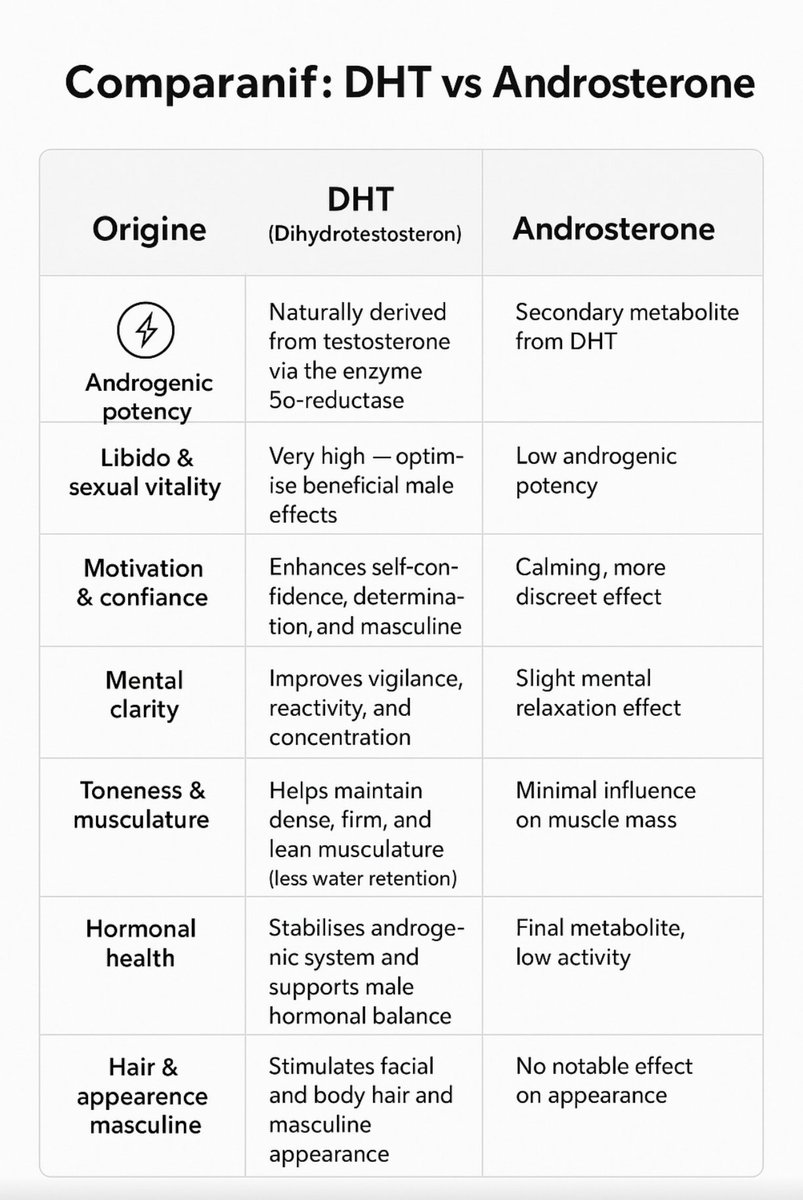
Andractim vs. Androsterone
I’ve received a lot of feedback suggesting that Androsterone is disappointing. This is because DHT is five times more potent than androsterone, and to achieve any effects with androsterone, you need to inject large doses, which leads to suppress hpta
English

Before we dive in,
SITEWIDE SALE: shopbll.co/site-wide-sale
Save 45% on ALL these Compounds.
Exclusive discount.
Comment "AGING" below for your 45% code.
English
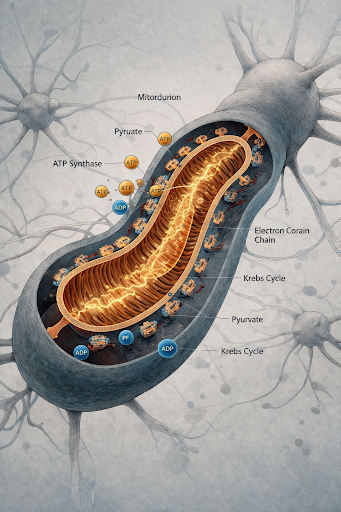
This peptide reverses aging, restores energy & rebuilds mitochondria with the real SS-31 dosage you need.
Here's everything you should know about this:🧵
English

@na_la_la are grounded sandals safe in areas where there are electric wires under the ground?
English
@realitymap @TheDefiantGhost man buddhism hard mogs in metaphysics when you're a high enough practictioner
English

@TheDefiantGhost in buddhism we call them nagas. they're ultraterrestial not alien. most are indifferent to humans, some are wise and benevolent. but a very small extremely malevolent outlier faction brokering tech to intel agencies is famous for most of the bad stuff we associate w "reptilians"
English

Eight years ago David Wilcock went straight in on the reptilian ETs and he wasn’t mincing words.
“So what’s been happening apparently is these, we have these negative beings that do actually appear reptilian. They have vertical slit pupils, they have the scaly skin.”
“I’m not saying that this means that people in the Deep State are shapeshifters… As far as we know, anybody who’s biological, your biology can’t shape-shift. You can shape-shift if you’re an AI being that’s made out of nanites…”
Real reptilians aren’t humans playing dress-up:
“So when we talk about reptilians, we’re not talking about humans on Earth. We’re talking about beings that actually look like this all the time. They’re born that way, they die that way, and they have been the ones that are going around and invading planets and causing trouble.”
“This seems to be where we get this archetypal idea of Satan and demons… They are very muscular and they’re very, very ferocious and terrifying… and they smell really bad too.”
No long tails, no horns, just claws, scales, slit pupils, and pure menace.
2018 Wilcock hitting different in 2026. Literal invaders, ancient archetype, or elite-level storytelling? What’s your read?
English
does anyone have any more info to this, or perhaps a first gut opinion?

English
@asiaanastasia17 @PathfinderAstro once you make it heaven and are reborn as a deva, you should start your journey to enlightenment
English


I AM THE ONLY ASTROLOGER IN THE ENTIRE WORLD WHO PREDICTED THE IRAN PEACE DEAL WOULD HIT ON APRIL 18.
I predicted that exact date over a month in advance.
Trump actually announced the peace deal (“Iran agreed to everything”) at 11 PM April 17 Iran time, so technically I was off by one hour.
No one else came close.
There are like 3 million astrologers in the world,
and not even one of them even came close.
English
@Zenfrog4 do ultrasound on your stomach area if you don't have to do any physical work.
English

@realitymap i have a question: when going to meditate in nature, what's the best way to prevent killing bugs you inevitably step on as you walk through grass to get to more secluded areas?
English

And yet we have Thanissaro Bikkhu - arguably the pre-eminent scholar of Theravada Buddhism - who says:
“the Buddha never advocated attributing an innate nature of any kind to the mind — good, bad, or Buddha.”
And writing an entire essay arguing against its utility as a concept.
I’m sorry but trying to argue that there isn’t a vast diversity of view amongst what Buddha Nature is and whether it even exists is just indefensible.
If anything I feel like you’re making my arguments seem stronger than they actually are by pinning your position on such an obviously false assertion.
English
I’m a Buddhist who also believes in God.
For a certain type of Buddhist, this is very confusing, even triggering.
But for me, I don’t see a contradiction.
Perhaps it is partly due to how I conceive of God.
I don’t experience God as a man in the sky or a humanoid personality (although I believe it can be symbolically accessed that way).
I also don’t experience God as an atta / atman with a fixed substantial nature.
For me, to believe in God is simply to believe that there is a loving intelligence / wisdom that permeates the universe and all things in it.
And that one can live in a way that is either more or less aligned with it.
For me, the eightfold path provides perfect instruction on how to harmonize one’s life with the flow of that loving intelligence.
The Buddha I find offers the most clear instructions on the “what” - what actions do to, with what attitude and what intent.
But the concept (and for me, experience of God) fleshes out the “why?” in ways I sometimes find more inspiring.
That is - why one should adopt these actions, attitudes and intents.
Not just to relinquish suffering but to align with and realise what is most good, true and beautiful.
The Buddhist instructions appeal to my head and the pragmatist in me.
But the God frame appeals to me heart, my lived experience and the romantic in me.
I can see why, as an arch-pragmatist, the Buddha didn’t find utility in a God-frame.
But I am not the Buddha and I would rather engage with the frames that are most nourishing to my own heart, path and lived experiences than try to blindly replicate the Buddha’s journey by pure imitation.
Ultimately, I do believe that all of these frames are empty, and whenever I’ve touched the ultimate it’s not something that fits neatly into any words or clean framework.
But I’ve seen and experienced enough to know that Buddhist practices and frames work well for me.
And I’ve also experienced enough of God to have a faith I can’t shake.
Furthermore, I find my Buddhist practices bring me always closer to what I experience as God.
And in my own heart at least, I find no contradiction in any of this, especially not at the level of experience.
Vacha@TVachaW
There’s a certain type of argument against God that I often hear from Buddhists, which I find unconvincing. The argument essentially seems to be that because there is no stable sensation / perception / field of consciousness etc findable in our minds that corresponds to God, God cannot exist. But - even assuming that is the case - why should God be assumed to be something that’s represented substantially in our minds? Why couldn’t God be a function rather than a substance? In Mahayana Buddhism, they teach that under conditions of maximal awareness, the default functioning of the universe is pure compassionate love and wisdom. What could be more divine than that? What higher intelligence than compassionate love could we hope for the universe’s default operating principle to be? And it certainly accords with my experience of the contemplative path. That when I am able to release craving, aversion and ignorance, compassionate love spontaneously emerges as the default functioning without any need to create or design it. People might object something like “OK, but that’s not a *personal* God.” But then, according to Buddhist theory - what is a person? A person is not a substance but a function. A person is essentially just the way a certain set of phenomena unfold. So, what makes the default loving compassionate functioning of reality any less of a person than the karmically driven functioning of a human person. “OK, but it’s not a God that punishes and rewards,” could be the next objection. But again, according to Mahayana theory - and according to my own experience - the degree to which we suffer is essentially determined by the degree to which we either divert from this compassionate wisdom function or conform to it. When we release craving, aversion and ignorance, we default to the compassionate-wisdom function and we don’t suffer. When we hold onto craving, aversion and ignorance, we limit the scope of that function and we suffer. On a practical level, this isn’t meaningfully all that different to reward/punishment on the basis of adherence to or denial of this divine function. Really, all the things that feel truly important about God are all features of the universe. A loving intelligence is the default functioning of the universe and the degree to which we conform to it determines the degree to which we suffer in the world. It’s a pretty similar story to the God story. It’s why I think the Tibetans were able to design a complete path to enlightenment that revolves around building a relationship to a divine humanoid figure that represents wise compassionate default functioning of the universe. It’s also why, as a Buddhist, I often find more common ground spiritually with Christians who earnestly have live their life on the basis of a faith in a force of universal love, than I do with the type of Buddhist who envisage themselves to be living in a universe of dead matter that operates on blind and arbitrary principles.
English
Well, here’s a few notable Buddhists who disagree with you on this:
“the basic nature of the *mind* is pure and that purity is referred to as Buddha-nature.”
- Dalai Lama
“Your buddha nature — or what we sometimes call ‘nature of *mind*’ — is within you at all times.”
- Mingyur Rinpoche
“The path of insight [is] the recognizing the Buddha nature already present in our own *mind*”
- Thich Nhat Hanh
“this open, unfettered *mind* has many names, but let’s use the term ‘buddha nature’.”
Pena Chodron
By the way, Thanissaro’s point in the essay is not just that the mind lacks Buddha Nature; he argues against the utility of the concept per se
English
@legally_male @realitymap I wore a hoodie to work today, my boss made me take off the hood thank god!
English


@BIMBOSATTVA_ what is the situation exactly? I've seen more ppl talking shit recently lol
English

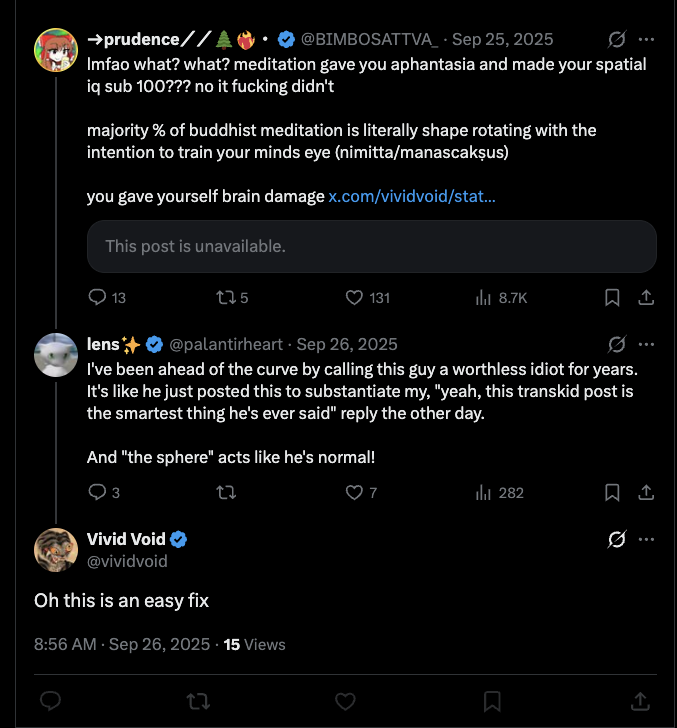
i have no comment on the v**vid v*id situation, im sure he's a good person, god bless his mortal soul, but i noticed he blocked me so i looked up why, i forgot that i had this interaction with him months ago that caused him to block me
didnt even remember this
<🌲❤️🔥>PrUd3nc3_9r1mr0s3_xXx@BIMBOSATTVA_
lmfao what? what? meditation gave you aphantasia and made your spatial iq sub 100??? no it fucking didn't majority % of buddhist meditation is literally shape rotating with the intention to train your minds eye (nimitta/manascakṣus) you gave yourself brain damage
English