

Charley Ma
9K posts

Charley Ma
@CharleyMa
co-founder, managing partner @pathlightvc. Former first biz / head of growth @tryramp, @Plaid, @usealloy.
Katılım Ocak 2009
1.9K Takip Edilen17.7K Takipçiler

Exa raised $250M at a $2.2B valuation, led by a16z, to continue organizing the web for agents:
- Exa now serves search to Cursor, Cognition, Openrouter, 5000+ other companies, 500k+ developers
- We’re SOTA in many important verticals (code, companies, people, news, more very soon)
- We make agents smarter and cheaper by returning 90% less text with little to no tradeoff in RAG quality
- We’re building out web agents that are Pareto optimal on price x performance x latency, possible because we own our search stack fully end to end
We used to tell candidates that without innovation in search, we may live in a world where we have both AGI and fake news. Funnily enough, I think that we’ve now been living in such a world for quite some time. With this funding, we should be able to dramatically improve the state of information in society.
🚀🚀🚀

English

Hot take: shorts should be acceptable business casual wear when it's 95°+ and humid.
English
@zachperret @jgreze @TownAI I also really enjoy the suggested automations that it proactively finds from being connected to emailed. yesterday it noticed that I’m hosting an event that’s getting a lot of rsvps and proactively suggested a workflow to help me filter!
English
@zachperret @jgreze @TownAI I run a lot of outbound through town! ex: last week I gave it the YC batch and asked it to create a spreadsheet companies + founders, and given what it knows on verticals we like, score companies that could be ICP and draft a personalized email for each. did it in one shot!
English
Next level alpha is using @TownAI for noobs like me. Has replaced my vibe coded (aka. very unsecure) openclaw set up and even my claude claude max usage. I don’t have to constantly reconfigure my code slop, I just assign it tasks and it just works.
Garry Tan@garrytan
The biggest alpha leak of 2026 is that you can tokenmax $10k/mo with OpenClaw/Hermes + GBrain and get the AI that everyone will have in 2028 for $100/mo, but you can get it now, and that is the biggest single unlock you can have vs your competition
English
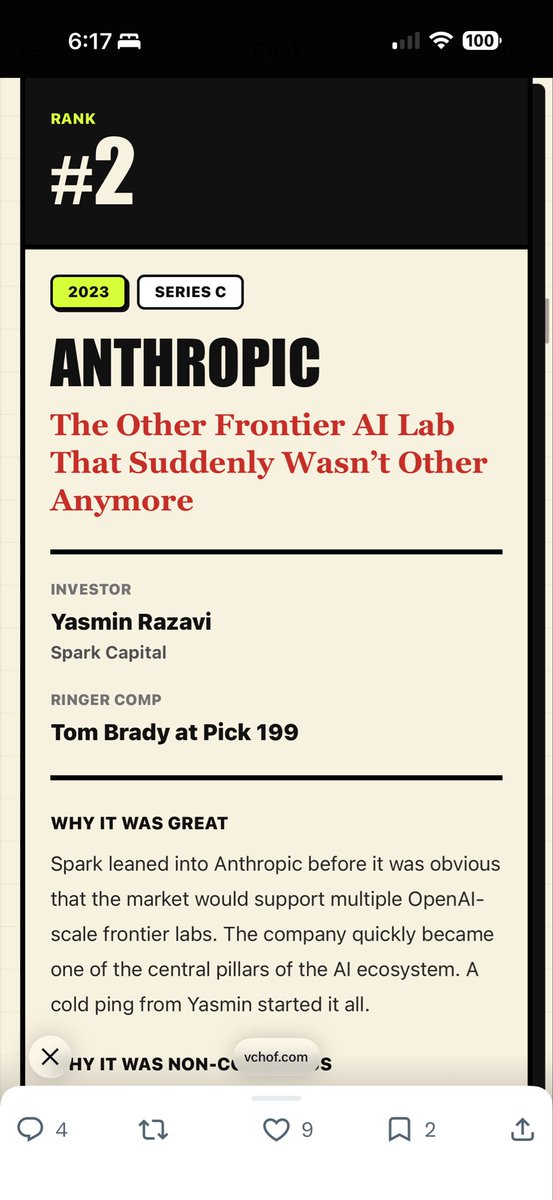
The ringer comps by @lmushin for top 10 venture investments are spot on👌
Leeor Mushin@lmushin
In honor of the Cerebras IPO and inspired by The Ringer, I vibe-coded a site to celebrate my favorite venture investments in the last 15 years - link below
English
@braveben haha more so too cheap to want to pay someone to pick up and donate as the next office also comes with desks and we have to move these out somewhere!!
English

@CharleyMa Damn didn’t know pathlight was ‘too rich for these desks now’ ballin
English
Dear power of the interwebs - we're moving offices in NYC and have 9 extra chairs + 9 desks from our old office - free for anyone that can pick up in flatiron! :)



English

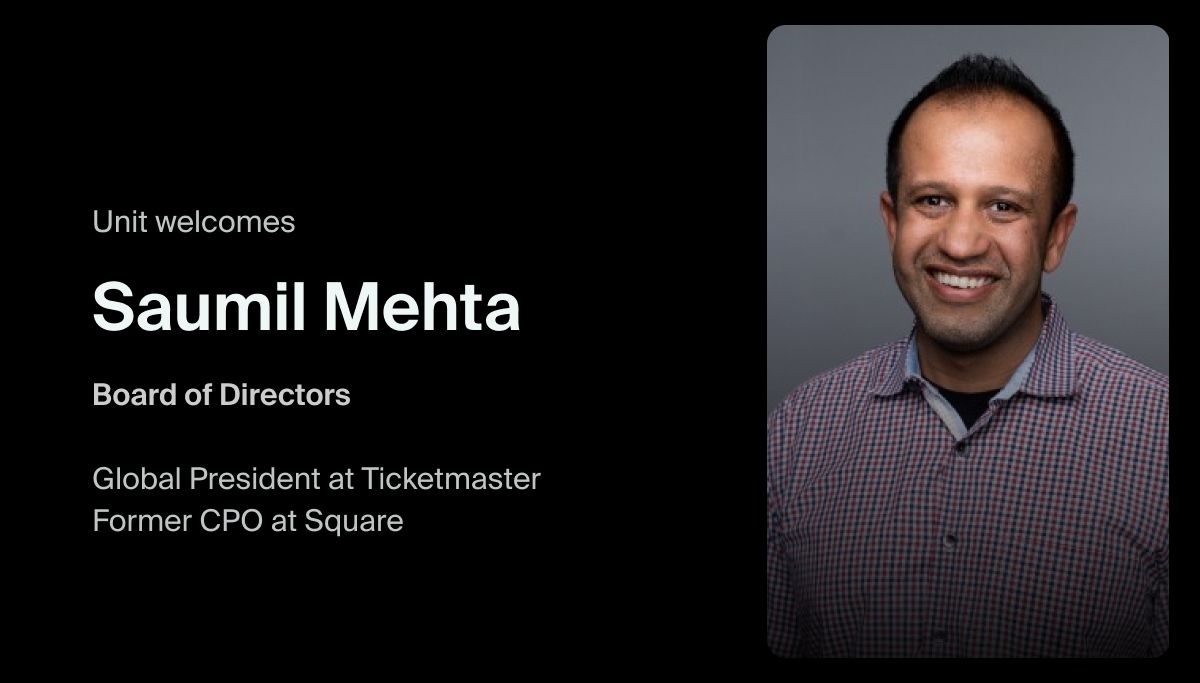
Big day at Unit: we're proud to welcome @saumil to our Board of Directors, as our first independent board member.
Saumil is the Global President of Ticketmaster. He spent the previous 9.5 years at @Square as CPO and Head of Business, scaling the company from pre-IPO to $3.6B in annual gross profit.
I have admired Saumil from the moment I met him. He's an incredibly smart, sophisticated, and humble operator. He has a world class network. And he plays to win.
Saumil's background is also a statement: great companies rethink every piece of infrastructure and stay close to the metal. With this foundation, they can solve the single toughest problem in embedded finance: adoption. Saumil has spent most of his career proving these things at Square.
Read more: unit.co/blog/saumil-me…
English
@yrechtman wait we should be doing regular people things vs vibe coding all night??
English

Finally sat down for The Bone Temple. Really cool movie and definitely my favorite of the series.
Human and deeply hopeful with some great tension. Awesome Raph Fiennes.
⭐️⭐️⭐️⭐️

English

Very excited to work with @OpenAI to launch Finances in ChatGPT!
AI is transforming how consumers interact with their finances. This is an important step towards bringing sophisticated, personalized financial advice to more people.
ChatGPT@ChatGPTapp
A preview for Pro users: a new personal finance experience in ChatGPT. Pro users in the U.S. can securely connect financial accounts, see where their money is going, and ask questions based on the information they choose to connect. Your full financial picture, now in ChatGPT.
English
Pretty wild and awesome to see @Plaid live within @ChatGPTapp!
ChatGPT@ChatGPTapp
A preview for Pro users: a new personal finance experience in ChatGPT. Pro users in the U.S. can securely connect financial accounts, see where their money is going, and ask questions based on the information they choose to connect. Your full financial picture, now in ChatGPT.
English

@CharleyMa This is close to my heart -- love it!
x.com/haridigresses/…
hari raghavan@haridigresses
AN ODE TO EARLY EMPLOYEES I once had someone tell me: “Hari, you’re essential to this company, and we might have died if not for you. But we’re founders and you’re not, and nothing you do can change that." That single sentence shapes the entire way I think about the people at a startup: founders, founding team, early employees, and everyone else. Until the 1990s in Silicon Valley… … being a founder was the toughest job around. It wasn’t cool to be a founder back then. Everyone thought “entrepreneur” was just a fancy way of saying “unemployed.” The greats busted their ass in the proverbial garage for years until they shipped something. They didn’t have AWS or a million open source libraries. They set up servers to run that shit, and built their databases and components from scratch. They tried desperately to recruit early employees because no one wanted to give up their cushy job. Even if they could find the rare person who wanted to change the world, the company was (probably) going to fail and they would get yelled at by their SO or their parents for wasting their life. There were very few VCs, so capital was precious. Founders had to give up onerous terms during fundraising, because they had no power. 3x liquidation preference + participating preferred was the norm back then. Starting a company and finding product-market fit is hard enough. Imagine if it was this much harder. And so, those who had the courage to start something in the face of such immense adversity, were celebrated once they succeed. They were truly one in a million. Special. Today, founders are still treated as if in a class of their own The world has changed a lot in the last 30 years. Virtually any founder(s) — assuming one of them can code — with the glimmer of an idea, can raise millions of dollars before there’s a product or revenue. Creating a prototype has never been easier. Literally a weekend project. Yet… “founders” are more celebrated than ever. Adored, even. I don’t think I truly understood this until I became a founder myself. As a founder of a pre-seed startup in 2019 who had accomplished exactly nothing to date, I suddenly had access to VCs and invitations to exclusive events. Way more than when I’d been a non-founder-COO who had been critical to building a successful Series B startup. It’s like moving up from economy to business class. Except I’d paid in blood, sweat and tears for that economy ticket; and I’d managed to enter business class simply by putting on a suit and walking in like I belonged. The burden of building has shifted from “founders” to “founders & founding team” When early employees join a startup today, they’re not joining a de-risked company with PMF. They’re usually joining a company with a Figma prototype and a bunch of money in the bank. Don’t get me wrong. The money is important. It means they aren’t working for peanuts like some early employees might have, back in the day. A staff engineer or head of operations at a seed stage company is usually making $140-180K base in SF / NY. That capital is incredibly valuable because it buys time to build and sell things. And the founders either had a lot of credibility, or undertook a herculean effort to raise that capital. Raising money is not easy. But the risk from that point on is not that different from that of a founder. 99.9% of the hard work is still ahead. Which means that early employees, particularly “ex post facto founders” (h/t Jason Lemkin: early employees or execs who shoulder “founder-like” burdens), are — according to current norms — left with the worst deal in the ecosystem, when it comes to equity, respect, and influence on a risk-adjusted basis. Here is a list of things that founders are subject to, that early employees don’t have to deal with: 1. Months spent in the wilderness, exploring if the idea can even become a company 2. Reputational & social capital risk with investors & employees Here is a list of things that both founders and ex-post-facto cofounders take on: 1. Reputational risk with partners, suppliers, customers 2. Day-to-day stress of success and failure 3. Stress of shielding junior / rank-and-file employees from the ups and downs Here is a list of things that all early team members (founders, execs, and early employees alike) take on: 1. Lost opportunity cost of making a “market” salary 2. Risk of product-market fit 3. Brand risk In return, founders make 1-2 orders of magnitude more equity; typically control the company through board seats and super-voting rights, and several orders of magnitude more recognition in the ecosystem for their role in the company. Here’s a visual to make it clear. Founders deal with some of the worst parts, and get some of the best perks. Later-stage employees deal with the best parts, and don’t really get any of the perks. You see lots of red and green in those columns. But why are we okay with a sea of orange and yellow for the columns in the middle? Of course it’s hard being a founder. I’m just saying that it might not be 10-100x times as hard, which is what the equity, voting rights, and recognition would imply. Take two co-founders with 30% each at a Series A, four years in. The apportionment would imply that they were each twenty times as valuable as the next strongest employee, and three to five times as valuable as all 20 employees to date, combined. If you’ve started or helped build a company before, you’ve hopefully learned that this is pretty much never reality. This is why nothing frustrates me more than accepting “first employee gets 1%” like it’s gospel. Being a founder is harder than any other role at the company. (Most) founders earn every bit of the money and credibility they get. So this is not about tearing down founders. Hell, I’m a founder now. This is about putting the founding team, ex post facto founders, and early employees where they belong. This ends up hurting both sides: - Companies get hamstrung and have to deal with too many transitions, because many of the best early employees leave 3-4 years in, very consistently. - There are too many companies being started, because lots of people with an entrepreneurial streak end up starting something even if they would have otherwise opted to be an early employee… because being an early employee is just such a bad deal. OK, SO NOW WHAT? Here are a few suggestions; many are controversial, so pick and choose what you like. Any of them would be a step in the right direction towards a trusting relationship and celebration of those who enabled the company in its earliest days: Be generous with honorary titles. Apparently Jack Ma made every one of his early employees a “co-founder” of Alibaba. They had like 17 co-founders. I’m not sure if we need to go that far, but I love the push behind the sentiment… personally, I’m trying out co-founder, founding team, and early employees. And if someone establishes a function — e.g., sales — give them the benefit of “founding head of sales” or “founding designer”. Allow people to get promoted into these honorary titles. It’s normal to promote high performers with title and compensation, so why not here? For example, someone starts as founding team and knocks it out of the park (i.e., behaves like an ex-post-facto cofounder), honor it by promoting them to co-founder status one or two years in. If someone is an early employee (or a ridiculously strong exec) but earns it, make them a co-founder or founding team later on. Notion did this their COO, Akshay Kothari, and Rewind did this more recently with Paul Stamatiou. Being a cofounder shouldn’t give anyone immunity. Underperforming co-founders shouldn’t get to coast or rest-and-vest. Such breakups are hard, but it’s even worse for morale if you let cofounders play by different rules or be held to a lower standard. Get more generous with early employee equity. Get rid of this silly 1% benchmark for first employee. Set up a dedicated “founding team pool” of 10-15% in restricted stock for the first 5-10 employees. Grant your first few employees several percent (at least); and if you want to trust but verify, split it across multiple “promotion” grants issued upfront, or set up a 6-year / 5-year vest for them. That way, your early employees can look at your 25% to their 4% and feel that it’s at least in the ballpark of reasonable. The founders would still each get perhaps twice the equity of the first 5 employees combined… but it starts to approach a “fair” setup.3 Institute friendly equity management policies Early exercise and / or an extended exercise window. The reasons not to do this are administrative and dumb, so push back on your lawyers if they tell you not to do this. (Not legal advice.) Earmark restricted stock for your founding team, not options. Your early employees deserve as “cheap” an exercise as possible for the risk they took. Founders and early team members should play by the same rules when it comes to liquidity. If there is a secondary in a financing round, founders, founding team, and early employees should get to participate in proportion to their (vested) holdings. Once the company crosses certain milestones (5-6 years in, Series C/D+), get more friendly to secondaries. If you don’t, they’re going to happen anyway in quiet handshake deals, and the devil you know is better than the devil you don’t. None of this stuff is rocket science! Just… Reward people in proportion to their contribution. A neutral third party should be able to take a fresh look at the arrangements and say “yeah that seems okay.” Because right now, it’s a deeply skewed incentive and reward system. Startups innovate all the time. Let’s apply some of that creativity to treating critical teammates the right way.
English
Everyone throws events for founders and investors. We wanted to do something different.
Introducing Cliff Club: a community exclusively for early employees at venture-backed companies and we're starting with NYC first! 🧵
English
Charley Ma retweetledi
Really excited to work on this with @CharleyMa and @lmushin. Cliff club - come take the dive.

Charley Ma@CharleyMa
Everyone throws events for founders and investors. We wanted to do something different. Introducing Cliff Club: a community exclusively for early employees at venture-backed companies and we're starting with NYC first! 🧵
English
We're building the community I wish I had, a space for early employees to share experiences, ask the weird questions unique to them, and just hang out.
Our NYC Chapter Launch event is on Tues, June 9th hosted by yours truly, @lmushin, @yrechtman, and our friends @jpmorgan.
Apply to attend here!
luma.com/bo6qilkj
English
As one of the biz hires at Plaid and Ramp, I remember navigating a lot of questions alone:
WTF is QSBS?
How should I think about early exercising?
How should my role evolve as the company scales?
How should I feel about getting layered?
Should I specialize into a role?
English

Excited to welcome Archetype and Circle Ventures as strategic investors, with continued support from our long-term backers.
The next generation of finance will be programmable. Software, agents, and onchain systems will move value globally at machine speed, and they’ll need infrastructure built for verifiable execution and programmable control.
That’s the future we’re building for at Turnkey: scalable, API-first wallets and verifiable computing infrastructure designed for a world of programmable money and agent-driven transactions.
Grateful for the continued conviction from Sequoia, Bain Capital Crypto, Lightspeed Faction, Galaxy Ventures, and Variant. Thank you to our customers for the trust you put in us, and a huge shoutout to the Turnkey team for grinding against this vision.
Turnkey 🔑@turnkeyhq
Thrilled to announce a $12.5M strategic investment to meet accelerating demand for crypto wallets and verifiable computing. With participation from @circle_ventures, @archetypevc, and existing investors @BainCapCrypto, @FactionVC, @galaxyhq, @sequoia, and @variantfund.
English
1-2 more spots available for this first cohort!
For funsies, I also vibe-coded an NYC founder path to series A chutes and ladders game - press play our own landing page to give it a try!
and konami code if you just want to get pre-empted :)

Charley Ma@CharleyMa
Launching something I wish existed when I was figuring out GTM at Plaid, Ramp, and Alloy! @PathlightVC GTM Scale-Up Program: 6 weeks in the summer, in-person in NYC, 100% free and equity-free. Speakers from Clay, Ramp, Apollo, ElevenLabs, Rippling and more + 1:1 office hours
English