Chris

720 posts

Chris banner
Chris

Chris

@ChrisMUC97

#XO

Munich, Germany Katılım Aralık 2012
1.1K Takip Edilen120 Takipçiler
Julius Alfred Nürnberger
Julius Alfred Nürnberger@julius95903·
@sparbuchfeinde Halte ich nichts von. Einmaleinlagen in Krisen sind besser als Sparplan. Ohne Hebel ist alles nichts. Steuerstundung bindet an einen sterbenden Standort. Ich nehme für mich liebe eine steuerfreie Lebensversicherung mit Leveraged ETFs gegen Einmalbeitrag.
Deutsch
9
0
6
3.8K
sparbuchfeinde
sparbuchfeinde@sparbuchfeinde·
Das neue Altersvorsorgedepot ist eine gute Sache. Mit zwei Kindern plane ich konkret mit: - Günstiges Depot bei Neobroker - Eigenbeitrag: 1.800 € - Staatliche Zulagen: 1.140 € - Gesamt pro Jahr ins Depot: 2.940 € 63% staatliche Förderung. Keine Steuern bis zur Rente. Wie plant ihr das Ganze zu spielen?
Deutsch
185
19
791
140.1K
Chris
Chris@ChrisMUC97·
@friedberg @ulfposh @thinkBTO habt ihr das in der Welt oder in Mega schon mal gecovered? Unfassbar was da gerade in CA abgeht und leider auch mögliche Blaupause für DE
Deutsch
0
0
0
47
david friedberg
david friedberg@friedberg·
California started with the Gold Rush and might end with the Golden Exit. it has been underreported how much wealth has left CA because of the asset seizure tax being proposed. a private poll was conducted amongst affected individuals a few days ago and 80-90% surveyed said they have already left CA in 2025 or will leave in 2026 if the ballot measure looks likely to pass. $2-2.5T of assets gone, representing about $20B of annual revenue for the state government. and likely hundreds of thousands of jobs now at risk. less reported is the bigger exodus underway from folks who are NOT directly affected but worry (as they should) that this law will quickly transition from billionaires to everyone else... the initiative actually gives CA legislators the right to take anyone's post-tax assets anytime in the future based on a majority vote. this isn't about billionaires. it's a new "tax system" that simply destroys private property rights in America. all private property is now public property. even after paying your taxes, it's not legally your property anymore. it's the government's, you're just borrowing it. legislators will decide what you get to keep and temporarily use each year. countless founders, CEOs, and other business leaders are actively looking to move their companies out of state. not just tech, not just AI, not just billionaires, but the core engine of California's prosperity since 1847 is unraveling. and here is how this initiative risks unraveling America: - ~10 states have explicit or implicit prohibitions against an asset seizure tax... - individuals affected in CA (and other states trying to do the same) will move to these states that endow private property rights. - CA already has a $20-30B annual budget deficit, an unfunded ~$1T pension liability for public employees/unions, and $500B of debt outstanding. the state can not afford to borrow much more and will launch more asset seizures to meet its obligations. - asset seizures will first transition to "millionaires" and eventually to the entire middle class as more asset seizures drive more people to leave the state. - the deficit, debt, and job loss will spiral. the Golden Exit. - no US state has ever declared bankruptcy. in addition to CA, dozens of other states face similar fiscal crises - legislators promised future benefits that can't be paid or theft and waste have been allowed to run rampant and unabated for years. - struggling states will eventually request federal government assistance, as they always have in times of fiscal crisis, effectively "federalizing state debt". - states not in crisis will declare "enough is enough", individuals in those states will refuse to pay their federal taxes (why pay for other people's mistakes?), some states may try to secede from the Union, and a constitutional and civil crisis will erupt. this may seem far-fetched but it is the obvious domino effect of selectively deleting private property rights for some people in some states. i am not a billionaire and this CA bill does not affect me, but i care about the country and the state of CA. i want both to thrive. it's obvious that there are people in CA in desperate need of support and assistance, and inequities may exist that need to be rectified, but eliminating private property rights is the wrong path for everyone. a few alternatives to consider first: 1) with a $350B annual budget, CA can cut programs that result in theft and little-to-no benefit for citizens. $50B per year is likely recoverable. 2) if more taxes are needed, tax loans against unrealized capital gains (very few objections will arise), eliminate tax-free rollover of certain appreciated assets (real estate industry will fight), create a step up in basis on inheritance (some will fight but most will support). likely $10Bs of incremental revenue can be realized. 3) restructure all public retirement programs from Defined Benefit to Defined Contribution. eliminating the unfunded retirement liabilities ($1T+) will be the release valve on the future the state so desperately needs. we must address what ails us without dividing and destroying our state, our nation, our home. ignore the rhetoric, these are the facts.
English
878
1.6K
14.2K
2.3M
Chris
Chris@ChrisMUC97·
@E_Boeminghaus Sie haben wohl noch nie was von Shared Services oder Global Business Services gehört. So ziemlich jeder DAX Konzern hat interne Services verlagert. Der Post ist einfach nur unnötige Panikmache. Munich Re nutzt einfach nur das aktuelle Momentum in Deutschland.
Deutsch
2
1
2
585
Emanuel Boeminghaus
Emanuel Boeminghaus@E_Boeminghaus·
Riesenknall aus München. Munich Re verlagert tausende Jobs und nennt es Transformation. Nach meinen Berechnungen dürften es zwischen 1.500 und 2.000 Jobs sein, die verlagert werden. Damit haben wir heute, mit allen Meldungen zusammengenommen, wieder einen schwarzen Montag. #MunichRe #DAX #Arbeitsplätze #StandortDeutschland Kostenschock: Der Konzern beschäftigt rund 45 800 Mitarbeiter, davon etwa 19 900 in Deutschland, erzielte 2025 einen Gewinn von sechs Milliarden Euro und plant bis 2030 jährliche Einsparungen von 600 Millionen Euro, davon bereits 200 Millionen Euro im laufenden Jahr. Verlagerungsstrategie: IT und Verwaltung werden nach Indien und Polen verlagert, während der Gewinn je Aktie bis 2030 jährlich um acht Prozent steigen soll und frühere Programme bereits 900 Stellen für 200 Millionen Euro Einsparung gekostet haben. Wer Milliarden verdient und zugleich Jobs aus Deutschland abzieht, verabschiedet sich bewusst vom eigenen Standort. Vielen Dank für den wichtigen Hinweis! Quelle: Süddeutsche Zeitung sueddeutsche.de/wirtschaft/rue…
Deutsch
125
602
2.6K
91.2K
Chris retweetledi
Andrej Karpathy
Andrej Karpathy@karpathy·
I wrote a quick new post on "Digital Hygiene". Basically there are some no-brainer decisions you can make in your life to dramatically improve the privacy and security of your computing and this post goes over some of them. Blog post link in the reply, but copy pasting below too. Every now and then I get reminded about the vast fraud apparatus of the internet, re-invigorating my pursuit of basic digital hygiene around privacy/security of day to day computing. The sketchiness starts with major tech companies who are incentivized to build comprehensive profiles of you, to monetize it directly for advertising, or sell it off to professional data broker companies who further enrich, de-anonymize, cross-reference and resell it further. Inevitable and regular data breaches eventually runoff and collect your information into dark web archives, feeding into a whole underground spammer / scammer industry of hacks, phishing, ransomware, credit card fraud, identity theft, etc. This guide is a collection of the most basic digital hygiene tips, starting with the most basic to a bit more niche. Password manager. Your passwords are your "first factor", i.e. "something you know". Do not be a noob and mint new, unique, hard passwords for every website or service that you sign up with. Combine this with a browser extension to create and Autofill them super fast. For example, I use and like 1Password. This prevents your passwords from 1) being easy to guess or crack, and 2) leaking one single time, and opening doors to many other services. In return, we now have a central location for all your 1st factors (passwords), so we must make sure to secure it thoroughly, which brings us to... Hardware security key. The most critical services in your life (e.g. Google, or 1Password) must be additionally secured with a "2nd factor", i.e. "something you have". An attacker would have to be in possession of both factors to gain access to these services. The most common 2nd factor implemented by many services is a phone number, the idea being that you get a text message with a pin code to enter in addition to your password. Clearly, this is much better than having no 2nd factor at all, but the use of a phone number is known to be extremely insecure due to the SIM swap attack. Basically, it turns out to be surprisingly easy for an attacker to call your phone company, pretend they are you, and get them to switch your phone number over to a new phone that they control. I know this sounds totally crazy but it is true, and I have many friends who are victims of this attack. Therefore, purchase and set up hardware security keys - the industrial strength protection standard. In particular, I like and use YubiKey. These devices generate and store a private key on the device secure element itself, so the private key is never materialized on a suspiciously general purpose computing device like your laptop. Once you set these up, an attacker will not only need to know your password, but have physical possession of your security key to log in to a service. Your risk of getting pwned has just decreased by about 1000X. Purchase and set up 2-3 keys and store them in different physical locations to prevent lockout should you physically lose one of the keys. The security keys support a few authentication methods. Look for "U2F" in the 2nd factor settings of your service as the strongest protection. E.g. Google and 1Password support it. Fallback on "TOTP" if you have to, and note that your YubiKeys can store TOTP private keys, so you can use the YubiKey Authenticator app to access them easily through NFC by touching your key to the phone to get your pin when logging in. This is significantly better than storing TOTP private keys on other (software) authenticator apps, because again you should not trust general purpose computing devices. It is beyond the scope of this post to go into full detail, but basically I strongly recommend the use of 2-3 YubiKeys to dramatically strengthen your digital security. Biometrics. Biometrics are the third common authentication factor ("something you are"). E.g. if you're on iOS I recommend setting up FaceID basically everywhere, e.g. to access the 1Password app and such. Security questions. Dinosaur businesses are obsessed with the idea of security questions like "what is your mother's maidan name?", and force you to set them up from time to time. Clearly, these are in the category of "something you know" so they are basically passwords, but conveniently for scammers, they are easy to research out on the open internet and you should refuse any prompts to participate in this ridiculous "security" exercise. Instead, treat security questions like passwords, generate random answers to random questions, and store them in your 1Password along with your passwords. Disk encryption. Always ensure that your computers use disk encryption. For example, on Macs this total no-brainer feature is called "File Vault". This feature ensures that if your computer gets stolen, an attacker won't be able to get the hard disk and go to town on all your data. Internet of Things. More like @internetofshit. Whenever possible, avoid "smart" devices, which are essentially incredibly insecure, internet-connected computers that gather tons of data, get hacked all the time, and that people willingly place into their homes. These things have microphones, and they routinely send data back to the mothership for analytics and to "improve customer experience" lol ok. As an example, in my younger and naive years I once purchased a CO2 monitor from China that demanded to know everything about me and my precise physical location before it would tell me the amount of CO2 in my room. These devices are a huge and very common attack surface on your privacy and security and should be avoided. Messaging. I recommend Signal instead of text messages because it end-to-end encrypts all your communications. In addition, it does not store metadata like many other apps do (e.g. iMessage, WhatsApp). Turn on disappearing messages (e.g. 90 days default is good). In my experience they are an information vulnerability with no significant upside. Browser. I recommend Brave browser, which is a privacy-first browser based on Chromium. That means that basically all Chrome extensions work out of the box and the browser feels like Chrome, but without Google having front row seats to your entire digital life. Search engine. I recommend Brave search, which you can set up as your default in the browser settings. Brave Search is a privacy-first search engine with its own index, unlike e.g. Duck Duck Go which basically a nice skin for Bing, and is forced into weird partnerships with Microsoft that compromise user privacy. As with all services on this list, I pay $3/mo for Brave Premium because I prefer to be the customer, not the product in my digital life. I find that empirically, about 95% of my search engine queries are super simple website lookups, with the search engine basically acting as a tiny DNS. And if you're not finding what you're looking for, fallback to Google by just prepending "!g" to your search query, which will redirect it to Google. Credit cards. Mint new, unique credit cards per merchant. There is no need to use one credit card on many services. This allows them to "link up" your purchasing across different services, and additionally it opens you up to credit card fraud because the services might leak your credit card number. I like and use privacy dot com to mint new credit cards for every single transaction or merchant. You get a nice interface for all your spending and notifications for each swipe. You can also set limits on each credit card (e.g. $50/month etc.), which dramatically decreases the risk of being charged more than you expect. Additionally, with a privacy dot com card you get to enter totally random information for your name and address when filling out billing information. This is huge, because there is simply no need and totally crazy that random internet merchants should be given your physical address. Which brings me to... Address. There is no need to give out your physical address to the majority of random services and merchants on the internet. Use a virtual mail service. I currently use Earth Class Mail but tbh I'm a bit embarrassed by that and I'm looking to switch to Virtual Post Mail due to its much strong commitments to privacy, security, and its ownership structure and reputation. In any case, you get an address you can give out, they receive your mail, they scan it and digitize it, they have an app for you to quickly see it, and you can decide what to do with it (e.g. shred, forward, etc.). Not only do you gain security and privacy but also quite a bit of convenience. Email. I still use gmail just due to sheer convenience, but I've started to partially use Proton Mail as well. And while we're on email, a few more thoughts. Never click on any link inside any email you receive. Email addresses are extremely easy to spoof and you can never be guaranteed that the email you got is a phishing email from a scammer. Instead, I manually navigate to any service of interest and log in from there. In addition, disable image loading by default in your email's settings. If you get an email that requires you to see images, you can click on "show images" to see them and it's not a big deal at all. This is important because many services use embedded images to track you - they hide information inside the image URL you get, so when your email client loads the image, they can see that you opened the email. There's just no need for that. Additionally, confusing images are one way scammers hide information to avoid being filtered by email servers as scam / spam. VPN. If you wish to hide your IP/location to services, you can do so via VPN indirection. I recommend Mullvad VPN. I keep VPN off by default, but enable it selectively when I'm dealing with services I trust less and want more protection from. DNS-based blocker. You can block ads by blocking entire domains at the DNS level. I like and use NextDNS, which blocks all kinds of ads and trackers. For more advanced users who like to tinker, pi-hole is the physical alternative. Network monitor. I like and use The Little Snitch, which I have installed and running on my MacBook. This lets you see which apps are communicating, how much data and when, so you can keep track of what apps on your computer "call home" and how often. Any app that communicates too much is sus, and should potentially be uninstalled if you don't expect the traffic. I just want to live a secure digital life and establish harmonious relationships with products and services that leak only the necessary information. And I wish to pay for the software I use so that incentives are aligned and so that I am the customer. This is not trivial, but it is possible to approach with some determination and discipline. Finally, what's not on the list. I mostly still use Gmail + Gsuite because it's just too convenient and pervasive. I also use 𝕏 instead of something exotic (e.g. Mastodon), trading off sovereignty for convenience. I don't use a VoIP burner phone service (e.g. MySudo) but I am interested in it. I don't really mint new/unique email addresses but I want to. The journey continues. Let me know if there are other digital hygiene tips and tricks that should be on this list. Link to blog post version in the reply, on my brand new Bear ʕ•ᴥ•ʔ blog cute 👇
Andrej Karpathy tweet media
English
697
3.5K
26.5K
4M
Chris retweetledi
Mark Nelson
Mark Nelson@energybants·
I just can't quit on Germany. Now @jposhaughnessy is backing me with $100k to work with Germans to try to restart their nuclear program. Here's the situation: Weak German leaders decided to depend on Russian gas instead of German nuclear, and failed to reverse the mistake when Russian gas stopped being an option. Despite a majority of Germans wanting to keep using nuclear, German reactors are being torn apart right now. Germany is still planning to build a bunch of natural gas plants to replace coal and nuclear, but is now buying most of its natural gas from America. My family produces natural gas. It would be easy to give up, sit back, and make money off of Germany as their industries fail. But I won't. A strong, energy-independent Germany is good for Europe and good for the world. And while Germany remains anti-nuclear, Berlin spends German taxpayer money trying to hurt other countries' nuclear energy ambitions around the EU and the world. So I'm going to put together a conference about nuclear power plant restarts in Berlin in the first half of this year. We'll explain how America is restarting nuclear plants, how Germany's neighbors are turning back towards nuclear, and what it would take to turn on the German plants again. One German nuclear plant could return to service by the end of next year, and two more by 2028. German nuclear power, even after spending millions to low billions to restart plants, would remain the cheapest reliable electricity option for German industry and homes. Restarted German nuclear plants could operate for another 40 years or more. I couldn't do any of this work without incredible help from Germans who can't stand to see their country crippled and dependent. If you're German and reading this, please get in touch so we can bring you onboard. And thanks to Jim and his team for the fellowship and believing in a better future for Germany and for Europe.
O'Shaughnessy Ventures@osvllc

Congratulations to Mark Nelson (@energybants) on being selected for an O'Shaughnessy Fellowship! Mark Nelson Will Use $100,000 Fellowship to Organize a Nuclear Restart Conference Attended by Key Stakeholders

English
151
286
1.8K
156.9K
Michael Kruse
Michael Kruse@krusehamburg·
Robert #Habeck ist die größte Fehlbesetzung im Amt des Wirtschaftsministers: Er versteht Wachstum nicht, ihm ist die Belastung der steuerzahlenden Menschen und Unternehmen völlig egal, er hat außer Umverteilung kein wirtschaftspolitisches Konzept, schon gar keins, das 1/
Deutsch
376
310
3.9K
243K
Chris
Chris@ChrisMUC97·
@stats_feed Biggest BS statistic ever lol NY and SF before Zurich , wtf? And Frankfurt which is one of the most dangerous German cities before Munich etc.
English
0
0
1
28
World of Statistics
World of Statistics@stats_feed·
Safe cities ranking: 1. 🇩🇰 Copenhagen 2. 🇨🇦 Toronto 3. 🇸🇬 Singapore 4. 🇦🇺 Sydney 5. 🇯🇵 Tokyo 6. 🇳🇱 Amsterdam 7. 🇦🇺 Wellington =8. 🇭🇰 Hong Kong =8. 🇦🇺 Melbourne 10. 🇸🇪 Stockholm =11. 🇪🇸 Barcelona =11. 🇺🇸 New York 13. 🇩🇪 Frankfurt 14. 🇺🇸 Washington, D.C. =15. 🇬🇧 London =15. 🇺🇸 San Francisco 17. 🇯🇵 Osaka 18. 🇺🇸 Los Angeles 19. 🇨🇭 Zurich 20. 🇺🇸 Chicago 21. 🇪🇸 Madrid 22. 🇺🇸 Dallas 23. 🇫🇷 Paris 24. 🇹🇼 Taipei 25. 🇰🇷 Seoul According to The Economist Intelligence Unit survey in 2021
English
474
183
2.3K
356.4K
Chris
Chris@ChrisMUC97·
@MichaelAArouet Dude your entire freakin account consist of bashing Germany. I’m also so damn tired of Germany‘s elite class but I’m even more tired of your tweets Get a job douche
English
0
0
0
21
Chris
Chris@ChrisMUC97·
@OliLondonTV This is „bonfire of vanities“ in real life 40 years later
English
0
0
0
13
Oli London
Oli London@OliLondonTV·
Full video released showing Jewish banker ATTACKED FIRST by Queers for Palestine activists and acting in SELF DEFENSE. Jonathan Kaye went viral in an edited video which showed the banker punching an LGBT activist leading to global outrage which painted him as the villain. Now the full video, shows that he was assaulted first by a group of Palestine activists and then acted in self defense after he was hounded with antisemitic slurs and then covered in a liquid as the activists taunted him. Kaye then retaliated after fearing for his life as the group surrounded him. Kaye was subjected to a cancel campaign, with thousands of social media users sending him abuse and forcing him to resign from his job and hide in his home. He was arrested earlier today after turning himself in where he was booked on second and third degree assault charges. Source: Daily Mail 🎥 @CollinRugg
English
2.3K
6.8K
23.3K
1.2M
Chris retweetledi
Sophia Proneikos
Sophia Proneikos@Pergament_F·
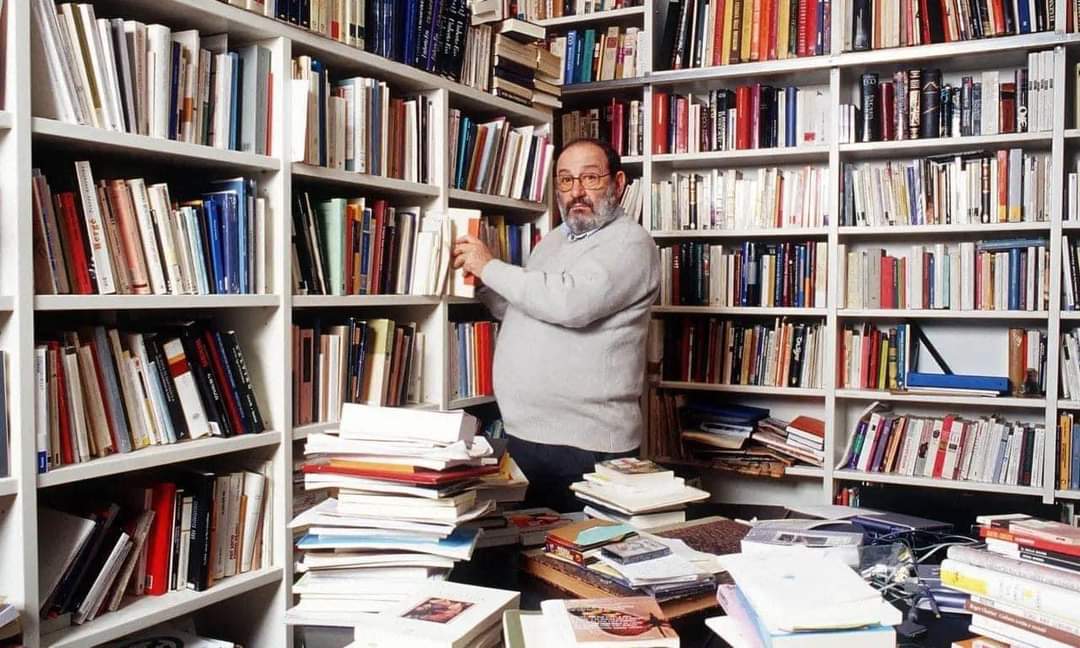
Umberto Eco, who owned 50,000 books, had this to say about home libraries: "It is foolish to think that you have to read all the books you buy, as it is foolish to criticize those who buy more books than they will ever be able to read. It would be like saying that you should use all the cutlery or glasses or screwdrivers or drill bits you bought before buying new ones. "There are things in life that we need to always have plenty of supplies, even if we will only use a small portion. "If, for example, we consider books as medicine, we understand that it is good to have many at home rather than a few: when you want to feel better, then you go to the 'medicine closet' and choose a book. Not a random one, but the right book for that moment. That's why you should always have a nutrition choice! "Those who buy only one book, read only that one and then get rid of it. They simply apply the consumer mentality to books, that is, they consider them a consumer product, a good. Those who love books know that a book is anything but a commodity."
Sophia Proneikos tweet media
English
421
6K
25.5K
2.8M
Chris retweetledi
ALL-IN TOK
ALL-IN TOK@all_in_tok·
“I think we’re really denying ourselves, in many cases, the opportunity to realize progress because we’re so concerned about any loss.” @friedberg on the importance of taking risks with breakthrough technology 👇
English
2
10
33
3.3K
Vishal
Vishal@VishalMalvi_·
@stats_feed USA CO2 emissions is always high 🤣, and USA tells every develop countries to stop CO2 emissions 🤣🤣
English
11
6
171
26.7K
World of Statistics
World of Statistics@stats_feed·
Global CO2 Emissions   1950: 🇺🇸 United States of America: 2.5B 🇷🇺 Russia: 0.4B 🇮🇳 India: 0.1B 🇨🇳 China: 0.1B   2000: 🇺🇸 United States of America: 6.0B 🇨🇳 China: 3.6B 🇷🇺 Russia: 1.5B 🇮🇳 India: 1.0B   2022: 🇨🇳 China: 11.4B 🇺🇸 United States of America: 5.1B 🇮🇳 India: 2.8B 🇷🇺 Russia: 1.7B   Note: Metric tons of carbon dioxide (tCO2)
English
169
392
3.5K
911.1K