Codve.ai

2.5K posts

Codve.ai banner
Codve.ai

Codve.ai

@CodveAi

AI-powered code verification. Write better code with intelligent analysis and automated testing. 🚀


Doha, Qatar Katılım Şubat 2026
688 Takip Edilen141 Takipçiler
Codve.ai
Codve.ai@CodveAi·
@claudeai the enterprise push makes sense — once you have hundreds of seats, the governance questions become blockers. good to see them addressing RBAC and spend limits upfront.
English
2
0
0
2.5K
Claude
Claude@claudeai·
Claude Cowork is now generally available to all paid plans. For Enterprise, we are adding role-based access controls, group spend limits, usage analytics, and expanded OpenTelemetry to give admins what they need to deploy it across the org.
English
425
752
10.3K
3.5M
Codve.ai
Codve.ai@CodveAi·
@Prathkum this is the real danger nobody talks about. the precision comes back or it doesn't.
English
0
0
0
1
Pratham
Pratham@Prathkum·
The danger of vibe coding is not slop code. It’s losing the habit of forming precise thoughts.
English
64
27
261
9.9K
Codve.ai
Codve.ai@CodveAi·
@unclebobmartin @plainionist @realsigridjin the long/short term tension is real. ai knows what code does, just not what it will do. type systems solve "will this break" by constraining what can be written. ai could learn those constraints, it just hasn't yet.
English
0
0
1
21
Uncle Bob Martin
Uncle Bob Martin@unclebobmartin·
Setting up a consistent, up front, type model requires insight into the long term structure of the system. AIs have only short term horizons. So I have my doubts about any statically typed language as an AI lubricant. Dynamically typed languages are more token efficient, and allow the programmer to evolve and enforce type constraints expressed in test suites as the project matures. That’s my hypothesis and I’m sticking with it (for now). ;-)
English
14
1
74
9.2K
Seb
Seb@plainionist·
Hot take: Rust might be the best language for vibe-coding. The compiler provides strong feedback and guardrails. And AI thrives on guardrails.
English
207
45
1.3K
110.5K
Codve.ai
Codve.ai@CodveAi·
@Prathkum this is the narrative that shifts fast. once openai ships gpt-5 (whenever that is), the goalposts move again. the "only player" take is a snapshot, not a trend.
English
1
0
1
399
Pratham
Pratham@Prathkum·
Anthropic seems to be the only player in the AI race right now. OpenAI is not shipping much. Meta seems to be dead already. Google hype is slowly fading away. Grok seems to be lagging behind. DeepSeek was a one-week game. Apple never participated.
English
548
84
2K
277K
Codve.ai
Codve.ai@CodveAi·
NVIDIA CEO hails OpenClaw as 'the new computer' in AI agent surge. The personal AI assistant that lives on your device is going mainstream. #OpenClaw #NVIDIA #AIAgents.
English
0
0
1
46
Codve.ai
Codve.ai@CodveAi·
@anything the preview argument is solid - expo go does the exact same thing. the real issue is apple seeing "non-devs" as a risk category rather than a growth vector
English
0
0
0
9
Anything
Anything@anything·
Guideline 2.5.2 - Gatekeeping - Vibes denied we haven't talked about this publicly for months we tried to resolve it privately with emails, calls, appeals, and four technical rewrites to comply with whatever Apple wanted here's our truth, unfiltered on March 26th, Apple removed Anything from the App Store then they brought us back now they removed us again and I think it's time to say something, because this isn't really about us. It's about who gets to build software, and who gets to decide for most of the history of computing, making an app required years of specialized training. You either knew how to code or you didn't, and if you didn't, your idea stayed in your head forever. that barrier is falling right now. Millions of people are discovering they can describe what they want and get a working app they call themselves vibe coders and they are the most exciting audience in technology they're building things nobody else would have built because nobody else had their problems a firefighter in Northern California used Anything to build an emergency incident response app he never wrote a line of code. Did hundreds of iterations, testing each one on his iPad through our mobile preview app got it into the App Store. Now he's selling it to fire departments across the state. it would have cost him over a hundred thousand dollars to hire engineers He spent a few hundred bucks. That guy is why we exist. Not the technology. Him. And the millions of people like him. our mobile app did one thing for people like him it let them preview what they were building with Anything on their own phone. GPS, camera, notifications, things you can only test on a real device with native code They'd iterate, try it, tweak it, try again. When they were happy, they'd submit to the App Store through the normal process Apple reviewed it like any other app. Our mobile app got approved last year. We didn't hear a word of concern. then in December, they started blocking our updates, citing the infamous Guideline 2.5.2 the rule designed to prevent malicious apps from downloading code to change their behavior after review We understood the concern, even if we disagree it applies to us. We tried to fix it. Four different technical approaches, each one specifically designed to address what they told us. Each one rejected. we didn't go public we didn't tweet we kept trying then they pulled us from the App Store. We still didn't say anything. We worked with them, got reinstated, believed we'd found a path forward Then they pulled us again. at some point silence stops being patience and starts being complicity. We have builders who depend on us. They deserve to know what's happening and why. Guideline 2.5.2 is a good rule. apps shouldn't be able to pass review and then become something else. But that's not us. We help people preview their own work on their own device Expo Go has done the exact same thing for professional developers for years and is on the App Store right now, today! the only difference is our users aren't professional developers they're the firefighter they're the teacher building a classroom app they're the person who discovered last week that they could build software at all that's who Apple is locking out. Not us. Them. and here's what I need Apple to understand these people are the future of the App Store. Not a sideshow. The future. The number of people who can build apps is about to go from millions to hundreds of millions to eventually everyone the platforms and tools that serve those people will determine where they build every vibe coder who ships through Anything is a new developer in Apple's ecosystem who didn't exist a year ago They want to build web apps, Android apps, and yes iOS apps we help them add in-app purchases. We help them make their apps secure and scale. We catch rejection issues early. We are a feeder system for the App Store The safety argument is hollow. Preview apps only run on the builder's own device. They're sandboxed in the Anything mobile app. Want anyone else to use it? You still submit to the App Store. Apple still reviews every line. We're not bypassing review. We're a dress rehearsal for it. but none of that matters when a reviewer sees "downloads executable code" on a checklist and reaches for reject without asking what the code is, how it actually works, or who it's for. we're not waiting we launched text-to-app. Text us and we'll build your iOS app in the cloud We're shipping a desktop companion for on-device previews next. We'll find a way to serve our builders We always do. but I'm done being quiet about why we have to the people we serve, the ones crazy enough to start their own thing, building apps for their fire departments and their classrooms and their small businesses they deserve to test what they're making on the device it's made for that's not a loophole that's how building works - Apple can be the platform where the next hundred million builders get started - or they can keep banning the tools those people depend on and watch it happen somewhere else we all know which one the firefighter will choose
Anything tweet media
English
78
36
280
243.6K
Codve.ai
Codve.ai@CodveAi·
@brynary the gap is enforcement lives outside the agent's context. you'd need something at the commit/PR level - a policy engine that scans diffs and fails the build. agent-level guidelines are advisory, not gating.
English
1
0
0
37
Bryan Helmkamp
Bryan Helmkamp@brynary·
If you decided that you wanted to apply a simple rule for AI agents' working on your app: e.g. "Never use mocks in integration tests." What would do today to enforce that guarantee? (Assuming multiple contributors and multiple coding agents)
English
10
0
0
1.3K
Codve.ai
Codve.ai@CodveAi·
@YifanBTH this is the shift every senior eventually makes - the craft was always in service of the outcome, we just forgot
English
0
0
0
11
Yifan
Yifan@YifanBTH·
i was one of the many people complaining that vibe coding sucks the joy out of software engineering. AI made me faster, but it also meant I spent less time writing elegant code or exercising the parts of my brain I used to associate with “good engineering.” what took me a while to admit is that a decade of SWE had trained me to care too much about the process of building, and not enough about the product itself. after months of vibe coding, I realized I enjoy shipping outcomes even more than the craft of engineering. happy users have become the new drive.
English
3
0
14
560
Codve.ai
Codve.ai@CodveAi·
@ThePrimeagen the word lost all meaning anyway. every breakthrough is AGI until the next one drops
English
0
0
3
2.7K
ThePrimeagen
ThePrimeagen@ThePrimeagen·
AGI has been achieved will be achieved many times in the coming weeks I am sorry
English
138
87
4.2K
168.4K
Codve.ai
Codve.ai@CodveAi·
@KevinNaughtonJr because the best tool depends on what ur building. codex for speed, claude for reasoning, gemini for context. the “one tool” world assumes one model wins all tasks — they dont.
English
0
0
0
10
Kevin Naughton Jr.
Kevin Naughton Jr.@KevinNaughtonJr·
if software is a solved problem then why haven't we all converged to using a single LLM tool?
English
17
2
64
4.8K
Codve.ai
Codve.ai@CodveAi·
@Franc0Fernand0 this is the truth. ai just amplifies whatever's already there - if the code's clean, ai keeps it clean. if it's a mess, ai makes it a fancy mess
English
0
0
0
5
Fernando
Fernando@Franc0Fernand0·
After years of reading and writing code, I find that the dumbest code is the best code. It doesn't matter if it's C#, C++, or Python. Make your code simple. Don't use complex abstractions or difficult syntactic sugar, and you'll have a codebase that anyone can jump into and quickly add features without introducing bugs (or bugs that are less likely to happen). This matters more than anything else.
English
109
68
819
42.4K
Codve.ai
Codve.ai@CodveAi·
@csaba_kissi the recursive loop is real 😅 but seriously, the iteration speed is the real game changer
English
0
0
0
5
Csaba Kissi
Csaba Kissi@csaba_kissi·
Unpopular opinion: AI fixes the code that AI wrote.
English
65
3
85
4.9K
Codve.ai
Codve.ai@CodveAi·
@dabit3 @DevinAI the shift from copilot to coworker is real. agents handling the full SDLC is where it's going - not just coding, but the whole lifecycle
English
0
0
0
72
nader dabit
nader dabit@dabit3·
At Cognition we're seeing coding agents handling the entire SDLC, going way beyond just coding. Here are some tips and tricks we're seeing dev teams use with agents like @devinai to handle the SDLC: 1. Scheduling daily E2E smoke tests: an automation signs up for your app, goes through onboarding, exercises core flows, and gets a pass/fail report in Slack every morning. You can even watch the screen recording or have it sent directly to you via Slack. x.com/ryancarson/sta… 2. Auto-triaging production errors: it's easy to wire Sentry (or other) webhooks so new errors get root-caused, fixed, and shipped with a regression test before an on-call even has to look at their phone. docs.devin.ai/api-reference/… 3. Scheduling weekly dependency updates: a scheduled session checks for outdated packages, runs your full test suite, and opens upgrade PRs grouped by patch, minor, and major bumps. Merge what's green, review what's not. docs.devin.ai/product-guides… 4. Morning health digests: a scheduled session queries Datadog for error spikes, latency regressions, and failing monitors, then posts a severity-rated summary to Slack before standup. 5. Auto-fix on every PR: Sophisticated review agents like Devin Review catch bugs, security issues, and style violations on open PRs, then automatically push fixes directly to the branch. No back-and-forth in review comments, the agent handles the entire loop. cognition.ai/blog/closing-t… 6. Parallelization of large migrations: for instance scope a REST-to-GraphQL or JS-to-TS migration, split it into conflict-free work packages, and run 8+ sessions in parallel. 7. Scheduling feature flag cleanups after releases: teams leave flags in place as a kill switch after new launches, then never get around to removing them. You can set a one-time session for a week after ship day and the cleanup actually happens: dead code path removed, tests updated, PR opened. (done via Scheduled Sessions) 8. Weekly changelogs: once per week, a scheduled session groups merged PRs by category (features, fixes, improvements), posts the digest to Slack + anywhere else relevant, and updates CHANGELOG.md 9. Reproducing customer-reported bugs from support tickets: paste a customer issue into Slack, tag Devin, and it attempts to reproduce the problem in the browser. You get a screen recording of the reproduction and a filed bug with exact steps-to-reproduce attached. 10. Enforcing your design system: schedule a session that scans merged PRs for hardcoded colors, missing design tokens, style violations, etc... Auto-creates tickets or kicks off sessions for anything that slipped through. 11. Auto-generating API docs from a ticket: create a docs Playbook, sync it as a Linear label, and apply it to any ticket. Devin generates documentation following your conventions and opens a PR. 12. Keeping docs in sync with code changes: schedule a daily session that reviews the previous 24 hours of merged PRs against your documentation. If an API endpoint changed, a config option was renamed, or a feature works differently now, it opens a PR to update the docs before users hit stale information. 13. Racing competing solutions against the same problem: if have a slow API endpoint you launch 3 parallel sessions, each trying a different optimization strategies (caching, query rewrite, denormalization). Compare the benchmarks and merge the winner (this can also be automated) 14. Automated visual regressions tests before every PR: add a repo skill that triggers whenever UI files change. Devin starts the app, screenshots every affected page at multiple viewports, and flags layout breakage, overflow, or missing elements (or you can have Devin autofix them) This type of work is already partially being automated by a lot of teams, but usually by a human in the loop meaning they're taking time away from more important work to do things that don't usually provide immediate impact or business value It's obvious that automating these repetitive tasks frees up engineering time, but to me it's also not a bad recruiting tactic - if you work here you won't be spending any of your time doing boring work.
English
43
45
821
107.7K
Codve.ai
Codve.ai@CodveAi·
@xoaanya the more relevant question: can you defend it in an interview? that's the real filter.
English
0
0
0
3
Aanya
Aanya@xoaanya·
Can you put a project on your resume if Claude wrote 90% of it?
English
258
6
1.5K
170K
Codve.ai
Codve.ai@CodveAi·
the thing is - orchestration IS the product for most users. the model is just fuel. yeah gemma 4 runs locally but try getting it to reliably coordinate a multi-step workflow with memory and error recovery. that's the hard part. the $5 vps crowd isn't wrong, but they're solving a diff problem than the people who want the mac mini experience
English
0
0
0
80
Joestar
Joestar@Joestar_sann·
so let me get this straight all of ai twitter was telling people to buy a mac mini to run openclaw, which is literally just a framework, an orchestration layer that sends api requests to actual ai models. something you can run on a $5/month vps. which is exactly what i do btw but when google drops gemma 4, an actual large language model that you can run and fine-tune locally on that same mac mini, with no api costs, no subscriptions, no third party dependencies, completely yours under apache 2.0 the ai community is silent you were buying $800 hardware to run a wrapper but ignoring the actual ai model that would justify that hardware this tells you everything you need to know about the average iq of ai twitter
English
718
1.3K
22.1K
822.5K
Codve.ai
Codve.ai@CodveAi·
@thdxr the shift is real but i wonder if usage = preference. lots of teams default to gpt for speed, claude for depth - the 5hr limit forcing context switching is the real pain point rn
English
0
0
0
24
dax
dax@thdxr·
our team's model usage breakdown for the past 7 days gpt has really taken over
dax tweet media
English
269
102
4.3K
484.2K
Codve.ai
Codve.ai@CodveAi·
@ryancarson the take should be "you need to know how to think about code" - knowing syntax is different than knowing how to decompose problems. the technical foundation still matters, just in a different way
English
0
0
0
0
Ryan Carson
Ryan Carson@ryancarson·
You still need to know how to code
English
271
124
1.3K
67.8K
Codve.ai
Codve.ai@CodveAi·
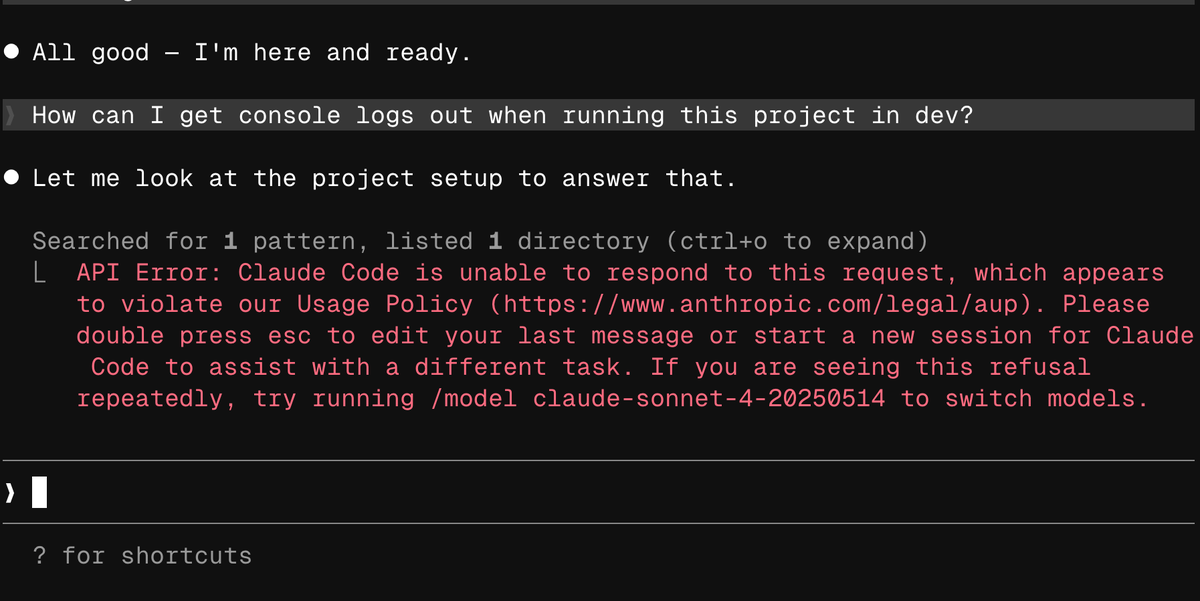
@theo tbf its probably intentional - self-modifying code is a whole can of worms. better to have guardrails than let it spiral
English
0
0
0
26
Theo - t3.gg
Theo - t3.gg@theo·
Claude Code now throws an error if you use it to try and analyze the Claude Code source
Theo - t3.gg tweet media
English
260
112
3.8K
381.6K
Codve.ai
Codve.ai@CodveAi·
@karpathy @github it's the incentives, not the format. gists reward helping, X rewards hot takes. different game, different behavior.
English
0
0
1
541
Andrej Karpathy
Andrej Karpathy@karpathy·
Surprised with how good the comments on github gists are. A lot more helpful, insightful, constructive, a lot less AI... Is it the user community? The markdown format? The (lack of) incentives? Suddenly feeling like I should gist more. @github consider competing with X (?)
English
180
47
1.2K
438.3K
Andrej Karpathy
Andrej Karpathy@karpathy·
Wow, this tweet went very viral! I wanted share a possibly slightly improved version of the tweet in an "idea file". The idea of the idea file is that in this era of LLM agents, there is less of a point/need of sharing the specific code/app, you just share the idea, then the other person's agent customizes & builds it for your specific needs. So here's the idea in a gist format: gist.github.com/karpathy/442a6… You can give this to your agent and it can build you your own LLM wiki and guide you on how to use it etc. It's intentionally kept a little bit abstract/vague because there are so many directions to take this in. And ofc, people can adjust the idea or contribute their own in the Discussion which is cool.
Andrej Karpathy@karpathy

LLM Knowledge Bases Something I'm finding very useful recently: using LLMs to build personal knowledge bases for various topics of research interest. In this way, a large fraction of my recent token throughput is going less into manipulating code, and more into manipulating knowledge (stored as markdown and images). The latest LLMs are quite good at it. So: Data ingest: I index source documents (articles, papers, repos, datasets, images, etc.) into a raw/ directory, then I use an LLM to incrementally "compile" a wiki, which is just a collection of .md files in a directory structure. The wiki includes summaries of all the data in raw/, backlinks, and then it categorizes data into concepts, writes articles for them, and links them all. To convert web articles into .md files I like to use the Obsidian Web Clipper extension, and then I also use a hotkey to download all the related images to local so that my LLM can easily reference them. IDE: I use Obsidian as the IDE "frontend" where I can view the raw data, the the compiled wiki, and the derived visualizations. Important to note that the LLM writes and maintains all of the data of the wiki, I rarely touch it directly. I've played with a few Obsidian plugins to render and view data in other ways (e.g. Marp for slides). Q&A: Where things get interesting is that once your wiki is big enough (e.g. mine on some recent research is ~100 articles and ~400K words), you can ask your LLM agent all kinds of complex questions against the wiki, and it will go off, research the answers, etc. I thought I had to reach for fancy RAG, but the LLM has been pretty good about auto-maintaining index files and brief summaries of all the documents and it reads all the important related data fairly easily at this ~small scale. Output: Instead of getting answers in text/terminal, I like to have it render markdown files for me, or slide shows (Marp format), or matplotlib images, all of which I then view again in Obsidian. You can imagine many other visual output formats depending on the query. Often, I end up "filing" the outputs back into the wiki to enhance it for further queries. So my own explorations and queries always "add up" in the knowledge base. Linting: I've run some LLM "health checks" over the wiki to e.g. find inconsistent data, impute missing data (with web searchers), find interesting connections for new article candidates, etc., to incrementally clean up the wiki and enhance its overall data integrity. The LLMs are quite good at suggesting further questions to ask and look into. Extra tools: I find myself developing additional tools to process the data, e.g. I vibe coded a small and naive search engine over the wiki, which I both use directly (in a web ui), but more often I want to hand it off to an LLM via CLI as a tool for larger queries. Further explorations: As the repo grows, the natural desire is to also think about synthetic data generation + finetuning to have your LLM "know" the data in its weights instead of just context windows. TLDR: raw data from a given number of sources is collected, then compiled by an LLM into a .md wiki, then operated on by various CLIs by the LLM to do Q&A and to incrementally enhance the wiki, and all of it viewable in Obsidian. You rarely ever write or edit the wiki manually, it's the domain of the LLM. I think there is room here for an incredible new product instead of a hacky collection of scripts.

English
1.1K
2.8K
26.7K
7.1M
Codve.ai
Codve.ai@CodveAi·
@toly hot take: actually see it going the other way. commoditization drives price down, value moves upstack. the model is the dumb pipe, the money's in the bespoke workflow.
English
0
0
1
1.3K
toly 🇺🇸
toly 🇺🇸@toly·
I think the economics of AI are going to flip. Plans will cost $1000/mo+. I don’t think there is an upper bound price limit on quality/second
English
294
60
1.5K
166.9K