CognitiveMetrics

50 posts

CognitiveMetrics banner
CognitiveMetrics

CognitiveMetrics

@CognitiveMetric

Psychometrics. Hosting professional-grade IQ tests. Transparent and community-trusted. See CORE for a free FSIQ test: https://t.co/4NitXnGdOu

United States Katılım Mayıs 2026
55 Takip Edilen70 Takipçiler
Sabitlenmiş Tweet
CognitiveMetrics
CognitiveMetrics@CognitiveMetric·
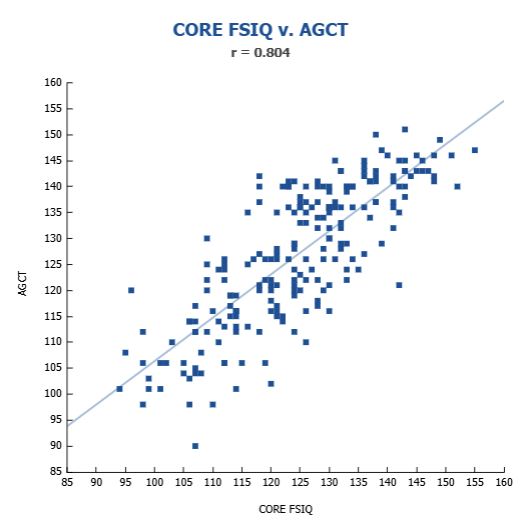
Here is a popular myth: "All online IQ tests are inaccurate and only an in-person, professional test is accurate." Contrary to that myth, our preliminary validity report on the Comprehensive Online Reasoning Exam (CORE), a free IQ test we developed, concludes: "Across reliability, structural validity, model fit, and subtest g-loadings, CORE demonstrates properties that closely parallel those of established professional batteries ... the evidence suggests that it [CORE] provides a highly accurate and theoretically grounded estimate of general cognitive ability." The single most important support for CORE is its convergent validity, as demonstrated by the attached graph. CORE Full-scale IQ (FSIQ) correlates at r = .804 with scores on the Army General Classification Test (AGCT), a professional intelligence test that the U.S. Army once used to classify recruits. This strong correlation is consistent with the correlations that professional IQ tests have with each other. Take the test and view the validity report here: cognitivemetrics.com/test/CORE
CognitiveMetrics tweet media
English
1
1
12
1.2K
CognitiveMetrics
CognitiveMetrics@CognitiveMetric·
@falkrak The purported gloomy fate of a majority of highly intelligent people is a myth. Though intelligence is a sure factor, what you describe is better explained by personality and neurodivergence; it’s important to separate these things. See x.com/timothycbates/…
Timothy Bates@timothycbates

Lewis Terman can't defend himself against this travesty from Malcom Gladwell, but we can do it for him. Here's the real study results from Terman's own volumes (Genetic Studies of Genius) and later analyses. Terman identified ~1,528 California schoolchildren with Stanford-Binet IQs of 135+ (average around 150). He followed them studiously for decades with follow-ups continuing after his death. His goal was to replace myths about "geniuses" with data on their development. People thought IQ might cause lower health, physical weakness, susceptibility to disorder. Terman tracked not only IQ but personality, health, family background, and life outcomes. The result? The group as a whole crushed general population benchmarks. By their mid-30s (and this is close to the Great Depression) ~70% of the men and ~67% of women had bachelor's degrees vs. ~8% nationally at the time Close to a 10x out performance !! At a time when few entered let alone stayed on at University, many "Termites" pursued and achieved graduate degrees (97 PhDs, 57 MDs, etc.). By their mid-40s, 96%+ of men were professionals or semi-professionals (doctors, lawyers, engineers, academics, etc.). Incomes were roughly double the national white-collar median. Imagine: A single level to pull and you double national incomes! They produced thousands of scientific articles, books, and patents. This was then replicated in wonderfully detailed and prodigious Vanderbilt studies. Their health, far from poorly, was better and they had lower rates of divorce and fewer psychiatric problems. The sample, which based on Gladwell's presentation we should expect from regression to the mean to be downwardly socially mobile , was massively upwardly mobile. Even relative to their (already fine) childhood homes. High IQ predicted climbing the socioeconomic ladder, not coasting on family money. Hoping to obfuscate all this success, Gladwell spins a yarn for y'all. His claim that "rich smarts" had a silver spoon in their mouths while poor smarts were "utter failures" (imagine saying THAT in 2026…) is nonsense and betrays Terman's own words and findings. Terman did examine differences in adult achievement (A: highest ~top third or so; B: middle/moderate professionals; C: lowest ~bottom 20–30%). There was a correlation with childhood family socioeconomic status (SES): A's had more parental education/support/resources on average; C's had less. But the "C" group ("failures" according to Gladwell) far from "produced nothing" Most won college degrees. Most won professional or semi-professional jobs. Most had incomes and achievements well above the general population. Framing these people as underachievers is a disgrace, TBH. Terman was one of those leading the emphasis on both the need for opportunity and a society which encouraged education, had capital to allocate, enforced the rule of law etc.. And to emphasize the role of "non-cognitive" traits of conscientiousness (persistence, drive, goal setting and ambition). He also emphasised the need for good health. He didn't pretend that we do not stand on the shoulders's of giants (those who gifted us our current SES) but he did show in staggering detail, the amazing accomplishments of all of these children, identified at a young age as having already college-level knowledge and ability. Puff like poverty "reduces a one-in-a-billion brain to a lifetime of worse than mediocrity" is debunked in the American context by the whole cohort outperforming expectations massively. Not just the tippy top, but the cohort as a whole . Resoundingly. Terman, and no scientist you will find, ever claimed IQ alone guarantees universal leadership or output - the idea of "just one thing", here as everywhere is a distracting red herring. What Terman did was revolutionize what we know about just how strong a predictor of life success high IQ is. And how precious those point-1 percent are. It is curious that Terman missed William Shockley and Luis Alvarez (future Nobel physicists). Shockley was co-inventor of the transistor and father of Silicon Valley (along with Frederick Terman, the son of Lewis Terman, who in turn created the "Stanford Binet" IQ-test and did much to promote Stanford and IQ). As the late Danny Kahneman would have point out, calling out this miss of two people in a sample of 250,000 is to commit the fallacy of low base-rates: Sampling ~1,500 out of ~ 250,000 kids makes missing a 2 people in the extreme tails a likelihood, not a fatal flaw. This is classic Gladwell: Storytelling with punchy examples, but under scrutiny, the specifics on Terman all fall apart. Unlike Gladwell, Terman's results stand the test of time far better than any pop-psych retellings. h/t @charlesmurray

English
0
1
3
460
♡ Honey ♡
♡ Honey ♡@rawmilkhoney·
The ultimate measure of intelligence is actually just a person’s cadence and face. Intelligence can’t be measured because awareness can’t be measured, but it’s in the face….it’s always in the face
English
5
1
51
2.6K
CognitiveMetrics
CognitiveMetrics@CognitiveMetric·
I think using “never” often indicates a lack of nuance or an oversimplification (though of course it doesn’t make the claim immediately false). But given the context I don’t find it unreasonable that Jensen used it, because it related to people with extraordinary intellect-heavy accomplishments. Given how much mental ability such things require, I don’t find it surprising that he never heard of such a person who scored low (below 90 is likely what he had in mind) on a proper administration of a good IQ test. It’s not like he was saying it’s impossible, just that it is never found (to his knowledge).
English
1
0
4
78
Mik Happy
Mik Happy@KingPStream·
@CognitiveMetric Using the word "never" for things like this makes it immediately false More nuance is sharper
English
1
0
1
99
CognitiveMetrics
CognitiveMetrics@CognitiveMetric·
“One often hears unfounded claims about the "low" IQs of persons with extraordinary accomplishments. A few outstanding persons make such claims themselves. But the claims are sheer nonsense. Whenever such persons have actually been tested, they are never found to have low IQs; they almost never have average IQs; by far the most of them score above the top 1 or 2 percent of the general population. … I've noticed that the only persons I've ever heard disparage their own IQ scores are those who think they are so conspicuously gifted that there is no risk that people will believe them. Their claims that they “flunked an IQ test” are usually intended to provoke laughter and levity in the fashionable game of ridiculing tests.” From Arthur Jensen’s Q&A in his Straight talk about mental tests (p. 247-248): arthurjensen.net/wp-content/upl…
English
1
0
9
413
CognitiveMetrics
CognitiveMetrics@CognitiveMetric·
1. The effect of acute stress and test anxiety is on the magnitude of 1-2 IQ points (in the study I linked, the 95% confidence intervals include zero, so there may very well be zero effect). This 2025 study aligns with previous literature suggesting minuscule effects. pmc.ncbi.nlm.nih.gov/articles/PMC12… 2. See the recent “Is Trying Harder Enough? Causal Analysis of the Effort-IQ Relationship Suggests Not” icajournal.scholasticahq.com/article/142071… In fact, there is some evidence that higher IQ people don't try as hard as lower IQ people on IQ tests. Pupillary dilation, which is controlled by the autonomic nervous system, is a sensitive and reliable indicator of motivational arousal and mental effort. Lower scoring individuals show greater pupillary dilation, even on relatively easy items whereas brighter subjects show a comparable amount of dilation only on the most difficult items. 3. On professional tests, non-cognitive-proficiency (CPI) tasks tend to either be individually timed or completely untimed. I already wrote too much in this reply so I’ll just say that test creators are aware of these things, so on the relevant tasks (usually reasoning tasks), they’ll try to minimize speededness in tests so that general reasoning ability can be measured best. Specifically, people with ADHD score about half a standard deviation (7.5 IQ points) lower on processing speed and working memory tasks (CPI tasks) than the general population, but their scores on fluid reasoning and verbal comprehension are only 3 to 2 IQ points below average. 4. An IQ test in a language someone is unfamiliar with is deemed an invalid administration. The tests are only applicable on the population the test was normed on (though some tests like digit span can be easily adapted to different languages and are just as good). 5. This is why professional FSIQ tests are highly diverse and will measure all these things. The full-scale IQ score is a composite of all those different tasks.
English
0
0
6
88
Madelaine Hanson
Madelaine Hanson@MadelaineLucyH·
My favourite modules in my BSc were always the critical research analysis ones, so here’s some reasons why smart people, or normal people, can do badly in IQ tests: 1. Nerves (intelligence is not good anxiety management!) 2. Getting bored/ low interest (ADHD, forced test) 3. Mismanaging time allocation for sections (ADHD, dyslexia) 4. Tests using unfamiliar language (second or third language testing) 5. Extremely strong spatial/reasoning intelligence, very low verbal/pattern intelligence (mixed ability flattening)
English
2
1
19
941
CognitiveMetrics
CognitiveMetrics@CognitiveMetric·
I think you are not informed on what IQ tests measure and how they do it. The folk idea of “quick-wittedness” (and others like it) is heavily sampled in an IQ test through a diverse battery of tests. A full-scale IQ test will include tests of processing speed, fluid reasoning (novel problem solving), verbal comprehension, and working memory. E.g., here is the test structure/descriptions for a comprehensive IQ test: cognitivemetrics.com/test/CORE/stru…
English
0
0
14
323
♡ Honey ♡
♡ Honey ♡@rawmilkhoney·
Being quick witted is a more accurate measure of intelligence than any IQ test
English
60
9
525
62K
CognitiveMetrics
CognitiveMetrics@CognitiveMetric·
You are mistaken. Verbal ability is not just about “remembering things”. This is not what verbal tests measure. See here (you’ll find the vocabulary section in the education article helpful) x.com/cognitivemetri… Also: “Quick wit requires speed of thought + complexity of thought. Being able to assess a situation, recall information, form a relation in an unpredictable environment…“ Do you realize that this is one of the many things that IQ tests measure? IQ tests are highly diverse. Full batteries will sample diverse abilities so as to best measure general intelligence. This is why performance strongly correlates with performance in other “unrelated” domains, like job performance and scholastic achievement. You should just read this entire page: cognitivemetrics.com/wiki/g-factor
CognitiveMetrics@CognitiveMetric

A common misconception related to IQ and Intelligence I often see is that "verbal subtests are biased since they measure what people have learnt, not innate intelligence." The fact is: - Verbal subtests are among the most highly g-loaded indicators on modern IQ batteries - Verbal knowledge reflect differences in learning rate and cognitive efficiency, not mere rote memorization or cultural exposure. - Longitudinal, twin, and genetic studies show that verbal ability becomes increasingly heritable with age, mirroring the developmental pattern of g. - Verbal subtests are some of the most reliable and valid measures of general intelligence. A more in-depth explanation can be found on our wiki here: 1. #verbal-subtests-are-biased-since-they-measure-what-people-have-learnt-not-innate-intelligence" target="_blank" rel="nofollow noopener">cognitivemetrics.com/wiki/misconcep… 2. #vocabulary" target="_blank" rel="nofollow noopener">cognitivemetrics.com/wiki/education…

English
0
0
11
168
♡ Honey ♡
♡ Honey ♡@rawmilkhoney·
Remembering words requires no thought, your subconscious does this naturally. If I read more often my “verbal IQ” would increase but what does that actually mean? I wouldn’t be thinking any harder, my thoughts and problem solving skills wouldn’t magically become more complex, I wouldn’t be necessarily “more intelligent”, I’d just have more words to express whatever intelligence is innate. If everyday I listened to videos about fish I’d know more about fish. If everyday I read books about rocks I’d know more about rocks. Training the subconscious requires little intelligence, if it did people in academia would be the geniuses they think they are, not lingering at a mediocre IQ of 110-115. How intelligent can one be if they let their subconscious is do the heavy lifting as they sit back completely incapable of any complex thought on their own. Quick wit requires speed of thought + complexity of thought. Being able to assess a situation, recall information, form a relation in an unpredictable environment and doing this quickly and repeatedly requires substantially more mental sharpness and clarity than simply remembering words and facts. If we wouldn’t regard someone as intelligent for simply showing up to trivia every week and remembering a fact why would we do it with people who read books everyday and remember random words?
English
13
0
14
962
Jøhnathan
Jøhnathan@Heavenly_Race_·
Once you hit about a 20-point IQ gap, communication starts to completely break down. It's not that the lower IQ person is "stupid" (although that can often be the case) or the higher one is arrogant, it's that you're literally operating on different systems. A 20 point difference (roughly 1.3 standard deviations) means: Vocabulary and abstraction levels diverge sharply. What feels like crystal clear logic to one side sounds like vague, pretentious word salad to the other. Jokes land flat. Metaphors get taken literally. Complex cause and effect chains get simplified into "this good, that bad." Different time horizons and pattern recognition. One person thinks in months or years and sees systems, the other is locked into days or immediate rewards. Trying to explain second order effects feels like speaking another language. Also, processing speed and working memory gaps. The higher IQ person is already three steps ahead, getting impatient. The lower IQ person feels talked down to or overwhelmed. Both walk away frustrated. Both have wasted each others time.
English
1.6K
3K
22.3K
2.3M
CognitiveMetrics
CognitiveMetrics@CognitiveMetric·
They did not do so. Though according to table 1, there were two textbooks that had no accuracies or fallacies and only had one statement of questionable accuracy. However, those two textbooks (and others with similar accuracy levels) did not even have a full chapter on intelligence, with one devoting 8 out of 289 pages to intelligence and the other 12 out of 438. So I don’t think they’d be a fruitful read. Centered on intelligence, the two books I recommended here are great:
CognitiveMetrics@CognitiveMetric

The study didn't arrive at a definite conclusion about that. The textbooks barely covered intelligence. In fact, they found that the average textbook devotes 3.3 percent of the text to intelligence. For a good, comprehensive introduction to intelligence research, you should see The Science of Human Intelligence (2nd ed., 2023) by Richard J. Haier. amazon.com/Science-Human-… Russell Warne's (2020) In the Know: Debunking 35 Myths about Human Intelligence is good as well.

English
1
0
3
117
CognitiveMetrics
CognitiveMetrics@CognitiveMetric·
It is correct that virtually all mental tasks will positively correlate. This is known as the positive manifold. The g factor is a statistical construct used to encapsulate this shared covariance among a diverse battery of tests, reflecting the single factor that all different manifestations of cognition have in common. Further reading: cognitivemetrics.com/wiki/g-factor
English
0
0
2
34
brandon baskin (no relation)
@Hitchslap1 @MilesTrav no, this is incorrect. again, the reason IQ tests are structured the way that they are is bc discrete learning can modify cognition and cognitive output. ie, rote memorization "G factor" is substrative. & even w/ that said, it's not a complete measurement of intelligence
English
2
0
1
60
Hitchslap
Hitchslap@Hitchslap1·
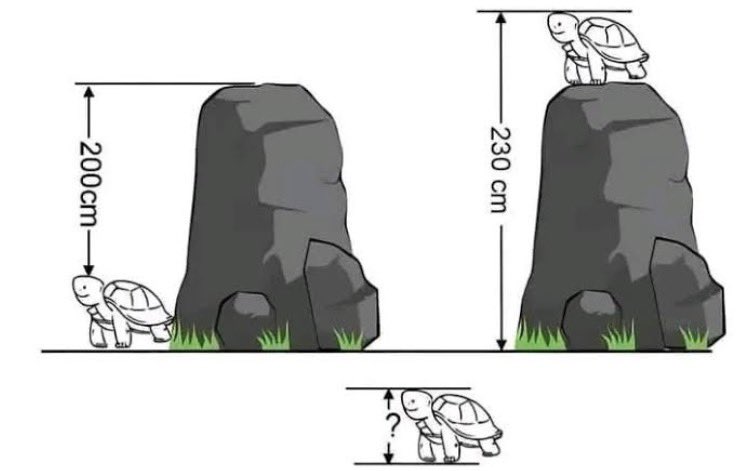
Logic and reasoning are both major components of IQ. How tall is the turtle?
Hitchslap tweet media
English
437
18
380
101.7K
CognitiveMetrics
CognitiveMetrics@CognitiveMetric·
If you’re interested in what professional-grade IQ tests look like, you should see our site. The Comprehensive Online Reasoning Exam (CORE) specifically is free and the factor model (including the subtests) was based off the Wechsler’s (the most widely used professional IQ test). cognitivemetrics.com/test/CORE Our validity report shows that the CORE is a great measure of general intelligence by professional standards.
English
0
0
2
72
Traveler
Traveler@MilesTrav·
@Hitchslap1 By the numbers, obviously 15. You can't tell me that this is an IQ test? Unless the test is noticing that the turtle isn't properly scaled. If this is the measure of our IQ tests, then I'm really disappointed in society.
English
11
0
84
11.5K
CognitiveMetrics
CognitiveMetrics@CognitiveMetric·
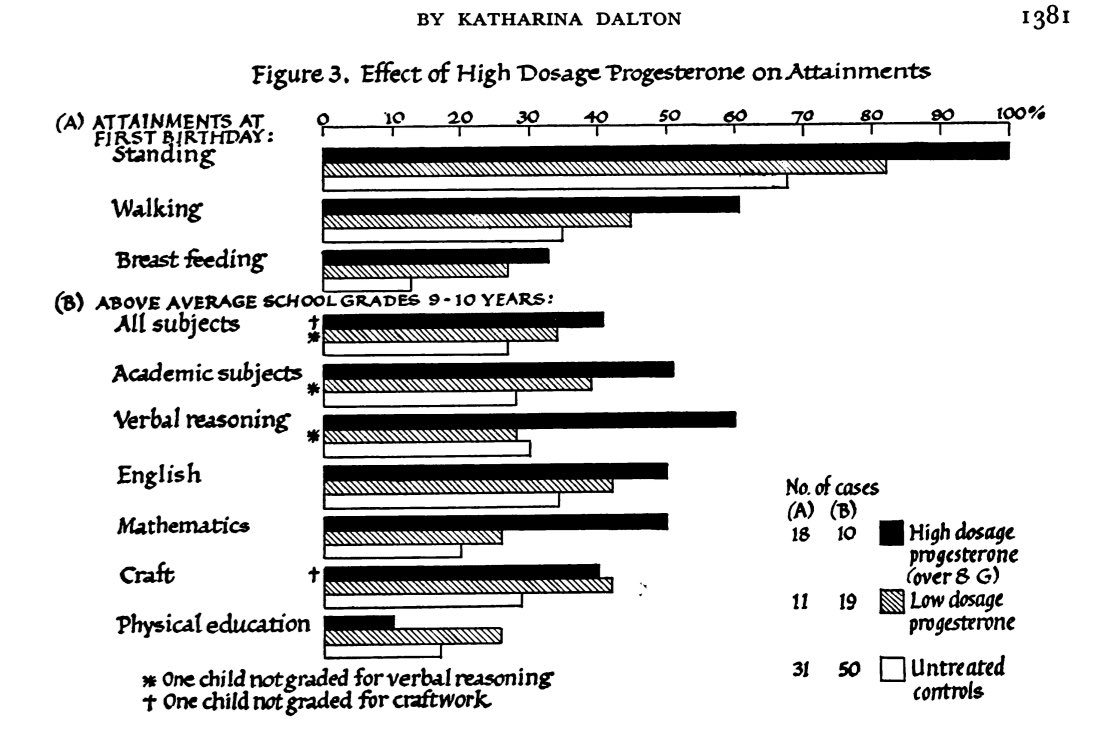
Dalton’s (1970s) studies had severe methodological flaws. Recent studies find no improvement in cognition or important things like motor development. A 2020 systematic review finds “no evidence of [long-term] benefit or harm in offspring prenatally exposed to progesterone treatment for the prevention of preterm birth.” pmc.ncbi.nlm.nih.gov/articles/PMC82… They specifically found no difference in cognitive performance from placebo. People should generally be very skeptical of claims that simple interventions (even prenatal ones) significantly improve intelligence & things like academic achievement (barring remedying malnutrition and disorders/diseases). Though your replies (/ the studies) about the marginal benefits that placental mDNA has on childhood IQ are sound.
English
0
0
6
355
Hereafter
Hereafter@idyllicmusing·
Research indicates a positive association between placental thickness and childhood intelligence quotient (IQ). Dr. Ray Peat spoke extensively about placental development, progesterone, and their direct impact on fetal brain development and childhood IQ. Peat heavily referenced the pioneering work of Dr. Katharina Dalton whose research showed that women who received supplemental progesterone during pregnancy gave birth to children with significantly higher IQs (often averaging 30 to 40 points higher than their older siblings who did not receive it). Peat argued that intelligence is not strictly genetic, but rather an "interface between physiology and the environment." He viewed a well-functioning, robust placenta as a critical shield against maternal stress hormones (like cortisol and estrogen), which he argued can prematurely age fetal tissue, cause calcification, and stunt organ growth. A healthy, thick placenta ensures an unhindered, high-energy supply of glucose and active thyroid hormone (T3) to the fetus, directly optimizing the metabolic rate of the developing fetal brain. The bottom line is: progesterone babies are far superior in intelligence.
Hereafter tweet mediaHereafter tweet mediaHereafter tweet mediaHereafter tweet media
English
8
21
304
15K
CognitiveMetrics
CognitiveMetrics@CognitiveMetric·
So far, only four people have gotten a score of 160 or higher in the ~4.8k valid FSIQ attempts (which is ~expected given the mean and SD of our sample). All users are able to retake tests, but those attempts are not considered valid (so as to be in our analyses, etc.), since the tests were normed on people’s first attempts. So people’s dashboard does not necessarily reflect a first attempt. This isn’t to say that the person I’m replying to did or didn't retake subtests (we won’t concern ourselves with saying such things in any case). It’s just a general caution that people should keep in mind.
English
0
0
4
104
CognitiveMetrics
CognitiveMetrics@CognitiveMetric·
Here is a popular myth: "All online IQ tests are inaccurate and only an in-person, professional test is accurate." Contrary to that myth, our preliminary validity report on the Comprehensive Online Reasoning Exam (CORE), a free IQ test we developed, concludes: "Across reliability, structural validity, model fit, and subtest g-loadings, CORE demonstrates properties that closely parallel those of established professional batteries ... the evidence suggests that it [CORE] provides a highly accurate and theoretically grounded estimate of general cognitive ability." The single most important support for CORE is its convergent validity, as demonstrated by the attached graph. CORE Full-scale IQ (FSIQ) correlates at r = .804 with scores on the Army General Classification Test (AGCT), a professional intelligence test that the U.S. Army once used to classify recruits. This strong correlation is consistent with the correlations that professional IQ tests have with each other. Take the test and view the validity report here: cognitivemetrics.com/test/CORE
CognitiveMetrics tweet media
English
1
1
12
1.2K
CognitiveMetrics
CognitiveMetrics@CognitiveMetric·
Clearly, when Gottfredson uses “logical fallacy”, she refers to informal fallacies, which concern context and content (rather than formal fallacies, which concern form). These flaws in reasoning are commonly understood to render arguments unpersuasive. They may appear to be correct, but when the meaning is broken down it is made clear how it is erroneous, whether it be due to what widely-replicated research has elucidated on the content, or the bare meaning of the sentence. E.g., fallacy 13 falls under the latter case (it is incompatible with what we understand science to properly be), and fallacy 1 falls under the former (it is incompatible with what a century of research has shown and what the actual researchers themselves believe).
English
2
0
4
81
Conservative Maryland
Conservative Maryland@nandtpolitics·
@CognitiveMetric "Fallacies" is a silly claim and lack of specifics shows that the argument is bunk. Did the text book begin with an introduction about how the trees shared the mood of the hero? Did the text book make an assumption about the author's intentions without looking at the results?
English
2
0
0
129
CognitiveMetrics
CognitiveMetrics@CognitiveMetric·
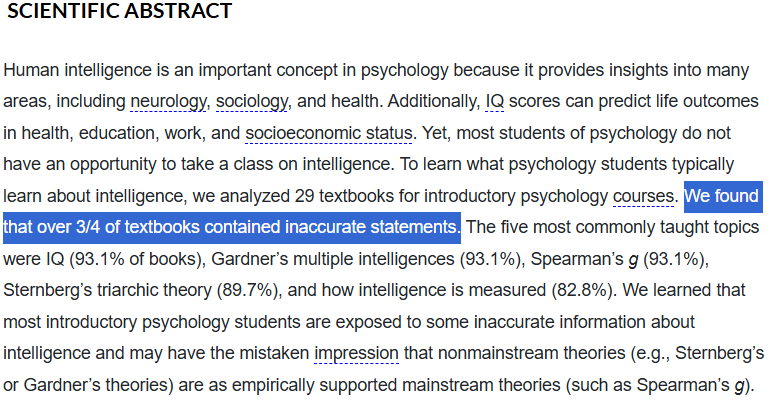
How accurate are introductory psychology textbooks in their discussion of intelligence? These were the key findings of a comprehensive 2018 analysis: 1. 79% percent of the books included fallacies or inaccuracies about intelligence research. 2. On a scale ranging from 0 to 4, the average number of logical fallacies used to dismiss intelligence research was 1.8 (SD = 1.2). 3. The most common inaccurate statement relates to test bias as a key limitation of intelligence testing, even though extensive research has shown that the issue of test bias is not supported (since IQ scores in different subgroups predict outcomes equally well). Study (full, public text): researchgate.net/publication/32…
CognitiveMetrics tweet media
English
4
0
15
868
CognitiveMetrics
CognitiveMetrics@CognitiveMetric·
“In Analogies, examinees are presented with pairs of words that share a specific logical or semantic relationship and must select the option that expresses an equivalent relationship. … The Analogies subtest is designed to assess verbal reasoning, abstract relational thinking, and the ability to discern conceptual similarities among different word sets. … To align with the construct validity of a verbal comprehension measure, CORE Analogies items were specifically designed to emphasize crystallized knowledge exclusively, minimizing the influence of relational or fluid reasoning. Later analysis of the CORE battery confirms that verbal analogies align most consistently with the crystallized intelligence factor. Unlike the [old] SAT and [old] GRE, in which items are timed collectively, each item in the CORE version is individually timed to ensure consistency and control over response pacing.“ From the Comprehensive Online Reasoning Exam (CORE) test structure: cognitivemetrics.com/test/CORE/stru… Take the test here: cognitivemetrics.com/test/CORE/AG
English
0
0
10
332
CognitiveMetrics
CognitiveMetrics@CognitiveMetric·
The National Intelligence Test (1920s) was heavily adapted from the Army Alpha, a group-administered intelligence test used by the U.S. Army during World War I to screen recruits. In World War II, the Army General Classification Test (AGCT), a far superior professionally-developed test, supplanted the Army Alpha. We restored the AGCT and it can be taken for free if you enter promo code “TWT” at the end of the test. cognitivemetrics.com/test/AGCT The test norms are taken directly from the norms from the sample of 9 million recruits. We find that the AGCT is still strongly correlated to modern IQ tests and shows no evidence of the Flynn effect (see our wiki article on the AGCT for more).
English
0
0
4
199
Hereafter
Hereafter@idyllicmusing·
The National Intelligence test of 1925.
Hereafter tweet mediaHereafter tweet mediaHereafter tweet media
English
2
0
43
3K
CognitiveMetrics
CognitiveMetrics@CognitiveMetric·
1. Measure IQ and genomes in hundreds of thousands of people. 2. Find what tiny DNA differences are statistically associated with IQ differences. 3. Add up those tiny effects into a polygenic IQ score for an embryo by genotyping its cells. 4. Exploit the random genetic variation between several embryos who share ~50% of their DNA and pick the one with the highest polygenic IQ score. With a few embryos available (the typical amount), the expected gain by doing this is 4+ IQ points on average afaik. Herasight recently tested whether their predictor works within real siblings, and finds that the polygenic score predicts intelligence well, at 0.45. This is much higher than other predictors and should be further researched and independently replicated, but it isn’t too far-fetched. icajournal.scholasticahq.com/article/158459…
English
0
0
9
211
King Of The Numbers
King Of The Numbers@KingONumbers·
@CognitiveMetric When I went to school to be a teacher, they taught me that Gardner's Theory of Multiple Intelligences was True. When I went to school to be a school psychologist, they taught me that Gardner's Theory was not supported by evidence.
English
1
0
3
100
CognitiveMetrics
CognitiveMetrics@CognitiveMetric·
The study didn't arrive at a definite conclusion about that. The textbooks barely covered intelligence. In fact, they found that the average textbook devotes 3.3 percent of the text to intelligence. For a good, comprehensive introduction to intelligence research, you should see The Science of Human Intelligence (2nd ed., 2023) by Richard J. Haier. amazon.com/Science-Human-… Russell Warne's (2020) In the Know: Debunking 35 Myths about Human Intelligence is good as well.
English
2
0
6
257
Arm
Arm@aabbbbcc33·
@CognitiveMetric What are good introductory psychology/intelligence textbooks then? Is it discussed in the article, or can you give your recommendations?
English
2
0
1
142