I. Glenn Cohen

9.7K posts

I. Glenn Cohen

I. Glenn Cohen

@CohenProf

Prof @harvard_law, Bioethics and Health Law Enthusiast, @PetrieFlom Faculty Director, https://t.co/DqdSAAuGQa 🏳️‍🌈

Katılım Şubat 2014
811 Takip Edilen8.3K Takipçiler
I. Glenn Cohen retweetledi
Ramez Kouzy, MD
Ramez Kouzy, MD@RKouzyMD·
We had a great time chatting with @CohenProf on our debut episode of @AIMDPodcast to discuss his recent @NEJM paper and more! @leah_minnie and I are hoping you join us on our learning journey about how AI can impact us and our profession IRL.
AIMDPodcast@AIMDPodcast

🤖 Is medical AI turning doctors into “quantified workers”? 🩺 Harvard’s Glenn Cohen joins #AI_MD to unpack clinical surveillance, physician autonomy, and the future of medicine. 🎧 Listen now: [open.spotify.com/episode/45amGX…] #AIinHealthcare #MedTech #Bioethics

English
1
4
10
1.8K
I. Glenn Cohen retweetledi
Petrie-Flom Center
Petrie-Flom Center@PetrieFlom·
Welcome Sofia Palmieri, our new Post-Doctoral Fellow in Medicine, Artificial Intelligence, and the Law, whose research is at the intersection of law, ethics, artificial intelligence, and health care: petrieflom.law.harvard.edu/people/postdoc…
Petrie-Flom Center tweet media
English
2
1
0
342
I. Glenn Cohen retweetledi
Heidi L. Williams
Heidi L. Williams@heidilwilliams_·
This meticulously careful and thoughtfully constructed paper by Azoulay-@mattsclancy-Li-Sampat is well worth reading. Thanks to the authors for so quickly pulling together such thoughtful evidence on such an important and policy-relevant question.
Matt Clancy@mattsclancy

Earlier this year, the President’s budget proposed a 40% cut to the NIH budget. This sparked an obvious research question: What if the NIH had been 40% smaller in previous years? Here’s what Pierre Azoulay, Danielle Li, Bhaven Sampat, and I found when we looked at grants that were at-risk of being cut in an alternative history with a smaller NIH budget: - 51% of 21st century drugs have a patent that cites one or more articles funded by an at-risk grant - 12% of drugs have more than a quarter of their patent-to-paper citations going to at-risk research - 35% of drugs that acknowledge NIH support reference a grant that would have been at-risk We were able to make these estimates because we have access to the real priority scores for all NIH grants made over 1980-2007. Since NIH mostly funds research by working down these priority scores until the budget runs out, we can identify the grants that would probably have been cut with a smaller budget. Would anyone miss the research funded by these at-risk grants? To help assess that, we link these at-risk grants to drugs, focusing on all 557 FDA approvals for new molecular entities approved in the 21st century. Most new drugs are protected by patents. We look at these patents to see if they cite research funded by at-risk grants. We find 51% of drugs have a patent that cites one or more articles funded by an at-risk grant. This doesn’t mean 51% of drugs wouldn’t exist if the NIH had been 40% smaller. Various caveats cut in different ways (see discussion in the online appendix). But we take this as evidence that the benefits of at-risk NIH research are wide and diffuse. We consider other ways to link drugs with at-risk grants. For example, we find that 12% of drugs have more than a quarter of their patent-to-paper citations going to at-risk research. See the paper for some examples of specific drugs. Finally, it’s less common, but in some cases, drugs directly acknowledge support from specific NIH grants in their patents. Only 40 drugs acknowledge NIH grant support, but of that group, 14 (35%) acknowledge support from a grant that is at-risk. Are drugs linked to at-risk research worse? We look at two proxies for drug value: whether a drug gets priority review at the FDA, and stock market reactions when a drug patent is announced. Yes, very imperfect, but we think still worth looking at. We find that drugs that cite at-risk research are, on average, no less likely to get priority reviews at FDA and do not have worse implied valuations by the stock market. In short, we don’t have reason to believe drugs linked to at-risk research are worse.

English
2
8
27
12.4K
I. Glenn Cohen retweetledi
Utah Law
Utah Law@sjquinney·
Associate Professor @MedlawDan, a health law expert, published a new article in @Health_Affairs about regulating oncology drugs.
Utah Law tweet media
Health Affairs@Health_Affairs

In his new Forefront article, @MedlawDan from @sjquinney discusses how HHS has a tremendous opportunity to ensure that both government and private insurers are paying for oncology treatments demonstrating clinically significant improvements in overall survival or quality of life. healthaffairs.org/do/10.1377/for…

English
0
2
6
998
Stephen E. Sachs
Stephen E. Sachs@StephenESachs·
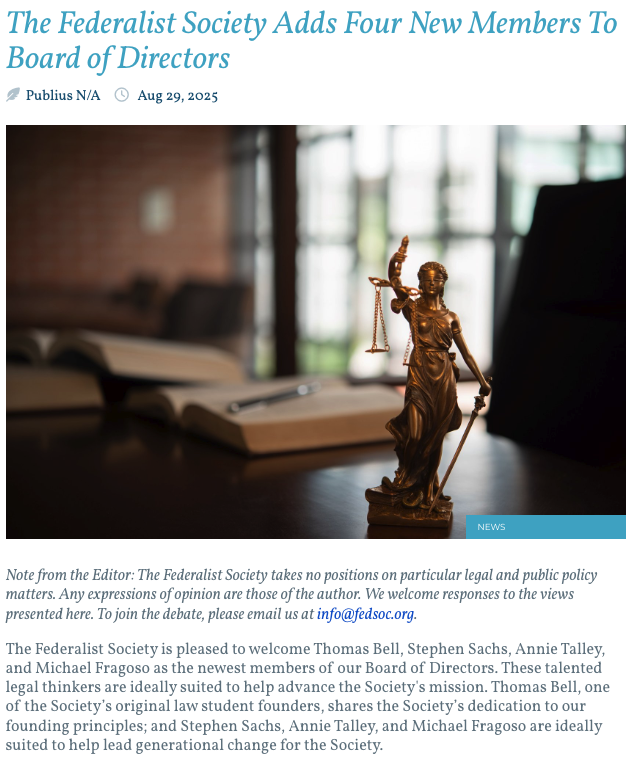
Some professional news, as they say! Honored to be among these new members of the Board of Directors of the Federalist Society. @FedSoc
Stephen E. Sachs tweet media
English
11
7
166
9.2K
I. Glenn Cohen retweetledi
Melissa Wasserman
Melissa Wasserman@MelissaWasserma·
Aspiring academics, apply to @UTexasLaw Academic Fellowships Program, which is a 2yr program supporting emerging scholars who aspire to join the legal academy as tenure-track faculty members! Please apply at the following link! law.utexas.edu/academic-fello…
English
1
12
20
3.5K
I. Glenn Cohen retweetledi
Dr. Tom Frieden
Dr. Tom Frieden@DrTomFrieden·
I joined eight former CDC directors—spanning Republican and Democratic administrations—to share this warning: our nation’s health is at risk.  The very systems that protect us from disease, cancer, and future health threats are being dismantled. nytimes.com/2025/09/01/opi…
English
1K
1.8K
5.4K
390.4K