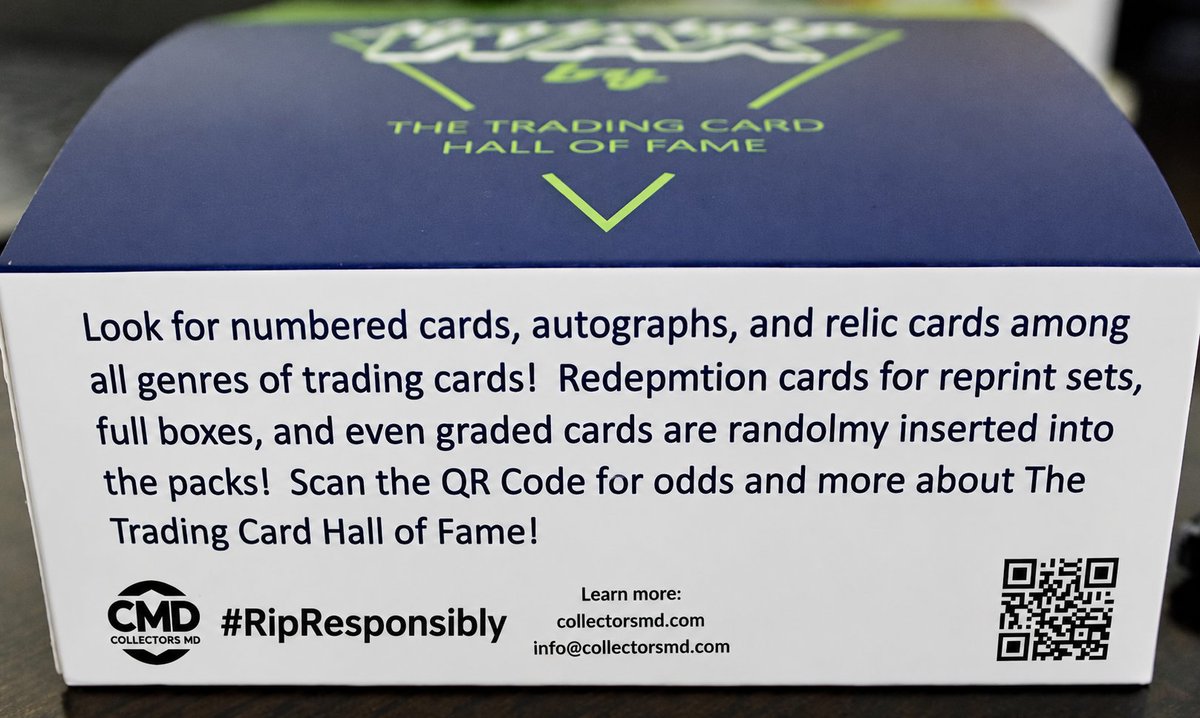
Collectors MD isn’t just a movement—it’s a community.
It was built to help collectors slow down, reconnect, and find balance in a hobby that often rewards excess.
If our message resonates, please feel free to share this flyer and spread the positive word. 🤍
#CollectorsMD | #RipResponsibly | #CollectResponsibly
@surgieboi@Whatnot Not necessarily. Plenty of regulated industries have investors and still implement safeguards. Responsible design and profitability aren’t mutually exclusive.
🚨💥🤯 Whatnot Complaint Review 🤯💥🚨
Whatnot's not the problem. Society’s lack of self-control is.
Moreover, this is bad for collectors and here’s why:
1️⃣ Fanatics monopolization
Without @Whatnot, Fanatics can defraud more consumers via Fanatics Live.
This is attributed to the following facts:
— 1. Fanatics does not properly report hit/winning chance or probability, and
— 2. Fanatics further skews consumer-odds-of-winning via back-door allocation.
Now, Fanatics will fully control sports card distribution — or, the lack there-of-it.
2️⃣ Less sales channels
Yes, every sales channel has issues.
For example, eBay and eBay Live enabled Probstein to shill and defraud the consumers for years.
Also, that fraud was allowed by a publicly-traded company (eBay).
So, if regulated and public markets are fraudulent, does legal-procedures in a private-market mean anything?
No, they do not.
3️⃣ Stop normalizing bad behavior
The issue in the Whatnot complaint is not a corporate one, it’s a personal one (ie. a lack of self-control).
Furthermore, mystery and repacks also exist on eBay and Fanatics Live.
So, the legal filing should have also named eBay, eBay Live, Fanatics, Fanatics Live and GameStop (ex. Power Packs) too.
Also, an argument could have been made to include Collectors (BGS/PSA/SGC), as their consumer-facing marketing includes promoting mystery and repacks.
TLDR: this is not good for collectors, it is short-sided, and should have included all parties engaging in or promoting similar behavior(s).
—
@CardPurchaser@Hobby_News_Plus@HobbyLaw@paullydoughnuts@jaybelleshhb@droolerapp
@surgieboi@Whatnot It’s absolutely up to the environment to ensure the systems and platforms people interact with aren’t designed in ways that amplify harmful behavior. Responsible product design and appropriate guardrails are essential.
I hear you, and I respect that perspective. At the same time, the science is very clear that environment and access also influence behavior. Decades of addiction research show these factors can significantly shape outcomes. That’s why guardrails exist in industries like alcohol, pharmaceuticals, and gambling. It’s not about removing responsibility - it’s about recognizing that both things can be true.
100% — i grew up in dysfunctional house and with a father that was an alcoholic. Moreover, an entire family of alcoholics when considering extended family too.
I get it and understand it’s hard, shit was extremely difficult on me and it took me a long time to build momentum in life.
But, that’s not anyone’s problem but mine. And, that applies to gambling addicts that can’t say no on eBay Live, Fanatics Live or Whatnot.
@surgieboi@Whatnot And respectfully, in the recovery community it’s often said there’s no such thing as a "recovered addict". Recovery is a lifelong commitment, which means we are always recovering.
@CollectorsMD@Whatnot an addiction is not Whatnot or anyone else’s problem but the person.
as a recovered addict, i stand by this and will die on this hill.
I think that framing oversimplifies what’s actually happening.
We've established that consumer responsibility matters. People should do research, understand checklists, avoid bad actors, and think critically before spending money. That’s part of being a healthy participant in any marketplace.
But the idea that people struggling in these environments are simply "stupid consumers" misses something incredibly important.
Addiction and compulsive behavior aren’t intelligence problems. They’re health problems.
We’ve known for decades that certain environments can exploit vulnerabilities in the brain’s reward system. When platforms design systems around frictionless activity, they are intentionally engineering faster, more impulsive behavior.
That’s not accidental. Those mechanics are well understood in behavioral science.
And when those systems are layered on top of randomized outcomes, scarcity messaging, countdown timers, and competitive live rooms, you end up with an environment that looks a lot less like a traditional retail transaction and a lot more like a variable-reward loop.
Some people can engage with that casually. Others can’t. And the ones who can’t are the people we hear from every week.
At Collectors MD, we talk to collectors who have lost jobs, homes, savings, relationships, and sometimes entire livelihoods. Many are carrying serious debt and dealing with not just financial strain, but real emotional and mental distress.
Not because they’re "stupid", but because they got pulled into systems designed to keep people engaged long past the point of healthy decision-making.
The reality is that both things can be true at the same time: Consumers should make informed decisions. And platforms should not design systems that quietly exploit human vulnerabilities. That’s the balance we should be aiming for.
Bottom line: healthy hobbies don’t require people to lose for the system to win.
If a breaker doesn’t post the mystery/repack checklist and you still buy, you’re a stupid consumer.
if a breaker with a bad reputation is selling and you still buy, you’re a stupid consumer.
if a platform is ubiquitously known for being deceptive and fraudulent, and you still buy — you’re a stupid consumer.
the core issue is a lack of consumer accountability and a societal need to get ahead, which has been as old as time and existed long before “the hobby”.
this is how capitalism works, there’s always a loser.
Personal responsibility absolutely matters. But the Google/password comparison isn’t remotely the same thing. Password resets and 2FA are examples of protective friction. They are intentionally designed to slow people down and prevent mistakes or fraud.
Many modern hobby [breaking] platforms are designed in the opposite direction. They REMOVE friction. Platforms built around frictionless transactions and constant engagement accelerate behavior.
That of course doesn’t remove personal responsibility. People (especially adults) still have to make their own [adult] decisions. But it DOES mean platform design influences behavior, whether we acknowledge it or not.
As I outlined earlier, the healthiest ecosystems usually recognize both sides of that equation:
-Consumers take ownership of their choices
-Platforms provide transparency and guardrails
When those two things coexist, the hobby can grow without burning people out or pushing people past their limits.
That’s really the balance many of us are trying to move the conversation toward.
We can’t sue Google when we forget our email password because password verification and reset is difficult to complete.
This is why 2FA and biometric prompts exist when confirming digital payments.
IRL, if a host creates a sense of danger or fraud, we leave the location. And, the same should applies digitally.
If consumers wanted accountability, they’d go after the primarily culprit of the hobby’s fraud: Collectors (BGS/PSA/SGC).
Why don’t they?
The same reason they keep hitting buy on Whatnot. It’s great, until it’s not.
JUST IN: An arbitration complaint has been filed against live shopping marketplace Whatnot.
The complaint alleges the e-commerce platform acts as an "unregulated online casino" and is structured to "harm" the consumer.
Additionally, the complaint alleges charges of racketeering.
What impact has legalising and accepting online gambling had in the US and UK?
Alyx at @CollectorsMD welcomes our co-founder @mattzarb onto the Collector’s Compass podcast.
Nobody talks about the real danger of the hobby…
You start buying $5 cards…
Then $50 cards…
Then $500 cards…
Next thing you know you’re watching a 3 hour livestream break at 2am convincing yourself you need the Jaguars in a random mixer.