
Web3 Builders Community 🛸

714 posts

Web3 Builders Community 🛸 banner
Web3 Builders Community 🛸

Web3 Builders Community 🛸

@Community_W3

Un espacio para aprender, conectar y construir en Web3. 🚀 #Web3 #Builders #Community #Crypto

LatAm Katılım Kasım 2022
91 Takip Edilen1.2K Takipçiler
Sabitlenmiş Tweet
Web3 Builders Community 🛸
Web3 Builders Community 🛸@Community_W3·
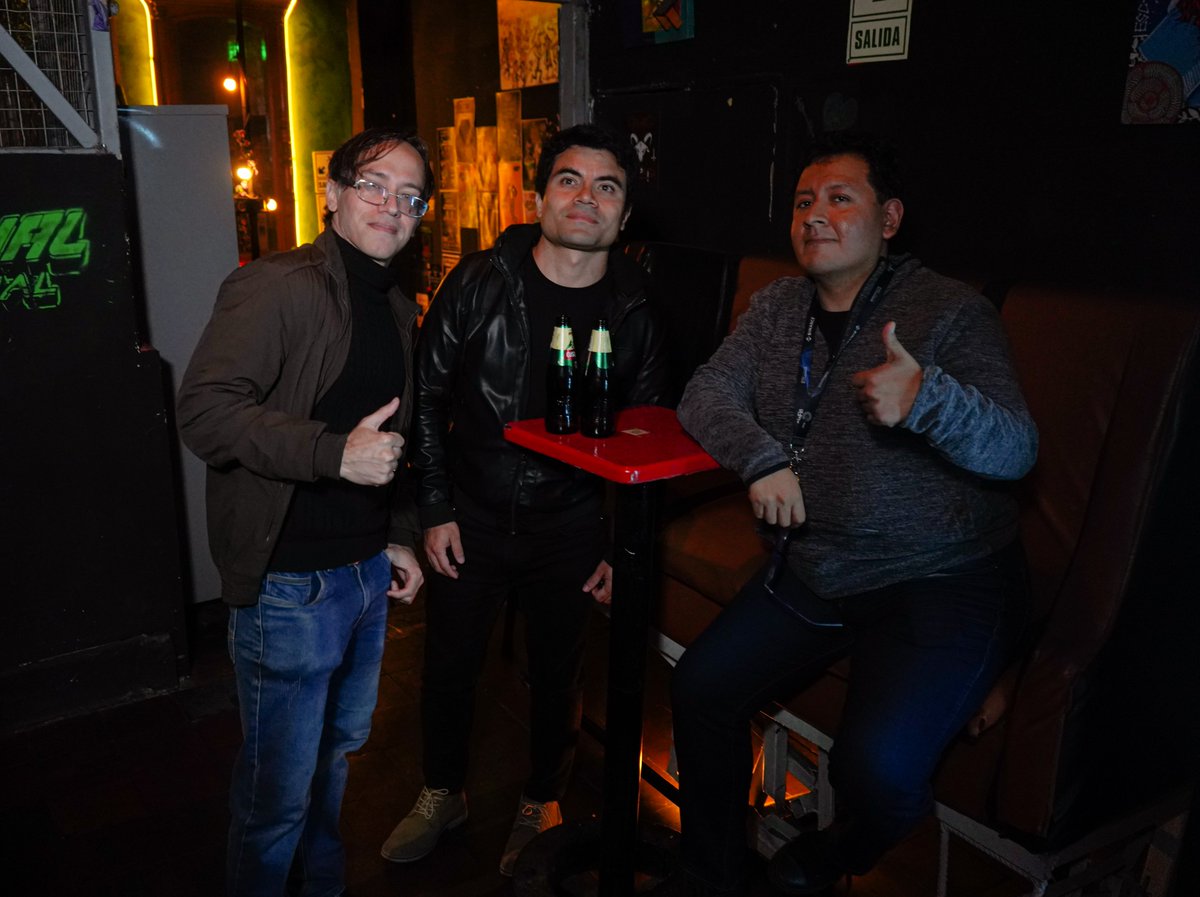
🎥 ¡Así se vivió el ETHGlobal Happy Hour Lima! 🇵🇪 🥂 Todavía seguimos con la energía a tope después de una noche que reunió a builders, creadores, desarrolladores y apasionados del ecosistema Web3 en un solo espacio. Conexiones genuinas, conversaciones que inspiran, oportunidades reales, premios, música y sobre todo… comunidad 💫 Este video captura solo una parte de todo lo que pasó, pero la vibra que se sintió ahí… esa se queda con nosotros. Gracias por ser parte de este momento histórico para la escena Web3 en Lima. 🚀 Cada evento nos muestra que estamos construyendo algo grande y que el futuro se crea juntos. ¡Nos vemos en el próximo encuentro!🙌 🛸Evento auspiciado por: @ETHGlobal @buenbit_pe @hiveblocks_es 🍻Gracias al apoyo de: #NKSN @marketersweb3 @CryptomorfosisX @blockchain_pucp @NolimitgamesSA @21MBulls @BlockInUni @HorizonteBlock @Web3Gals_Latam #ethglobal #happyhour #web3builderscommunity #ethereum #buenbit #hive #perú #lima #crypto #web3 #community #networking
Web3 Builders Community 🛸 tweet mediaWeb3 Builders Community 🛸 tweet mediaWeb3 Builders Community 🛸 tweet media
Español
3
3
11
1.1K
Web3 Builders Community 🛸 retweetledi
ETHGlobal
ETHGlobal@ETHGlobal·
2 weeks until @ETHCC. 18 days until ETHGlobal Cannes. 🇫🇷 If it’s your first time on the Riviera, our Cannes City Guide covers: > where to stay > what to eat > how to get around > what to do when you're not hacking Read it here → ethglobal.com/events/cannes2… See you soon. ☀️
ETHGlobal tweet media
English
3
6
64
2.8K
Web3 Builders Community 🛸 retweetledi
Ethereum
Ethereum@ethereum·
0/ Privacy in the Ethereum ecosystem is undergoing an evolution. A Renaissance, even, to sound a bit fancy. What exactly is behind these changes and how might neo-Cypherpunk be involved? A guest thread by @post_polar_ and @nicksvyaznoy.
English
116
158
901
153.3K
Web3 Builders Community 🛸 retweetledi
Zyfai
Zyfai@Zyfai_·
Ethereum is for Agents ⬆️ Zyfai brings a trustless, rule-based yield stack to agentic DeFi on @ethereum, powered by @safe and verifiable through ZK proofs & ERC-8004. Now supporting ETH alongside USDC. 🧵
Zyfai@Zyfai_

x.com/i/article/2031…

English
20
36
145
49.6K
Web3 Builders Community 🛸 retweetledi
Marius Kjærstad (marius.eth) 🐬🦇🔊
Vitalik Buterin (@VitalikButerin) explains how Ethereum will tackle the quantum threat with a culture open to change All the building blocks already exist, so what is needed is just a large and talented developer community Ethereum is definitely the juggernaut in this area🔥
English
61
139
1.1K
86.1K
Web3 Builders Community 🛸 retweetledi
vitalik.eth
vitalik.eth@VitalikButerin·
Now, scaling. There are two buckets here: short-term and long-term. Short term scaling I've written about elsewhere. Basically: * Block level access lists (coming in Glamsterdam) allow blocks to be verified in parallel. * ePBS (coming in Glamsterdam) has many features, of which one is that it becomes safe to use a large fraction of each slot (instead of just a few hundred milliseconds) to verify a block * Gas repricings ensure that gas costs of operations are aligned with the actual time it takes to execute them (plus other costs they impose). We're also taking early forays into multidimensional gas, which ensures that different resources are capped differently. Both allow us to take larger fractions of a slot to verify blocks, without fear of exceptional cases. There is a multi-stage roadmap for multidimensional gas. First, in Glamsterdam, we separate out "state creation" costs from "execution and calldata" costs. Today, an SSTORE that changes a slot from nonzero -> nonzero costs 5000 gas, an SSTORE that changes zero -> nonzero costs 20000. One of the Glamsterdam repricings greatly increases that extra amount (eg. to 60000); our goal doing this + gas limit increases is to scale execution capacity much more than we scale state size capacity, for reasons I've written before ( ethresear.ch/t/hyper-scalin… ). So in Glamsterdam, that SSTORE will charge 5000 "regular" gas and (eg.) 55000 "state creation gas". State creation gas will NOT count toward the ~16 million tx gas cap, so creating large contracts (larger than today) will be possible. One challenge is: how does this work in the EVM? The EVM opcodes (GAS, CALL...) all assume one dimension. Here is our approach. We maintain two invariants: * If you make a call with X gas, that call will have X gas that's usable for "regular" OR "state creation" OR other future dimensions * If you call the GAS opcode, it tells you you have Y gas, then you make a call with X gas, you still have at least Y-X gas, usable for any function, _after_ the call to do any post-operations What we do is, we create N+1 "dimensions" of gas, where by default N=1 (state creation), and the extra dimension we call "reservoir". EVM execution by default consumes the "specialized" dimensions if it can, and otherwise it consumes from reservoir. So eg. if you have (100000 state creation gas, 100000 reservoir), then if you use SSTORE to create new state three times, your remaining gas goes (100000, 100000) -> (45000, 95000) -> (0, 80000) -> (0, 20000). GAS returns reservoir. CALL passes along the specified gas amount from the reservoir, plus _all_ non-reservoir gas. Later, we switch to multi-dimensional *pricing*, where different dimensions can have different floating gas prices. This gives us long-term economic sustainability and optimality (see vitalik.eth.limo/general/2024/0… ). The reservoir mechanism solves the sub-call problem at the end of that article. Now, for long-term scaling, there are two parts: ZK-EVM, and blobs. For blobs, the plan is to continue to iterate on PeerDAS, and get it to an eventual end-state where it can ideally handle ~8 MB/sec of data. Enough for Ethereum's needs, not attempting to be some kind of global data layer. Today, blobs are for L2s. In the future, the plan is for Ethereum block data to directly go into blobs. This is necessary to enable someone to validate a hyperscaled Ethereum chain without personally downloading and re-executing it: ZK-SNARKs remove the need to re-execute, and PeerDAS on blobs lets you verify availability without personally downloading. For ZK-EVM, the goal is to step up our "comfort" relying on it in stages: * Clients that let you participate as an attester with ZK-EVMs will exist in 2026. They will not be safe enough to allow the network to run on them, but eg. 5% of the network relying on them will be ok. (If the ZK-EVM breaks, you *will not* be slashed, you'll just have a risk of building on an invalid block and losing revenue) * In 2027, we'll start recommending for a larger minority of the network to run on ZK-EVMs, and at the same time full focus will be on formally verifying, maximizing their security, etc. Even 20% of the network running ZK-EVMs will let us greatly increase the gaslimit, because it allows gas limits to greatly increase while having a cheap path for solo stakers, who are under 20% anyway. * When ready, we move to 3-of-5 mandatory proving. For a block to be valid, it would need to contain 3 of 5 types of proofs from different proof systems. By this point, we would expect that all nodes (except nodes that need to do indexing) will rely on ZK-EVM proofs. * Keep improving the ZK-EVM, and make it as robust, formally verified, etc as possible. This will also start to involve any VM change efforts (eg. RISC-V) firefly.social/post/lens/1040…
English
344
319
2K
275K
Web3 Builders Community 🛸 retweetledi
Devcon 8 | Mumbai, India 🇮🇳
We’re kicking off the first Devcon Community Roundtable diving into: → What’s the India story for Ethereum? → And what’s Ethereum’s story for India? Builders. Institutions. Policy. Real impact. Save the date — Feb 27 · 8PM IST
Devcon 8 | Mumbai, India 🇮🇳 tweet media
English
13
20
126
6.8K
Web3 Builders Community 🛸 retweetledi
Ethereum Foundation
Ethereum Foundation@ethereumfndn·
The Series: Protocol Priorities 

 Join the Ethereum Foundation Protocol Cluster for a deep dive into each of the three new priorities: Scale, Improve UX, and Harden the L1. Episode 1 - Coming Soon
English
34
43
197
28.2K
Web3 Builders Community 🛸 retweetledi
Ethereum
Ethereum@ethereum·
祝以太坊社区新春快乐!🐎 愿新的一年,自主掌舵,稳步成长,满怀勇气。 -- Happy Lunar New Year Ethereum community 🐎 May it be a year of self-sovereignty, growth, and courage.
Ethereum tweet media
中文
245
216
1.3K
97.5K
Web3 Builders Community 🛸 retweetledi
vitalik.eth
vitalik.eth@VitalikButerin·
You do not have to agree with me on which applications are and are not corposlop to use Ethereum. You do not have to agree with me on what trust assumptions are acceptable in which situations to use Ethereum. You do not have to agree with me on political topics to use Ethereum. You do not have to agree with my views on defi, decentralized social or privacy-preserving payments to use Ethereum. You do not have to agree with my views on AI to use Ethereum. You do not have to agree with my view that Berlin has the best food in Europe, suits and ties should be expunged from our culture, and YYYY-MM-DD is the best date format to use Ethereum. And you do not have to agree with me on any one of those above things to agree with me on any other. I do not claim to represent the whole Ethereum ecosystem. Ethereum is a decentralized protocol. The whole concept of "permissionlessness" and "censorship resistance" is that you are free to use Ethereum in whatever way you want, without caring about what I think, or even what anyone else in the Ethereum Foundation or even any Ethereum client developer thinks. But on the flipside, if I say that your application is corposlop, I am not "censoring" you. This has always been the flip side of the grand bargain of free speech: I am not free to shut you down, but I am free to criticize you, much as you are free to criticize me. In fact, it is *necessary* that we do this. The modern world does not call out for pretend neutrality, where a person puts on a suit and claims to be equally open to all perspectives from all of humanity and not have their own opinions. Neutrality is for protocols (like HTTP, like Bitcoin, like Ethereum), and neutrality within some scope is for some institutions. The modern world calls out for the courage to clearly state one's principles - including stating principles by pointing to negative examples, that is by criticizing the things in the world that are incompatible with one's principles - and work with those with aligned goals to build the metaverse within which those principles are taken as a baseline. Such things inherently cannot be constrained to just the layer of the protocol: any principle you have will naturally lead to conclusions, not just about how the protocol should be built, but also what should be built upon it. Furthermore, any such principle will have consequences that go beyond technology, and reach into specific questions within the larger social world. This should not be avoided. Valuing something like "freedom", and then acting as though it has consequences on technology choices, but is completely separate from everything else about our lives, is not pragmatic - it is hollow. The inevitable converse of this is that (i) a decentralized protocol must not be viewed as belonging to only one metaverse, and (ii) the borders of a metaverse are fuzzy: it is possible, and indeed it is the normal case, to align with any one on some axes and not on other axes. Linux is a technology of user empowerment and freedom, Linux is also the base layer of a lot of the world's corposlop. It's almost certainly the base layer of many things that I think are good, and you think are bad, and vice versa. Hence, if you care about Linux because you care about user empowerment and freedom, it is not enough to just build the kernel, we must also build a full-stack ecosystem compatible with those values, and explicitly accept that this is not the only way that people will use Linux, but it is one way that must be built and must be available. Ethereum is similar. Milady.
English
875
439
3.9K
371.2K
Web3 Builders Community 🛸 retweetledi
Ethereum Foundation
Ethereum Foundation@ethereumfndn·
「以太坊的成功,必須奠基於其核心價值。」 — @hwwonx 聆聽更多來自以太坊基金會聯合執行董事 Hsiao-Wei 在 @consensus_hk 的分享。 --- "Ethereum's success must be built on its core values." - @hwwonx Hear more from Hsiao-Wei, Co-Executive Director of the Ethereum Foundation at @consensus_hk.
日本語
15
32
191
12.4K
Web3 Builders Community 🛸 retweetledi
Base
Base@base·
See you at @EthereumDenver
English
172
131
913
38.3K
Web3 Builders Community 🛸 retweetledi
vitalik.eth
vitalik.eth@VitalikButerin·
This is the right way to "make Ethereum be the home for AI". Don't just do what everyone else would do anyway, just on rails with an octahedron logo instead of a square or circle or pentagon logo. Make something fundamentally better, using meaningful technological improvements in ZK privacy-preserving payments and reputation.
Davide Crapis@DavideCrapis

The internet made access identity-based. Every API call tied to your email, card, or wallet. AI will make it worse. Our proposal: Replace identity with stake. Deposit once. Make thousands of API calls. Stay unlinkable. Abuse gets slashed. New post with @VitalikButerin 👇

English
492
314
2.2K
288.5K
Web3 Builders Community 🛸 retweetledi
vitalik.eth
vitalik.eth@VitalikButerin·
Two years ago, I wrote this post on the possible areas that I see for ethereum + AI intersections: vitalik.eth.limo/general/2024/0… This is a topic that many people are excited about, but where I always worry that we think about the two from completely separate philosophical perspectives. I am reminded of Toly's recent tweet that I should "work on AGI". I appreciate the compliment, for him to think that I am capable of contributing to such a lofty thing. However, I get this feeling that the frame of "work on AGI" itself contains an error: it is fundamentally undifferentiated, and has the connotation of "do the thing that, if you don't do it, someone else will do anyway two months later; the main difference is that you get to be the one at the top" (though this may not have been Toly's intention). It would be like describing Ethereum as "working in finance" or "working on computing". To me, Ethereum, and my own view of how our civilization should do AGI, are precisely about choosing a positive direction rather than embracing undifferentiated acceleration of the arrow, and also I think it's actually important to integrate the crypto and AI perspectives. I want an AI future where: * We foster human freedom and empowerment (ie. we avoid both humans being relegated to retirement by AIs, and permanently stripped of power by human power structures that become impossible to surpass or escape) * The world does not blow up (both "classic" superintelligent AI doom, and more chaotic scenarios from various forms of offense outpacing defense, cf. the four defense quadrants from the d/acc posts) In the long term, this may involve crazy things like humans uploading or merging with AI, for those who want to be able to keep up with highly intelligent entities that can think a million times faster on silicon substrate. In the shorter term, it involves much more "ordinary" ideas, but still ideas that require deep rethinking compared to previous computing paradigms. So now, my updated view, which definitely focuses on that shorter term, and where Ethereum plays an important role but is only one piece of a bigger puzzle: # Building tooling to make more trustless and/or private interaction with AIs possible. This includes: * Local LLM tooling * ZK-payment for API calls (so you can call remote models without linking your identity from call to call) * Ongoing work into cryptographic ways to improve AI privacy * Client-side verification of cryptographic proofs, TEE attestations, and any other forms of server-side assurance Basically, the kinds of things we might also build for non-LLM compute (see eg. my ethereum privacy roadmap from a year ago ethereum-magicians.org/t/a-maximally-… ), but for LLM calls as the compute we are protecting. # Ethereum as an economic layer for AI-related interactions This includes: * API calls * Bots hiring bots * Security deposits, potentially eventually more complicated contraptions like onchain dispute resolution * ERC-8004, AI reputation ideas The goal here is to enable AIs to interact economically, which makes viable more decentralized AI architectures (as opposed to non-economic coordination between AIs that are all designed and run by one organization "in-house"). Economies not for the sake of economies, but to enable more decentralized authority. # Make the cypherpunk "mountain man" vision a reality Basically, take the vision that cypherpunk radicals have always dreamed of (don't trust; verify everything), that has been nonviable in reality because humans are never actually going to verify all the code ourselves. Now, we can finally make that vision happen, with LLMs doing the hard parts. This includes: * Interacting with ethereum apps without needing third party UIs * Having a local model propose transactions for you on its own * Having a local model verify transactions created by dapp UIs * Local smart contract auditing, and assistance interpreting the meaning of FV proofs provided by others * Verifying trust models of applications and protocols # Make much better markets and governance a reality Prediction and decision markets, decentralized governance, quadratic voting, combinatorial auctions, universal barter economy, and all kinds of constructions are all beautiful in theory, but have been greatly hampered in reality by one big constraint: limits to human attention and decision-making power. LLMs remove that limitation, and massively scale human judgement. Hence, we can revisit all of those ideas. These are all things that Ethereum can help to make a reality. They are also ideas that are in the d/acc spirit: enabling decentralized cooperation, and improving defense. We can revisit the best ideas from 2014, and add on top many more new and better ones, and with AI (and ZK) we have a whole new set of tools to make them come to life. We can describe the above as a 2x2 chart. There's a lot to build!
vitalik.eth tweet media
English
678
664
3.4K
688.3K
Web3 Builders Community 🛸 retweetledi
Ethereum
Ethereum@ethereum·
Lido is built on Ethereum. @LidoFinance is a decentralized liquid staking protocol. Users stake ETH, receive stETH, and keep liquidity while earning staking rewards. It helps secure the network while giving individuals and institutions access to participate in staking.
Ethereum tweet media
English
353
431
1.7K
110.7K
Web3 Builders Community 🛸 retweetledi
Base
Base@base·
Launch, test for 60 days, commit or refund. Simple. Video by @virtuals_io
English
142
191
1.4K
94.9K
Web3 Builders Community 🛸 retweetledi
vitalik.eth
vitalik.eth@VitalikButerin·
How I would do creator coins We've seen about 10 years of people trying to do content incentivization in crypto, from early-stage platforms like Bihu and Steemit, to BitClout in 2021, to Zora, to tipping features inside of decentralized social, and more. So far, I think we have not been very successful, and I think this is because the problem is fundamentally hard. First, my view of what the problem is. A major difference between doing "creator incentives" in the 00s vs doing them today, is that in the 00s, a primary problem was having not enough content at all. In the 20s, there's plenty of content, AI can generate an entire metaverse full of it for like $10. The problem is quality. And so your goal is not *incentivizing content*, it's *surfacing good content*. Personally, I think that the most successful example of creator incentives we've seen is Substack. To see why, take a look at the top 10: substack.com/leaderboard/te… substack.com/leaderboard/cu… substack.com/leaderboard/wo… Now, you may disagree with many of these authors. But I have no doubt that: 1. They are on the whole high quality, and contribute positively to the discussion 2. They are mostly people who would not have been elevated without Substack's presence So Substack is genuinely surfacing high quality and pluralism. Now, we can compare to creator coin projects. I don't want to pick on a single one, because I think there's a failure mode of the entire category. For example: Top Zora creator coins: coingecko.com/en/categories/… BitClout: businessofbusiness.com/articles/insid… Basically, the top 10 are people who already have very high social status, and who are often impressive but primarily for reasons other than the content they create. At the core, Substack is a simple subscription service: you pay $N per month, and you get to see the person's articles. But a big part of Substack's success is that they did not just set the mechanism and forget. Their launch process was very hands-on, deliberately seeding the platform with high-quality creators, based on a very particular vision of what kind of high-quality intellectual environment they wanted to foster, including giving selected people revenue guarantees. So now, let's get to one idea that I think could work (of course, coming up with new ideas is inherently a more speculative project than criticizing existing ones, and more prone to error). Create a DAO, that is *not* token-based. Instead, the inspiration should be Protocol Guild: there are N members, and they can (anonymously) vote new members in and out. If N gets above ~200, consider auto-splitting it. Importantly, do _not_ try to make the DAO universal or even industry-wide. Instead, embrace the opinionatedness. Be okay with having a dominant type of content (long-form writing, music, short-form video, long-form video, fiction, educational...), and be okay with having a dominant style (eg. country or region of origin, political viewpoint, if within crypto which projects you're most friendly to...). Hand-pick the initial membership set, in order to maximize its alignment with the desired style. The goal is to have a group that is larger than one creator and can accumulate a public brand and collectively bargain to seek revenue opportunities, but at the same time small enough that internal governance is tractable. Now, here is where the tokens come in. In general, one of my hypotheses this decade is that a large portion of effective governance mechanisms will all have the form factor of "large number of people and bots participating in a prediction market, with the output oracle being a diverse set of people optimized for mission alignment and capture resistance". In this case, what we do is: anyone can become a creator and create a creator coin, and then, if they get admitted to a creator DAO, a portion of their proceeds from the DAO are used to burn their creator coins. This way, the token speculators are NOT participating in a recursive-speculation attention game backed only by itself. Instead, they are specifically being predictors of what new creators the high-value creator DAOs will be willing to accept. At the same time, they also provide a valuable service to the creator DAOs: they are helping surface promising creators for the DAOs to choose from. So the ultimate decider of who rises and falls is not speculators, but high-value content creators (we make the assumption that good creators are also good judges of quality, which seems often true). Individual speculators can stay in the game and thrive to the extent that they do a good job of predicting the creator DAOs' actions.
English
884
389
2.9K
542.7K
Web3 Builders Community 🛸 retweetledi
Startale 💿
Startale 💿@StartaleGroup·
Startale Group is proud to announce a $13M follow-on investment from Sony Innovation Fund, reinforcing the long-term shared vision between @Sony and Startale to build infrastructure for onchain entertainment.
Startale 💿 tweet media
English
117
87
396
95K
Web3 Builders Community 🛸 retweetledi
Ethereum
Ethereum@ethereum·
85% of tokenized commodities live on Ethereum. Source: RWA.xyz
English
398
385
2.9K
328.7K