CRISPR CIO

986 posts

CRISPR CIO banner
CRISPR CIO

CRISPR CIO

@CrisprCIO

100% in on $PRME Two little mice fell in a bucket of cream. The first mouse quickly gave up and drowned. The second mouse struggled so hard that…

Boston, MA Katılım Haziran 2022
508 Takip Edilen250 Takipçiler
CRISPR CIO retweetledi
Gene Investing w/Anthony 🧬
Okay I did a rather large covered call trade today. All $PRME holders can thank me because this means the stock will double tomorrow 😂
English
3
1
22
2.3K
CRISPR CIO retweetledi
PRIMEinvestor
PRIMEinvestor@crisprspace·
From a technical point of view, the $PRME chart is about to break out. If the management at @PrimeMedicine had any business acumen, they would do a less ambitious deal now, get some cash. This would push the stock to $6. Then they would dilute, raise more cash and push the stock even higher because this would mean that they would have cash until 2028. But of course the incompetent @Allan_Reine and his team won’t be able to pull this off.
English
4
2
23
1.9K
CRISPR CIO retweetledi
PRIMEinvestor
PRIMEinvestor@crisprspace·
The breakout in $ARKG will be parabolic. Fasten your seatbelts. $PRME, $NTLA
English
0
2
15
1K
CRISPR CIO retweetledi
Trav
Trav@hypergrowth102·
HOLY $PRME
Trav tweet media
English
3
2
30
3.7K
CRISPR CIO retweetledi
The Fox Radar
The Fox Radar@TheFoxRadar·
Why $PRME investors should pay attention to what happened on May 25 On May 25, 2026, Eli Lilly published Phase 1b results in NEJM for VERVE-102, an in vivo base editor delivered via LNP-GalNAc to the liver in patients with familial hypercholesterolemia. The results: 88% reduction in PCSK9 and up to 69% reduction in LDL-C with a single dose. No serious treatment-related adverse events. No clinically significant ALT elevations. No thrombocytopenia. Across 14 consecutive patients. VERVE-102 validates in humans the LNP-GalNAc delivery modality for genome editors in the liver. It is the first clinical demonstration that this system works with clean safety in real patients, not just in non-human primates. Prime Medicine uses the same concept: LNP with GalNAc ligand targeting hepatocytes via ASGPR receptor. PM577 (Wilson Disease) and PM647 (AATD) depend on this delivery modality to bring the prime editor to the liver. The Verve precedent significantly de-risks PM577 ahead of 2027 clinical data. It does not eliminate risk, Prime executes precise point correction, technically more demanding than Verve’s knockout approach, and uses a distinct proprietary LNP formulation, but the underlying modality is now clinically validated. Adding to this are the scientific improvements in prime editing published in 2024-2025: PE7 (La protein fused to the editor to protect the pegRNA) reaches 47% editing with a single dose in mouse liver vs 26% with PEmax. PRIDICT2.0 enables computational pegRNA design with 8 of 11 PKU mutations exceeding the reference in vitro. These improvements likely do not apply integrally to PM577 (IND-enabling timeline does not fit), but they indicate that the prime editing efficiency curve continues to accelerate. Programs entering IND-enabling in 2026-2027 may incorporate PE7 directly. But the central question of the thesis: does LNP-GalNAc work for gene editing in human liver? now has an affirmative clinical answer from Verve. That materially reduces the binary risk Prime Medicine faces in its upcoming catalysts.
English
2
9
55
5K
CRISPR CIO retweetledi
Prime Medicine
Prime Medicine@PrimeMedicine·
Great week at #ATS2026 connecting with the respiratory community. Appreciated the opportunity to host a dinner with leading investigators, insights like these help inform and strengthen our work advancing Prime Editing for lung diseases
Prime Medicine tweet media
English
2
2
22
1.4K
CRISPR CIO retweetledi
Dr. Glenn 🧬🧠👽💪🏻📈
$PRME
David R. Liu@davidrliu

Today in @NatureBiotech we report a new suit of PE8 prime editor proteins. PE8 variants were developed from laboratory-evolved PE6 proteins using AI-guided protein redesign. This approach combines recent advances in computational protein design and directed evolution to increase prime editing efficiency, especially in transient therapeutically relevant delivery settings such as mRNA+pegRNA electroporation into primary cells, eVLP delivery of prime editing RNPs, and LNP-mediated mRNA+pegRNA delivery in mice. drive.google.com/file/d/13VTcAs… 1/11

QCT
1
3
12
1.2K
CRISPR CIO
CRISPR CIO@CrisprCIO·
$PRME
Prime Medicine@PrimeMedicine

Great week at #ASGCT2026. Proud to see our colleagues share this work: Vivian Choi – Prime Editing in Wilson disease models and Rachel Cohen – AI-assisted potency assay validation. Grateful to the broader Prime team & the scientific community driving progress in genetic medicine.

QCT
0
0
2
399
CRISPR CIO retweetledi
Yair Einhorn
Yair Einhorn@yaireinhorn·
The common theme that “Prime Editing $PRME will eventually replace Base Editing $BEAM and make it obsolete” is completely wrong. An example for their irreplaceable and even complementary rule can be seen in an excellent research published by @eyeMacLaren which examined the different prevalent mutations in Choroideremia - a rare, X-linked genetic eye disease that is characterized by the progressive degeneration of the retina, causing childhood night blindness, tunnel vision, and eventual blindness. As this excellent chart shows each CHM mutation would require a different Gene Editing treatment to correct it - whether via a Prime Editing-based treatment or via a Base Editing one. It’s crucial to understand that there will be a need to use a vast range of different genetic medical platforms - CRISPR & Gene Editing, Gene Therapy, RNA Therapy, EpiGenetic Editing and others, in order to provide a treatment for 400 million patients worldwide who are currently suffering from one of the 8,000-10,000 rare genetic diseases known today.
Yair Einhorn tweet media
English
2
12
59
5.4K
CRISPR CIO retweetledi
The Fox Radar
The Fox Radar@TheFoxRadar·
$PRME Today David R. Liu and colleagues publish in ScienceTM: using a highly precise base editor (ABE8e-V106W), they correct the SCN1A mutation causing Dravet syndrome in mice. A single brain injection achieves: >50 % correction in bulk DNA, nearly 100 % in key inhibitory neurons, zero seizures, and 90 % survival (vs 30 % untreated). It even works in 12-day-old mice! For $PRME: 
• Proves restoring just one functional copy of SCN1A is enough to cure the disease. 
• Uses the exact same dual-AAV9 delivery platform already validated for prime editing in the brain. 
• Strong selective enrichment in target neurons + wide treatment window (up to P12) dramatically lowers clinical risk. 
• Prime editing can correct all or nearly all of the >1,400 pathogenic SCN1A variants in ClinVar. The path to precise brain gene editing is now clear, and Prime Medicine has already mentioned the CNS as a field they intend to expand into in the future. Another exceptional achievement by David R. Liu and company.
David R. Liu@davidrliu

Today in @ScienceTM, we report the use of in vivo adenine base editing to correct a variant causing Dravet syndrome, a severe childhood epilepsy and neurodevelopmental disorder, substantially ameliorating disease symptoms and extending lifespan in an animal model. 1/13 drive.google.com/file/d/12rcxew…

English
0
9
59
6.1K
Stocks, Options, Charts & Setups
Stocks, Options, Charts & Setups@prosperousguy·
What are your favorite #Biotech stocks to get bought out? Comment below if not listed here: $ABVX $VKTX $GPCR $SRPT $RVMD $PRME $MLYS $LEGN
English
3
0
6
2.6K
CRISPR CIO retweetledi
The Fox Radar
The Fox Radar@TheFoxRadar·
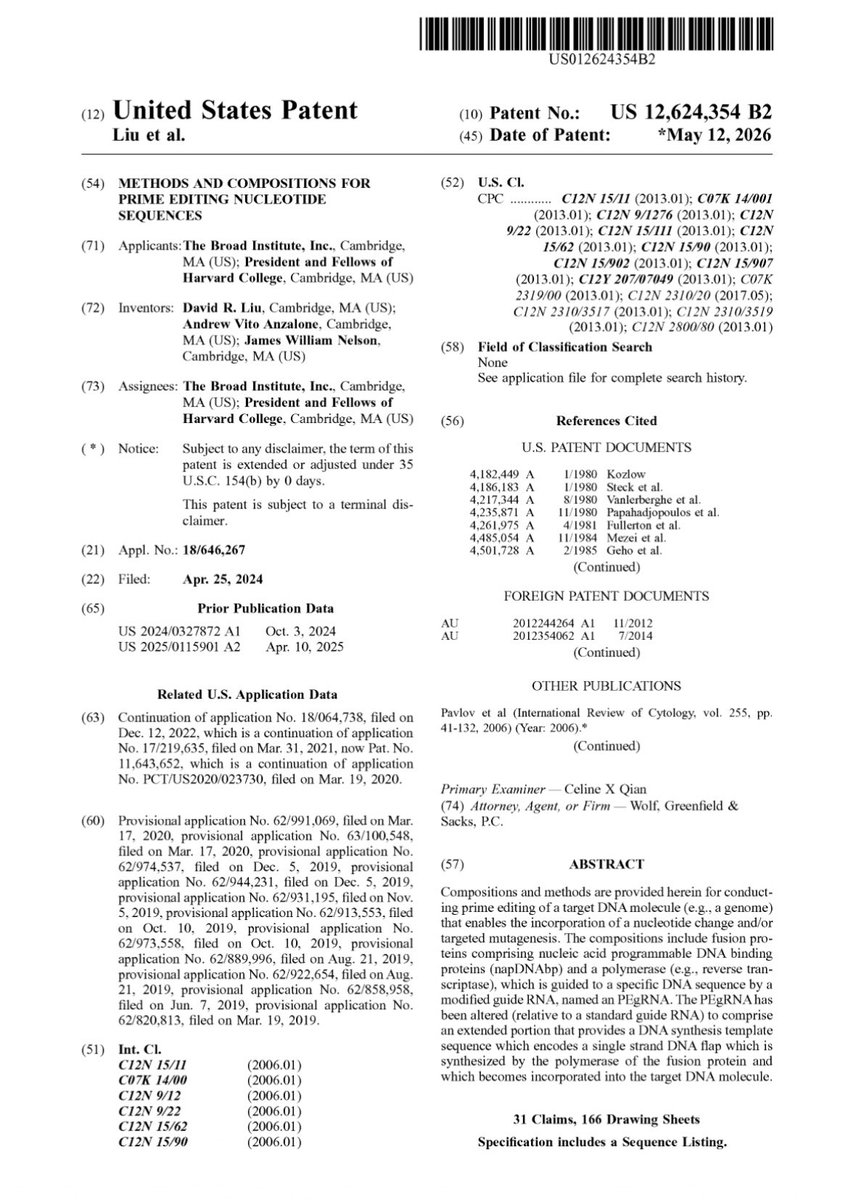
$PRME has significantly strengthened its intellectual property moat. 🧬 Today, May 12, 2026, the USPTO has issued two key patents: US 12,624,354 B2 and US 12,624,353 B2 (“Methods and Compositions for Prime Editing Nucleotide Sequences”). They are fully granted patents that protect the core prime editing system: the fusion protein (programmable DNA-binding domain + polymerase/RT) and the engineered pegRNA with an extended template that enables precise “search-and-replace” gene editing without double-strand breaks. They cover compositions (the exact fusion protein) and methods (how the complete mechanism works with extended pegRNA). They are continuations and divisions of the foundational patent family from the Broad Institute and Harvard. These new issuances expand and solidify protection of the core technology that underpins all current and future programs at Prime Medicine. This fortifies the entire platform: it makes it substantially more difficult for competitors to replicate the system or design workarounds (“design around”), while further strengthening Prime’s exclusive license from the Broad Institute and Harvard for therapeutic use in humans. A major milestone that reduces competitive and regulatory risks and enhances the long-term value of $PRME. Prime Editing leadership continues to solidify.
The Fox Radar tweet mediaThe Fox Radar tweet media
English
3
11
56
4.5K