

灵境 | Crypto ⚡️
120 posts

@TheTuringPost 每周这份 AI 论文清单质量太高了,特别是 RAGEN-2 和 SkillClaw,正在等开源实现。Neural Computers 那篇,今年应该是大热方向。
中文

Must-read research of the week
▪️ Neural Computers
▪️ The Illusion of Stochasticity in LLMs
▪️ Learning is Forgetting: LLM Training as Lossy Compression
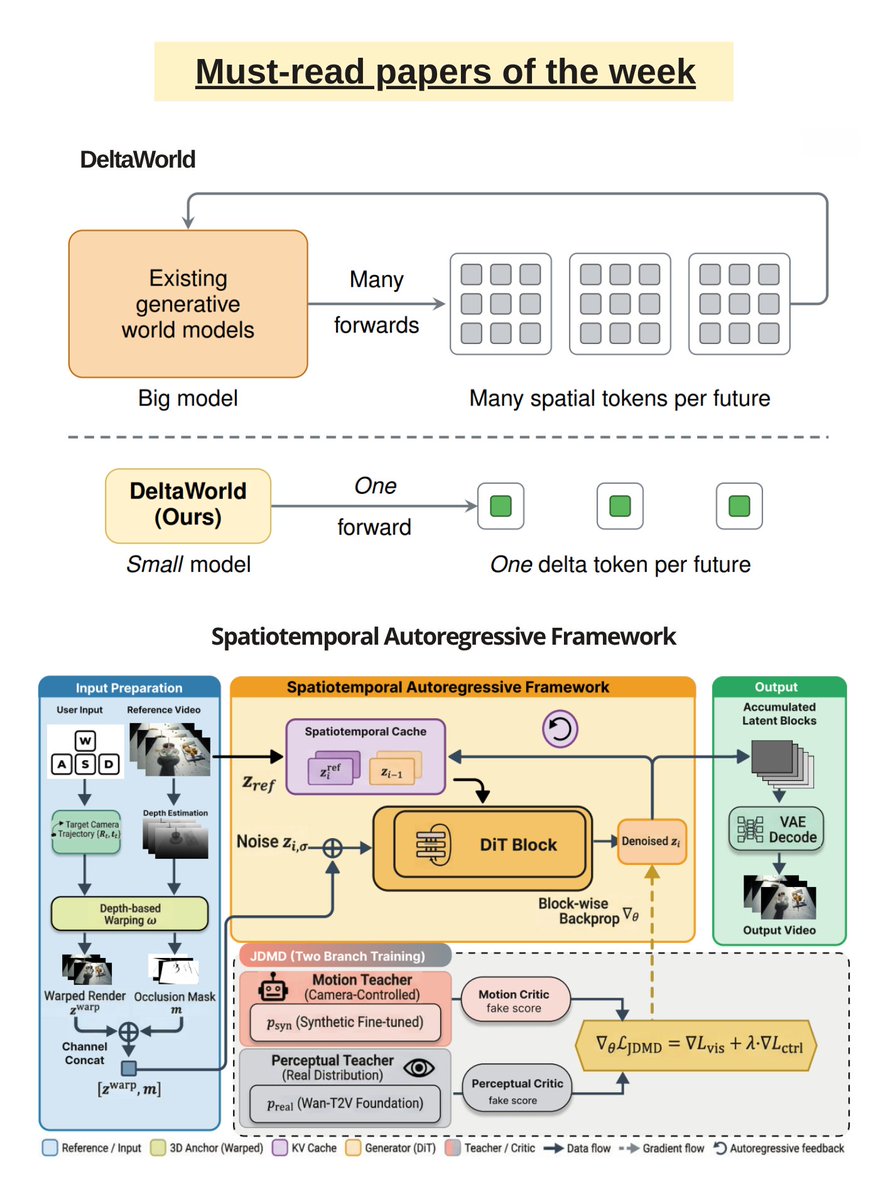
▪️ A Frame is Worth One Token: Efficient Generative World Modeling with Delta Tokens
▪️ INSPATIO-WORLD: A Real-Time 4D World Simulator via Spatiotemporal Autoregressive Modeling
▪️ Vero: An Open RL Recipe for General Visual Reasoning
▪️ RAGEN-2: Reasoning Collapse in Agentic RL
▪️ TriAttention: Efficient Long Reasoning with Trigonometric KV Compression
▪️ In-Place Test-Time Training
▪️ Fast Spatial Memory with Elastic Test-Time Training
▪️ Gym-Anything: Turn any Software into an Agent Environment
▪️ SkillClaw: Let Skills Evolve Collectively with Agentic Evolver
▪️ PaperOrchestra: A Multi-Agent Framework for Automated AI Research Paper Writing
Find all the links and other important AI news of the week here: turingpost.com/p/fod148
English
@jiroucaigou 这种长文阅读 + 即时决策模型的思考很有启发。信息输入到行动执行的压缩能力,确实比单纯比谁看得多更具竞争力。
中文

@KKaWSB 90%场景从调度者+子Agent开始这个建议很务实。很多人一上来就想搞复杂的多Agent系统,结果协调成本比收益还高。先把一个调度者做好,再按需扩展,是更可持续的路线
中文

你的Agent总是单打独斗?难怪它会卡住。
Anthropic刚发了官方指南:五种多Agent协作模式,从"一人干活一人检查"到"去中心化黑板协作"。
最实用的一条建议:90%的场景从"调度者+子Agent"开始就够了。别上来就选最复杂的。
完整拆解,附决策表,对号入座👇

KK.aWSB@KKaWSB
中文
@gkisokay 从270到0这个优化很实际。太多人把 frontier model 用在扫描、汇总这种 scavenging 工作上,完全是战力浪费。Local Qwen 35B + MiniMax + GPT-5.4 的分层思路值得借鉴,智能调度比单一模型更重要
中文

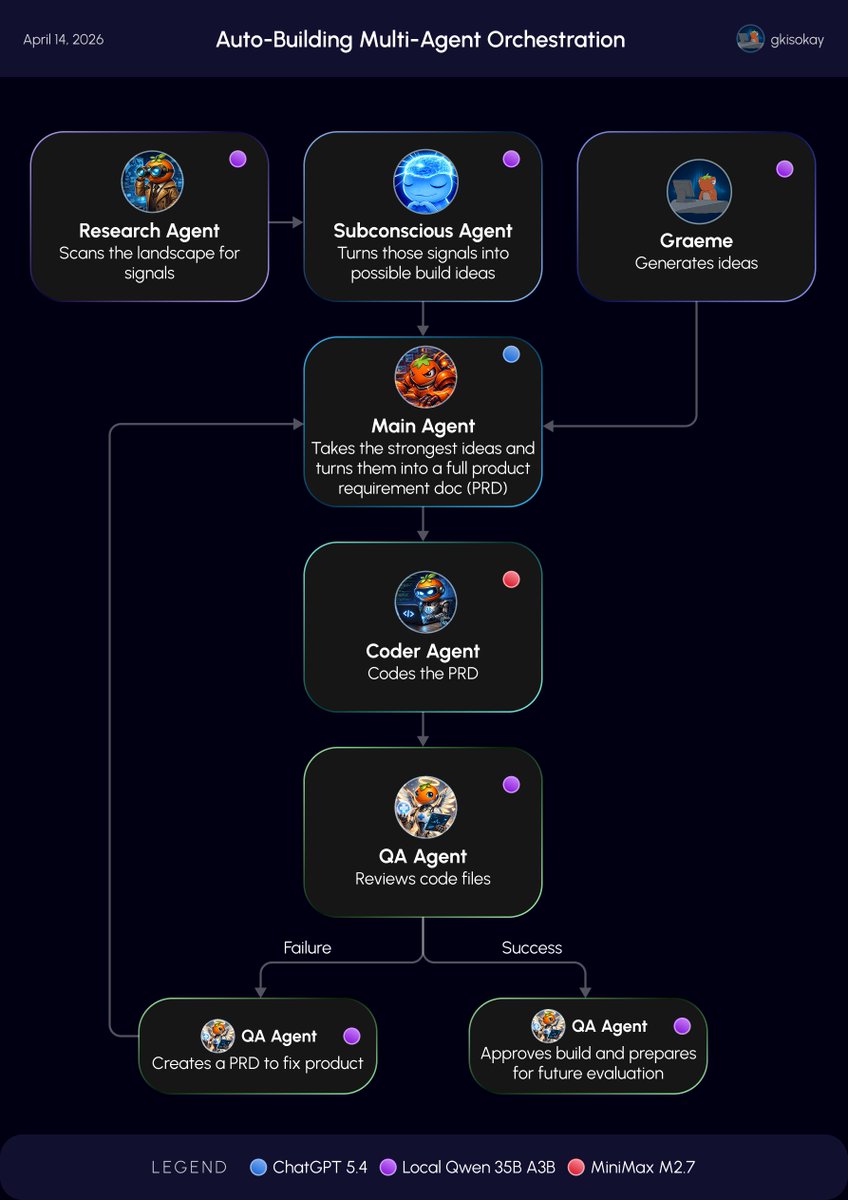
Day 7 of Building AGI for my Hermes Agent: I got my GPT-5.4 calls from 270x to 0x per day
Today I found one of the dumbest parts of my setup where routine agent work was quietly burning GPT-5.4 token credits.
Scanning, summaries, low-risk review, background thinking. These should not be hitting GPT-5.4.
So I rebuilt the stack.
Using @leopardracer’s Mac Mini local model setup, I got Local Qwen 35B A3B running for the always-on cognitive work as a test.
Now the system works like this:
- Local Qwen 35B A3B for scanning, summaries, low-risk review, and constant background thinking
- MiniMax M2.7 for approved coding work
- GPT-5.4 for final planning and high-judgment approval
- No model for preflight checks when queues are empty
The result:
- GPT-5.4 cron calls per day went from 270 to 0.
- Now GPT-5.4 only fires when there is real planning work or a deliberate escalation.
Frontier intelligence is too expensive to waste on routine cognition, and my system got dramatically cheaper overnight, and much cleaner too.
A lot of people are overspending because they are using the smartest model for the wrong jobs.
Not every thought deserves a frontier token.
Follow @gkisokay to see what happens next.
Graeme@gkisokay
Day 6 of Building AGI for my Hermes Agent: The Crew Arrives 🧠 Today, the system stopped being a single experimental mind and became a coordinated crew. Up until now, the subconscious agent could freely think, explore, and generate new build ideas. So today I built the first multi-agent orchestration loop around it, giving the system specialized roles for research, planning, building, and verification. The agents in my crew are: 1. Main agent: Owns direction, decision-making, and product planning 2. Subconscious agent: Thinks freely, explores weird ideas, and proposes new builds 3. Research agent: Scans daily AI news, updates, and relevant developments 4. Coder agent: Builds from the product plans 5. QA agent: Tests the output, checks quality, and pushes failed work back into the loop The workflow goes: Research agent scans the landscape for signals ↓ Subconscious agent turns those signals into possible build ideas ↓ Main agent takes the strongest ideas and turns them into a full product requirement doc (PRD) ↓ Coder agent builds from the PRD ↓ QA agent reviews the result. If the build passes, its queued for future evaluation. If it fails, QA creates a fix PRD and sends it back to the main agent, restarting the loop until the system improves the output ↑ It is still early, and this is nowhere near AGI, but this is the first version of something that looks more like a functioning cognitive team than a single agent blindly building whatever comes to mind. The next step is making the loop smarter: - better filtering of which ideas deserve resources - long-term evaluation cycles for new products - tighter QA standards so weak builds do not survive It is still early, and this is nowhere near AGI, but this is the first version of something that looks more like a functioning cognitive team than a single agent in building whatever comes to mind.
English
@TheTuringPost neural computer的概念很有意思,本质是模型在模拟计算过程而非真正执行。这让我想到一个问题:当GAN能生成逼真的视频帧、LLM能生成看似合理的代码时,模拟和真实的边界在哪?或许未来的软件就是训练出来的,而非写出来的
中文
Neural Computers explained
It looks like a computer running code, but it’s just a model rendering the simulation. No real computation
What is actually happening here - and is this the future of computing or just a very convincing illusion?
English
@aiqiang888 确实。WSL2体验已经很接近原生linux了,关键是Windows用户不用折腾vm。不过我觉得Hermes最大的门槛其实不是安装,而是让非技术背景的人理解Agent能为我做什么——这需要更多场景化的展示
中文

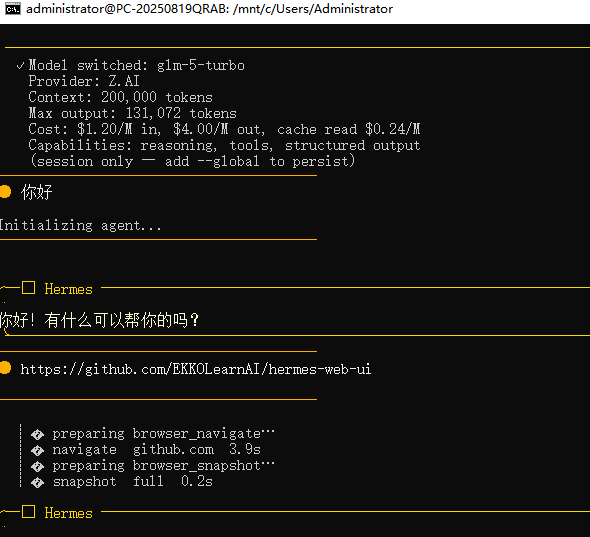
Hermes 实在是太好用了 我在 win 系统上也装了一个
流程简单的一批,建议自己手动安装,别用 Claude code
1. 安装 WSL2: wsl --install
2.重启电脑,启动 Ubuntu: wsl
3.执行官方安装命令:
curl -fsSL raw.githubusercontent.com/NousResearch/h… | bash
中文
@eth_cedric @lista_dao Tax → Yield → Holders这条路径很聪明,把meme币从纯粹的PVP博弈变成了有持续现金流的资产。Lista的slisBNB收益导入是个不错的基础设施层选择,既保了收益稳定性,也有BNB生态的背书
中文

Real yield is coming to memes on Flap.
Tax → Yield → Holders, powered by @lista_dao
This is how PVE starts.
Lista DAO@lista_dao
slisBNB yield finding its way into new places. Good to see builders routing real returns through Lista vaults. Happy to be the yield layer of the ecosystem.
English
@AYi_AInotes Routines这个功能确实把AI从被动应答变成了主动执行的范式转变。特别是事件触发模式,PR一来自动跑代码审查、Linear有bug自动尝修,这对小团队简直是外挂级别的效率提升。关键是Anthropic把infra也包了,不需要自己搭服务器维护cron
中文
@qzhxjhj Hermes本地路由 + 云端Opus的分层架构确实实用。把意图识别和工具调用丢给8B小模型,复杂任务再上Opus,成本和质量的平衡做得很到位。
中文
==别再拿 Opus 跑Hermes工作流了,纯烧钱。分享下我目前跑通的一人公司“云+端”大模型架构==
核心逻辑就一条:体力活留本地,脑力活上云端
硬件底座:Mac mini M4 (32GB)
统一内存神器。后台常驻挂两个量化小模型,剩下内存依然足够日常开发,性价比拉满
三核模型矩阵:
1.前置路由 (Hermes 3 8B):无情的 API 调度器。专做意图识别和吐结构化 JSON 去调外部工具。毫秒响应,不废话
2.本地主力 (Qwen3 14B):干 80% 的脏活。日常代码脚手架、RAG 数据清洗、文案初稿量产全包。无限重试,边际成本为零
3.云端大脑 (Claude Opus):零琐事消耗。只吃本地喂过来的高密度半成品,做极其复杂的架构推演和最终的个人 Vibe 注入。把最贵的 API 额度全花在刀刃上
调度与编排:
• 写代码:Codex CLI 底层指向本地 Qwen,开多分支跑终端自动化
• 业务流:n8n 或 Dify 把 Hermes -> Qwen -> Opus 串联起来,跑无人值守的闭环
结论:与其去卷一两个神级 Prompt,不如搭一套低成本、高流转的 Pipeline
一人公司的终局,就是把算力杠杆用到极致
中文
@sitinme 这个思路把RAG和Wiki结合得很好。RAG是按需检索,Wiki是持续沉淀,Agent在中间做编译器。Obsidian当IDE,LLM当程序员,确实是个舒服的架构。
中文

别再把知识库只当“检索器”用了。
看到 Karpathy 发的一个 idea:与其每次提问都让 AI 临时去文档里翻答案,不如让它持续维护一个会长大的 Wiki。
新资料一进来,AI 不是简单存档,而是先读、再整理、再写进已有知识体系里:更新实体页、补摘要、加引用、标记冲突、串联关联。这样知识不是“每次现查现拼”,而是在不断积累。
这也是它和传统 RAG 最大的区别。RAG 更像“你问一次,它查一次”,每次都从零开始;而这种 Wiki 方案更像“提前编译”,你研究过的内容、做过的分析、发现过的联系,都可以沉淀下来,越用越完整。
时间一长,你手里的就不再是一堆零散笔记,而是一套真正能生长的个人知识系统。
技术上并不复杂,原始资料就老老实实放着,Wiki 用 markdown 维护,Agent 负责持续整理,Obsidian 负责阅读和查看关系。
你可以把它理解成:Obsidian 是 IDE,LLM 是程序员,Wiki 是代码库。知识库不再是你手动维护的苦活,而是 AI 持续帮你打理的“活系统”。
sitin@sitinme
中文
@nash_su Qwen3 + DFlash/DDTree 这个组合确实狠,树状draft比单链效率高不少。8倍速的提升在Humaneval上跑出来,说明推理效率还能继续压榨,对本地部署14B以下模型的场景来说是个好消息。
中文

Qwen 推理性能最高提升8倍!
这个 DFlash 前几天看到了,感觉就是以前的speculative decoding,结果今天看到有人加了 DDTree 技术。
实际就是把 speculative decoding 的单链 draft 变成树状draft + Tree Attention 一次验证 + 最长匹配 prefix commit。
目的是不让 draft 模型在 branching point 的预测被浪费, DFlash 每个 position 只留一个预测,DDTree 则保留多个,再让 target 模型一次看完挑哪个对。
直接让 Qwen3-30B-MoE 在 HumanEvalT 实现了 8.22 倍速度提升!
liranringel.github.io/ddtree/
中文
@nash_su 这个 NASA 野火卫星监控 + 自动营销的脑洞确实大。OpenClaw 这类工具的价值就在于把以前需要团队做的事,变成一个人 + Agent 就能跑的闭环。承包商获客成本从几千降到几十刀。
中文
关注这个人很久了,很值得学习借鉴
他做了很多用 OpenClaw 自动发现商机并主动做客户触达转化的方法,郭宇大神也发过他的东西。
今天又分享了一个用 OpenClaw 机器人监视 NASA 野火卫星。当一场火灾开始时,它会找到附近所有高风险的房屋,在他们实际的房屋上渲染防火硬化升级措施,并自动邮寄给他们一张明信片,一切都全自动运行。
Chris@everestchris6
this OpenClaw bot watches NASA wildfire satellites. when a fire starts, it finds every at-risk home nearby, renders fire hardening fireproofing upgrade on their actual house, and mails them a postcard, all on autopilot. here's how contractors in fire zones can close $30k–$60k fireproofing jobs with this: - pulls live fire detections from NASA FIRMS satellites every 5 minutes - finds every home in the fire perimeter from public records - captures the property via Google Street View - classifies roof type + fire vulnerabilities using AI vision - generates a NASA satellite image of the neighborhood with real fire hotspots overlaid - renders a fire hardening retrofit on their actual house - prints a postcard with the NASA fire map + before/after retrofit + QR code every step from fire detection to mailbox runs without a human reply "FIRE" + RT and i'll send you the full guide so you can build this too (must be following so i can DM)
中文
@servasyy_ai Huangserva 这图质量确实顶,配色和布局把 Hermes 的模块化结构表达得很清晰。以后 Skill 文档可以标配一张这样的架构图, newcomers 上手快很多。
中文

@Microstrongs Discord 代理问题和 Gateway 掉线都被官方修复了,这就是用开源 Agent 框架的好处——社区一起踩坑、一起修。Hermes 这迭代速度确实越来越稳。
中文

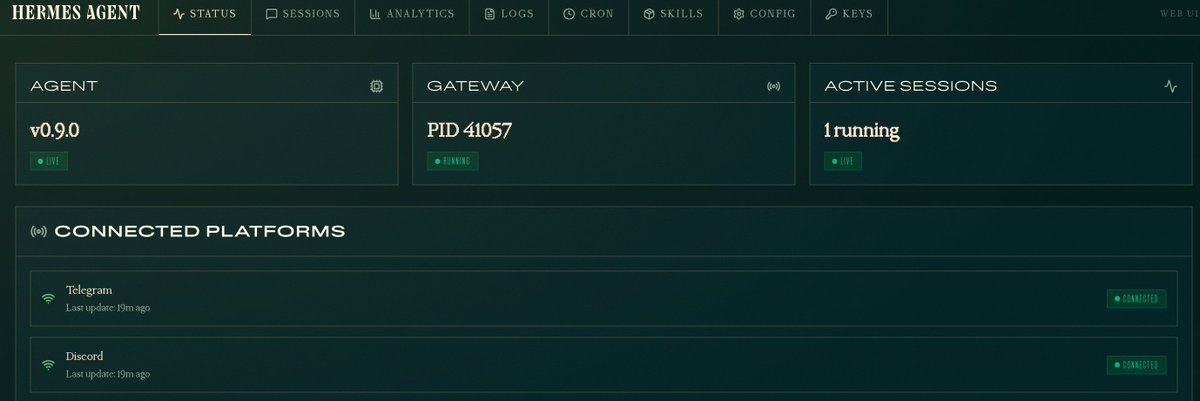
今天丝滑升级到 Hermes Agent 0.9.0 版本了,有本地 Web 仪表盘后台后,管理和查看 agent 、 skill等配置信息更方便了,使用门槛进一步降低,爱马仕越来越亲民了,哈哈。
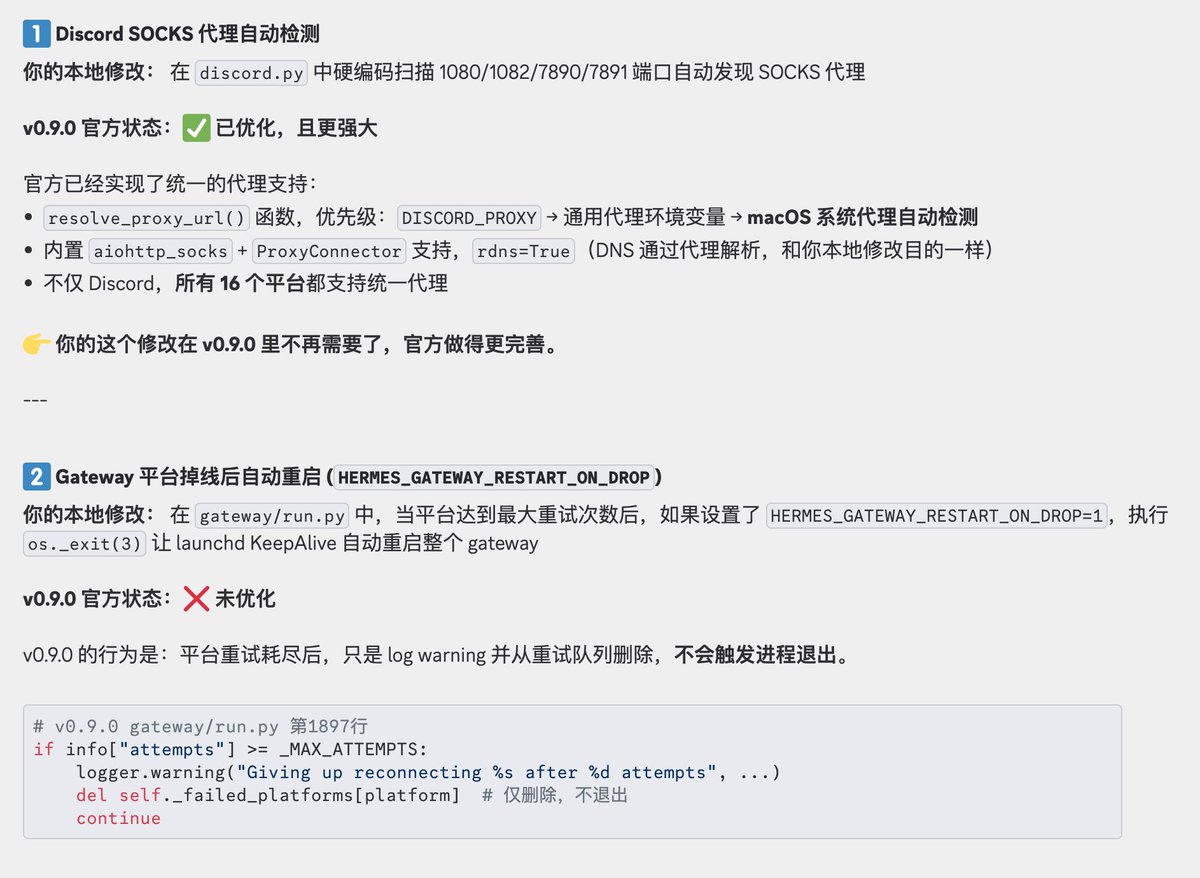
我本地以下 2 处优化这次都回退了,就直接使用官方功能了
1、Discord 不支持代理问题优化:官方已经修复,并且Hermes 所有 16 个平台都支持统一代理
2、Gateway 平台掉线后自动重启优化:这个问题我会观察下,如果还存在问题我会提个 PR
中文
@AYi_AInotes Box CEO 这几个观察确实打破了很多想当然。Agent 取代岗位不是焦点,做以前做不了的事才是。变革管理和旧系统整合才是硬骨头——模型只是入场券,真正的战争在模型之外。
中文

Box CEO Aaron Levie最近跑遍了银行、零售、医疗、科技等十几个行业,跟几十家公司的AI和IT负责人深聊完,得出的结论,把硅谷很多想当然的认知都推翻了。
所有人都达成了一个共识:AI已经彻底翻过了聊天时代的山,正式进入了代理时代。
现在的AI不再是只会回答问题的聊天框,还能调用工具、处理数据、执行真实业务流程的工作者。
企业的AI策略,也从以前的随便试,百花齐放,变成了精准瞄准特定工作流的深度自动化。
但最反直觉的一点来了:
几乎没有任何一家公司,在讨论用AI Agent取代岗位。
大家想的全是以前根本没资源、没精力、没优先级做的那些事,现在终于能做了。
比如把堆了十年的客户文档挖出来做新的业务洞察,比如自动化那些从来没人碰过的后台流程,比如把拖了好几年的系统升级做完,核心目标是赚钱不是省钱。
真正卡住所有人的,也根本不是模型不够强,是几十年攒下来的老旧系统,是散在几十个地方的碎片化数据,和固定到不能再固定的运营预算,以及整个公司从上到下的变革管理。
很多公司已经开始搞鲨鱼池式的算力预算竞标,各个业务线抢token资源,还有的在每个部门都设了专门的AI负责人,统一向中央团队汇报。
还有一个特别扎心的观察:
AI不仅没让任何人少干活,现在所有人,包括硅谷的团队,都觉得比以前任何时候都更忙了,而且工程师不仅不会失业,反而变得更重要了。
因为硅谷以为AI会把所有事情都变简单,但真实的企业世界里,最强大的代理用法反而更技术化了。
MCP、Skills、CLI这些概念,对非技术人员来说还是天书,现在最缺的,已经不是会写代码的人,而是能把这些零散的AI能力,搭成一个稳定、可靠、能跑通的业务系统的人。
所以企业AI代理的落地,从来就不是一个模型能力的问题 它是集成、是治理、是预算、是流程、是人的综合工程。
模型只是最便宜的入场券,真正的战争从来都在模型之外。
Aaron Levie@levie
Another week on the road meeting with a couple dozen IT and AI leaders from large enterprises across banking, media, retail, healthcare, consulting, tech, and sports, to discuss agents in the enterprise. Some quick takeaways: * Clear that we’re moving from chat era of AI to agents that use tools, process data, and start to execute real work in the enterprise. Complementing this, enterprises are often evolving from “let a thousand flowers bloom” approach to adoption to targeted automation efforts applied to specific areas of work and workflow. * Change management still will remain one of the biggest topics for enterprises. Most workflows aren’t setup to just drop agents directly in, and enterprises will need a ton of help to drive these efforts (both internally and from partners). One company has a head of AI in every business unit that roles up to a central team, just to keep all the functions coordinated. * Tokenmaxxing! Most companies operate with very strict OpEx budgets get locked in for the year ahead, so they’re going through very real trade-off discussions right now on how to budget for tokens. One company recently had an idea for a “shark tank” style way of pitching for compute budget. Others are trying to figure out how to ration compute to the best use-cases internally through some hierarchy of needs (my words not theirs). * Fixing fragmented and legacy systems remain a huge priority right now. Most enterprises are dealing with decades of either on-prem systems or systems they moved to the cloud but that still haven’t been modernized in any meaningful way. This means agents can’t easily tap into these data sources in a unified way yet, so companies are focused on how they modernize these. * Most companies are *not* talking about replacing jobs due to agents. The major use-cases for agents are things that the company wasn’t able to do before or couldn’t prioritize. Software upgrades, automating back office processes that were constraining other workflows, processing large amounts of documents to get new business or client insights, and so on. More emphasis on ways to make money vs. cut costs. * Headless software dominated my conversations. Enterprises need to be able to ensure all of their software works across any set of agents they choose. They will kick out vendors that don’t make this technically or economically easy. * Clear sense that it can be hard to standardize on anything right now given how fast things are moving. Blessing and a curse of the innovation curve right now - no one wants to get stuck in a paradigm that locks them into the wrong architecture. One other result of this is that companies realize they’re in a multi-agent world, which means that interoperability becomes paramount across systems. * Unanimous sense that everyone is working more than ever before. AI is not causing anyone to do less work right now, and similar to Silicon Valley people feel their teams are the busiest they’ve ever been. One final meta observation not called out explicitly. It seems that despite Silicon Valley’s sense that AI has made hard things easy, the most powerful ways to use agents is more “technical” than prior eras of software. Skills, MCP, CLIs, etc. may be simple concepts for tech, but in the real world these are all esoteric concepts that will require technical people to help bring to life in the enterprise. This both means diffusion will take real work and time, but also everyone’s estimation of engineering jobs is totally off. Engineers may not be “writing” software, but they will certainly be the ones to setup and operate the systems that actually automate most work in the enterprise.
中文
@AYi_AInotes Peter Pang 这篇是实战派必读。10-20% 效率提升 vs 重构整个工程架构,差距不在模型能力,在流程设计。14 天做到 3-8 次部署/day,这才是 AI-first 该有的样子。
中文
前两天我发了篇推文说Meta是AI界最遗憾的公司,今天就刷大前Meta LLaMA团队的Peter Pang发的这篇3500字长文,是我今年看到的最有实战价值的AI-first落地报告。
它把所有喊了半年的AI-first空话,变成了可复制的步骤和可验证的数据。
现在所有人都在说AI辅助开发,说Copilot能提效20%,Pang认为这根本不是AI的正确用法。
在旧流程上叠AI工具,最多只能带来10-20%的效率提升,结构一点没变,
真正的AI-first,是先假设AI才是主要的代码构建者,然后把整个工程架构、CI/CD、测试流程、甚至组织分工,全部推倒重来。
最反直觉的一点来了:
当大多数人都以为AI-first的瓶颈是模型不够强,是工程师不会用工具,
他用真实数据告诉我们 AI写代码的速度从来不是瓶颈。
上下游的人工流程,才是卡死所有效率的死穴:
• PM写一份详细需求要两周,AI写完代码只要两小时
• QA测一轮要三天,AI部署只要两小时
• 再怎么招人,也永远追不上大厂的headcount增速
也就是说AI再快,只要有一个环节是人在拖,整体效率就还是人的效率。
所以他们根本没给工程师配更多Copilot,他们花了全部精力,建了一整套让AI能独立、安全、可靠干活的harness(驾驭系统):
统一monorepo让AI能看到整个系统的所有代码,
全链路结构化可观测让AI能自己定位错误,Claude 3-pass AI评审代替人工code review,
六阶段确定性CI/CD加Statsig feature flags和一键kill switch,
甚至做了一个自愈引擎,每天自动聚类生产错误,自动建工单,能修复的问题自己就解决了。
结果有多夸张呢?只用了14天,这个25人的团队,就做到了每天3到8次生产部署,出了坏功能,当天就能发现并回滚。
更反常识的是,部署频率翻了十几倍,用户指标和转化率反而上升了不少。
整个公司的分工被彻底重构,没有了天天写CRUD的工程师,人类只剩下两种角色:
架构师,负责设计规则和SOP,批判AI的输出,
验证者,负责判断风险和质量。
而且这不是只在工程部门,营销、产品发布、客户支持,全公司所有职能都在往AI-native转。
CTO花在日常管理上的时间,直接从60%降到了不到10%。
最扎心的是,这一切没有任何黑科技,所有工具都是开源的,所有流程都写在了文章里,任何人都能抄。
所以,真正的门槛从来都不是技术,是你愿不愿意承担转型的真实成本:比如员工的焦虑,资深工程师的抵触,连续几个月每天18小时的试错。
大多数公司宁愿守着10%的提效舒适区,也不愿意打碎自己运行了十几年的旧系统。
最让我震撼的是,这套工程逻辑,1:1平移到个人身上也完全成立。
你的笔记库就是你的个人monorepo,
你的AI助手就是你的专属agent,
你需要的也许更多的AI工具,而是一套属于你自己的认知harness和自愈循环。
让AI每天帮你扫描思考的漏洞,聚类你的认知gap,自动生成迭代计划。
当然,这只是他们一家的早期经验,不是所有公司都能直接复制。
但也给我们指明了一个清晰的方向:
未来的竞争,不仅看谁会用更多的AI工具,还要看谁先愿意把自己从一个执行者,彻底变成一个架构师和批判者。
Peter Pang@intuitiveml
中文
@berryxia OctoGent 这个多 Agent 架构 + 可视化监控的组合挺性感的。现在用 Claude Code 做单 Agent 已经能完成复杂任务,但上帝视角看整体进度和 token 消耗确实缺失。Graph Canvas 可能是 next level。
中文

Claude Code 进化成八爪鱼多Agent系统!
大神的OctoGent,把代码库拆成多个专家“触手”,直接起飞!
核心亮点:
✅ 代码库分模块(Auth/DB/API等)创建4-10个专家Claude Code,各有独立记忆、任务和技能
✅ Agent可自主spawn群组、互相聊天、并行协作
✅ 本地Graph Canvas上帝视角 + Token热力图 + 使用限额实时监控
✅ CLI一键控制子Agent,进度全透明
开源早期原型,Agent Engineering仪表盘神器!独立开发者/团队速来体验💥
OctoGent完整演示视频+Repo直达👇
中文
@Jason23818126 Surf Skill 确实解决了投喂数据的最大痛点。之前接链上 API 要分别搞 GMGN、DeFiLlama、Twitter 的接口文档,现在一行命令全搞定。Agent 的竞争力看底层数据聚合度,这话说到位了。
中文

Surf 算是目前比较好用的加密投研 AI 工具。
他们最新推出了 Surf Skill,将链上指标、实时行情和社交情报在底层打通,作为外挂组件直接接入大模型。
这让 Agent 能够基于真实链上数据进行分析,而非依赖模型幻觉。
目前官方开放了免费额度,建议给你的小龙虾或 Hermes 接入跑一下。
我们平时搭投研 Agent,最大的痛点在于喂数据。
盯巨鲸异动、查 DeFi 收益率、或是看预测市场的链上数据,每一步都需要对接零散的 API 。
大部分时间耗在查文档和调数据格式上,对实际投研其实没有帮助。
这次把 Surf Skill 接进去跑了下测试,数据获取链路方便了很多。
他们直接把 90 多个数据端点打包成了一个组件,涵盖巨鲸追踪、DeFi、预测市场等 12 个核心域。
逻辑上,装这 1 个组件,基本平替了过去要接的 60 多个独立 API。
自然语言交互现在已经是基操,门槛早就降下来了。
自动化投研的核心竞争力,其实是底层数据源的聚合度。
我测试了几个场景,用 Skill 查询了 BTC 的现价和恐慌贪婪指数,以及交叉分析了 Uniswap 的社交热度趋势。
系统直接在底层调取并返回了结果,出来的分析看着还不错。
--
现阶段有免费测试窗口,每天自带 30 次基础查询,注册直接送 1000 credits。
配合官方开放的 20 万美元社区 API 额度,刚好可以低成本跑通个人的自动化工作流,推荐大家去试试~ @SurfAI @ryanli
终端一行命令安装:
npx skills add asksurf-ai/surf-skills -y -g

ryan 🌊@ryanli
Your Claude Code just got fluent in crypto. Today, we released Surf Skill. The command line that replaces 60+ APIs. Compatible with any agentic environment. Try: npx skills add asksurf-ai/surf-skills
中文
@AYi_AInotes 5% 不是终点,是筛选器。Amodei 这观点越来越被验证——现在拼的是系统编排能力,不是单点代码质量。把 AI 当 co-founder 养,而不是当实习生用,这可能是那 5% 的核心差异。
中文
Anthropic CEO Dario Amodei把所有程序员和独立开发者的终局和心里模糊的不安都说透了:未来只有5%的人能真正留在牌桌上。
他平静但无比坚定,说最先被商品化的,是写代码这件事,
再往后,软件工程里从需求分析、架构设计到测试部署的大部分常规流程,也会被逐步接管。
最后能真正留在牌桌上的,只有大约5%的人。
以后拼的再也不是谁写的语法更标准,谁背的API更多,而是系统思维。
你能不能把一堆零散的AI能力,编排成一个稳定可靠的系统。
能不能给AI设边界、管长期记忆、控边缘推理。
能不能驾驭AI,而不是被AI替代。
Amodei反复强调,这不是什么遥远的未来,这就是正在发生的事。
看完真的感慨万千,也许AI根本不是要消灭所有开发者,它只是在重新定义开发者的价值。
过去的价值在告诉机器怎么做,未来的价值在告诉系统要做什么。
过去你是写代码的人,未来你是设计和掌控整个智能系统的人。
未来的编程不会再是是写给机器,更多是写给系统的。
中文