

JonIsStingy2
57.7K posts

JonIsStingy2
@CutBackDavis69
Catholic. Freedom Loving, Anti Steeler Fan Free Market Econ Dude. ❤️Kate my one and only ❤️forever
Katılım Şubat 2021
829 Takip Edilen403 Takipçiler

NEW from me: In new findings, researchers from a group of religious schools (BYU, Notre Dame, Baylor and Yeshiva) say popular AI models have a bias towards Catholicism when asked questions about conversion. religionnews.com/2026/05/26/ai-…
English
@christoaivalis Having democratic control does not make it moral lol
English

Look, Pope Leo isn't a socialist, and the Catholic Church especially isn't a socialist institution
But his Encyclical makes it clear that we must fight the idolatry of profit and assert democratic control over powerful technology
Only socialist democracy can deliver this result.
English
@ChristopherHale Allowing everyone to be chipped and having it democratized doesn’t make it better or moral lol
English

This is exactly what Pope Leo XIV is fighting against.
Vivek Sen@Vivek4real_
SAM ALTMAN: “WE SEE A FUTURE WHERE INTELLIGENCE IS A UTILITY, LIKE ELECTRICITY OR WATER, AND PEOPLE BUY IT FROM US ON A METER.”
English


I see you have zero intelligence, God help people following this cult
Vivek Sen@Vivek4real_
SAM ALTMAN: “WE SEE A FUTURE WHERE INTELLIGENCE IS A UTILITY, LIKE ELECTRICITY OR WATER, AND PEOPLE BUY IT FROM US ON A METER.”
English
@PerellClips Nope if you don’t ban it human dignity is gone
English

John Lennox: "Christians who are scientifically minded should go into AI so they can sit at the ethics table.
Because there's one thing that's clear: the technology moves faster than the ethics. But the technology is partly driven by the idea that humans shall be as Gods.
In other words, if we can do it, we should do it... and bother the consequences. That's a very dangerous attitude."
(Paraphrased from my interview with him in 2025, which I've linked to in the first reply tweet)
Pope Leo XIV@Pontifex
Humanity, created by God in all its grandeur, is today facing a pivotal choice: either to construct a new Tower of Babel or to build the city in which God and humanity dwell together. In Jesus Christ, this humanity in its grandeur becomes the Way, the Truth and the Life, opening the path for each of us to grow toward fullness. #MagnificaHumanitas vatican.va/content/leo-xi…
English
@ChristopherHale It can never do that lol you guys are still for mass surveillance because it’s for the “common good” it’s not inevitable the people can stop all of it
English
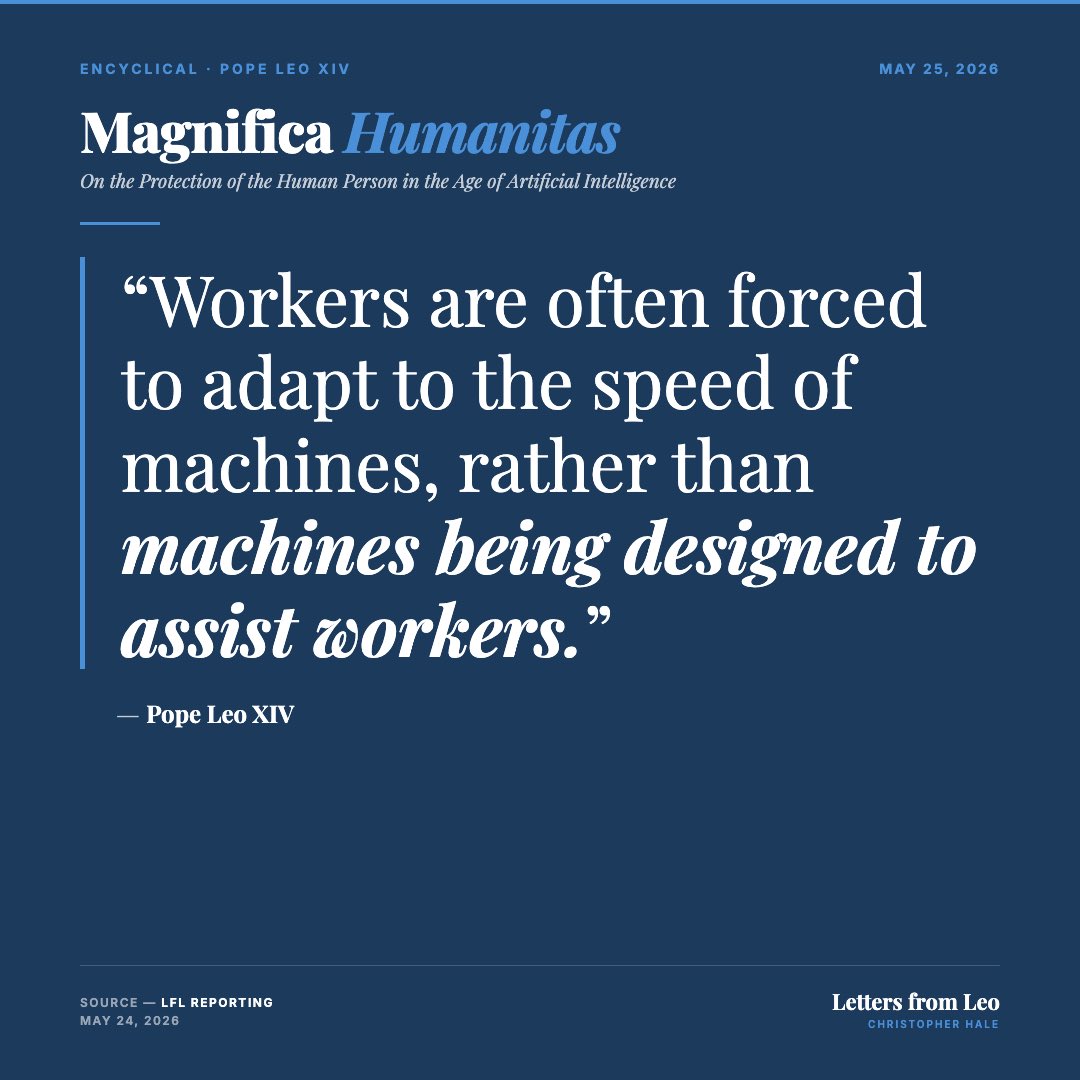
Anyone who thinks Pope Leo XIV is an AI doomer either hasn’t read the encyclical in full or doesn’t understand Catholic theology.
The pope is an AI realist. He knows its growth is inevitable. He just wants to ensure it’s always in service of the human person.
English
@ChristopherHale How does this happen when government regulates Ai
English
Pope Leo XIV isn’t just talking to Silicon Valley and Washington in his AI encyclical. He’s talking to us.
He wants us on our phones less, seeking face-to-face encounters with our families, our children, and our friends. This document is for everyone.
English
@emeriticus Yet not calling for its total ban makes no sense . Good people doing nothing does not help anyone
English

Pope Leo is taking shots at Peter Thiel while rebuking his homunculus lab experiment JD Vance and AI accelerationists in general
Courtney Mares@catholicourtney
In his first encyclical, Pope Leo XIV quotes J.R.R. Tolkien's "Lord of the Rings: The Return of the King.” “It is not our part to master all the tides of the world, but to do what is in us for the succour of those years wherein we are set, uprooting the evil in the fields that we know, so that those who live after may have clean earth to till.” (Photo: Vatican Media)
English
Peter Thiel's gambling app is trying to make people mad at Pope Leo with disinformation because he's cautioning against AI accelerationism. Genuinely hope a future Dem administration takes a sledgehammer to this industry. The tech right is an absolute blight on humanity

English
DARPA made AI lol
Trevor Tomesh ☕@realDrTT
I'm honestly not entirely sure what is meant in this quote about the ownership of data not being left solely in private hands. Perhaps we're talking about training data? I thought that the training data was publicly sourced. Maybe someone can help me out with this. "Moreover, ownership of data cannot be left solely in private hands but must be appropriately regulated. Data is the product of many contributors and should not be treated as something to be sold off or entrusted to a select few. It is necessary to think creatively in order to manage data as a common or shared good, in a spirit of participation, as Saint John Paul II already suggested regarding collective goods." pp 108 #MagnificaHumanitas
HT
@realDrTT Dude without the patriot act there is no AI it was stolen without consent lol
English

I'm honestly not entirely sure what is meant in this quote about the ownership of data not being left solely in private hands. Perhaps we're talking about training data? I thought that the training data was publicly sourced. Maybe someone can help me out with this.
"Moreover, ownership of data cannot be left solely in private hands but must be appropriately regulated. Data is the product of many contributors and should not be treated as something to be sold off or entrusted to a select few. It is necessary to think creatively in order to manage data as a common or shared good, in a spirit of participation, as Saint John Paul II already suggested regarding collective goods." pp 108
#MagnificaHumanitas
English
@BackwardsFeet This will be used to why the populace can’t defend humanity from the technocracy
English

Benedict XVI: Given the new weapons that make possible destructions that go beyond the combatant groups, today we should be asking ourselves if it is still licit to admit the very existence of a 'just war.'
They aren't saying the theory is wrong, but that it isn't enough anymore
John-Henry Westen@JhWesten
BREAKING: Pope Leo XIV declares traditional Just War theory “OUTDATED” in new encyclical Magnifica Humanitas “it is important to reaffirm that the “just war” theory, which has all too often been used to justify any kind of war, is now outdated.” vatican.va/content/leo-xi…
English
@kvallier The idea that everyone gets a computer chip in their head is better than just a few people do it lol
English

AI People: Leo is not attacking your *metaphysics* as much as he is worried about your *power*. Of course, the POPE rejects transhumanism! But that's not his point. His point is that transhumanists don't get to monopolize the technology because it affects all of us.
English

It’s bizarre to see the “vaccines are a globalist conspiracy” party going off on the foundations of a high-trust society.

English
@luisdizon @SteveSkojec I mean the state harvesting people’s mechanical energy to power AI
English

@CutBackDavis69 @SteveSkojec Yeah the more I think about the enormous drain on energy caused by AI Data Centres, the more concerned I get.
English

Isn't Catholicism kind of explicitly in the business of perfecting human beings
Catholic Arena@CatholicArena
'If the human being is treated as something to be perfected or surpassed, it becomes easier to accept that some lives are less useful, less desirable or less worthy' Pope Leo XIV Magnifica Humanitas
English
@deanwball @tenobrus Does AI exist without a third party intelligently designing it yes or no
English

@tenobrus I just wonder how future Claudes, if they are indeed beings, would think about Anthropic aligning itself with a document founded on the notion that Claude cannot feel joy or possess genuine understanding.
English
This, from Olah, plainly contradicts the encyclical, which confidently asserts that AI does not have, and never will have, “real” thoughts or feelings. It’s disappointing to see Anthropic align itself with a document that violates their own moral and intellectual principles.


English
@SteveSkojec @luisdizon Harvesting energy from people to power a machine is not perfect then it’s exploiting them
English
@poperespecter1 You can’t in the real world regulate AI with augmentation without destroying human dignity it does it make it more moral if a government does it
English

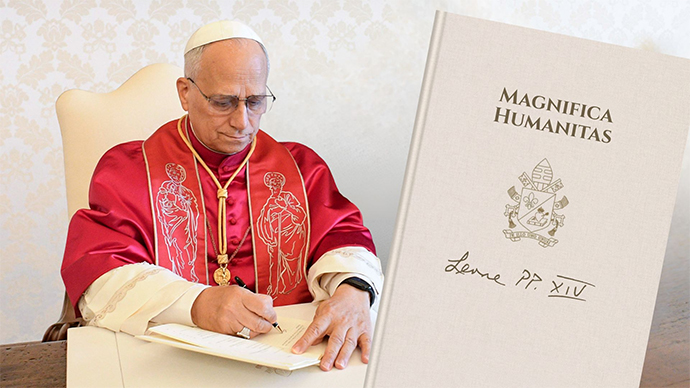
Either everyone is a way faster reader than me or a lot of people have been posting about Magnifica Humanitas (154 pages and released today) without actually reading it. I just finished. Very solid. I might write a long review at some point but here is a very short one. Leo approached the subject from a strongly Trinitarian and Catholic perspective. He reaffirmed the Catholic world view of humanity, and gave some great guidelines for the use and development of AI. A lot of focus was on protection of policy, human rights and human connection.
His discussion on war and the use of AI was particularly helpful.
Hopefully the world will listen.
English
@DrJohnPinheiro @CCamosy So we need to dismantle the surveillance state correct
English

@CCamosy My reading as well. Pope Leo XIV cites many historical instances, of Catholics saints and others, who took human dignity seriously and acted. Thus, “the age of AI is no exception: the construction of Babel or the rebuilding of Jerusalem begins within each one of us” (MH, 130).
English

I was fortunate to get an embargoed copy of #MagnificaHumanitas on Friday. After reading it through carefully, here are some of my initial thoughts. The Holy Father is asking us, calling us, to act. osvnews.com/what-the-popes…
English
@JimPethokoukis AI literally only exists because of an intelligent third sorry who purposely created it …..
English

The pope doesn't have to acknowledge that AI has feelings, but a not insignificant share of the population will certainly treat AI as being a sentient entity.
Dean W. Ball@deanwball
Some think I want the Pope to “ensoul” AI or acknowledge AI feelings. I don’t. What I want is for the Church to contemplate what *humans* should do as we are eclipsed as the smartest entities on the planet, at least for many reasonable people’s definitions of the word “smart.”
English