Alexander Bogomolny

14.9K posts

Alexander Bogomolny banner
Alexander Bogomolny

Alexander Bogomolny

@CutTheKnotMath

Freelance mathematician and educational web developer. I am a proud Israeli American, with love and respect for both countries.

NJ, USA Katılım Aralık 2009
342 Takip Edilen20.6K Takipçiler
Alexander Bogomolny
Alexander Bogomolny@CutTheKnotMath·
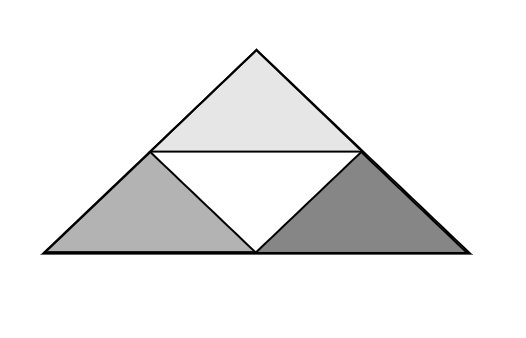
@KriteeshP What this shows is that "P interior to KLM" => "P interior to the medial traingle" But this is trivial because the former is inscribed in the latter.
English
0
0
0
0
कृतीश पाराशर 🇮🇳
@CutTheKnotMath For P to be interior of KLM. AP > AK, implies AP > AA'/2, implies AP/AA' >1/2 Hence AP/AA' , BP/BB', CP/CC' all must be more than 1/2 together. If AP/AA' < 1/2, the area covered by all possible P could be found by plotting AP/AA' = 1/2, which gives a line parallel to base BC.
English
1
0
0
0
कृतीश पाराशर 🇮🇳
@CutTheKnotMath 1/4. Could be redefined as CP > CM, which is redefined as P divides AA' in ratio k : 1, where k > 1. Limiting case is the ratio 1:1. In case of 1:1 we get locus of P as a line parallel to the opposite side BC Applying Thales theorem and similarity, area is 1/4 for each vertex.
कृतीश पाराशर 🇮🇳 tweet media
English
2
0
1
0
Alexander Bogomolny
Alexander Bogomolny@CutTheKnotMath·
@KriteeshP I've nothing against (I am all for) the Indians' pride in their culture and history. But, for crying out loud, did anybody hear the word probability c. 600 BCE.
English
1
0
1
0
Alexander Bogomolny
Alexander Bogomolny@CutTheKnotMath·
@dasanil @nntaleb @gcfr20 That is right. I now examples of statements whose "normal" proofs are rather convoluted, while, with a probabilistic interpretation, you have something short and elegant. E.g., #160352" target="_blank" rel="nofollow noopener">math.stackexchange.com/questions/1602…
English
1
0
1
0
Anil Das
Anil Das@dasanil·
@nntaleb @CutTheKnotMath @gcfr20 I confess the implication of the distribution escapes me, since the actual inequality doesn’t depend on the distribution at all.
English
1
0
0
0
Alexander Bogomolny
Alexander Bogomolny@CutTheKnotMath·
@dasanil @nntaleb @gcfr20 I think you are trying to prove the inequality; I only asked about its possible probabilistic interpretation. Honestly, I indeed thought of using this interpretation for proving the inequality. Your ideas may be the right way of pursuing that goal
English
1
0
0
0
Anil Das
Anil Das@dasanil·
@CutTheKnotMath @nntaleb @gcfr20 Minimum variance is achieved when you can bunch the value together as close as possible is a probabilistic interpretation, no? twitter.com/dasanil/status…
Anil Das@dasanil

@nntaleb @CutTheKnotMath @gcfr20 My approach is (not rigorous, but can be made so) is this: WLOG, assume x_n > 0. Variance is minimized when all positive x = x_n, and all negative x also equal. i.e. x_i = x_n for i >= n, and for j < n, x_j = - (x_n) * (n/n-1). Thus LHS becomes 2n/(2n-1) * x_n^2. QED


English
1
0
0
0
Alexander Bogomolny
Alexander Bogomolny@CutTheKnotMath·
@nntaleb @gcfr20 I have a proof for this inequality. There is no doubt that the inequality holds under the stated condition. I was curious whether it admits a probabilistic interpretation
English
2
0
0
0
Alexander Bogomolny
Alexander Bogomolny@CutTheKnotMath·
@nntaleb @gcfr20 Note that you never used (attached). If you did, you would not have any mildly misleading minus signs on the right
Alexander Bogomolny tweet media
English
1
0
2
0