Daniel Burkhardt

552 posts

Daniel Burkhardt banner
Daniel Burkhardt

Daniel Burkhardt

@DBBurkhardt

Digital Biology @ NVIDIA

Toronto Katılım Ocak 2009
313 Takip Edilen1.1K Takipçiler
Sabitlenmiş Tweet
Daniel Burkhardt
Daniel Burkhardt@DBBurkhardt·
Ready, set, code! The Open Problems in Single-Cell Analysis competition at #NeurIPS2022 is open, featuring $25,000 in prizes & a new multimodal #singlecell timecourse deeply profiling hematopoiesis 🥳 🎉🧪🧫 Join us on Kaggle! kaggle.com/competitions/o… To learn more, read on 🧵👇
English
3
110
312
0
Daniel Burkhardt retweetledi
Edison Scientific, Inc
Edison Scientific, Inc@EdisonSci·
At Edison Scientific, we build agents for scientific discovery. Training these agents often requires scaling to 1000s of simultaneous environments, for which we rely on @nvidia's recently announced NeMo Gym and RL frameworks. Read more about the integration with Aviary
English
2
26
92
28.6K
Daniel Burkhardt retweetledi
NVIDIA Healthcare
NVIDIA Healthcare@NVIDIAHealth·
🤯 Discover how you can scale transformer models to billions of parameters in PyTorch - without rewriting your pipeline. Dive into NVIDIA BioNeMo Recipes to see how FP8 acceleration, efficient sequence packing, and the Transformer Engine empower breakthrough R&D on NVIDIA GPUs. Ready to transform model training? Read the blog 👉 nvda.ws/3Xc4jeu
NVIDIA Healthcare tweet media
English
11
50
212
12.5K
Daniel Burkhardt retweetledi
Sam Rodriques
Sam Rodriques@SGRodriques·
Today, we’re announcing Kosmos, our newest AI Scientist, available to use now. Users estimate Kosmos does 6 months of work in a single day. One run can read 1,500 papers and write 42,000 lines of code. At least 79% of its findings are reproducible. Kosmos has made 7 discoveries so far, which we are releasing today, in areas ranging from neuroscience to material science and clinical genetics, in collaboration with our academic beta testers. Three of these discoveries reproduced unpublished findings; four are net new, validated contributions to the scientific literature. AI-accelerated science is here. Our core innovation in Kosmos is the use of a structured, continuously-updated world model. As described in our technical report, Kosmos’ world model allows it to process orders of magnitude more information than could fit into the context of even the longest-context language models, allowing it to synthesize more information and pursue coherent goals over longer time horizons than Robin or any of our other prior agents. In this respect, we believe Kosmos is the most compute-intensive language agent released so far in any field, and by far the most capable AI Scientist available today. The use of a persistent world model also enables single Kosmos trajectories to produce highly complex outputs that require multiple significant logical leaps. As with all of our systems, Kosmos is designed with transparency and verifiability in mind: every conclusion in a Kosmos report can be traced through our platform to the specific lines of code or the specific passages in the scientific literature that inspired it, ensuring that Kosmos’ findings are fully auditable at all times. We are also using this opportunity to announce the launch of Edison Scientific, a new commercial spinout of FutureHouse, which will be focused on commercializing our agents and applying them to automate scientific research in drug discovery and beyond. Edison will be taking over management of the FutureHouse platform, where you can access Kosmos alongside our Literature, Molecules, and Precedent agents (previously Crow, Phoenix, and Owl). Edison will continue to offer free tier usage for casual users and academics, while also offering higher rate limits and additional features for users who need them. You can read more about this spinout on our blog, below. A few important notes if you’re going to try Kosmos. Firstly, Kosmos is different from many other AI tools you might have played with, including our other agents. It is more similar to a Deep Research tool than it is to a chatbot: it takes some time to figure out how to prompt it effectively, and we have tried to include guidelines on this to help (see below). It costs $200/run right now (200 credits per run, and $1/credit), with some free tier usage for academics. This is heavily discounted; people who sign up for Founding Subscriptions now can lock in the $1/credit price indefinitely, but the price ultimately will probably be higher. Again, this is less chatbot and more research tool, something you run on high-value targets as needed. Some caveats are also warranted. Firstly, we find that 80% of Kosmos findings are reproducible, which also means 20% are not -- some things it says will be wrong. Also, Kosmos certainly does produce outputs that are the equivalent to several months of human labor, but it also often goes down rabbit holes or chases statistically significant yet scientifically irrelevant findings. We often run Kosmos multiple times on the same objective in order to sample the various research avenues it can take. There are still a bunch of rough edges on the UI and such, which we are working on. Finally, we are aware that the 6 month figure is much greater than estimates by other AI labs, like METR, about the length of tasks that AI Agents can currently perform. You can read discussion about this in our blog post. Huge congratulations to our team that put this together, led by @ludomitch and @michaelathinks: Angela Yiu, @benjamin0chang, @sidn137, Edwin Melville-Green, Albert Bou, @arvissulovari, Oz Wassie, @jonmlaurent. A particular shout out to @m_skarlinski and his team that rebuilt the platform for this launch, especially Andy Cai @notAndyCai, Richard Magness, Remo Storni, Tyler Nadolski @_tnadolski, Mayk Caldas @maykcaldas, Sam Cox @samcox822 and more. This work would not have been possible without significant contributions from academic collaborators @mathieubourdenx, @EricLandsness, @bdanubius, @physicistnevans, Tonio Buonassisi, @BGomes_1905, Shriya Reddy, @marthafoiani, and @RandallBateman3. We also want to thank our numerous supporters, especially @ericschmidt, who has been a tremendous ally. We will have more to say about our supporters soon!
English
274
650
3.7K
727.6K
Daniel Burkhardt retweetledi
Edison Scientific, Inc
Edison Scientific, Inc@EdisonSci·
Edison Scientific is launching today, with our launch of Kosmos, the most powerful AI Scientist released yet. We are a spinout from FutureHouse, focused on building and commercializing AI agents for science. Try our newest agents, including Kosmos, on our platform today.
English
31
41
340
44K
Krishnaswamy Lab
Krishnaswamy Lab@KrishnaswamyLab·
A bit late, but excited to announce our new paper, "Defining and benchmarking open problems in single-cell analysis," a joint effort led by our team (@scottgigante, @DBBurkhardt ) at @Yale and the @fabian_theis and @MDLuecken at Helmholtz! 🚀 **Open Problems**, is a living, community-driven benchmarking platform that formalizes and evaluates key challenges in single-cell analysis. By standardizing tasks, datasets, and metrics, our platform enables robust, extensible, and transparent comparison of methods—raising the bar for innovation and best practices in the field. #SingleCell #OpenScience #Benchmarking #Yale #HelmholtzB nature.com/articles/s4158…
English
1
10
40
8.4K
Daniel Burkhardt retweetledi
Sanjay Srivatsan
Sanjay Srivatsan@SRsrivatsan·
Thrilled to announce the opening of the Srivatsan Lab (srivatsan-lab.com) at the @fredhutch. The lab will be building new sequencing technologies to understand how our cells and bodies form over the course of development.
Hutch Basic Sciences@HutchBasicSci

The newest @FredHutch Basic Sciences lab opens its doors! The @SRsrivatsan Lab is developing new sequencing technologies to interrogate structure-function relationships during vertebrate development. The lab is growing and hiring at all levels: srivatsan-lab.com

English
44
92
601
177.7K
Daniel Burkhardt
Daniel Burkhardt@DBBurkhardt·
Thanks again @cellaritybio and @cziscience for making this possible! We’ve already got 100+ teams signed up. I can’t wait to see what the community comes up with 🤩
Kaggle@kaggle

📣Competition Launch Alert! Open Problems – Single-Cell Perturbations, hosted by the non-profit collaboration - openproblems.bio 🎯 to predict how small molecules affect gene expression in various cell types. 💰 $100,000 Prize Pool ⏰ Entry Deadline: November 23, 2023 goo.gle/3PFbKYI

English
0
3
9
2K
Daniel Burkhardt retweetledi
Kaggle
Kaggle@kaggle·
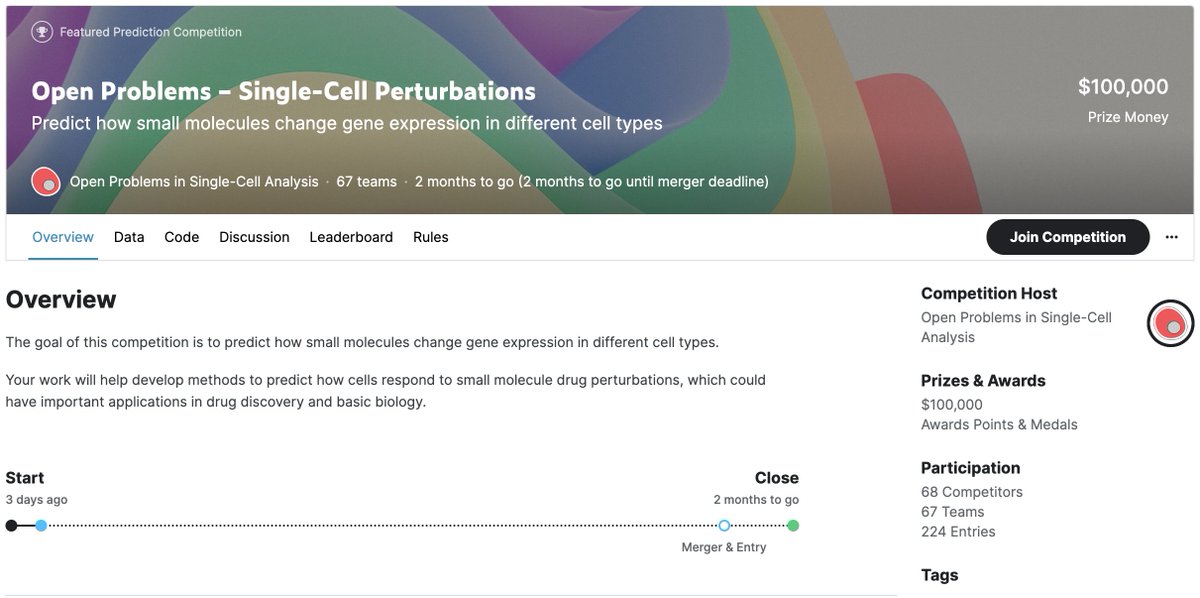
📣Competition Launch Alert! Open Problems – Single-Cell Perturbations, hosted by the non-profit collaboration - openproblems.bio 🎯 to predict how small molecules affect gene expression in various cell types. 💰 $100,000 Prize Pool ⏰ Entry Deadline: November 23, 2023 goo.gle/3PFbKYI
Kaggle tweet media
English
0
30
96
25.3K
Daniel Burkhardt
Daniel Burkhardt@DBBurkhardt·
We're also thrilled to announce that we're splitting our prize pool 50/50 to include an all-new Judges Award 🧑‍⚖️ for best write-ups that help us advance our scientific understanding of the problem. You can find details on the Judges award here: kaggle.com/competitions/o…
English
1
0
3
173
Daniel Burkhardt
Daniel Burkhardt@DBBurkhardt·
I'm thrilled to share that our 2023 openproblems.bio competition is now live 🎉 More details in 🧵, and you can get started on @kaggle today to compete for $100k in prizes: kaggle.com/competitions/o…
Cellarity@cellaritybio

For our 3rd competition for #NeurIPS2023, we’re asking: can you predict a new algorithm for how cells respond to a drug treatment?​ Learning how #singlecells respond to perturbations will help support more efficient drug design. See more on Kaggle: kaggle.com/competitions/o…

English
1
26
65
15.9K
Daniel Burkhardt retweetledi
Tony Kulesa
Tony Kulesa@kulesatony·
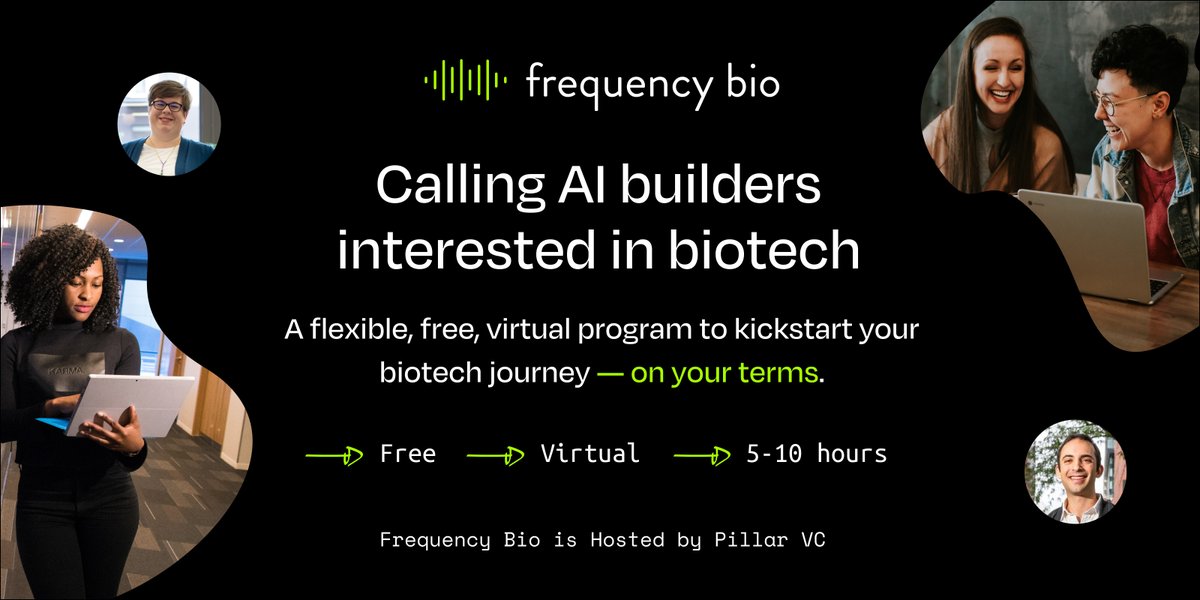
I get DMs daily from people in tech who want to work on biology, so we built something: In August, we'll do a free, virtual course. Assumes no background in biotech, and you'll on-ramp into great projects, get intros to the best labs & companies, join an incredible network.
Tony Kulesa tweet media
English
4
59
251
63.8K
Daniel Burkhardt
Daniel Burkhardt@DBBurkhardt·
@anshulkundaje @raedjinn I think about how a company like Novartis spends $10B on R&D per year and so much of that depends on high impact science from academics. How that much money gets spent in industry research, yet academics struggle to pay $13k seems the real issue.
English
0
0
1
46
Daniel Burkhardt
Daniel Burkhardt@DBBurkhardt·
@anshulkundaje @raedjinn I guess my point is just that the publishing costs of glam journals is trivial in the grand scheme. The biggest issues I see are paywalled science, unpaid peer review, and that $13k isn’t pocket change to a lab doing high impact science because academic science funding is small
English
1
0
1
91
Anshul Kundaje
Anshul Kundaje@anshulkundaje·
Glam journals now have a great new revenue source - well endowed industry players in biotech and AI! This is really great news in a way. Since they have a viable path forward, can most of us piss-poor academics abandon them? (I know the answer. But we can dream.)
English
3
1
30
8K
Daniel Burkhardt
Daniel Burkhardt@DBBurkhardt·
@anshulkundaje @raedjinn I think that $13k pub fee is under market value for a peer review because we should be paying reviewers. The real problem is that you also need to pay to read, and that $13k is exorbitant for academics. We need more science funding.
English
1
0
1
96
Daniel Burkhardt
Daniel Burkhardt@DBBurkhardt·
@anshulkundaje @raedjinn So, if $13k for publication fees became pocket change for academics, would this be okay? Something I’ve realized in industry is outside of academia, $13k isn’t that much to pay for an org to coordinate peer review, host a PDF, and manage an email list.
English
1
0
1
75
Daniel Burkhardt retweetledi
biohub
biohub@biohub·
We’re excited to launch #CZCellxGene Discover Census, a new capability that can cut parts of the #SingleCell analysis process from weeks to minutes. czi.co/41Zj3ya
English
1
19
72
58.4K