Manifesto Cardano Brasil

458 posts

Manifesto Cardano Brasil banner
Manifesto Cardano Brasil

Manifesto Cardano Brasil

@DRepsCardanoBR

Manifesto Cardano Brasil - Era Voltaire - Diretrizes e Missões críticas para dReps e Catalyst dReps https://t.co/jQXJm7NUKH

Brasil Katılım Ekim 2023
42 Takip Edilen218 Takipçiler
Sabitlenmiş Tweet
Manifesto Cardano Brasil
Manifesto Cardano Brasil@DRepsCardanoBR·
Olá família #Cardano! É com grande prazer que anunciamos oficialmente a publicação do Manifesto Cardano Brasil, um manifesto dedicado a orientar futuros #dReps e #CatalystdReps sobre diretrizes e missões críticas idenficadas pela comunidade. O link está na nossa bio.
Português
4
6
16
449
Manifesto Cardano Brasil retweetledi
Rodrigo P₳cini | Agora Research | dRep
In hindsight... I wrote this tweet 👇🏻 about a week before the official announcement of the cancellation of #ProjectCatalyst Funds 15 and 16. Now things seem even more dire, brace yourselves. Check it out why I'm pessimistic about #Cardano grassroots projects and builders and share your views below👇🏻
Rodrigo P₳cini | Agora Research | dRep@RodrigoPacini

🚨Under Cardano’s 2025 annual treasury budget of 350M ADA, well under 1% has effectively reached grassroots & community-led initiatives. 👉That is the scale of the imbalance. If 1% or percentages feel abstract, remember The Lord of the Rings and the Battle of Helm’s Deep. ⚔️What does the Battle of Helm’s Deep in The Lord of the Rings have to do with #Cardano treasury and governance⁉️ I use this comparison to symbolize disparity and the tension between morale/volunteerism and structural reality/incentives. In a pivotal moment of the film, one that would define an entire era of Middle-earth (much like Voltaire in Cardano), Aragorn and Legolas debate. Aragorn looks at the defenders of Rohan and sees farmers, stable boys, men too old or too young to battle. Legolas states the odds of victory in disbelief: 300 men against 10,000 orc soldiers. Roughly 3%. His conclusion wasn’t despair. It was realism. The imbalance was structural. Aragorn rallies to fight anyway. That wasn’t denial. It was leadership. In that moment, morale was necessary. Without morale, the walls would fall faster. Both were right. Realism names the imbalance. Morale keeps people standing. But morale alone does not change arithmetic. However, Helm’s Deep fortress does not hold because hope increases. It holds because the equation changes. It was reinforcements that turned a last stand into a victory. The lesson isn’t about pessimism or blind optimism. It's about holding both truths at once: Realism to accept the imbalance and morale to endure it, while recognizing that morale has limits if the structure doesn't change. The Cardano community has morale. That morale often expresses itself as volunteerism, builders willing to contribute, open-source, mentor, and persist even without guarantees. ⚠️But volunteerism alone cannot sustain an ecosystem indefinitely. Volunteerism can hold the wall for a while. It cannot fund the ecosystem forever. Coordination, allocation safeguards, and structural support are the reinforcements. Without them, the base layer doesn’t collapse dramatically. It thins out. Legolas wasn’t wrong. Aragorn wasn’t wrong. But without reinforcements, Helm’s Deep would have been lost. Governance is no different: without reflection and more resilient design, centralization becomes a systemic risk. It narrows development dispersion, concentrates decision power, and gradually suffocates the community layer that keeps the ecosystem alive. 🔎Back to Reality: A Cardano Ecosystem Funding Diagnosis under the lens of grassroots initiatives Now back to the numbers. In 2025, under a 350M ADA treasury ceiling, less than 1% has effectively flowed to community-led initiatives, almost all of these funds via Catalyst. That gap isn’t symbolic. It’s structural. The official Catalyst website projectcatalyst.io shows Fund 14 with 18,591,246 ADA in total to be allocated to funded projects, but only 3,254,948 ADA were distributed as of Feb/2026. Even taking the full distributed figure, that represents roughly 0.93% of a 350M-scale ceiling. Cardano needs forward momentum. But “just a higher NCL = growth” does not align with what 2025 execution shows in practice. Catalyst is the primary practical funding lane for community-sized initiatives. Execution speed and composition therefore matter. Fund 14’s category budgets included: 🔸 Open Developers: 3M 🔸 Open Ecosystem: 3M 🔸 Use Cases Concepts: 4M 🔸 Use Cases: Partners & Products: 8.5M The “Partners & Products” track is explicitly framed around enterprise collaborations and large-scale applications — not small independent teams. Numerically, roughly 45% of Fund 14’s available budget is structurally oriented toward enterprise-scale work (8.5M out of 18.59M). The community-facing side of the fund is therefore closer to ~10M ADA in budget capacity — not the full headline. Execution is the second constraint. Overall distribution stands at roughly 17.5% so far (3.254M out of 18.591M). Without a clear public dashboard breaking down distribution by category, the exact flow to grassroots initiatives cannot be stated precisely. But even under proportional assumptions, the effective flow into community-oriented tracks remains in the low single-digit millions — preserving the “well under 1% of treasury-scale capacity” reality. Zooming out: the 2025 NCL was set at 350M ADA (Epoch 532–604). In 2026, with ADA weaker and many budgets quoted in USD, a similar nominal ceiling buys less real capacity while incentives tilt further toward concentration into a few large mandates. The structural outcome is predictable: 👉 The base community layer gets squeezed. 👉 Open-source maintainers lose runway. 👉 Small teams pivot or exit. If growth is the goal, discussing only the ceiling is not sufficient. 🔹Minimum safeguards must be explicit: 🔹Transparent category-level distribution reporting 🔹 Execution gates and stop-conditions for large mandates 🔹 Coordination rules across funded work 🔹 Denomination discipline for USD-based budgets 🔹 A protected community floor with guaranteed cadence Otherwise, 2026 repeats 2025. I expanded on several of these budget and NCL considerations in my recent Governance Action vote thread. Link below for context.👇 🔗x.com/AgoraCardano/s… #Cardano #dRep #blockchain

English
1
4
13
394
Manifesto Cardano Brasil retweetledi
Project Catalyst
Project Catalyst@Catalyst_onX·
We would like to share an update regarding Project Catalyst. Following our joint review, @IOGroup, which operates Catalyst today, and the @Cardano_CF have agreed to work expediently towards the Cardano Foundation assuming stewardship of Project Catalyst. This transition is now underway and members of our Catalyst team will join the Cardano Foundation to ensure funding continuity for all existing grantees. The programme continues to administer funding to more than 500 active projects, with over 2200 projects funded to date. As part of this process, in consultation with the Cardano Foundation we have also agreed that running Fund15 and Fund16 in their proposed form is not feasible at this time of transition. The near-term focus will be on maintaining continuity for all grantees through Fund14, ensuring that funds continue to be administered in line with agreed milestones. Meanwhile, the Catalyst team, the Cardano Foundation and @IntersectMBO will continue to work together to develop a clear path forward for the future of community funding. At the heart of these plans is our community whose input will be invaluable to this process. Work also continues steadily towards other funding opportunities and maximising synergies for the @Cardano ecosystem. We would like to thank all those projects that submitted their applications for funding to Fund15 and deeply regret that we cannot see these projects through at this time. While we recalibrate, we believe it is appropriate that all ada previously earmarked for grant funding in Fund15 and Fund16 be returned to the treasury in alignment with Intersect. We’d like to thank the community for their patience while we finalize the process. Further updates on the status of this and future rounds will be shared once the transition is complete.
Project Catalyst tweet media
English
103
78
321
97.3K
Manifesto Cardano Brasil retweetledi
Rodrigo P₳cini | Agora Research | dRep
📢 Catalyst is transitioning stewardship! 🙅‍♂️ But governance transitions do not automatically fix accountability problems 🚨 This Deep Dive identifies 8 critical structural gaps in the Milestone Review Program that still shape how treasury funds are validated Read below 👇 x.com/RodrigoPacini/… Shared for visibility as Catalyst moves into a new phase under @Cardano_CF stewardship, relevant to @planetmaaz , @dannyribar, and @krissbaird #ProjectCatalyst #Cardano
Project Catalyst@Catalyst_onX

We would like to share an update regarding Project Catalyst. Following our joint review, @IOGroup, which operates Catalyst today, and the @Cardano_CF have agreed to work expediently towards the Cardano Foundation assuming stewardship of Project Catalyst. This transition is now underway and members of our Catalyst team will join the Cardano Foundation to ensure funding continuity for all existing grantees. The programme continues to administer funding to more than 500 active projects, with over 2200 projects funded to date. As part of this process, in consultation with the Cardano Foundation we have also agreed that running Fund15 and Fund16 in their proposed form is not feasible at this time of transition. The near-term focus will be on maintaining continuity for all grantees through Fund14, ensuring that funds continue to be administered in line with agreed milestones. Meanwhile, the Catalyst team, the Cardano Foundation and @IntersectMBO will continue to work together to develop a clear path forward for the future of community funding. At the heart of these plans is our community whose input will be invaluable to this process. Work also continues steadily towards other funding opportunities and maximising synergies for the @Cardano ecosystem. We would like to thank all those projects that submitted their applications for funding to Fund15 and deeply regret that we cannot see these projects through at this time. While we recalibrate, we believe it is appropriate that all ada previously earmarked for grant funding in Fund15 and Fund16 be returned to the treasury in alignment with Intersect. We’d like to thank the community for their patience while we finalize the process. Further updates on the status of this and future rounds will be shared once the transition is complete.

English
1
5
20
610
Manifesto Cardano Brasil retweetledi
Rodrigo P₳cini | Agora Research | dRep
Quick question for voting dReps & CC members on Cardano Blockchain Ecosystem Constitution v2.4: Did you have time to review the full proposed text and check additions/removals against the previous version ?
English
1
3
3
153
Manifesto Cardano Brasil retweetledi
Rodrigo P₳cini | Agora Research | dRep
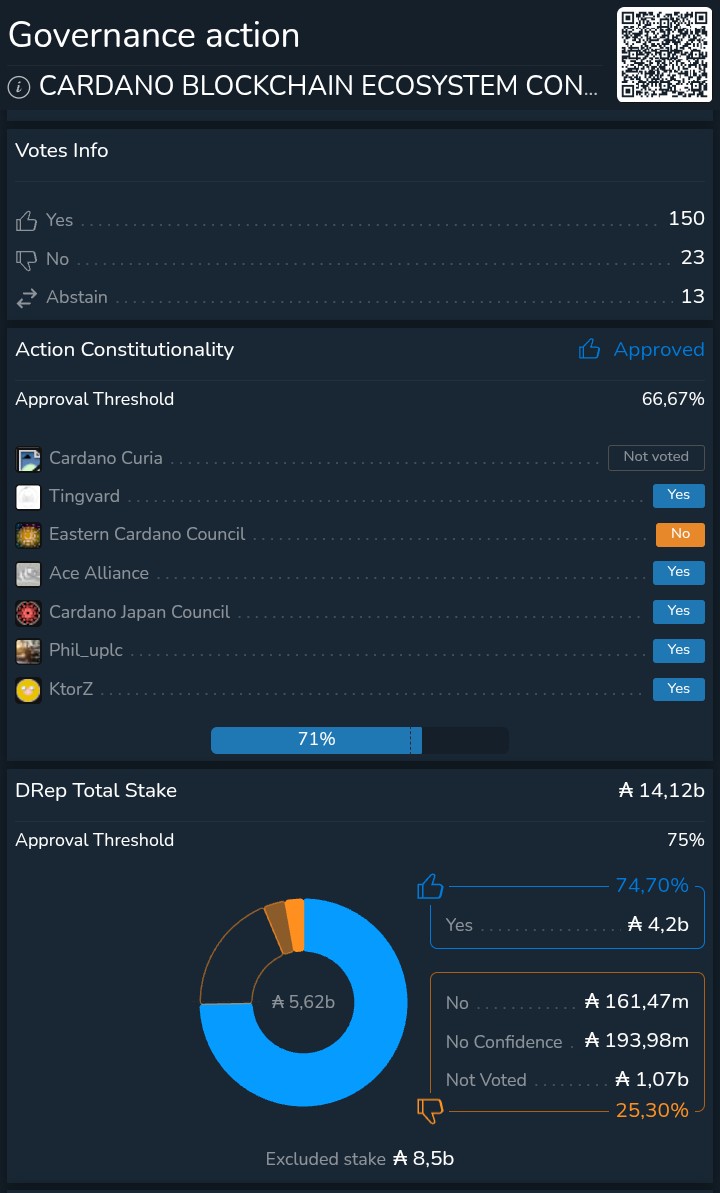
Quick question for voting dReps & CC members on Cardano Blockchain Ecosystem Constitution v2.4: Did you have time to review the full proposed text and check additions/removals against the previous version ? If you think this question matters, please VOTE on the poll 👆🏻 & SHARE for reach! adastat.net/governances/91… #Cardano
Rodrigo P₳cini | Agora Research | dRep tweet media
English
0
3
4
145
Manifesto Cardano Brasil retweetledi
Rodrigo P₳cini | Agora Research | dRep
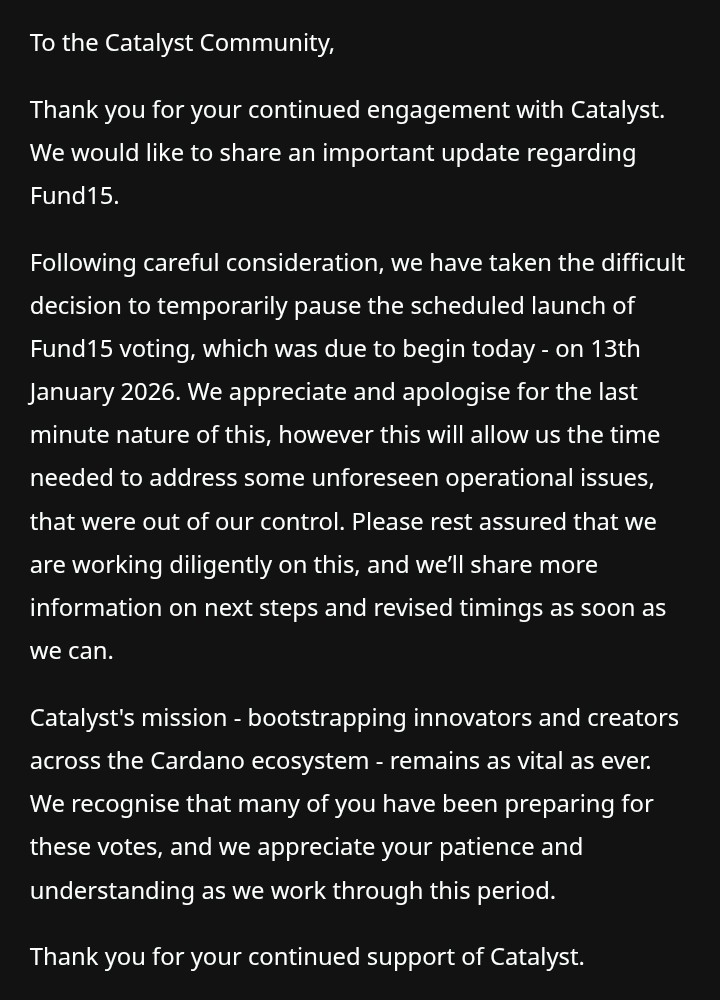
🚨ATTENTION! The start of voting stage for Fund15 has been postponed; more details in the text below written by the Catalyst team. projectcatalyst.io/blog/update-on…
Rodrigo P₳cini | Agora Research | dRep tweet media
Rodrigo P₳cini | Agora Research | dRep@RodrigoPacini

🚨#ProjectCatalyst Fund 15 voting will start SOON! 🔥My proposals to foster critical thinking, decentralization & accountability for better decision-making If you’d like to know more, keep reading 👇 🧠 Proof of work / credibility This work builds on years of hands-on participation in Project Catalyst since Fund 2, including roles that directly touch decision quality and accountability (proposer work, veteran community reviewing, moderation, milestone review processes, and mentorship). Governance-related work has also been produced and shared publicly in structured formats. 🗳️ My Proposals in Fund 15 1⃣ Agora Research Bureau – Voltaire 🔗catalystexplorer.com/en/proposals/a… 📌Deep dive reviews of Governance Actions & off-chain voting, this Bureau delivers structured, public & bilingual (PT/EN) reports. By standardizing how governance is analyzed and communicated, it raises transparency, strengthens accountability, and helps Cardano governance grow on solid foundations. 📊 Community Reviewers Score – 4.0/5.0 2⃣ Project Catalyst dRep Analysis Framework 🔗catalystexplorer.com/en/proposals/p… 📌A practical framework for dReps to filter, analyze & share rationales with clarity and consistency. It systematizes pilot lessons, decentralizes influence away from whales, and reduces voter fatigue. Empowering delegators and dReps alike with transparent, replicable, and accessible methodology. 📊 Community Reviewers Score – 4.1/5.0 ⭐ My proposals were endorsed by Nicolas Cerny, Governance Lead at the Cardano Foundation, under his “Governance Lens” review in Fund 14 — and they remain essentially the same in scope. More details below 👇 🔗 forum.cardano.org/t/fund-14-asse… That endorsement was part of the Catalyst Representatives Pilot Program initiated by Cardano Foundation / Cardano. Within the same initiative, I also curated and endorsed 22 Fund 14 proposals on Distributed Decision Making — a pro bono proof-of-concept aligned with the Project Catalyst dRep Analysis Framework proposal scope. 📌 Full list & methodology: 🔗 forum.cardano.org/t/distributed-… Both proposals were designed to address critical gaps in the Cardano ecosystem that remain underexplored and unresolved, such as: 🔴Tackle the scarcity of structured review frameworks by publishing clear, reproducible methodologies for Governance Actions and Catalyst proposals. 🔴 Mitigate hype-driven voting asymmetry by surfacing high-quality proposals that lack reach, using merit-based curation and standardized comparisons. 🔴 Mitigate language-access barriers by publishing consistent multilingual governance content that enables broader participation beyond English-speaking circles. Together, these initiatives strengthen transparency, accountability, decentralization, and education, ensuring that Cardano’s governance grows on a stronger, more inclusive foundation. Which proposal resonates with you the most? 💬 Your FEEDBACK & VOTE matters. Let’s build stronger governance together! Drop your thoughts below 👇

English
1
2
8
257
Manifesto Cardano Brasil retweetledi
Agora | Cardano
Agora | Cardano@AgoraCardano·
🧵 [1/7] Votamos. E aqui está o porquê. @AgoraCardano analisou a seguinte Governance Action: 📌Cardano 2030: Vision, Mission, Strategy Framework and KPIs 🗳️Voto: 🔴Não Segue o fio com os principais aspectos da nossa decisão 👇 #Cardano
Agora | Cardano tweet media
Português
2
3
4
180
Manifesto Cardano Brasil retweetledi
Rodrigo P₳cini | Agora Research | dRep
🚨#ProjectCatalyst Fund 15 voting will start SOON! 🔥My proposals to foster critical thinking, decentralization & accountability for better decision-making If you’d like to know more, keep reading 👇 🧠 Proof of work / credibility This work builds on years of hands-on participation in Project Catalyst since Fund 2, including roles that directly touch decision quality and accountability (proposer work, veteran community reviewing, moderation, milestone review processes, and mentorship). Governance-related work has also been produced and shared publicly in structured formats. 🗳️ My Proposals in Fund 15 1⃣ Agora Research Bureau – Voltaire 🔗catalystexplorer.com/en/proposals/a… 📌Deep dive reviews of Governance Actions & off-chain voting, this Bureau delivers structured, public & bilingual (PT/EN) reports. By standardizing how governance is analyzed and communicated, it raises transparency, strengthens accountability, and helps Cardano governance grow on solid foundations. 📊 Community Reviewers Score – 4.0/5.0 2⃣ Project Catalyst dRep Analysis Framework 🔗catalystexplorer.com/en/proposals/p… 📌A practical framework for dReps to filter, analyze & share rationales with clarity and consistency. It systematizes pilot lessons, decentralizes influence away from whales, and reduces voter fatigue. Empowering delegators and dReps alike with transparent, replicable, and accessible methodology. 📊 Community Reviewers Score – 4.1/5.0 ⭐ My proposals were endorsed by Nicolas Cerny, Governance Lead at the Cardano Foundation, under his “Governance Lens” review in Fund 14 — and they remain essentially the same in scope. More details below 👇 🔗 forum.cardano.org/t/fund-14-asse… That endorsement was part of the Catalyst Representatives Pilot Program initiated by Cardano Foundation / Cardano. Within the same initiative, I also curated and endorsed 22 Fund 14 proposals on Distributed Decision Making — a pro bono proof-of-concept aligned with the Project Catalyst dRep Analysis Framework proposal scope. 📌 Full list & methodology: 🔗 forum.cardano.org/t/distributed-… Both proposals were designed to address critical gaps in the Cardano ecosystem that remain underexplored and unresolved, such as: 🔴Tackle the scarcity of structured review frameworks by publishing clear, reproducible methodologies for Governance Actions and Catalyst proposals. 🔴 Mitigate hype-driven voting asymmetry by surfacing high-quality proposals that lack reach, using merit-based curation and standardized comparisons. 🔴 Mitigate language-access barriers by publishing consistent multilingual governance content that enables broader participation beyond English-speaking circles. Together, these initiatives strengthen transparency, accountability, decentralization, and education, ensuring that Cardano’s governance grows on a stronger, more inclusive foundation. Which proposal resonates with you the most? 💬 Your FEEDBACK & VOTE matters. Let’s build stronger governance together! Drop your thoughts below 👇
English
1
4
12
757
Manifesto Cardano Brasil retweetledi
Rodrigo P₳cini | Agora Research | dRep
📉 #ProjectCatalyst expanded in size, but voter participation stagnated between F10 and F13, and even decreased in the last Fund. ✅More wallets & ✅ more proposals ⛔ Yet fewer votes. A system stuck under a rule that no longer scales, check it out 👇
GIF
Rodrigo P₳cini | Agora Research | dRep tweet media
Rodrigo P₳cini | Agora Research | dRep@RodrigoPacini

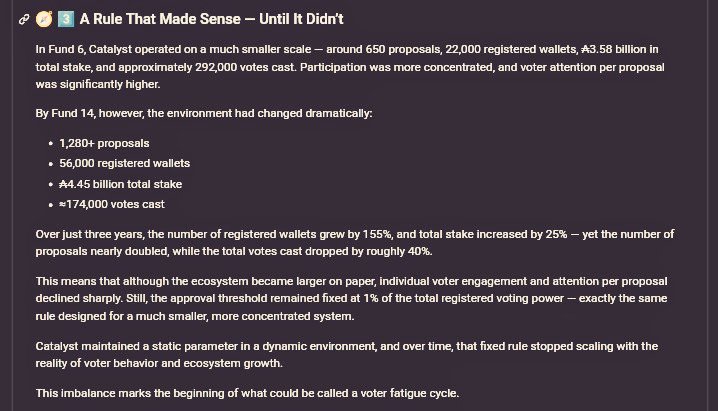
Grassroots projects are quietly dying under outdated #ProjectCatalyst rules that no longer fit innovation & independent builders who keep #Cardano alive Decision-making in Catalyst remains top-down, community has ideas, but no voice in the final call 🧩Let’s talk about why👇 Over my five years in Project Catalyst, I’ve seen too many talented contributors walk away, not because they lacked good ideas or a strong track record of contributions to the ecosystem, but because they felt unheard. Rules meant to promote fairness ended up discouraging those building from the ground up. We’re losing passionate builders who spend countless volunteer hours shaping proposals, joining Town Halls, reviewing, and voting — yet the system punishes them with rules that no longer make sense. Charles Hoskinson once emphasized that Cardano should avoid becoming a “cult of personalities,” ensuring governance remains decentralized and community-driven. Yet Catalyst’s current structure unintentionally rewards visibility over merit and diversity. Successful funded proposers absolutely deserve their recognition — but when marketing and outreach become the primary drivers of funding success, talented grassroots teams without massive outreach, wide networks and whales support are left behind. Fund14 made this painfully clear: dozens of ecosystem proposals with strong engagement were rejected because of one outdated threshold. Project Catalyst has been promoted for years — both officially and informally — as the world’s largest decentralized innovation fund. Yet that claim rings hollow when its core rules and parameters continue to be decided in a centralized manner. That’s not decentralization — that’s how innovation quietly dies in plain sight.💥 ✋🏻Now bear with me — I’ll break down the data behind this. The insights I found explain why these rules no longer fit Catalyst’s current scale, and why you should care if we want an ecosystem that stays open, fair, and alive for independent builders. 👇🏻 🧮 When Parameters Become Politics: The 1% Threshold Paradox in Project Catalyst ⚙️ 1️⃣ Why Parameters Matter in Blockchain Governance In blockchain systems, parameters aren’t just numbers — they’re politics written in code. Every rule, from block size to staking limits, defines how power flows. In Catalyst, one such rule — the 1% approval threshold — has silently decided which ideas live or die since Fund 6, without revision. ⚖️ 2️⃣ The Fixed Threshold Paradox The 1% threshold was introduced in Fund 6 by IOG Research and the Catalyst team, alongside a new voting and rewards model. It made sense at the time — a safeguard against proposals passing with too few votes. But as Catalyst scaled, that same rule became a bottleneck, mathematically misaligned with the system’s growth. Despite extensive review of Catalyst and IOG research outputs, no public documentation explains why 1% was chosen or how it was calibrated. A parameter that defines funding outcomes should have a transparent, traceable rationale — one open to community review. 🧭 3️⃣ A Rule That Made Sense — Until It Didn’t In Fund 6, Catalyst had - 🔹 650 proposals 🔹 22K wallets 🔹 ₳3.58B stake 🔹 292K votes cast. By Fund 14: 🔹 1,280 proposals 🔹 56K wallets 🔹 ₳4.45B stake 🔹 But only 174K votes cast. 🔹Wallets grew +155% & registered voting stake +25% ❗️Yet votes cast fell 40% Catalyst kept a static rule in a dynamic system — the 1% threshold — and it stopped scaling with reality. What began as legitimacy became exclusion. 📉 4️⃣ Statistical Evidence of Voter Fatigue Correlation analysis between proposal volume and approval rate across Funds 6–13 shows a strong negative trend: more proposals → fewer approvals. As categories grew, voter attention and approvals collapsed. What once filtered for merit now filters for visibility. ⚠️ 5️⃣ How the Fixed Threshold Warps Governance The 1% rule, once a quality filter, now distorts outcomes: Legitimate proposals fail despite engagement. Teams feel demotivated; results seem arbitrary. Participation declines as voters feel their impact fading. The shift to Quadratic Voting (QV) deepened the problem: voting power was compressed, yet the same threshold applied. A system demanding more precision from fewer signals. Fairness eroded, not improved. 🏛️ 6️⃣ Parameters and Centralized Adjustments Over time, Catalyst parameters have been altered internally — allocations, rewards, milestones, categories — often without community deliberation. Even the most decentralized innovation fund in the world can behave like a centralized system when parameter governance isn’t open. 🧮 7️⃣ The IOG–Photrek Alternative Voting Research Between 2024–2025, IOG Research and Photrek explored Quadratic and γ-Power Voting. They proved mathematically that f(x)=x^γ (0<γ<1) redistributes influence from large to small holders, built privacy-preserving protocols, and simulated fairer outcomes. But gaps remained — no identity layer, no modeling of fatigue, and unclear communication that left the community confused about which method would be used in Fund 14. 🧩 8️⃣ Why Fund 14 Failed When Catalyst delayed Fund 14 results mentioning “an outcome that just doesn’t make any sense for Cardano ecosystem” data already explained why. Low engagement, too many proposals, static threshold, and no identity layer — the perfect storm. The cubic formula compressed power, the threshold demanded absolutes — the two canceled each other out. A dynamic formula stacked on a static rule. 🧠 9️⃣ The Deeper Structural Issue Quadratic systems without identity are Sybil-prone. Meanwhile, the threshold from Fund 6 remained unchanged, ignoring the huge increase in proposals and stagnant engagement over the last Funds. 🧭 1️⃣0️⃣ A Potential Fix 🔹 Dynamic thresholds Let approval scale with system activity: Threshold = f(proposals, voters, votes cast) 🔹 Decentralized identity “One human, one voter” — using privacy-preserving DIDs to ensure fairness. 🔹 Delegated (dRep) voting Delegation amplifies participation without centralization, restoring density and fairness. 💡 1️⃣1️⃣ Lessons from the Failure Fund 14’s issue wasn’t a bug — it was parameter misalignment. A new voting curve was applied to an old social structure. Adaptive thresholds, identity, and transparent parameter governance should be the next steps. 🌐 1️⃣2️⃣ Toward Voltaire: Parameters as Public Policy Now in the Voltaire era, Catalyst parameters are public policy instruments, not technical constants. Changes to voting models, rewards, or thresholds must come with open documentation, discussion, and ideally, community ratification — on-chain or off-chain. 🙏 Acknowledgments & Author’s Note This analysis was made by @Agora_Cardano, using publicly available data, performed voluntarily and independently to foster discussion — not blame. The goal is fairness, transparency, and decentralization that scales with community growth. Catalyst, IOG Research, and the teams behind new voting models deserve recognition for pioneering this governance experiment. 🧭 Full version with data, methods & sources: 🔗 github.com/Agora-Cardano/…

English
0
3
15
499
Manifesto Cardano Brasil retweetledi
Rodrigo P₳cini | Agora Research | dRep
❓ Public question to @Catalyst_onX @krissbaird and @dannyribar 👉What will be the official vote-counting method in Fund 15 — Legacy (1 ADA = 1 vote) or Quadratic Voting(QV)? According to the official research produced by IOG Research team in collaboration with Photrek and the Catalyst Team, the implementation of Quadratic Voting (QV) — whether in its square-root, cubic-root, or generalized forms — inherently carries Sybil-attack risks. milestones.projectcatalyst.io/projects/11000… So why did Catalyst team decided to apply the QV model in Fund 14’s tally stage without any decentralized identity layer, or technical Sybil-resistance mechanisms such as wallet-splitting detection or identity proofs? If these same conditions are maintained for Fund 15, why insist on using a formula that is already known to be Sybil-prone by design — a risk described and acknowledged in the very research that Catalyst funded? During Fund 14, Sybil mitigation was handled not through technology or governance, but through timing. The snapshot timing was convenient to narrow the coordination window, preventing large wallets from fragmenting in time. But that was not a solution — only a temporary workaround, centralized and unsustainable. Now, the context is far riskier. Since the QV approach has been publicly known for weeks — and will have been known for months by the time Fund 15 voting begins — the probability of coordinated whale behavior and Sybil manipulation increases dramatically. What was once hidden by timing can no longer be hidden by secrecy. Therefore, I’m asking Catalyst to publicly clarify, with full transparency and documentation: 1️⃣ What will be the official vote-counting method in Fund 15 — Legacy (1 ADA = 1 vote) or Quadratic Voting(QV)? 2️⃣ Will any decentralized identity or Sybil-resistance mechanisms be implemented? 3️⃣ If not, why were the warnings and recommendations from IOG Research ignored or only partially applied? For years, Project Catalyst has been promoted — both officially and informally — as “the world’s largest decentralized innovation fund.” But decentralization isn’t a slogan. It requires transparency, community participation, and accountability — especially in governance parameters that decide which ideas live or die. The community deserves public answers. If these decisions remain centralized and opaque, Fund 15 risks repeating the same mistakes that broke Fund 14 tallying outcome.
Rodrigo P₳cini | Agora Research | dRep@RodrigoPacini

Grassroots projects are quietly dying under outdated #ProjectCatalyst rules that no longer fit innovation & independent builders who keep #Cardano alive Decision-making in Catalyst remains top-down, community has ideas, but no voice in the final call 🧩Let’s talk about why👇 Over my five years in Project Catalyst, I’ve seen too many talented contributors walk away, not because they lacked good ideas or a strong track record of contributions to the ecosystem, but because they felt unheard. Rules meant to promote fairness ended up discouraging those building from the ground up. We’re losing passionate builders who spend countless volunteer hours shaping proposals, joining Town Halls, reviewing, and voting — yet the system punishes them with rules that no longer make sense. Charles Hoskinson once emphasized that Cardano should avoid becoming a “cult of personalities,” ensuring governance remains decentralized and community-driven. Yet Catalyst’s current structure unintentionally rewards visibility over merit and diversity. Successful funded proposers absolutely deserve their recognition — but when marketing and outreach become the primary drivers of funding success, talented grassroots teams without massive outreach, wide networks and whales support are left behind. Fund14 made this painfully clear: dozens of ecosystem proposals with strong engagement were rejected because of one outdated threshold. Project Catalyst has been promoted for years — both officially and informally — as the world’s largest decentralized innovation fund. Yet that claim rings hollow when its core rules and parameters continue to be decided in a centralized manner. That’s not decentralization — that’s how innovation quietly dies in plain sight.💥 ✋🏻Now bear with me — I’ll break down the data behind this. The insights I found explain why these rules no longer fit Catalyst’s current scale, and why you should care if we want an ecosystem that stays open, fair, and alive for independent builders. 👇🏻 🧮 When Parameters Become Politics: The 1% Threshold Paradox in Project Catalyst ⚙️ 1️⃣ Why Parameters Matter in Blockchain Governance In blockchain systems, parameters aren’t just numbers — they’re politics written in code. Every rule, from block size to staking limits, defines how power flows. In Catalyst, one such rule — the 1% approval threshold — has silently decided which ideas live or die since Fund 6, without revision. ⚖️ 2️⃣ The Fixed Threshold Paradox The 1% threshold was introduced in Fund 6 by IOG Research and the Catalyst team, alongside a new voting and rewards model. It made sense at the time — a safeguard against proposals passing with too few votes. But as Catalyst scaled, that same rule became a bottleneck, mathematically misaligned with the system’s growth. Despite extensive review of Catalyst and IOG research outputs, no public documentation explains why 1% was chosen or how it was calibrated. A parameter that defines funding outcomes should have a transparent, traceable rationale — one open to community review. 🧭 3️⃣ A Rule That Made Sense — Until It Didn’t In Fund 6, Catalyst had - 🔹 650 proposals 🔹 22K wallets 🔹 ₳3.58B stake 🔹 292K votes cast. By Fund 14: 🔹 1,280 proposals 🔹 56K wallets 🔹 ₳4.45B stake 🔹 But only 174K votes cast. 🔹Wallets grew +155% & registered voting stake +25% ❗️Yet votes cast fell 40% Catalyst kept a static rule in a dynamic system — the 1% threshold — and it stopped scaling with reality. What began as legitimacy became exclusion. 📉 4️⃣ Statistical Evidence of Voter Fatigue Correlation analysis between proposal volume and approval rate across Funds 6–13 shows a strong negative trend: more proposals → fewer approvals. As categories grew, voter attention and approvals collapsed. What once filtered for merit now filters for visibility. ⚠️ 5️⃣ How the Fixed Threshold Warps Governance The 1% rule, once a quality filter, now distorts outcomes: Legitimate proposals fail despite engagement. Teams feel demotivated; results seem arbitrary. Participation declines as voters feel their impact fading. The shift to Quadratic Voting (QV) deepened the problem: voting power was compressed, yet the same threshold applied. A system demanding more precision from fewer signals. Fairness eroded, not improved. 🏛️ 6️⃣ Parameters and Centralized Adjustments Over time, Catalyst parameters have been altered internally — allocations, rewards, milestones, categories — often without community deliberation. Even the most decentralized innovation fund in the world can behave like a centralized system when parameter governance isn’t open. 🧮 7️⃣ The IOG–Photrek Alternative Voting Research Between 2024–2025, IOG Research and Photrek explored Quadratic and γ-Power Voting. They proved mathematically that f(x)=x^γ (0<γ<1) redistributes influence from large to small holders, built privacy-preserving protocols, and simulated fairer outcomes. But gaps remained — no identity layer, no modeling of fatigue, and unclear communication that left the community confused about which method would be used in Fund 14. 🧩 8️⃣ Why Fund 14 Failed When Catalyst delayed Fund 14 results mentioning “an outcome that just doesn’t make any sense for Cardano ecosystem” data already explained why. Low engagement, too many proposals, static threshold, and no identity layer — the perfect storm. The cubic formula compressed power, the threshold demanded absolutes — the two canceled each other out. A dynamic formula stacked on a static rule. 🧠 9️⃣ The Deeper Structural Issue Quadratic systems without identity are Sybil-prone. Meanwhile, the threshold from Fund 6 remained unchanged, ignoring the huge increase in proposals and stagnant engagement over the last Funds. 🧭 1️⃣0️⃣ A Potential Fix 🔹 Dynamic thresholds Let approval scale with system activity: Threshold = f(proposals, voters, votes cast) 🔹 Decentralized identity “One human, one voter” — using privacy-preserving DIDs to ensure fairness. 🔹 Delegated (dRep) voting Delegation amplifies participation without centralization, restoring density and fairness. 💡 1️⃣1️⃣ Lessons from the Failure Fund 14’s issue wasn’t a bug — it was parameter misalignment. A new voting curve was applied to an old social structure. Adaptive thresholds, identity, and transparent parameter governance should be the next steps. 🌐 1️⃣2️⃣ Toward Voltaire: Parameters as Public Policy Now in the Voltaire era, Catalyst parameters are public policy instruments, not technical constants. Changes to voting models, rewards, or thresholds must come with open documentation, discussion, and ideally, community ratification — on-chain or off-chain. 🙏 Acknowledgments & Author’s Note This analysis was made by @Agora_Cardano, using publicly available data, performed voluntarily and independently to foster discussion — not blame. The goal is fairness, transparency, and decentralization that scales with community growth. Catalyst, IOG Research, and the teams behind new voting models deserve recognition for pioneering this governance experiment. 🧭 Full version with data, methods & sources: 🔗 github.com/Agora-Cardano/…

English
1
7
16
1.2K
Manifesto Cardano Brasil retweetledi
Spentron
Spentron@SpentronSpence·
When Grants become Crutches, The Catalyst Funding Problem. @minted.venture/when-grants-become-crutches-the-catalyst-funding-problem-394e00121cd2" target="_blank" rel="nofollow noopener">medium.com/@minted.ventur…
English
2
4
38
1.3K
Manifesto Cardano Brasil retweetledi
Phil Lewis
Phil Lewis@phillewisit·
Hey @Catalyst_onX Team It would seem there is quite a lot of discussion atm about whether Catalyst funding is being effective in launching new initiatives on #Cardano given the amount of funds going to established projects. I appreciate that you are experimenting with voting approaches, however there may be some simpler changes that could be introduced to help mitigate against this. One approach could be to tighten the eligibility criteria for certain categories, such as Concept or Ecosystem. This could include things like excluding teams who have already received more than a certain amount, or who have launched a token (something that implies a more progressed stage). Either way, it sounds like a community discussion may be needed.
GIF
English
4
10
31
1.6K
Manifesto Cardano Brasil retweetledi
QU△Z△R
QU△Z△R@QuasarSure·
Roots won't grow in bad soil
Rodrigo P₳cini | Agora Research | dRep@RodrigoPacini

Grassroots projects are quietly dying under outdated #ProjectCatalyst rules that no longer fit innovation & independent builders who keep #Cardano alive Decision-making in Catalyst remains top-down, community has ideas, but no voice in the final call 🧩Let’s talk about why👇 Over my five years in Project Catalyst, I’ve seen too many talented contributors walk away, not because they lacked good ideas or a strong track record of contributions to the ecosystem, but because they felt unheard. Rules meant to promote fairness ended up discouraging those building from the ground up. We’re losing passionate builders who spend countless volunteer hours shaping proposals, joining Town Halls, reviewing, and voting — yet the system punishes them with rules that no longer make sense. Charles Hoskinson once emphasized that Cardano should avoid becoming a “cult of personalities,” ensuring governance remains decentralized and community-driven. Yet Catalyst’s current structure unintentionally rewards visibility over merit and diversity. Successful funded proposers absolutely deserve their recognition — but when marketing and outreach become the primary drivers of funding success, talented grassroots teams without massive outreach, wide networks and whales support are left behind. Fund14 made this painfully clear: dozens of ecosystem proposals with strong engagement were rejected because of one outdated threshold. Project Catalyst has been promoted for years — both officially and informally — as the world’s largest decentralized innovation fund. Yet that claim rings hollow when its core rules and parameters continue to be decided in a centralized manner. That’s not decentralization — that’s how innovation quietly dies in plain sight.💥 ✋🏻Now bear with me — I’ll break down the data behind this. The insights I found explain why these rules no longer fit Catalyst’s current scale, and why you should care if we want an ecosystem that stays open, fair, and alive for independent builders. 👇🏻 🧮 When Parameters Become Politics: The 1% Threshold Paradox in Project Catalyst ⚙️ 1️⃣ Why Parameters Matter in Blockchain Governance In blockchain systems, parameters aren’t just numbers — they’re politics written in code. Every rule, from block size to staking limits, defines how power flows. In Catalyst, one such rule — the 1% approval threshold — has silently decided which ideas live or die since Fund 6, without revision. ⚖️ 2️⃣ The Fixed Threshold Paradox The 1% threshold was introduced in Fund 6 by IOG Research and the Catalyst team, alongside a new voting and rewards model. It made sense at the time — a safeguard against proposals passing with too few votes. But as Catalyst scaled, that same rule became a bottleneck, mathematically misaligned with the system’s growth. Despite extensive review of Catalyst and IOG research outputs, no public documentation explains why 1% was chosen or how it was calibrated. A parameter that defines funding outcomes should have a transparent, traceable rationale — one open to community review. 🧭 3️⃣ A Rule That Made Sense — Until It Didn’t In Fund 6, Catalyst had - 🔹 650 proposals 🔹 22K wallets 🔹 ₳3.58B stake 🔹 292K votes cast. By Fund 14: 🔹 1,280 proposals 🔹 56K wallets 🔹 ₳4.45B stake 🔹 But only 174K votes cast. 🔹Wallets grew +155% & registered voting stake +25% ❗️Yet votes cast fell 40% Catalyst kept a static rule in a dynamic system — the 1% threshold — and it stopped scaling with reality. What began as legitimacy became exclusion. 📉 4️⃣ Statistical Evidence of Voter Fatigue Correlation analysis between proposal volume and approval rate across Funds 6–13 shows a strong negative trend: more proposals → fewer approvals. As categories grew, voter attention and approvals collapsed. What once filtered for merit now filters for visibility. ⚠️ 5️⃣ How the Fixed Threshold Warps Governance The 1% rule, once a quality filter, now distorts outcomes: Legitimate proposals fail despite engagement. Teams feel demotivated; results seem arbitrary. Participation declines as voters feel their impact fading. The shift to Quadratic Voting (QV) deepened the problem: voting power was compressed, yet the same threshold applied. A system demanding more precision from fewer signals. Fairness eroded, not improved. 🏛️ 6️⃣ Parameters and Centralized Adjustments Over time, Catalyst parameters have been altered internally — allocations, rewards, milestones, categories — often without community deliberation. Even the most decentralized innovation fund in the world can behave like a centralized system when parameter governance isn’t open. 🧮 7️⃣ The IOG–Photrek Alternative Voting Research Between 2024–2025, IOG Research and Photrek explored Quadratic and γ-Power Voting. They proved mathematically that f(x)=x^γ (0<γ<1) redistributes influence from large to small holders, built privacy-preserving protocols, and simulated fairer outcomes. But gaps remained — no identity layer, no modeling of fatigue, and unclear communication that left the community confused about which method would be used in Fund 14. 🧩 8️⃣ Why Fund 14 Failed When Catalyst delayed Fund 14 results mentioning “an outcome that just doesn’t make any sense for Cardano ecosystem” data already explained why. Low engagement, too many proposals, static threshold, and no identity layer — the perfect storm. The cubic formula compressed power, the threshold demanded absolutes — the two canceled each other out. A dynamic formula stacked on a static rule. 🧠 9️⃣ The Deeper Structural Issue Quadratic systems without identity are Sybil-prone. Meanwhile, the threshold from Fund 6 remained unchanged, ignoring the huge increase in proposals and stagnant engagement over the last Funds. 🧭 1️⃣0️⃣ A Potential Fix 🔹 Dynamic thresholds Let approval scale with system activity: Threshold = f(proposals, voters, votes cast) 🔹 Decentralized identity “One human, one voter” — using privacy-preserving DIDs to ensure fairness. 🔹 Delegated (dRep) voting Delegation amplifies participation without centralization, restoring density and fairness. 💡 1️⃣1️⃣ Lessons from the Failure Fund 14’s issue wasn’t a bug — it was parameter misalignment. A new voting curve was applied to an old social structure. Adaptive thresholds, identity, and transparent parameter governance should be the next steps. 🌐 1️⃣2️⃣ Toward Voltaire: Parameters as Public Policy Now in the Voltaire era, Catalyst parameters are public policy instruments, not technical constants. Changes to voting models, rewards, or thresholds must come with open documentation, discussion, and ideally, community ratification — on-chain or off-chain. 🙏 Acknowledgments & Author’s Note This analysis was made by @Agora_Cardano, using publicly available data, performed voluntarily and independently to foster discussion — not blame. The goal is fairness, transparency, and decentralization that scales with community growth. Catalyst, IOG Research, and the teams behind new voting models deserve recognition for pioneering this governance experiment. 🧭 Full version with data, methods & sources: 🔗 github.com/Agora-Cardano/…

English
1
5
7
349
Manifesto Cardano Brasil retweetledi
Rodrigo P₳cini | Agora Research | dRep
🧠 Voter fatigue on #ProjectCatalyst is real. As proposal volume grows, approval rates collapse — attention is finite, and the system shows it. 📉 Data doesn’t lie. Check it out why👇 #Cardano
Rodrigo P₳cini | Agora Research | dRep tweet media
GIF
Rodrigo P₳cini | Agora Research | dRep@RodrigoPacini

Grassroots projects are quietly dying under outdated #ProjectCatalyst rules that no longer fit innovation & independent builders who keep #Cardano alive Decision-making in Catalyst remains top-down, community has ideas, but no voice in the final call 🧩Let’s talk about why👇 Over my five years in Project Catalyst, I’ve seen too many talented contributors walk away, not because they lacked good ideas or a strong track record of contributions to the ecosystem, but because they felt unheard. Rules meant to promote fairness ended up discouraging those building from the ground up. We’re losing passionate builders who spend countless volunteer hours shaping proposals, joining Town Halls, reviewing, and voting — yet the system punishes them with rules that no longer make sense. Charles Hoskinson once emphasized that Cardano should avoid becoming a “cult of personalities,” ensuring governance remains decentralized and community-driven. Yet Catalyst’s current structure unintentionally rewards visibility over merit and diversity. Successful funded proposers absolutely deserve their recognition — but when marketing and outreach become the primary drivers of funding success, talented grassroots teams without massive outreach, wide networks and whales support are left behind. Fund14 made this painfully clear: dozens of ecosystem proposals with strong engagement were rejected because of one outdated threshold. Project Catalyst has been promoted for years — both officially and informally — as the world’s largest decentralized innovation fund. Yet that claim rings hollow when its core rules and parameters continue to be decided in a centralized manner. That’s not decentralization — that’s how innovation quietly dies in plain sight.💥 ✋🏻Now bear with me — I’ll break down the data behind this. The insights I found explain why these rules no longer fit Catalyst’s current scale, and why you should care if we want an ecosystem that stays open, fair, and alive for independent builders. 👇🏻 🧮 When Parameters Become Politics: The 1% Threshold Paradox in Project Catalyst ⚙️ 1️⃣ Why Parameters Matter in Blockchain Governance In blockchain systems, parameters aren’t just numbers — they’re politics written in code. Every rule, from block size to staking limits, defines how power flows. In Catalyst, one such rule — the 1% approval threshold — has silently decided which ideas live or die since Fund 6, without revision. ⚖️ 2️⃣ The Fixed Threshold Paradox The 1% threshold was introduced in Fund 6 by IOG Research and the Catalyst team, alongside a new voting and rewards model. It made sense at the time — a safeguard against proposals passing with too few votes. But as Catalyst scaled, that same rule became a bottleneck, mathematically misaligned with the system’s growth. Despite extensive review of Catalyst and IOG research outputs, no public documentation explains why 1% was chosen or how it was calibrated. A parameter that defines funding outcomes should have a transparent, traceable rationale — one open to community review. 🧭 3️⃣ A Rule That Made Sense — Until It Didn’t In Fund 6, Catalyst had - 🔹 650 proposals 🔹 22K wallets 🔹 ₳3.58B stake 🔹 292K votes cast. By Fund 14: 🔹 1,280 proposals 🔹 56K wallets 🔹 ₳4.45B stake 🔹 But only 174K votes cast. 🔹Wallets grew +155% & registered voting stake +25% ❗️Yet votes cast fell 40% Catalyst kept a static rule in a dynamic system — the 1% threshold — and it stopped scaling with reality. What began as legitimacy became exclusion. 📉 4️⃣ Statistical Evidence of Voter Fatigue Correlation analysis between proposal volume and approval rate across Funds 6–13 shows a strong negative trend: more proposals → fewer approvals. As categories grew, voter attention and approvals collapsed. What once filtered for merit now filters for visibility. ⚠️ 5️⃣ How the Fixed Threshold Warps Governance The 1% rule, once a quality filter, now distorts outcomes: Legitimate proposals fail despite engagement. Teams feel demotivated; results seem arbitrary. Participation declines as voters feel their impact fading. The shift to Quadratic Voting (QV) deepened the problem: voting power was compressed, yet the same threshold applied. A system demanding more precision from fewer signals. Fairness eroded, not improved. 🏛️ 6️⃣ Parameters and Centralized Adjustments Over time, Catalyst parameters have been altered internally — allocations, rewards, milestones, categories — often without community deliberation. Even the most decentralized innovation fund in the world can behave like a centralized system when parameter governance isn’t open. 🧮 7️⃣ The IOG–Photrek Alternative Voting Research Between 2024–2025, IOG Research and Photrek explored Quadratic and γ-Power Voting. They proved mathematically that f(x)=x^γ (0<γ<1) redistributes influence from large to small holders, built privacy-preserving protocols, and simulated fairer outcomes. But gaps remained — no identity layer, no modeling of fatigue, and unclear communication that left the community confused about which method would be used in Fund 14. 🧩 8️⃣ Why Fund 14 Failed When Catalyst delayed Fund 14 results mentioning “an outcome that just doesn’t make any sense for Cardano ecosystem” data already explained why. Low engagement, too many proposals, static threshold, and no identity layer — the perfect storm. The cubic formula compressed power, the threshold demanded absolutes — the two canceled each other out. A dynamic formula stacked on a static rule. 🧠 9️⃣ The Deeper Structural Issue Quadratic systems without identity are Sybil-prone. Meanwhile, the threshold from Fund 6 remained unchanged, ignoring the huge increase in proposals and stagnant engagement over the last Funds. 🧭 1️⃣0️⃣ A Potential Fix 🔹 Dynamic thresholds Let approval scale with system activity: Threshold = f(proposals, voters, votes cast) 🔹 Decentralized identity “One human, one voter” — using privacy-preserving DIDs to ensure fairness. 🔹 Delegated (dRep) voting Delegation amplifies participation without centralization, restoring density and fairness. 💡 1️⃣1️⃣ Lessons from the Failure Fund 14’s issue wasn’t a bug — it was parameter misalignment. A new voting curve was applied to an old social structure. Adaptive thresholds, identity, and transparent parameter governance should be the next steps. 🌐 1️⃣2️⃣ Toward Voltaire: Parameters as Public Policy Now in the Voltaire era, Catalyst parameters are public policy instruments, not technical constants. Changes to voting models, rewards, or thresholds must come with open documentation, discussion, and ideally, community ratification — on-chain or off-chain. 🙏 Acknowledgments & Author’s Note This analysis was made by @Agora_Cardano, using publicly available data, performed voluntarily and independently to foster discussion — not blame. The goal is fairness, transparency, and decentralization that scales with community growth. Catalyst, IOG Research, and the teams behind new voting models deserve recognition for pioneering this governance experiment. 🧭 Full version with data, methods & sources: 🔗 github.com/Agora-Cardano/…

English
1
7
18
932
Manifesto Cardano Brasil retweetledi
Project Catalyst
Project Catalyst@Catalyst_onX·
🚨Fund14 Results Update Fund14 was another giant leap ⏩ Sometimes experiments don’t go as planned, we’re adapting to keep things fair, trusted and transparent.  F14 Voting itself worked really well The final tallying step in the process, introducing the quadratic formula, produced an outcome that just doesn't make any sense for Cardano right now. 📺 @krissbaird explains everything on the video below Thank you to everyone who voted 💙Catalyst only works because you do 🐈‍⬛
English
50
47
223
40.4K