Drew Alexander

8.1K posts

Drew Alexander banner
Drew Alexander

Drew Alexander

@DTedifies

29. Son. Husband. Father. Servant of Jesus. 8th Grade ELA Teacher. Fatherhood Program Coordinator. Science of Reading Advocate. Mentor. Coffee Enthusiast.

New Jerusalem Katılım Kasım 2021
1.2K Takip Edilen1.2K Takipçiler
Joe Finch, M.S. Ed.
Joe Finch, M.S. Ed.@MrJFinch·
Ss were complaining that the sentence combining was boring, so to day I modified it. They had to choose and justify their choice.
Joe Finch, M.S. Ed. tweet media
English
11
7
67
5.4K
Drew Alexander retweetledi
Doug Lemov
Doug Lemov@Doug_Lemov·
There are seven key themes Colleen Driggs, Erica Woolway and I write about in our new book, The Teach Like a Champion Guide to the Science of Reading: 1) The fracturing of student attention (and how to implement attention-reinforcing low tech; high text classrooms). 2) The importance of fluency to comprehension, the hidden epidemic of dysfleuncy, especially in older grades (and what to do about it). 3) The importance of background knowledge to understanding in reading (and how to design lessons to be more knowledge rich). 4) The centrality of vocabulary to a knowledge rich classroom (and how to teach vocabulary more effectively). 5) The synergy between intentional writing activities and better reading (and how to understand different types and purposes of writing, especially short, mid-stream writing). 6) The necessity of reading whole books, great ones, together as a class (and why the science clearly supports this). 7) The importance of close reading (and how putting complex passages in a cognitively privileged environment can help students learn to read “above their comfort zone”). Many of these topics are on the top of people’s minds right now and if that includes you, the book will help you think about how to teach and design lesson materials accordingly. It’s full of videos of real classrooms and samples from our own curriculum. amazon.com/Teach-Champion…
English
2
12
40
3.1K
Drew Alexander retweetledi
Bob Woodson
Bob Woodson@BobWoodson·
The Woodson Center Mourns the Passing of Founder and President Robert L. Woodson, Sr. - A visionary leader whose life's work transformed communities from the inside out. Read the full statement here: woodsoncenter.org/news-and-media…
Bob Woodson tweet media
English
828
1.3K
5K
316.1K
Drew Alexander
Drew Alexander@DTedifies·
Induction ceremony today and clearing my credential. Thank you Jesus. Shout out to coffee and cognitive load theory!
English
0
0
0
33
Drew Alexander retweetledi
Tom Bennett OBE
Tom Bennett OBE@tombennett71·
‘Teaching students how to use smartphones responsibly’ as an alternative to banning them in school, sounds reasonable, but isn’t. We don’t teach them how drink sensibly by surrounding them with booze in classes. We prohibit things that are distracting or attractive because it damages their social skills, reduces concentration, and presents a safeguarding nightmare. We protect children. We teach them to not be online constantly, or be in a permanent state of being online soon. There are no risks here, only benefits. Equity can’t be rolled out every time you want to justify your hobbyhorse. I could make an argument that equity is better served by phone bans. The idea that allowing phone usage will reduce cyberbullying more than literally banning phones, is certainly a bold move, but not a sane one. And ‘scrolling through Instagram’ and ‘sharing TikTok short videos about gunge challenges’ are not workforce skills. We don’t need smartphones to teach literature, art, sport, science. We did just fine for centuries without. There is no evidence that they help. Cellphones are the Monkey’s Paw of education. You think it’s granting your wish but be careful what you wish for. Ban these things twice from schools.
Tom Bennett OBE tweet media
English
17
47
181
16.3K
Drew Alexander retweetledi
Fixing Education
Fixing Education@FixingEducation·
Yes, teaching can suck, but… • 50M people are fighting cancer • 80M people can’t walk • 300M people can’t see colors • 55M people can’t remember memories • 430M people can’t hear • 173,000 people don’t wake up this morning Our ordinary is someone’s dream. #Grateful
English
7
12
145
6.9K
Drew Alexander retweetledi
Carl Hendrick
Carl Hendrick@C_Hendrick·
English reading comprehension apps are often poor because they inherit a flawed model of reading: the idea that comprehension can be taught and assessed through generic skills descriptors such as “find the main idea”, “identify key details”, or “make an inference" etc What that kind of architecture forces is a particular kind of item like this. A generic skill must, by definition, be assessable on any text whatever which means the only operation that generalises is one that does not depend on understanding the specific passage.
Carl Hendrick tweet media
English
16
15
97
21.7K
Sean Morrisey
Sean Morrisey@smorrisey·
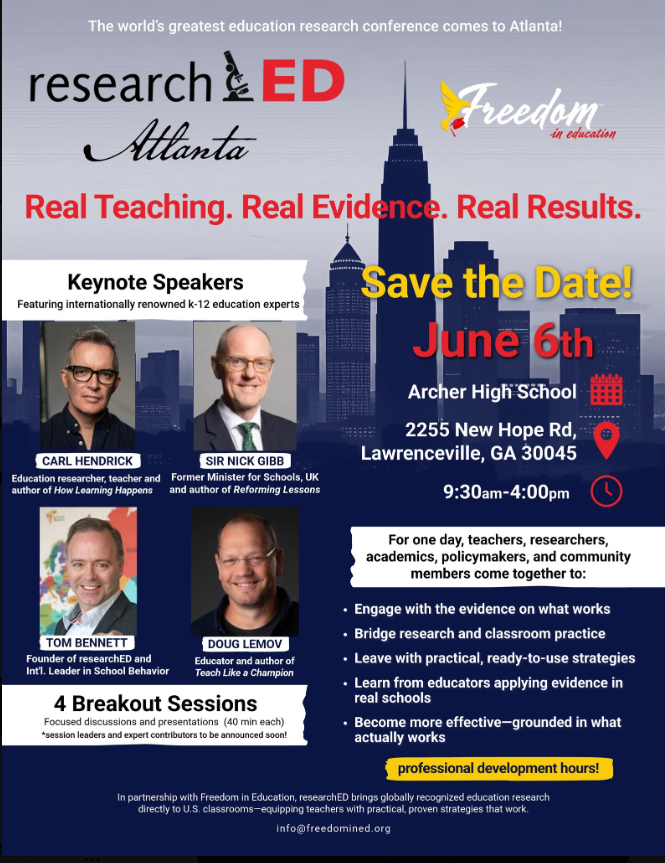
I will be in Atlanta and Houston next month presenting at ResearchEd! My breakout sessions will revolve around vocabulary instruction.
Sean Morrisey tweet mediaSean Morrisey tweet media
English
2
9
47
2.2K
Zach Groshell
Zach Groshell@MrZachG·
Registration is now open for the Explicit Teaching Institute NYC 2026! Join me in New York City for 5 days of deep dives into the science of learning, explicit instruction, video study, and deliberate practice. No fluff. Just better teaching. 🎟️ educationrickshaw.com/2026/05/15/boo…
English
2
9
26
2.7K
Drew Alexander retweetledi
Vince Boley
Vince Boley@VinceBoley·
"Teaching whole books effectively means cultivating 'cognitive persistence' in ways that are becoming increasingly rare in our fragmented digital culture." Latest from @rpondiscio is gold. open.substack.com/pub/thenext30y…
English
2
3
15
707
Drew Alexander retweetledi
beanie0597_2.0
beanie0597_2.0@0Beanie05923291·
“Whole books matter not merely because they are long, but because they allow students to inhabit another consciousness deeply enough to encounter enduring questions about human life and moral values.”
Robert Pondiscio@rpondiscio

A new report suggests panic over whole books disappearing from classroom and ELA curriculum is overblown. The bigger issue may be standardized tests, which have quietly undermined the deeper habits of reading that matter most. thenext30years.substack.com/p/books-arent-…"

English
4
15
71
4.7K
Drew Alexander retweetledi
North Landesman
North Landesman@MrLandesman·
Bad teacher questions are either too easy, too difficult, or off topic. From Power Up Your Questioning
North Landesman tweet media
English
5
8
53
4.6K
Drew Alexander retweetledi
Dissident Teacher
Dissident Teacher@educatedandfree·
Whenever I tell people I have students take notes on reading, I get the “You’re stealing the joy of reading!” response. While I’m sympathetic, this attitude is a big part of the reason at-risk kids never improve much as readers. The fact that teachers have been trying to vibe code reading instruction since the 70s is a huge contributor to the absolute state of literacy in America today. Mass schooling creates huge trade offs. You don’t get free daycare and—hopefully—some learning, without major costs. In the age of ai, you can’t just say, “read 30 pages at home” and believe the teacher can assess individual student understanding on vibes. A 45-minute class doesn’t allow for a full check-in with every kid. You have to hold students accountable for reading consistently and assess them frequently over time. This improves their overall reading comprehension, especially when the CLASS discusses the novel instead of the teacher just telling the kids what happens because most of them didn’t read. If you care about every kid in your class learning and not just the ones from the most engaged families, you can’t just hope they read because making them take notes feels like work. You still won’t succeed with 100% of the students. You’ll be lucky to get to half at first, but as the kids see what you’re doing, and see how it invites them, PERSONALLY, further into the text regardless of comprehension level, they start to try a little harder. If you love what you’re reading with them, more will join and they’ll get more out of the reading because they have multiple touch points (reading, notes, review of notes, discussion, summary or argument questions they write about). They also learn to read deeply instead of just for enjoyment which helps them get through significantly harder texts in later years that aren’t immediately rewarding but have great value.
Ivana Krumi@IvanaKrumi

@RivendellM52270 @educatedandfree @b_fink Completely agree. At home, we just read. And maybe talk about it a little. All this stuff kills the joy of reading

English
5
6
50
4.2K
Drew Alexander retweetledi
Brian Fink
Brian Fink@b_fink·
Catch-22: Assign several novels to students per year. Students don't/won't read at home. Resort to reading novels in class. Can't get through the novels. What's the solution, people?
English
299
17
250
53.3K
Drew Alexander retweetledi
Sarah Oberle, Ed.D.
Sarah Oberle, Ed.D.@S_Oberle·
My 13 year old just went on a rant about how constantly “finding the main idea” is useless for her future. I swear I’ve never discussed this with her. IYKYK
English
21
4
136
21.2K
Drew Alexander retweetledi
SoL in the Wild
SoL in the Wild@SoLInTheWild·
This is an extension of the “build relationships” and “kids don’t learn from teachers they don’t like” messaging that permeates much of the PD landscape in the U.S. I’ve had plenty of students who didn’t necessarily like me, and we certainly didn’t have a signature handshake, yet they still learned a great deal because I focused on building their relationship with the content. That’s the relationship that matters most.
Red Pilled Teacher@BasedRedWolf

This is what has gotten us in trouble. Kids need exposure to happy, bitter, exciting, and unenthusiastic teachers in their lives. The mix of all these personalities is what grows a school. Obviously, I’d take 80% enthusiastic educators but we need every personality to keep this thing on the tracks.
English
11
11
119
12.4K
Drew Alexander retweetledi
Zach Groshell
Zach Groshell@MrZachG·
Clear models. Guided practice. Frequent checks for understanding. Atomized, systematic, precise instruction. Students deserve teaching that helps them learn.
Zach Groshell tweet media
English
3
13
62
2K
Drew Alexander retweetledi
SoL in the Wild
SoL in the Wild@SoLInTheWild·
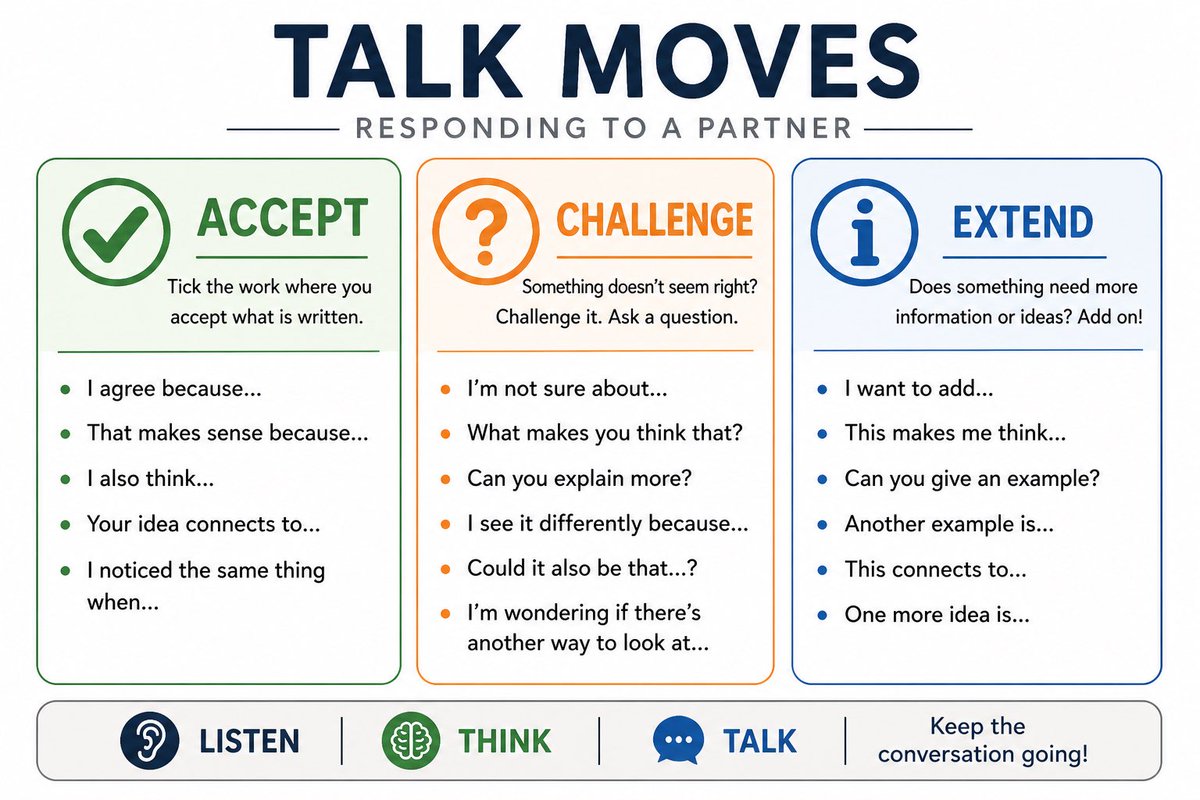
Over the past couple of days, I’ve embedded the Accept–Challenge–Extend routine into our existing turn-and-talk and cold-call procedures. It has led to some of the strongest partner discussions and whole-class responses we’ve had all year. One key reason is that it sustains students’ attention on what their partner is saying, and on what the student being cold-called is saying, because they know they may need to respond in one way or another. It also gives students additional opportunities to think about the learning objective in diverse contexts. This is also an ideal time of year to field-test new techniques and routines you’re considering for next year. Think of it as a soft launch before the official rollout.
SoL in the Wild tweet media
English
2
13
47
1.5K