Dynastic_Accretion

93 posts

Dynastic_Accretion banner
Dynastic_Accretion

Dynastic_Accretion

@D_Accretion

Katılım Haziran 2025
255 Takip Edilen102 Takipçiler
Skeptical Shrink
Skeptical Shrink@most_real_psymd·
@D_Accretion @camelfinance Swing trading the weekly cycles to accumulate (dynastically accrete, even). Have 115k shares, but would love to hold 500k shares at peak if I can swing it correctly across this prolonged range.
English
1
0
1
67
Camel Finance YT ⚡️
Camel Finance YT ⚡️@camelfinance·
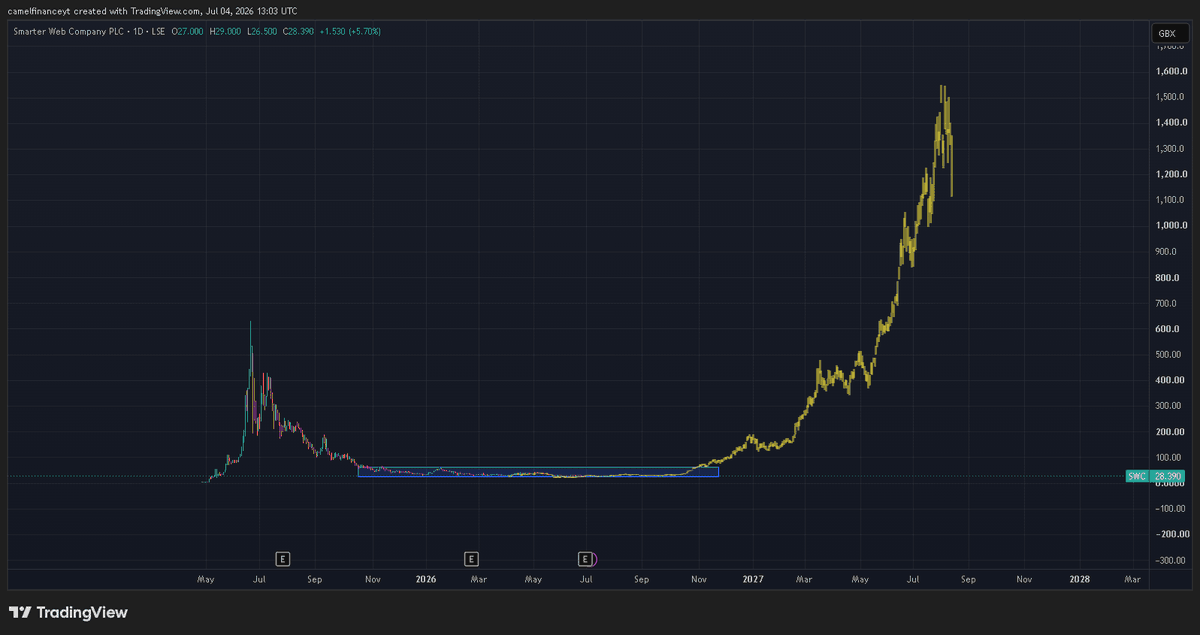
SWC (Smarter Web Company) Don't call me crazy, just track it - let's have some fun
Camel Finance YT ⚡️ tweet media
English
43
18
296
49.2K
Adam Livingston
Adam Livingston@AdamBLiv·
@ZynxBTC Wild how the market is pricing risk. 43x the Bitcoin? NO THANKS! 9 months more in cash? AW YEAH!
English
8
2
51
3K
Climb That Ladder
Climb That Ladder@ActuallyClimber·
From closing prices today and assuming no rate changes: In 1 year, if $SATA is trading at par, holders will have earned $13/share (13%). In 1 year, if $STRC is trading at par, holders will have earned $11.5 per share in dividends and $11 per share in accumulation to par. $22.5 on top of today’s closing price of $89 is 25.3%. Assuming Strategy does the right thing and raises the dividend since it’s trading low, the total return from today would be around 26%, twice that of SATA. I don’t know if these will be trading at par in a year but the way I see it, the R/R is almost 2 to 1 in favor of STRC at current prices. I bought STRC recently considering this. I lean bearish overall and bought it anyway because I saw it as compelling. Feel free to grab popcorn with me and see how this turns out.
English
24
6
154
15.7K
Ronnie Diamonds
Ronnie Diamonds@MadScrilla1·
@Breedlove22 Dealing it out arbitrarily or to a specific set of actors before it trickles down at a higher cost to everybody else?
English
1
0
2
136
Robert ₿reedlove
Robert ₿reedlove@Breedlove22·
If you want to understand how the dollar got corrupted, watch this. It'll take you 34 seconds:
English
18
51
237
17.3K
Dynastic_Accretion retweetledi
Bobby Tierney
Bobby Tierney@chcbearsfan·
Saylor was asked how to measure whether a deal is accretive. His answer is to calculate satoshis per share, net basis, attributable to common shareholders, after subtracting the liabilities. That calculation has had a name since January and cebetracker.io publishes it weekly In the same conversation 'for you to understand whether the company's accreting or diluting, you have to understand all of the tangible assets, the cash, all of the liabilities.' All of the liabilities, net of cash. That is the entire CEBE methodology in one sentence He also pushed back on netting preferred, calling it mezzanine capital rather than a balance sheet liability. Fair framing from the issuer's seat. From the common shareholder's seat, the liquidation preference stands ahead of you in every outcome that matters, whatever the balance sheet calls it. CEBE is measured from the common seat. Both views are correct. They answer different question Another interesting line surfaced, 'there's still a lot of room for debate about what is the right way to value a hybrid credit instrument like STRC.' Agreed. More on that soon
Bobby Tierney tweet media
English
7
21
126
11.2K
HODLWhisperer
HODLWhisperer@HODL_Whisperer·
@saylor @mattkratter TL;DR: You can be BTC Yield negative and yet be share holder accretive. @saylor I think it is probably helpful to track BTC/share minus all claims to the bitcoin senior to $MSTR. That is a trued BTC/share metric and it also would have been positive in this case.
English
1
0
10
1.7K
Matthew R. Kratter #BIP-110
Matthew R. Kratter #BIP-110@mattkratter·
For those who have been listening to orange-tie wearing idiots about MSTR dilution, you should realize that Strategy's own website demonstrates that the capital raise over the weekend was dilutive to MSTR shareholders. See the BTC Yield columns and how they moved down from 6/1 to 6/8
Matthew R. Kratter #BIP-110 tweet media
English
110
53
724
223.6K
Hendrik_Z
Hendrik_Z@Hendrik__Z·
Good point. The 10x is not from the extra 30k BTC. The table combines two effects: - 0.86M = low holdings + very low market valuation (Q1 Quantile) - 0.89M = high holdings + very hi Q99 valuation The Q01-to-Q99 spread is about 10x. That is where almost all of the difference comes from (historic variations).
Hendrik_Z tweet media
English
1
0
0
102
Hendrik_Z
Hendrik_Z@Hendrik__Z·
MSTR - BTC Korrelationen in 3D Die MSTR Aktie korreliert mit mindestens folgenden Größen: - verwässerten Aktienbestand (fully diluted shares) - Bitcoin Holdings von Strategy - Bitcoin Preis (genauer Residuen-Level RL): Percentile, wo sich der Preis zwischen dem Power Law Bottom und einem geschätzten Zyklus-Top befindet - Zeit Mit etwas Mühe schafft man dies gegen 3-Achsen darzustellen, zu extrapolieren und unter verschiedenen Szenarien auf den MSTR-Preis zurückzurechnen. RL um 20%: realistischer Pessimismus?
Hendrik_Z tweet media
Deutsch
7
4
30
10.5K
Dynastic_Accretion
Dynastic_Accretion@D_Accretion·
@Hendrik__Z Still thinking about this. So at 12/31/26, the 0% RL is $89k. So an extra 30k BTC holdings x 89k BTC price equals about $2.6B. Still struggling to understand how this is material (let alone a 10x) when their current BTC stack would be valued at around $75B at that point.
English
1
0
1
44
Hendrik_Z
Hendrik_Z@Hendrik__Z·
@D_Accretion 1M would be great.... I always try to be careful, reasonable and don't want to produce "moon"-predictions.
English
1
0
0
67
Dynastic_Accretion
Dynastic_Accretion@D_Accretion·
@Hendrik__Z Interesting work, I hope you’re right! I wouldn’t be surprised if they finished the year with closer to 1m btc holdings 🤞
English
1
0
1
59
Hendrik_Z
Hendrik_Z@Hendrik__Z·
Yes. Bitcoin holdings at the lower end are, so to speak, valued increasingly negatively by the market as time progresses, and the same applies at the upper end. Since MSTR reacts with such strong leverage, the projections probably shouldn't be extended too far into the future. I'll track this extrapolation every month or two and see how it is going...
English
1
0
1
80
Dynastic_Accretion
Dynastic_Accretion@D_Accretion·
@Hendrik__Z I’m trying to follow. So it’s a 12/31/26 snapshot. If we look at 0 RL, an increase of 30k BTC means a 10x difference in mstr price?
English
2
0
0
67
Hendrik_Z
Hendrik_Z@Hendrik__Z·
@D_Accretion Yes, because the Power Law rises over time, implying a higher Bitcoin valuation as time progresses. This is therefore not just an extrapolation of MSTR's Bitcoin holdings, but also a projection of Bitcoin itself forward in time.
English
1
0
1
278
Adam Livingston
Adam Livingston@AdamBLiv·
USE CEBE BECAUSE IT ANNIHILATES THE BEAR CASE WITH UNDENIABLE MATH. BTC Yield is closer to a bank CEO bragging: “We bought some assets, but our loans per share went up!” Okay, sick. But how were the loans funded? Deposits? Debt? Preferreds? Common dilution? Warrants? Converts? Expensive capital? Gross asset growth per share is not the same as residual value growth per share. For a bank: Assets minus liabilities and preferreds = common equity book value. For a Bitcoin treasury company: BTC minus senior claims = common equity BTC. Then divide by shares. That’s the residual. That’s the snapshot.
English
6
4
49
5.3K
Bobby Tierney
Bobby Tierney@chcbearsfan·
@thebtcpharaoh Great post. The residual value calculation you ran, BTC plus cash less SATA face, divided by shares is exactly what CEBE formalizes. Your double compression grid is the drag engine working in reverse Nice work Pharaoh! cebetracker.io
English
2
1
16
701
THE BITCOIN PHARAOH
THE BITCOIN PHARAOH@thebtcpharaoh·
Strive Is Doing Everything Right. The Math Is Doing Something Else. There is a lot to admire about what Strive ($ASST) has built since February. Sixteen thousand bitcoin in a treasury that was empty at the start of last year. A 13% perpetual preferred market that has cleared every tranche near par. The first daily-dividend structure on a U.S. listed security, launching June 16. The chart genuinely looks like a flywheel set in glass. But the case is pretty above the fold and thin below it. Sitting with the May 22 8-K and walking the structure forward, I find a constant drag and two compression mechanisms the discourse is not capturing. None of the three break the credit math, though they matter for the equity. What the May 22 8-K actually says. 16,500 #BTC. 5,759,719 $SATA shares outstanding — $576M of par face. 75.8M common shares. $93M cash. $50M of Strategy's $STRC on the asset side. Annual SATA coupon at 13% on par: $74.9M of fixed USD obligations against an asset base that is 89% bitcoin. Amplification is a ratchet. It works both ways. At BTC $73K, SATA face is ~48% of the bitcoin stack. Hold the SATA stack constant — because the issuance schedule is decided, but the BTC price is not — and let's see what happens under different scenarios. See "Amplification is a Ratchet" table below. At $50K, prefs are 70% of the bitcoin stack and common NAV halves while BTC drops 32%. That is amplification working symmetrically — the same feature that supercharges returns in a bid tape supercharges them in reverse in an offered one. Side note: I am NOT calling for $50K BTC. If you've been following me long enough, you already know that I am an eternal BTC bull. But I've been in #Bitcoin long enough to be humbled enough times to 'never say never' when it comes to near-term price movements. The engine isn't free, even on a calm day. $74.9M is ~5.4% of Strive's ~$1.38B market cap. Add public-company overhead and the legacy asset-management business and the all-in fixed drag sits closer to 6% p.a. Before BTC does anything. The coins in their treasury don't pay it. The legacy AM business is not sized to cover it. The $50M STRC stake throws off ~$5M/yr, a rounding error against the obligation. In practice the coupon gets funded by the Class A common ATM. $75M of fresh common per year at the current ~$18 stock prints ~4M new shares — another 5%+ of constant dilution on top of whatever BTC is doing. That is the floor. The compression scenarios sit on top of it. And one piece the consensus does not surface: ATM dilution is least painful when the multiple is bid up. The moment mNAV compresses, the same coupon obligation requires more shares to fund. Drawdown does not only hit NAV — it accelerates the dilution velocity exactly when shareholders can least absorb it. Granted, they hold a fiat reserve that should cover near term drawdowns. The compression most readers are missing. The premium $ASST trades at is not just a multiple on the bitcoin in custody. It is partly a multiple on the funding engine itself — on the perception that SATA can be issued reliably, at par, in $40-100M weekly tranches, to buy more BTC. Keep it running and you own a compounding machine. Strip it away and you own a small-cap with 16,500 BTC and a $75M annual coupon. So how much is the market paying for the engine? Run the arithmetic. Common's net residual value — BTC at market plus cash plus STRC, less SATA face — is $772M. Across 75.8M shares, that is $10.19 per share of intrinsic. Stock at $18.21 implies $8.02 of premium per share — roughly 44% of the price is paying for the engine, not the stack. Aggregate: ~$608M of premium baked into the common, sitting above $1.20B of BTC NAV. Roughly half a billion dollars of capitalized confidence in the chassis. Now stress two dials together — BTC price and the mNAV multiple. Today's implied mNAV is ~1.50x (EV / BTC value). See table "The Double Compression" below. Read the corners. BTC stays at $73K and the premium collapses to NAV: −44%. BTC drops 32% to $50K and the multiple holds at 1.50x: −41%. BTC drops 32% and the multiple compresses to par: −71%. The other 30 points of drawdown in that worst cell — the gap between "NAV down" and "NAV plus premium gone" — is the engine giving back what it bought. That is the double-compression in a single grid. The mechanism behind it is the part the consensus is underweighting. When bitcoin drops materially, the SATA market itself becomes a harder bid. 13% on a treasury that just lost a third of its collateral is a different security than the one buyers were pricing in April. New tranches need a higher coupon, print below par, or do not print at all. The moment it freezes is the moment the mNAV multiple resets, because the multiple was paying for the engine in part. NAV down. Premium on the engine, also down. Both legs hit at the same tick. That is the asymmetry. The same reflexivity that built the premium is the reflexivity that closes it. Pro-cyclical on the way up sounds like a virtue. Pro-cyclical on the way down is the same word, slightly less flattering. What this is not. This is not "Strive is overleveraged." Coverage at $50K BTC is still ~13 years on pure asset-over-coupon math. So the credit is fine. This is "the equity is exposed to a compression that the consensus is underweighting." Different problem. MSTR's preferred stack has been here before. $STRC compressed in stress; it never froze. The difference was scale — at Strategy's size, the funding engine is a smaller fraction of the thesis. At Strive's current scale, the engine is a larger fraction of it. And they're coming off a smaller base. That is also why the growth has been so visible and why the multiple has been so generous. The same property cuts both ways. What I am watching. To be clear: this is not a post that is meant to be bearish on $ASST, in fact, if/when we see BTC strength, I expect it to be one of the best performing stocks in the sector. Having said that, for the later entrants, be careful what you're paying for in the near term. The first SATA tranche that prints below par will be the tell. Until then, the engine is working — and working well. After that print, the question worth answering is not whether to be long $ASST — it is how much of today's mNAV is paying for the bitcoin, and how much is paying for the engine. Today those two questions look like the same trade. They will not always be. Disclosure: I do not hold $ASST or $SATA. I hold $MPJPY (#Metaplanet).
THE BITCOIN PHARAOH tweet mediaTHE BITCOIN PHARAOH tweet media
English
18
12
93
10.5K
Dynastic_Accretion
Dynastic_Accretion@D_Accretion·
@ActuallyClimber Understood. I know you had some big success with them in the past, wasn’t sure if there was a level where you couldn’t help but dip your toe again
English
1
0
0
63
Climb That Ladder
Climb That Ladder@ActuallyClimber·
@D_Accretion For me it’s sailed. I’ve also benefitted a lot from Bitcoin (since 2016) and MSTR (since late 2022) so really don’t line the idea of trying to milk it again even aside from my logical reasons. I’m fine missing it if it rockets.
English
1
0
0
254
Climb That Ladder
Climb That Ladder@ActuallyClimber·
People totally miss that the companies issuing “digital credit” need to issue around $2 worth of common shares for every $1 worth of pref. This is a big reason equilibrium mNAV should be below 1 to block this infinite money (from infinite common shares buying) potential.
BitcoinTreasuries.NET@BTCtreasuries

JUST IN: Strive $ASST CEO Matt Cole (@ColeMacro) just said, "If digital credit took 1% of the $300 trillion credit market, it would send #Bitcoin to $1 million just on its own." "$3 trillion in demand flowing in to buy BTC exposure from issuers like Strive is conservative." 👀

English
7
1
15
10.3K
Climb That Ladder
Climb That Ladder@ActuallyClimber·
@D_Accretion It also puts pressure on bitcoin both to exceed the yield on the prefs (Bitcoin CAGR) and that if common trades below 1 mNAV, bitcoin may be sold to pay dividends which is crappy optics.
English
1
0
0
182