

Judith Dada
749 posts

Judith Dada
@DadaJudith
GP @VisionariesVC https://t.co/xNTWhLDaEh https://t.co/UsMMAAeE26 https://t.co/ZCXsCzMJfs https://t.co/uaAJeEiYyb
Berlin, Deutschland Katılım Ocak 2014
754 Takip Edilen2.4K Takipçiler

People like to talk about doing what they believe to be the right thing for their country. Ian gave up his home run investment of a lifetime to do it. Heroic. 🫡
Oscar Sykes@OscarSykes7
Ian Hogarth is a legend
English
Judith Dada retweetledi

@thisiss0l @AnjneyMidha Sure. Ran an experiment to investigate the benefits of interactivity in digital data visualization drive.google.com/file/d/1zckVec…
English

@DadaJudith @AnjneyMidha do you mind sharing a link to your thesis if it's open access?
English

last year, a group of researchers i mentor came home for dinner
‘how do we better communicate our research out to the world?’ one of them asked
i recommended these texts as starting points
did it work? idk
they were from anthropic, periodic, deepmind and black forest




English
Little brass bull needs to be replaced with a little brass lobster next time around @pallipau

English
Won investor of the year at the German Startup Awards.
Called for drastically more compute & commitment to AI - @bundeskanzler.
Thanks for this award @StartupVerband.
Lots of work to do.
PS: missed official award photo bc I was deep in AI discussion land 😅


English
Judith Dada retweetledi

i have a lot of respect for @arthurmensch for trying to engage and educate the french institutions.
This is un-ironically important work that you're doing mate 🙏
May it be fruitful
English
Judith Dada retweetledi

Microsoft put $13 billion into OpenAI and built the cloud infrastructure Anthropic runs on.
This week it canceled its internal Claude Code licenses because the token bill was too high.
Even for MSFT Claude is too expensive.
Hedgie@HedgieMarkets
🦔Microsoft canceled its internal Claude Code licenses this week after token-based billing made the cost untenable, even for a company with effectively infinite cloud resources. Uber's CTO sent an internal memo warning the company burned through its entire 2026 AI budget in just four months. American AI software prices have jumped 20% to 37%, and GitHub (owned by Microsoft) is dropping flat-rate plans for usage-based billing across its products. My Take The AI subsidy era is ending in real time. The same company that put $13 billion into OpenAI and built the Azure infrastructure powering most of Anthropic's compute just looked at the bill from a competitor's coding tool and decided it was not worth paying. That is not a productivity failure on Anthropic's end. Token-based pricing is forcing every enterprise customer to confront the actual cost of running these models at scale, and the number turns out to be far higher than the flat-rate experiments suggested. This ties directly to my Gemini Flash post yesterday. Anthropic, OpenAI, and Google all raised effective prices in the last six months. Enterprises that built workflows assuming AI costs would keep falling are now watching annual budgets evaporate in months. Two outcomes look likely from here. Either enterprises scale back AI usage to fit budgets, which slows the revenue ramp the labs need to justify their valuations ahead of IPOs, or the labs cut prices and absorb the losses, which makes the unit economics worse at exactly the wrong moment. Both paths land in the same place, the numbers stop working, and somebody has to take the writedown. Hedgie🤗
English
After a year of blogging about AI & society: My Substack got a little glow up. Thank you @Anna_Daki_ and Leon Driese!
What a privilege it is to live, breathe, think and explore this strange but infinitely interesting world.


English
Judith Dada retweetledi

One of the most important and under appreciated trends in the world right now.
1. 100s of billions of dollars will soon be available to solve big problems (making the world resilient to ASI, ending factory farming, etc).
2. The projects and organizations which will turn billions of 2027/28 dollars into impact need to be started NOW.
3. We need really talented people to start and run and work for these new projects. What @nanransohoff calls general managers, who feel personally resposible for solving one of the world’s important problems.
What is especially scarce are detailed visions about what making AI go well looks like. These will help inform what problems these new projects ought to work on.
Nan Ransohoff@nanransohoff
New blog post: The third wave of American philanthropy Hundreds of billions of dollars in new philanthropic capital will soon become liquid. The OpenAI Foundation holds 26% of OpenAI, worth about $220B at today’s valuation. Anthropic’s seven co-founders have pledged to give away 80% of their wealth and have instituted the most aggressive donor matching program for employees in tech history. How much does this all add up to? And how meaningful is that in the context of philanthropy today? I was doing some simple napkin math to wrap my head around the scale of what’s coming, and radicalized myself in the process. I had dramatically underappreciated the scale of the philanthropic capital that’s about to become available and the corresponding gap in talent and organizations that will be needed to make the most of it. This piece aims to directionally sketch the scale of what’s coming, the gap in operational capacity needed to absorb it, and what we can do to fill it. (Link to full post in reply)
English

We’re dropping Gemini Omni: our first step towards a model that can create anything from anything - starting with video.
It combines Gemini’s intelligence with our generative media systems - representing a leap forward in world understanding, multimodality, and editing 🧵
English

Personal update: I've joined Anthropic. I think the next few years at the frontier of LLMs will be especially formative. I am very excited to join the team here and get back to R&D. I remain deeply passionate about education and plan to resume my work on it in time.
English
The way I smile when we discuss more compute and European AI researchers killing it. Thanks for a great discussion @nvidia @kyosu @mpvl_ @bfl_ml @tobiashalloran


English
Judith Dada retweetledi
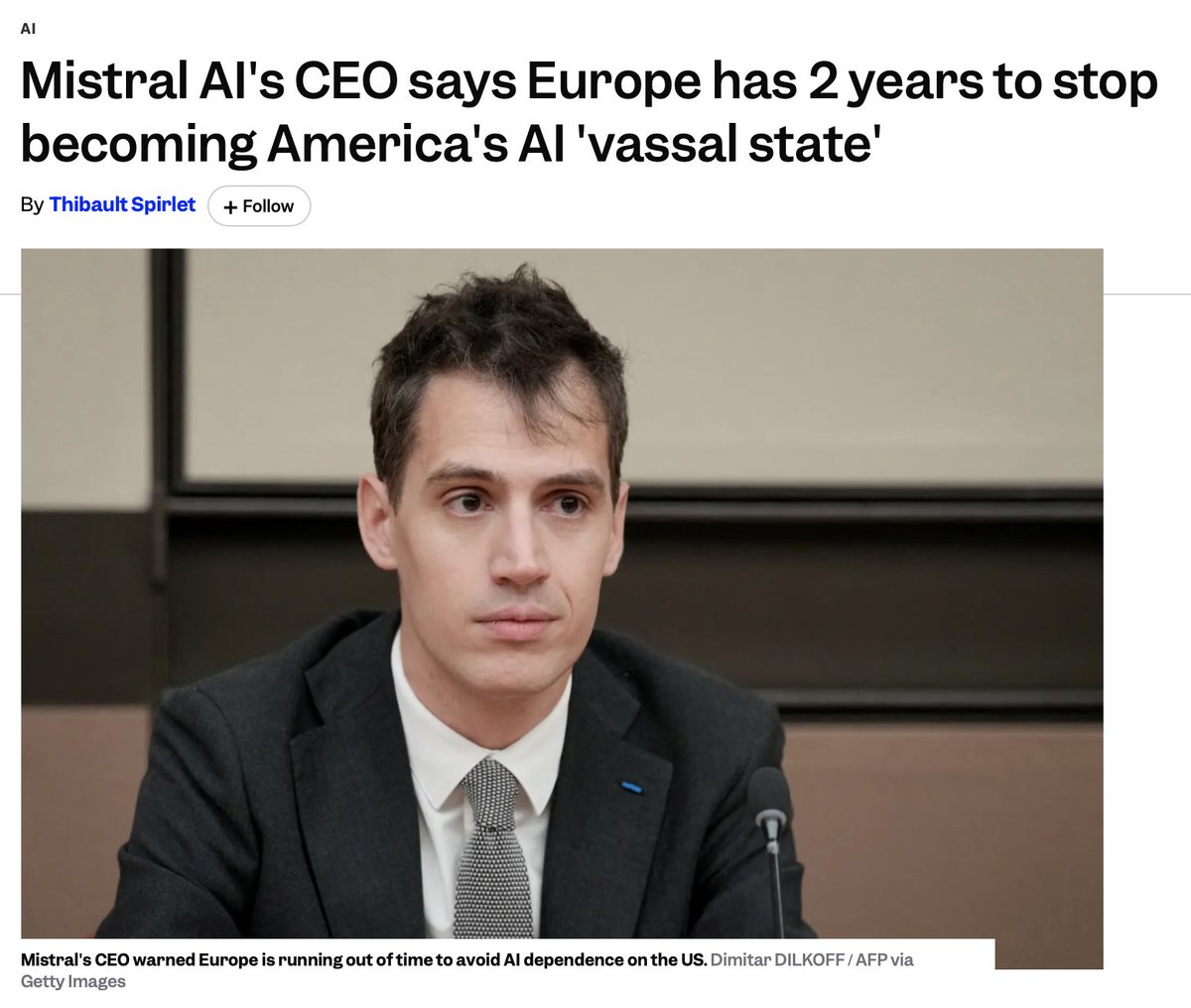
Mistral AI's CEO says Europe has 2 years to stop becoming America's AI 'vassal state'
Well, how about Europe finally starting to invest massively in data centers and energy policy instead of just constantly complaining?
Europe, and Germany in particular, has some of the highest energy prices worldwide and has deliberately relied on volatile energy sources.
Similarly, there is no discernible policy promoting the expansion of data centers that even remotely aim to compete with the US and China.
English
@HarryStebbings Fully agree with this "When you see OpenAI and Anthropic deploying engineers into enterprises, it’s a sign of a huge opportunity for vertical AI."
English

Why OpenAI and Anthropic doing consulting businesses is such an obvious and right move
"When you see OpenAI and Anthropic deploying engineers into enterprises, it’s a sign of a huge opportunity for vertical AI.
It’s not easy to go into these companies, access the data, clean it, organize it, and integrate into workflows in a compliant way.
There’s so much complexity, from high trust to different types of sensitive data, and it takes a lot of effort to build something scalable." @ShivdevRao
Love to hear your thoughts on this and the opportunity here @rodriscoll @kirbyman01 @jamdac
Harry Stebbings@HarryStebbings
I have interviewed 1,000s of the world's best founders over the past decade. Few have impressed me like @ShivdevRao at @AbridgeHQ. He navigated a brutal 5-year wilderness before exploding into one of the most dominant forces in vertical AI. Today, Abridge is a $5.3BN powerhouse. I sat down with Shiv to unpack exactly how he did it and condensed my notes below: 🚀 6 Lessons on Building a $5.3B Vertical AI Juggernaut 1. Survive Long Enough for Market Timing to Catch Up: Abridge spent 5 years in the "wilderness" before hitting a tidal wave of adoption. When you have an absolute true north thesis, your primary job in the early days is simple: stay standing and don’t die. You must be alive when the sky finally opens up. 2. Pivot the Product, Never the Core Thesis: Shiv was willing to pivot on features, go-to-market strategies, and business models. But he refused to budge on his core thesis that healthcare is ultimately powered by the spoken human signal. Die on the hill of your thesis; adapt everything else. 3. Target the Concentration of Scale Early: A massive trap for healthcare and enterprise founders is staying down-market too long for "fast feedback loops". In the US, the vast majority of clinicians are concentrated within large, integrated delivery networks. Time your "YOLO shot" to go up-market the moment the market inflects. Single biggest advice to founders on when to go up market @bhalligan @dharmesh? 4. Own Your Stack to Protect Your P&L and UX: While many AI startups rely entirely on frontier systems, 40% of Abridge's model outputs are generated by in-house models. Milliseconds matter in high-stakes enterprise workflows. Building your own models gives you insane performance gains, lower latency, and ultimate control over your P&L. When should you vs should you not build your own model @matanSF @MaxJunestrand @antonosika? 5. Don't Fight Foundation Models—Counter-Position Instead If you try to fight the frontier model giants directly, you've already lost. You win by going millions of miles deep into regulated industries with proprietary datasets and workflows they can't easily replicate. Find ways to coexist and leverage their tailwinds. Reminds me of what @bradlightcap said on his 20VC. 6. Move Toward the "Flat Company" Era: With the explosion of AI agents and advanced tooling, the traditional management layer is compressing. Shiv’s latest idealistic shift is building a hyper-flat organization: fewer managers, and highly leverageable "Super ICs" who can move in lockstep and cover massive surface area. (link in comments)
English
@simongerman600 @jburnmurdoch Ubiquitous porn + social media killed IRL sex and the desire to build a family? Yeah, I think I buy it.
English
One of my favorite data journalists is @jburnmurdoch and he is cooking once again with this piece: “In country after country the birth rate plunged after the introduction of smartphones, no matter what the previous trend was…the modern digital media environment has had profound effects on society that have led to a decline in romantic coupling”. Read here: ft.com/content/fba35e…

English
Judith Dada retweetledi

"But only frontier models are being used!"
No, it's a Cambrian explosion of models

English

Judith Dada retweetledi

Recursive, the company building recursive self-improving superintelligence, has one of the most goated AI teams in history.
Tim Rocktäschel, Co-Founder: helped invent Retrieval-Augmented Generation, Rainbow Teaming, Promptbreeder, and Genie 3.
Jeff Clune, Co-Founder: wrote the Darwin Gödel Machine and HyperAgents papers.
Tim Shi, Co-Founder: Cresta Co-Founder & CTO.
Josh Tobin, Co-Founder & CTO: led work at OpenAI on ChatGPT Agents, Codex, and Deep Research.
Caiming Xiong, Co-Founder: co-inventor of prompt engineering.
Alexey Dosovitskiy, Co-Founder: co-inventor of the Vision Transformer.
Yuandong Tian, Co-Founder: former RL Lead at Meta.
English