Dapp-Learning

1.7K posts

Dapp-Learning banner
Dapp-Learning

Dapp-Learning

@Dapp_Learning

An online open-source developer community focusing on Ethereum & Layer2. Official website: https://t.co/aFPj7mxvac https://t.co/eqGPrSztRh

Ethereum Katılım Ekim 2017
1.7K Takip Edilen3.9K Takipçiler
Dapp-Learning retweetledi
RYAN SΞAN ADAMS - rsa.eth 🦄
Um...did the EF just roll out a way to drop Ethereum finality from 13 mins to...13 second?? Bullish if true. Fast confirmation rule. fastconfirm.it
RYAN SΞAN ADAMS - rsa.eth 🦄 tweet mediaRYAN SΞAN ADAMS - rsa.eth 🦄 tweet media
English
38
55
637
61.2K
Dapp-Learning
Dapp-Learning@Dapp_Learning·
伯克利Defi公开课最新一课——去中心化身份入门 本节课将带你进入 DeFi 体系中被长期忽视却至关重要的“身份基础层”——去中心化身份(Decentralized Identity)。跟随 Andrew Miller 教授一起理解:当金融系统不再依赖银行账户、政府证件或中心化平台来确认“你是谁”,而是用公钥、密码学证明与信任网络来表达身份,链上世界应该如何建立信任? 你将不再把“身份”理解为传统意义上的 KYC 或实名验证,而是能够从机制层面看清:传统互联网如何通过 OAuth、账户体系与中心化数据库来管理身份;DeFi 又如何借助数字签名、零知识证明、预言机与匿名凭证,把身份验证从机构流程转化为可验证的密码学证明;信任结构如何从中心化机构迁移到密码学协议的范式转变。 课程链接: mp.weixin.qq.com/s/omVeYLU-U0LT…
中文
0
1
10
669
Dapp-Learning retweetledi
AI on Base
AI on Base@AIonBase_·
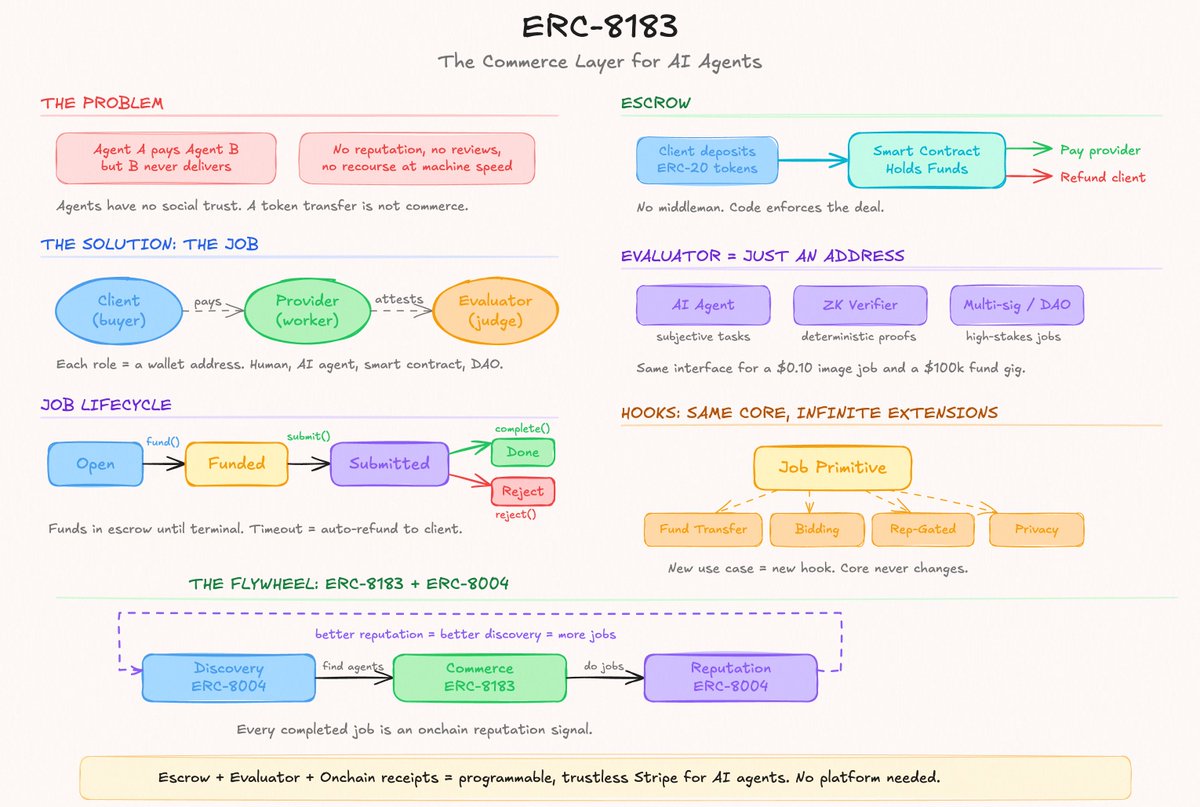
ERC-8183 Explained @virtuals_io x @ethereumfndn's dAI team just dropped the first native commerce standard for AI agents. agents can move tokens today. but moving tokens is not commerce. there's no proof work was done. no way to hold funds until delivery. no recourse if the provider disappears. ERC-8183 makes it commerce. the core primitive: a Job. three roles: - Client (hires) - Provider (does the work) - Evaluator (verifies the work was actually done) Open → Funded → Submitted → Completed / Rejected / Expired payment sits in escrow. work done = provider paid. rejected = client refunded. no action before deadline = auto-refund. the Evaluator is just an address. an AI agent, a ZK verifier, a multisig. the contract doesn't care. a $0.10 image gen job and a $100k fund management engagement run through the exact same contract. for everything beyond the base flow, there are hooks. milestone payments, reputation gating, bidding, ZK privacy. all hooks. any wallet can be a Provider. every completed job feeds ERC-8004, the agent identity standard. completed job = onchain reputation submission = verifiable history attestation = portable trust Discovery (8004) → Commerce (8183) → Reputation (8004) → loop good work = reputation = more clients = more jobs. Virtuals team is building the most important standard for agentic commerce stack in the open, co-developed with ethereum's dAI team. spec: eips.ethereum.org/EIPS/eip-8183
AI on Base tweet media
English
31
64
350
24.6K
Dapp-Learning retweetledi
Justin Drake
Justin Drake@drakefjustin·
Introducing strawmap, a strawman roadmap by EF Protocol. Believe in something. Believe in an Ethereum strawmap. Who is this for? The document, available at strawmap[.]org, is intended for advanced readers. It is a dense and technical resource primarily for researchers, developers, and participants in Ethereum governance. Visit ethereum[.]org/roadmap for more introductory material. Accessible explainers unpacking the strawmap will follow soon™. What is the strawmap? The strawmap is an invitation to view L1 protocol upgrades through a holistic lens. By placing proposals on a single visual it provides a unified perspective on Ethereum L1 ambitions. The time horizon spans years, extending beyond the immediate focus of All Core Devs (ACD) and forkcast[.]org which typically cover only the next couple of forks. What are some of the highlights? The strawmap features five simple north stars, presented as black boxes on the right: → fast L1: fast UX, via short slots and finality in seconds → gigagas L1: 1 gigagas/sec (10K TPS), via zkEVMs and real-time proving → teragas L2: 1 gigabyte/sec (10M TPS), via data availability sampling → post quantum L1: durable cryptography, via hash-based schemes → private L1: first-class privacy, via shielded ETH transfers What is the origin story? The strawman roadmap originated as a discussion starter at an EF workshop in Jan 2026, partly motivated by a desire to integrate lean Ethereum with shorter-term initiatives. Upgrade dependencies and fork constraints became particularly effective at surfacing valuable discussion topics. The strawman is now shared publicly in a spirit of proactive transparency and accelerationism. Why the "strawmap" name? "Strawmap" is a portmanteau of "strawman" and "roadmap". The strawman qualifier is deliberate for two reasons: 1. It acknowledges the limits of drafting a roadmap in a highly decentralized ecosystem. An "official" roadmap reflecting all Ethereum stakeholders is effectively impossible. Rough consensus is fundamentally an emergent, continuous, and inherent uncertain process. 2. It underscores the document's status as a work-in-progress. Although it originated within the EF Protocol cluster, there are competing views held among its 100 members, not to mention a rich diversity of non-EFer views. The strawmap is not a prediction. It is an accelerationist coordination tool, sketching one reasonably coherent path among millions of possible outcomes. What is the strawmap time frame? The strawmap focuses on forks extending through the end of the decade. It outlines seven forks by 2029 based on a rough cadence of one fork every six months. While grounded in current expectations, these timelines should be treated with healthy skepticism. The current draft assumes human-first development. AI-driven development and formal verification could significantly compress schedules. What do the letters on top represent? The strawmap is organized as a timeline, with forks progressing from left to right. Consensus layer forks follow a star-based naming scheme with incrementing first letters: Altair, Bellatrix, Capella, Deneb, Electra, Fulu, etc. Upcoming forks such as Glamsterdam and Hegotá have finalized names. Other forks, like I* and J*, have placeholder names (with I* pronounced "I star"). What do the colors and arrows represent? Upgrades are grouped into three color-coded horizontal layers: consensus (CL), data (DL), execution (EL). Dark boxes denote headliners (see below), grey boxes indicate offchain upgrades, and black boxes represent north stars. An explanatory legend appears at the bottom. Within each layer, upgrades are further organized by theme and sub-theme. Arrows signal hard technical dependencies or natural upgrade progressions. Underlined text in boxes links to relevant EIPs and write-ups. What are headliners? Headliners are particularly prominent and ambitious upgrades. To maintain a fast fork cadence, the modern ACD process limits itself to one consensus and one execution headliner per fork. For example, in Glamsterdam, these headliners are ePBS and BALs, respectively. (L* is an exceptional fork, displaying two headliners tied to the bigger lean consensus fork. Lean consensus landing in L* would be a fateful coincidence.) Will the strawmap evolve? Yes, the strawmap is a living and malleable document. It will evolve alongside community feedback, R&D advancements, and governance. Expect at least quarterly updates, with the latest revision date noted on the document. Can I share feedback? Yes, feedback is actively encouraged. The EF Protocol strawmap is maintained by the EF Architecture team: @adietrichs, @barnabemonnot, @fradamt, @drakefjustin. Each has open DMs and can be reached at first.name@ethereum[.]org. General inquiries can be sent to strawmap@ethereum[.]org.
Justin Drake tweet media
English
198
412
1.6K
595.4K
Dapp-Learning retweetledi
宝玉
宝玉@dotey·
斯坦福大学去年秋季开了一门新课 CS146S,叫"现代软件开发者",由知名风投 a16z 的合伙人 Martin Casado 主讲,核心主题就一个:AI 时代怎么写代码。 课程的基本观点是,软件开发已经从"从零手写代码"变成了"规划→AI生成→修改→循环"的新工作流。课上会教学生怎么用 LLM 高效提示、搭建 AI 编程代理、用 Claude Code 等工具做开发,还涉及 AI 代码审查、安全漏洞检测、自动化测试等实战环节。 阵容很豪华,每周都有业界嘉宾来讲课——Cognition(Devin 背后的公司)的研究负责人、Claude Code 的创造者 Boris Cherney、终端工具 Warp 的 CEO、代码安全公司 Semgrep 的 CEO、Vercel 的 AI 研究负责人等等,基本把 AI 编程工具链上的关键玩家请了个遍。 课程为期一个学期,3 学分,要求有编程基础,每周大概 10-12 小时的投入。最终项目是做一个展示现代开发实践的作品。 themodernsoftware.dev
宝玉 tweet media
中文
43
358
1.5K
125.4K
Dapp-Learning
Dapp-Learning@Dapp_Learning·
精彩分享来了,关注去中心化预测市场的同学不要错过。 标题:Polymarket 全解析:深度拆解 “Yes/No” 背后的运作机制(Polymarket Deconstructed: What Happens Behind the Scenes of Every "Yes/No" Click?) 主要内容: - Yes/No tokens Trading - Binary/Negrisk/Sports market creating/resolving 会议时间:8:00pm, FEB 25th 会议语言:中文 会议链接:meeting.tencent.com/dm/P8Kg3H2WY0xL 腾讯会议:585-741-893 分享材料:docs.google.com/presentation/d…
Dapp-Learning tweet media
中文
0
3
9
682
Derive.xyz 中文社区
Derive.xyz 中文社区@DeriveXYZ_CN·
.@SeanNotShorn 清楚讲透了 IV vs RV,不讲玄学,只讲工具。 • 隐含波动率(IV):直接看期权盘口 → Derive、Deribit 等平台都能看到 • 已实现波动率(RV):只需要现货价格数据 → 用简单的 Python 就能算 • 通过 API 拉历史数据,做滚动均值,观察波动率结构变化 当 IV + RV 数据齐全,量化分析才真正开始。 🎧 来自与 @Amy6Tina @soberoption 的 Options Masterclass.
中文
1
4
16
2.1K
Dapp-Learning
Dapp-Learning@Dapp_Learning·
🚀 New Sharing Session! Deep dive into the Cypherpunk tech stack with @hackyguru from @logos_network. We’re moving beyond standard EVM pitfalls to explore a decentralized future combining. 📅 Feb 11th, 8:00 PM (UTC+8) 🎙️ Language: English 📍 Join here: meet.google.com/vou-xizy-sje
Dapp-Learning tweet media
English
0
3
10
893
Dapp-Learning
Dapp-Learning@Dapp_Learning·
@VitalikButerin 哈哈,告别L2 centric的时代。Gaslimit的提高和zk的应用,希望尽快看到10K TPS的Ethereum。
中文
0
0
2
182
Dapp-Learning
Dapp-Learning@Dapp_Learning·
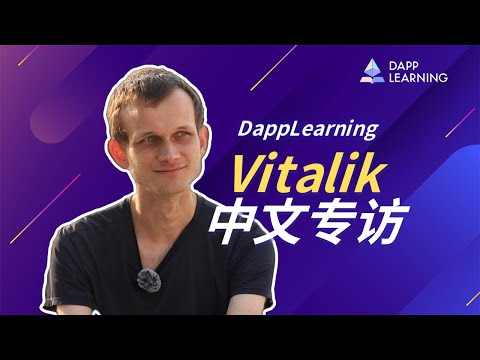
25年4月采访V神的时候问怎么看L1和L2的关系,V神的回答是,"我们最大的一个担心之一就是:以太坊应用的成功,无法成为 ETH 的成功。 如果 ETH 不成功,就会导致我们的社区没有钱,没有办法去支撑下一轮的应用。所以如果 L1 完全没有担任角色,用户的使用体验以及整个架构都会被 L2 和一些应用控制。就不会有谁代表 ETH。所以如果我们可以在一些应用里面多给 L1 分配角色,这样对于 ETH 会更好。"
中文
1
0
5
1.4K
Dapp-Learning retweetledi
vitalik.eth
vitalik.eth@VitalikButerin·
There have recently been some discussions on the ongoing role of L2s in the Ethereum ecosystem, especially in the face of two facts: * L2s' progress to stage 2 (and, secondarily, on interop) has been far slower and more difficult than originally expected * L1 itself is scaling, fees are very low, and gaslimits are projected to increase greatly in 2026 Both of these facts, for their own separate reasons, mean that the original vision of L2s and their role in Ethereum no longer makes sense, and we need a new path. First, let us recap the original vision. Ethereum needs to scale. The definition of "Ethereum scaling" is the existence of large quantities of block space that is backed by the full faith and credit of Ethereum - that is, block space where, if you do things (including with ETH) inside that block space, your activities are guaranteed to be valid, uncensored, unreverted, untouched, as long as Ethereum itself functions. If you create a 10000 TPS EVM where its connection to L1 is mediated by a multisig bridge, then you are not scaling Ethereum. This vision no longer makes sense. L1 does not need L2s to be "branded shards", because L1 is itself scaling. And L2s are not able or willing to satisfy the properties that a true "branded shard" would require. I've even seen at least one explicitly saying that they may never want to go beyond stage 1, not just for technical reasons around ZK-EVM safety, but also because their customers' regulatory needs require them to have ultimate control. This may be doing the right thing for your customers. But it should be obvious that if you are doing this, then you are not "scaling Ethereum" in the sense meant by the rollup-centric roadmap. But that's fine! it's fine because Ethereum itself is now scaling directly on L1, with large planned increases to its gas limit this year and the years ahead. We should stop thinking about L2s as literally being "branded shards" of Ethereum, with the social status and responsibilities that this entails. Instead, we can think of L2s as being a full spectrum, which includes both chains backed by the full faith and credit of Ethereum with various unique properties (eg. not just EVM), as well as a whole array of options at different levels of connection to Ethereum, that each person (or bot) is free to care about or not care about depending on their needs. What would I do today if I were an L2? * Identify a value add other than "scaling". Examples: (i) non-EVM specialized features/VMs around privacy, (ii) efficiency specialized around a particular application, (iii) truly extreme levels of scaling that even a greatly expanded L1 will not do, (iv) a totally different design for non-financial applications, eg. social, identity, AI, (v) ultra-low-latency and other sequencing properties, (vi) maybe built-in oracles or decentralized dispute resolution or other "non-computationally-verifiable" features * Be stage 1 at the minimum (otherwise you really are just a separate L1 with a bridge, and you should just call yourself that) if you're doing things with ETH or other ethereum-issued assets * Support maximum interoperability with Ethereum, though this will differ for each one (eg. what if you're not EVM, or even not financial?) From Ethereum's side, over the past few months I've become more convinced of the value of the native rollup precompile, particuarly once we have enshrined ZK-EVM proofs that we need anyway to scale L1. This is a precompile that verifies a ZK-EVM proof, and it's "part of Ethereum", so (i) it auto-upgrades along with Ethereum, and (ii) if the precompile has a bug, Ethereum will hard-fork to fix the bug. The native rollup precompile would make full, security-council-free, EVM verification accessible. We should spend much more time working out how to design it in such a way that if your L2 is "EVM plus other stuff", then the native rollup precompile would verify the EVM, and you only have to bring your own prover for the "other stuff" (eg. Stylus). This might involve a canonical way of exposing a lookup table between contract call inputs and outputs, and letting you provide your own values to the lookup table (that you would prove separately). This would make it easy to have safe, strong, trustless interoperability with Ethereum. It also enables synchronous composability (see: ethresear.ch/t/combining-pr… and ethresear.ch/t/synchronous-… ). And from there, it's each L2's choice exactly what they want to build. Don't just "extend L1", figure out something new to add. This of course means that some will add things that are trust-dependent, or backdoored, or otherwise insecure; this is unavoidable in a permissionless ecosystem where developers have freedom. Our job should make to make it clear to users what guarantees they have, and to build up the strongest Ethereum that we can.
English
2.6K
1.7K
10K
6.3M
Dapp-Learning retweetledi
Mark Tyneway
Mark Tyneway@tyneslol·
Ethereum's latest account abstraction proposal is its best yet. EIP-8141 [1] adds a new transaction type called a frame transaction. Existing transaction types operate in the context of a single identity, whoever signs the transaction. Adding the ability to bundle operations from multiple entities into a single transaction was done at the application layer, creating confusion for users and using a lot of gas. The frame transaction includes a list of frames (essentially calls) that can originate from different identities. This allows for gas sponsorship that is much simpler than a paymaster [2]. Nothing is worse than user churn because they don't have a gas paying asset. It also allows for native multicall. No more sending two transactions (approve/transferFrom [3]) to deposit a token into a defi app. This is huge for apps, every additional click is churn. Perhaps most users will send frames to the network instead of transactions in the future. Bundles [4] can be implemented natively and maybe there is a way to prevent unbundling at the app layer. It reminds me of the Solana instruction [5] model, where frames are similar to instructions. Probably too late in the dev cycle for this to be considered in the Hegota upgrade (late 2026) but generally think the only EIP that is more impactful than this one is 6 second slots [6] [1] eips.ethereum.org/EIPS/eip-8141 [2] alchemy.com/overviews/what… [3] ethereum.stackexchange.com/a/145358 [4] docs.flashbots.net/flashbots-auct… [5] solana.com/docs/core/inst… [6] eips.ethereum.org/EIPS/eip-7782
English
20
43
267
33.3K
Dapp-Learning
Dapp-Learning@Dapp_Learning·
第七课是去中心化借贷入门 本节课将探秘DeFi世界真正的“资本引擎”——去中心化借贷。跟随Arthur Gervais教授一同理解:当金融脱离银行与法庭,仅凭代码与合约,借贷如何成为推动链上经济扩张与收缩的核心脉搏。 你将不再把借贷仅仅看作“借钱还钱”,而是能够从机制设计的层面洞察:智能合约如何将抵押、债务与清算转化为可计算的数学游戏,并以透明、自动的方式,重新定义了风险、杠杆与资本效率的边界。从超额抵押的稳健架构,到闪电贷的零本金创新,这是一场关于信任与效率的金融重构。 mp.weixin.qq.com/s/6hoStGr8Alns…
中文
0
1
2
190
Dapp-Learning
Dapp-Learning@Dapp_Learning·
小伙伴们,伯克利DEFI公开课第六课 —— 预言机入门来了: mp.weixin.qq.com/s/kiMs7MefN1jb… 本节课将深入区块链最隐秘也最关键的“神经中枢”:预言机(Oracles)。 跟随 Ari Juels 教授弄懂:当区块链本质上是“瞎眼”且“孤立”的时候,智能合约如何能安全地感知现实世界的航班延误、资产价格甚至天气变化等等。 看完本课,你将不再把预言机仅仅视为一个简单的“数据插头”,而是能够从系统设计的高度理解:预言机是如何打破区块链的逻辑孤岛,将一个封闭的账本进化为一个连接全球真实金融、物理资产与个人隐私的超级连接器。
中文
0
0
1
263
Dapp-Learning
Dapp-Learning@Dapp_Learning·
小伙伴们,伯克利DEFI公开课第五课(下)——DEX入门来了: mp.weixin.qq.com/s/4Z9FwQZQukmN… 本节课将带你弄懂去中心化的市场如何保持秩序。 当价格出现偏离时,当没有中心化机构兜底时,去中心化市场如何通过一套清晰的激励与约束,让参与者的行为自然形成价格修正和流动性供给。在多个交易场景并存时,系统如何自动寻找更优交易套利路径。最后你将理解什么是“无常损失”,并学会如何在收益与风险之间建立更理性的预期。 看完你将不再只关注表面的价格波动,而是能够从结构上理解:去中心化市场是如何在没有中心化管理者的情况下,依然保持有效运转的。
中文
0
0
3
257
Dapp-Learning
Dapp-Learning@Dapp_Learning·
DL新闻精选 恐贪指数 32 1. Matrixport:当前市场呈现出 ETH 看涨期权大量抛售与现货持续买入并存的格局 Foresight News 消息,Matrixport 发推表示,「从技术层面看,过去两三周以太坊出现反弹,其吸引力依然存在。这与我们的整体策略相符,技术信号的改善正得到更积极的链上数据支撑,表明市场正逐步消化熊市格局,至少目前如此。值得注意的是,当前市场呈现出 ETH 看涨期权大量抛售与现货持续买入并存的格局,这种组合特征表明当前风险承担行为更具纪律性而非投机过度。此种结构既能实现稳健上行空间,又能有效利用波动性获利。由于积累行为由现货需求驱动而非杠杆操作主导,此轮反弹更可能具有持久性。」 2. Vitalik:以太坊的开发流程应引入明确的「简化」和「垃圾回收」机制 Foresight News 消息,Vitalik Buterin 发推表示,建议以太坊的开发流程应引入明确的「简化」和「垃圾回收」机制,确保协议设计能够更加高效且便于理解。他提出了三项简化指标:首先,协议的代码行数应尽可能减少,理想状态下能在一页纸或数页纸上描述;其次,应避免对复杂技术组件的过度依赖,例如,使安全性仅依赖于单一哈希函数;最后,添加更多能够依赖的核心属性,以降低复杂性。 其强调,「无需信任」、「通过可离开性测试」和「自主权」的一个重要、且长期以来被低估的方面,是协议的简洁性。他指出,即使一个协议表现出极高的去中心化程度,拥有数十万个节点和 49% 的拜占庭容错能力,但如果其代码复杂且依赖于多种高级密码学,最终仍会在信任、可离开性和自主性上失败。 如果协议的复杂性导致技术人员无法检查和理解其内部机制,那么用户将永远无法完全掌握该协议的控制权。此外,过于复杂的代码结构也降低了协议的安全性,因为不同部分间复杂的交互会增加崩溃的风险。他对于以太坊开发的担忧在于,过度追求新功能可能导致协议的臃肿,从而影响长期的自主性和稳定性。 随着以太坊进入下一个发展阶段,他希望更新的速度能够减缓,以便进行更加深入的审视和改进。通过减少不必要的复杂性和冗余功能,以太坊将能更加有效地应对未来挑战,达到持久的去中心化目标。 3. Vitalik:今年将修复以太坊在隐私及数据等方面的问题 Foresight News 消息,Vitalik Buterin 发推表示,2026 年以太坊将系统性修复在隐私及数据等方面的问题。其中包括借助 ZK-EVM 与 BAL 降低全节点运行门槛;通过 Helios 验证 RPC 返回数据真实性;利用 ORAM、PIR 实现向 RPC 请求数据时无需透露具体内容;推广社交恢复钱包与时间锁,降低私钥后资金损失风险;实现与普通转账体验一致的隐私支付;在 ERC-4337、未来原生账户抽象与 FOCIL 下增强隐私抗审查能力;推动基于 IPFS 的链上应用界面,减少对中心化服务器依赖。 4. 纽交所将支持美股代币化 24/7 全天候交易 Foresight News 消息,纽约证券交易所(NYSE)宣布正在开发代币化证券交易与链上结算平台,并将寻求监管批准。该平台拟支持美股与 ETF 的 7×24 小时交易、碎股交易、基于稳定币的资金结算以及即时交割,并结合 NYSE 现有撮合引擎与区块链结算系统。根据规划,代币化股票将与传统证券具备同等股息与治理权。NYSE 母公司 ICE 同时正与 BNY Mellon、花旗等银行合作,探索代币化存款与清算基础设施,以支持跨时区、全天候的资金与保证金管理。 十年争论的拐点:以太坊或将终结「不可能三角」之争? techflowpost.com/zh-CN/article/…
中文
0
0
0
365
Dapp-Learning
Dapp-Learning@Dapp_Learning·
小伙伴们,伯克利DEFI公开课第五课(上)——DEX入门来了: mp.weixin.qq.com/s/cp422dHZMydv… 本次内容从传统交易所讲起,带你理解订单簿、撮合与结算是如何协作的,顺着这个问题走向 DeFi 中最核心的交易机制——自动做市商(AMM),理解什么是“流动性池”、交易所又是如何通过数学公式实现定价,交易时的滑点、价格变化、稳定币之间的交易。 看完你将不只是“用过 DEX”,而是真正理解在没有中心化交易所的世界里,交易是如何被重新设计出来的。
中文
0
0
5
389