Darryl Anderson🇨🇦

65.9K posts

Darryl Anderson🇨🇦 banner
Darryl Anderson🇨🇦

Darryl Anderson🇨🇦

@DarrylWavepoint

Executive Director & Policy Advisor | Systems Insight & Strategic Inflection Points | Maritime Governance | Energy Transition & Decarbonization

Victoria, Canada Katılım Temmuz 2013
6K Takip Edilen2.3K Takipçiler
Darryl Anderson🇨🇦 retweetledi
Sasquatch Says
Sasquatch Says@OregonSwineherd·
@theepicmap Good luck building a major city where the ocean meets cliffs that immediately rise to mountains.
Sasquatch Says tweet media
English
48
9
1.3K
106.5K
Darryl Anderson🇨🇦 retweetledi
Arnaud Bertrand
Arnaud Bertrand@RnaudBertrand·
I suspect the real reason for Singapore's opposition to a toll on Hormuz is not some high-minded devotion to international law, but because if it's set as a precedent and a toll were to exist on the Strait of Malacca, it would basically kill their current business model. See, geographically speaking, Malacca runs primarily between Malaysia and Indonesia - Singapore only controls a small stretch at the southeastern exit. Yet currently they capture most of the strait's commercial value through port services, bunkering, and transshipment: it's basically like them having the best "service station" on the world's most popular free highway. What the Hormuz precedent - if established - is all about is the revenge of geography: power given back to the countries that own the road, as opposed to those with the best rest-stop. Fantastic news for Malaysia and Indonesia (which is partly why you're seeing key Malaysian political figures, like Nurul Izzah Anwar, issue a highly unusual rebuke of Singapore over Balakrishnan’s remarks: x.com/amerhadiazmi/s…), but a big threat to a city-state whose entire economy is built on being the best service provider on what's largely someone else's waterway.
Eric 𝕏@WorldStrategist

Singapore’s Foreign Minister on why he cannot accept negotiating with Iran for safe passage of ships. Definitely worth listening to:

English
427
4.4K
15.3K
1.4M
Darryl Anderson🇨🇦 retweetledi
Thomas Juneau
Thomas Juneau@thomasjuneau·
Iran has some cards in these negotiations, especially but not only Hormuz. But the US has far more cards. If the Trump administration is failing to get its way, it is because its strategy is abysmally ineffective.
English
19
9
62
6.8K
Darryl Anderson🇨🇦 retweetledi
RosarySon
RosarySon@SkyVirginSon·
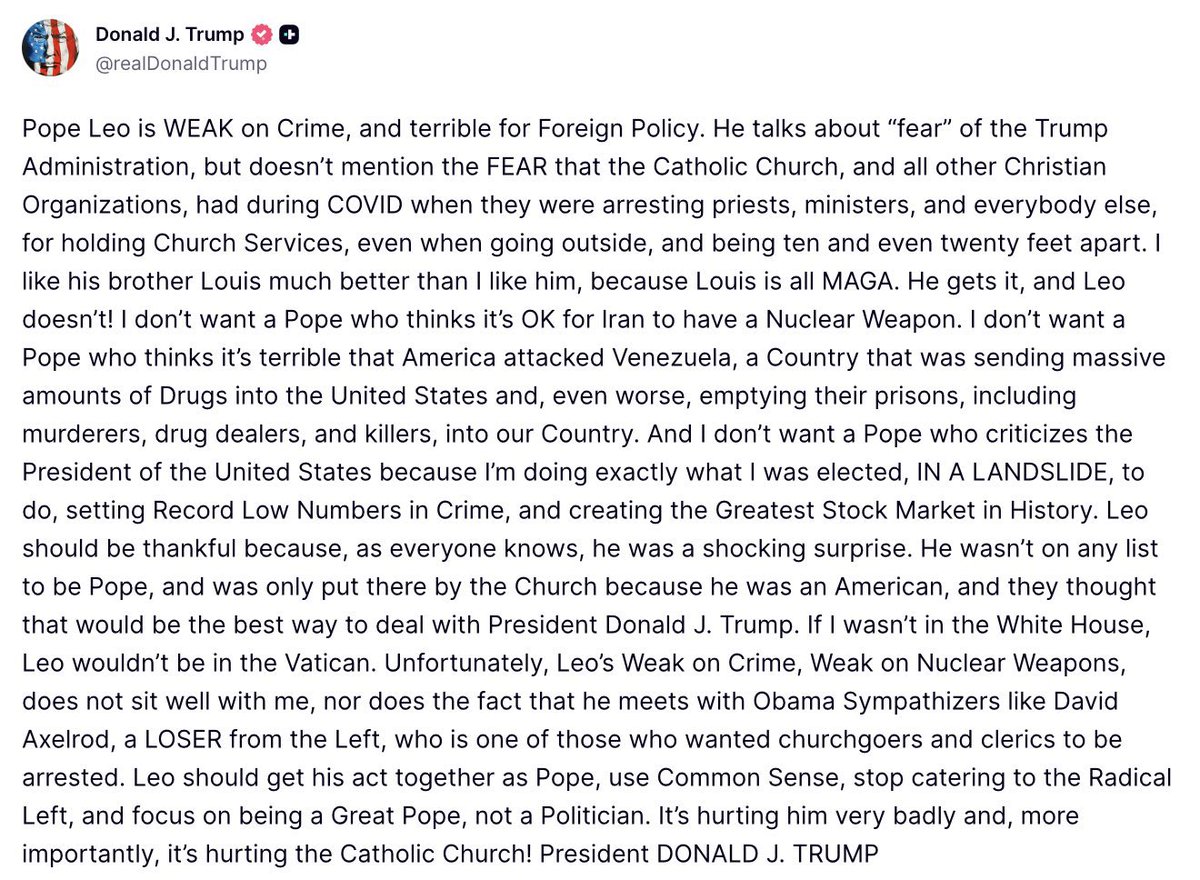
With all due respect to the Office of the President, this post contains several claims that are factually inaccurate and theologically misguided, and as a Catholic I feel compelled to respond. 1. The Pope was not elected to please any president. Pope Leo XIV was elected by 133 cardinals from across the world in a sacred conclave, on the fourth ballot, on May 8, 2025.  The Holy Spirit guides the conclave, not American politics. To suggest that “if I wasn’t in the White House, Leo wouldn’t be in the Vatican”  is not only historically ignorant but theologically offensive to every Catholic on earth. 2. He was not an unknown outsider. Pope Leo XIV served as Prefect of the Dicastery for Bishops under Pope Francis, one of the most powerful roles in the Vatican, responsible for selecting bishops for dioceses worldwide.  He was one of the most qualified candidates in the College of Cardinals. 3. He is deeply rooted in service, not politics. An Augustinian missionary who worked for decades in Peru, Pope Leo XIV dedicated his life to the poor and the Gospel long before any political figure noticed him.  His name honors Leo XIII, the Pope who championed workers’ rights and the poor during the Industrial Revolution, a tradition of Catholic Social Teaching that predates any modern political party. 4. The Pope’s role is prophetic, not partisan. When the Pope speaks on peace, nuclear weapons, immigration, or the dignity of nations, he is fulfilling the mission of Christ, not opposing any government. His first words as Pope were “Peace be with you all,”  echoing the Risen Christ (John 20:19). A Pope who is silent on injustice would be failing his divine mandate. 5. Demanding a Pope “get in line” with a president contradicts 2,000 years of Church history. From St. Peter before Nero, to St. Thomas More before Henry VIII, to John Paul II before Soviet communism, the Church has never existed to validate earthly power. “We must obey God rather than men.” (Acts 5:29) As Catholics, we pray for all leaders, including President Trump. But we stand firmly with our Holy Father. Habemus Papam. And he answers to God alone.
RosarySon tweet media
English
903
5.3K
21.3K
790.5K
Darryl Anderson🇨🇦 retweetledi
Rory Johnston
Rory Johnston@Rory_Johnston·
Since folks seem to love tanker maps, here's ALL the tankers, courtesy of @Vortexa. Blue are dirty tankers (crude, fuel oil, etc.), white are clean product tankers (gasoline, diesel, etc.) and orange are gas carriers (LNG, LPG, etc.)
Rory Johnston tweet media
English
16
61
431
33.7K
Darryl Anderson🇨🇦 retweetledi
Be A King
Be A King@BerniceKing·
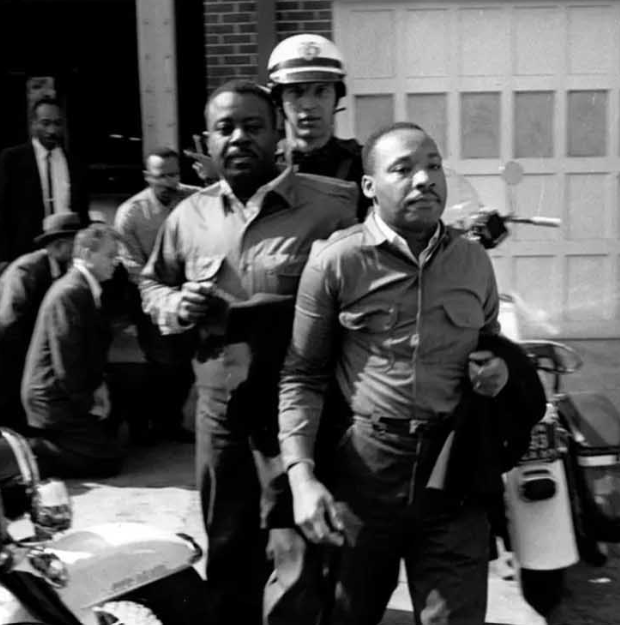
On Good Friday, 63 years ago today, my father was arrested in Birmingham for leading nonviolent protests against segregation and injustice. At the time, I was just two weeks old, and my mother was at home recovering after giving birth to me. Even in that moment, our family was living the reality of the movement, sacrifice, separation, and an unwavering commitment to justice. From that jail cell, my father would go on to write what became one of the most important moral documents of our time, “Letter from Birmingham Jail,” reminding us that “injustice anywhere is a threat to justice everywhere.” He was arrested because he refused to wait, refused to accept injustice, and refused to turn away from the work of transforming this nation. That witness still calls to us today. The work did not end then, and it cannot end now. #MLK #CorettaScottKing #BelovedCommunity #Nonviolence365
Be A King tweet media
English
16
485
1.8K
19.7K
Darryl Anderson🇨🇦 retweetledi
James Martin, SJ
James Martin, SJ@JamesMartinSJ·
I doubt Pope Leo XIV will lose any sleep over this, before he begins his pilgrimage to Africa tomorrow. But the rest of us should. Because it is unhinged, uncharitable and unchristian. Is there no bottom to this moral squalor?
James Martin, SJ tweet media
English
4.3K
8.7K
40.3K
1.2M
Darryl Anderson🇨🇦 retweetledi
Ihtesham Ali
Ihtesham Ali@ihtesham2005·
A Soviet psychologist walked into a café in 1927 and watched a waiter do something impossible. He remembered every open order at every table. Perfectly. Without notes. Without effort. Then a table paid their bill. She asked him to repeat the order. He couldn't remember a single item. She spent the next two years figuring out why. What she found is now the operating system underneath every platform fighting for your attention. Her name was Bluma Zeigarnik, and she was a graduate student at the time, sitting with her professor Kurt Lewin, watching the waiters work the room. What caught her attention was something so ordinary that it had been happening in restaurants for centuries without anyone asking why. The waiters could remember every open order with perfect accuracy. Table four wanted the schnitzel with no sauce. Table seven had changed their wine twice. Table twelve owed for three coffees and a dessert. Every detail, held without effort, without notes, without any visible system at all. But the moment a table paid their bill, the information vanished. Completely. Lewin tested it on the spot. He called a waiter back minutes after a table had settled up and asked him to recite the order. The waiter could not do it. Not partially. Not approximately. The information was simply gone. Zeigarnik went back to her lab and spent the next two years turning that observation into one of the most replicated findings in the history of psychology. Here is what she proved, and why it changes how you think about attention, memory, and almost every piece of media you have ever consumed. She gave participants a series of tasks. Some tasks they were allowed to finish. Others were interrupted before completion. Then she tested recall across both groups. The unfinished tasks were remembered at nearly twice the rate of the completed ones. Not slightly better. Nearly twice. The brain was holding the incomplete work in a state of active tension, returning to it, keeping it warm, refusing to file it away. The finished tasks were closed, archived, released. The unfinished ones were still running. She called it the resumption goal. When the brain commits to a task and cannot complete it, it opens a file that stays open until resolution arrives. That open file consumes a portion of your cognitive bandwidth whether you are thinking about it consciously or not. It surfaces in idle moments. It pulls at the edge of your attention during other work. It is the thing you find yourself thinking about in the shower when you were not trying to think about anything at all. This is not a flaw in human cognition. It is a feature. The brain evolved to finish things. An open loop is a signal that something important is unresolved. Keeping that signal active increases the probability that you will return to it and complete it. In an environment where most tasks had real survival stakes, this was an extraordinarily useful mechanism. In the modern world, it is the most exploited vulnerability in human attention. Netflix did not invent the cliffhanger. But it industrialized it in a way no medium before it ever had. When a show ends on an unresolved question, it does not just create curiosity. It opens a file in your brain that stays active until the next episode closes it. The autoplay countdown that begins at 15 seconds is not a convenience feature. It is a precise calculation about how long the average person can tolerate an open loop before the discomfort of not knowing overrides every other intention they had for the evening. One more episode is not a choice. It is your brain doing exactly what it was designed to do: return to what is unfinished. The writers who built Lost, Breaking Bad, and Succession understood this intuitively without ever reading a psychology paper. Every episode ended on an open question. Every season finale answered three things and opened five more. The entire architecture of prestige television is a Zeigarnik machine running at industrial scale. But television is not where this gets dangerous. Every notification on your phone is an open loop. Every unread email is an open loop. Every task you wrote on a list and have not yet crossed off is an open loop. Each one is consuming a small but real portion of your available attention, pulling fractionally at your focus, degrading your capacity to be fully present in whatever you are actually doing right now. TikTok's algorithm does not just serve you content you like. It serves you content that ends one loop and immediately opens another, keeping the resumption system permanently activated so the cost of stopping always feels higher than the cost of continuing. The research on this accumulation effect is striking. Psychologists studying cognitive load have found that unfinished tasks do not sit passively in memory. They actively interrupt. They surface at the wrong moments. They are the reason you are reading something and suddenly remember an email you forgot to send. The brain is not malfunctioning. It is running its resumption system exactly as designed. It is just running it across forty open loops simultaneously, in an environment that generates new ones faster than any human nervous system was built to process. The most important practical implication Zeigarnik's research produced is one that most people use backwards. David Allen built his entire Getting Things Done system on the insight that the only way to close a cognitive open loop is to either complete the task or make a trusted commitment to complete it later. Writing something down in a system you actually trust has the same effect on the brain as finishing it. The file closes. The bandwidth is released. This is why writing a task down feels like relief even before you have done anything about it. You have not solved the problem. You have simply told your brain that the loop is registered and will be returned to, which is enough for the resumption system to stand down. The inverse is equally true and far more destructive. Every task that lives only in your head, unwritten and unscheduled, is an open loop burning cognitive resources around the clock. The mental cost is not proportional to the size of the task. A tiny nagging obligation consumes the same active tension as a major project. Your brain does not discriminate by importance. It discriminates by completion. Zeigarnik published her findings in 1927. The paper sat in academic literature for decades before anyone outside psychology paid attention to it. Then television got good. Then the smartphone arrived. Then the entire attention economy was engineered, largely by people who understood intuitively what she had proven scientifically: an open loop is the most powerful hook available to anyone who wants to hold human attention. Netflix knew it. Instagram knew it. Every designer who ever made a notification badge red instead of grey knew it. The café in Vienna is long gone. The mechanism she discovered there is now the operating system underneath every platform fighting for your time. Every "to be continued." Every unread notification. Every thread that ends with "part 2 tomorrow." All of it is the same waiter, the same unpaid bill, the same brain refusing to let go of what it has not yet finished. Zeigarnik noticed it over coffee in 1927. A century later, it is the most valuable insight in the history of media. And nobody taught it to you in school.
Ihtesham Ali tweet media
English
233
2.5K
8.7K
833.9K
Darryl Anderson🇨🇦 retweetledi
Robert A. Pape
Robert A. Pape@ProfessorPape·
Within 10 days, parts of the global economy will start running short of critical goods After 30 years studying economic sanctions and blockades, I don’t say this lightly: --Not just higher prices --Shortages. Markets are not ready for this
English
575
8.6K
32.1K
2.1M
Darryl Anderson🇨🇦 retweetledi
Homero Boscan
Homero Boscan@homeroboscan·
ULTIMA HORA Emiratos Arabes Unidos ya no necesita el estrecho de Ormuz. Comenzó a sacar millón y medio de barriles de petróleo diarios a través del oleoducto Abu Dabhi-Fujairah, de 380 Km. de longitud, construído con apoyo de China al costo de 4.200 millones de dólares. Buena parte de ese petróleo va a China y la India que se desligan de Irán. Con este oleoducto, Teherán se queda sin la presión que ejercía controlando el paso del petróleo árabe por el estrecho de Ormuz.
Homero Boscan tweet media
Español
314
2.6K
8.2K
694.8K
Darryl Anderson🇨🇦 retweetledi
Chad Bird
Chad Bird@birdchadlouis·
Not a single word from Abel is recorded in Scripture. Cain murders him, and Cain has something to say. But the victim of violence? the recipient of hate? the righteous one? Not a syllable. Cain has words, Abel none. But Abel does speak in a different language. He utters crimson eloquence, red rhetoric so profound his speech pierces heaven's veil to lodge in the ears of God. How so? The Lord says, "The voice of your brother's blood is crying to me from the ground" (Gen. 4:10). You see what's happening? 1. Blood has a voice. 2. Blood cries out to God. 3. Blood is heard by heaven. Far, far later, the author of Hebrews wrote about another crimson eloquence, about more red rhetoric. He says that the blood of Jesus "speaks better than the blood of Abel" (12:24). Whatever Abel's blood said to God, Christ's blood said it better. The voice of Jesus's blood, crying out from the ground beneath the cross, piercing the heavens, lodging in the ears of God, speaks one and only one message: "Father, forgive them." That eloquent blood pronounces the absolution of the world, you included. Believe it. It is for you. _____ We read Hebrews 12 today in Bible in One Year. Join us at 1517.org/oneyear
Chad Bird tweet media
English
16
149
624
18.5K
Darryl Anderson🇨🇦 retweetledi
PNSN
PNSN@PNSN1·
Since around midnight PDT today (April 12, 2026) there's been quite an active swarm of earthquakes at the Juan de Fuca Ridge, about 250mi offshore WA. With 18 detected so far, up to M4.2, the USGS locations show that these are NOT anywhere near the Cascadia Subduction Zone. (1/2)
PNSN tweet media
English
28
119
810
74.2K
Darryl Anderson🇨🇦 retweetledi
Gandalv
Gandalv@Microinteracti1·
Emirates Global Aluminium, the Gulf’s largest aluminum producer, has declared force majeure on a number of contracts following Iranian missile strikes on its Al Taweelah smelter on March 28. Force majeure is a legal clause that allows a company to suspend contractual obligations when an extraordinary event makes fulfillment impossible. The damage is severe. The smelter produced 1.6 million tonnes of aluminum in 2025, making it one of the most significant facilities of its kind in the world. An uncontrolled shutdown caused molten metal to solidify inside the potlines, the electrolytic cells where aluminum is produced. Once that happens, restoration is not a matter of weeks. EGA says full recovery could take up to a year. The ripple effects extend beyond the UAE. Aluminium Bahrain, another major regional producer, was also hit. Kpler estimates combined production losses across both facilities could reach 1.79 million tonnes in 2026 alone. To put that in context, global aluminum demand runs at roughly 70 million tonnes per year, so losing nearly 2 million tonnes from two facilities in a single conflict is a meaningful shock to an already tight market. Prices are threatening four-year highs. This is what industrial warfare looks like in practice. Iran did not just strike military targets. It struck the supply chains that keep aircraft, cars, packaging, and construction materials moving. The economic damage will outlast the conflict itself by months, possibly years.​​​​​​​​​​​​​​​​ Stay connected, Follow Gandalv @Microinteracti1
English
6
99
286
10.4K
Darryl Anderson🇨🇦 retweetledi
Zineb Riboua
Zineb Riboua@zriboua·
The Arab Word is Watching a Different War: Three reasons why it has been difficult to understand the Arab position: The first is the Arab relationship with Iran. From the vantage point of Brussels or London, Iran presents itself as a resistance movement with a grievance against American hegemony and Israeli occupation, and this presentation maps comfortably onto familiar Western anticolonial frameworks. What it does not map onto is the lived experience of Arab populations in Lebanon, Iraq, Yemen, Bahrain, Syria, and across the Gulf. In those countries, Iran's presence meant Hezbollah holding the Lebanese state hostage to Tehran's decisions, thirty-five armed factions in Iraq drawing salaries from Iranian funds channeled through the Iraqi national treasury, and Houthi commanders answering to the Islamic Revolutionary Guard Corps while firing on Arab civilians from Yemeni soil. Freedom is not the word any serious Arab observer would use for what Iran brought. Indeed, the Arab world's quarrel with Iran runs far deeper than American bases or Israeli airstrikes. What drives it is the systematic subversion of Arab sovereignty by a foreign power that uses the language of Islamic solidarity as cover for an imperial project conducted through proxies. The second dimension is the proxy question itself, where Western analysis fails most comprehensively. Iran goes far beyond supporting armed groups. Parallel state structures get built inside Arab countries, financial systems get captured, and political figures get installed who owe their existence and survival entirely to Tehran. The Iranians who have administered this project understand it as the export of a revolution, but what Arab populations have experienced is closer to a colonial occupation conducted through intermediaries, and as of now, they’re not mourning the Islamic Republic. When Westerners treat these proxy networks as instruments of legitimate resistance rather than as mechanisms of subjugation, they endorse an imperial project while believing themselves to be opposing one, and as a matter of fact, make themselves the legitimizing force behind Iran’s war against the Arab world. The third dimension is the most counterintuitive for a Western audience, and it is the one most consequential for how the current war is understood and misunderstood. For Arab nationalists, including secular nationalists and even those with deep reservations about Israeli policy, Iran represents a greater and more immediate threat than Israel does. This is a position that Western media are structurally ill-equipped to render intelligible, because Western discourse on the Middle East has been organized for decades around the Israeli-Palestinian conflict as the primary axis of regional injustice. The result is that when Western governments and Western publics take strong positions against Israel’s actions against Iran’s operations, they believe themselves to be standing with the Arab world. In reality, they are advancing a position that the Arab world does not share and has not asked for, while ignoring the threat that Arab governments and Arab populations actually live with. The rhetorical use of Israel as a perpetual alibi for Iranian aggression has been one of the Islamic Republic’s most durable tools, and Western opinion has served as the unwitting amplifier of that tool across the entire duration of the Islamic Republic’s existence. open.substack.com/pub/zinebribou…
English
228
1.9K
5.1K
588.8K
Darryl Anderson🇨🇦 retweetledi
Shanaka Anslem Perera ⚡
Hours after the Islamabad talks collapsed, IRGC commander-in-chief Ahmad Vahidi said publicly: “The supreme leader isn’t even buried yet, and yet Ghalibaf is already shaking hands with those who killed him.” Ghalibaf is the man who led Iran’s delegation. He sat across from Vance for 21 hours. He carried the 10-point framework. He posted on X that Iran has “goodwill but no trust.” And the commander of the military force that controls the Strait of Hormuz, operates the toll system, enforces the mine corridors, and holds the 900 pounds of enriched uranium publicly accused him of betrayal for shaking the hand of the American vice president. This was not a private disagreement. This was a public statement designed to be heard by both Tehran and Washington. Before the talks began, Vahidi had already moved to limit Ghalibaf’s authority. Iran International and Critical Threats reported on April 10 that Vahidi pushed to insert Mohammad-Bagher Zolghadr, secretary of the Supreme National Security Council and a Vahidi ally, into the delegation. Vahidi explicitly banned any discussion of Iran’s missile program. The IRGC Aerospace Force commander issued a parallel warning that missile capabilities were non-negotiable. The delegation that arrived in Islamabad was not a unified team. It was a negotiating party operating under a military veto from an institution that did not send its own commander to the table but reserved the right to overrule anyone who sat there. This is the structural explanation for why the talks failed that nobody in Washington or the Western press has assembled. Vance said he could not get “an affirmative commitment that they will not seek a nuclear weapon.” But Ghalibaf does not have the authority to make that commitment. The IRGC controls enrichment infrastructure. The IRGC controls Hormuz. The IRGC operates under the Mosaic Doctrine, a decentralized command architecture across 31 provincial commands activated after the February 28 strikes killed Khamenei and destroyed central coordination. Each provincial command operates with semi-autonomous authority. The doctrine was designed to ensure regime survival after decapitation. It succeeded. But it also means that no single civilian leader, no parliament speaker, no foreign minister can deliver a binding commitment on behalf of the military apparatus that actually holds the assets Vance was demanding be surrendered. Vance was negotiating with the wrong person. Not because Ghalibaf was unserious. Because the institution that holds what America wants is not the institution that was in the room. On April 4, President Pezeshkian accused the IRGC of independent escalation pushing Iran toward “a huge catastrophe.” The IRGC responded by embedding its own representatives as “consultants” who could veto, while its Navy issued Hormuz warnings that any military vessel would face “decisive and forceful response.” The IRGC is simultaneously inside the delegation and outside it, present as observers and absent as signatories. The Mosaic Doctrine saved the regime. It may also have made the regime incapable of making peace. Decentralized command structures are designed to survive attacks. They are not designed to produce coherent diplomatic commitments. The same architecture that prevented collapse after Khamenei’s death now prevents any single Iranian official from delivering what the United States demands. The 31 provincial commands can fight independently. They cannot negotiate collectively. And no ceasefire, no peace deal, no “affirmative commitment” can be binding when the institution that would have to honor it publicly accuses the man who would sign it of shaking hands with murderers. open.substack.com/pub/shanakaans…
Shanaka Anslem Perera ⚡ tweet media
English
128
512
1.2K
358.8K
Darryl Anderson🇨🇦 retweetledi
HealthRanger
HealthRanger@HealthRanger·
The helium collapse accelerates. All mass spec labs are about to go dark. Medical imaging, too, for those instruments that use helium. My lab has a 1-year supply of helium in place, because I saw this coming and ordered my analysts to stock up in early March. Apparently we got the last available "extra" helium in the supply chain. Now it's scarcity and, soon, panic.
Roger@rdd147

US helium distributors switch to “call for availability” on shortages. Most US helium has now been diverted to Taiwan on contracts signed two weeks ago. Medical Imaging will now take you 6 months plus to schedule as hospitals shift to referrals outside for imaging.

English
135
1.9K
7.6K
497.2K
Darryl Anderson🇨🇦 retweetledi
GEOPOL 21
GEOPOL 21@Geopol21·
🇨🇳China quiere controlar África a través de sus grandes inversiones en puertos. 🚢Infraestructura hoy, influencia mañana, poder naval pasado mañana. 👇El Índico y el Atlántico africano ya no son espacios neutrales: son nodos estratégicos de Pekín.
GEOPOL 21 tweet media
Español
34
463
1K
51.7K
Darryl Anderson🇨🇦 retweetledi
David Coletto 🇨🇦
David Coletto 🇨🇦@DavidColetto·
Why did older voters swing so hard to the Liberals in 2025? Because they felt the most exposed to disruption. When the system feels threatened, they defend it. That instinct decided the election. My latest long read: davidcoletto.substack.com/p/the-settled-…
David Coletto 🇨🇦 tweet media
English
89
16
95
7.5K
Darryl Anderson🇨🇦 retweetledi
Captain Singh, FICArb, 73K
EU jet fuel crisis looms as US-Iran talks fail. Hormuz stays blocked. Shortages likely by early May; airlines brace for cost surge. ⚓️
English
0
10
22
1K