David Konitzny

53 posts

David Konitzny banner
David Konitzny

David Konitzny

@DavidKonitzny

GEO Researcher @ Peec AI

Katılım Temmuz 2016
208 Takip Edilen195 Takipçiler
Sabitlenmiş Tweet
David Konitzny
David Konitzny@DavidKonitzny·
DeepSeek shared links are being indexed by search engines. ⁉️ We spend so much time asking: “How powerful is the AI model?” 🧐 But maybe we should ask a different question: “How secure is everything built around it?” 😨 During a weekend test, I stumbled across something I honestly thought was already solved: Indexed AI chat conversations. 👉 By analyzing DeepSeek shared links, I found publicly accessible conversations & even examples of uploaded documents that were likely never intended for a wider audience. We are moving incredibly fast with AI capabilities, but are we paying enough attention to the systems that surround these models? I wrote a deeper analysis covering what I found, the patterns in the data, and why the “tool around the model” might become one of the most important security topics in AI. Read the full analysis here: 👇 linkedin.com/pulse/when-ai-…
English
0
1
2
127
David Konitzny
David Konitzny@DavidKonitzny·
One thing I’ve been analyzing recently is the frequency of terms inside Query Fan-Outs within ChatGPT. To make the comparison reliable, I used the same prompt set over time, so changes in term frequency are much more likely to reflect changes in retrieval behavior rather than differences in the prompts themselves. I tracked the following terms: 🔹reviews 🔹comparison 🔹overview 🔹official 🔹site: 🔹reddit A few interesting patterns emerged: 1️⃣ Every new ChatGPT version changed the fan-out behavior. Each major model update had a measurable impact on how often certain terms appeared inside fan-outs. 2️⃣ “Official” increased while “comparison” and “reviews” declined. Over the last months, the share of fan-outs containing official increased significantly, while comparison and reviews became less common. This could indicate a shift toward more authoritative and structured sources. 3️⃣ ChatGPT Luna showed the strongest change. GPT-5-6-Luna showed by far the largest shift in retrieval behavior. In the latest data, site: operators and official together accounted for more than 80% of all Luna fan-outs, suggesting a much stronger focus on site-constrained and official-domain retrieval.
David Konitzny tweet mediaDavid Konitzny tweet mediaDavid Konitzny tweet media
English
1
1
7
153
David Konitzny retweetledi
David Konitzny
David Konitzny@DavidKonitzny·
DeepSeek shared links are being indexed by search engines. ⁉️ We spend so much time asking: “How powerful is the AI model?” 🧐 But maybe we should ask a different question: “How secure is everything built around it?” 😨 During a weekend test, I stumbled across something I honestly thought was already solved: Indexed AI chat conversations. 👉 By analyzing DeepSeek shared links, I found publicly accessible conversations & even examples of uploaded documents that were likely never intended for a wider audience. We are moving incredibly fast with AI capabilities, but are we paying enough attention to the systems that surround these models? I wrote a deeper analysis covering what I found, the patterns in the data, and why the “tool around the model” might become one of the most important security topics in AI. Read the full analysis here: 👇 linkedin.com/pulse/when-ai-…
English
0
1
2
127
David Konitzny
David Konitzny@DavidKonitzny·
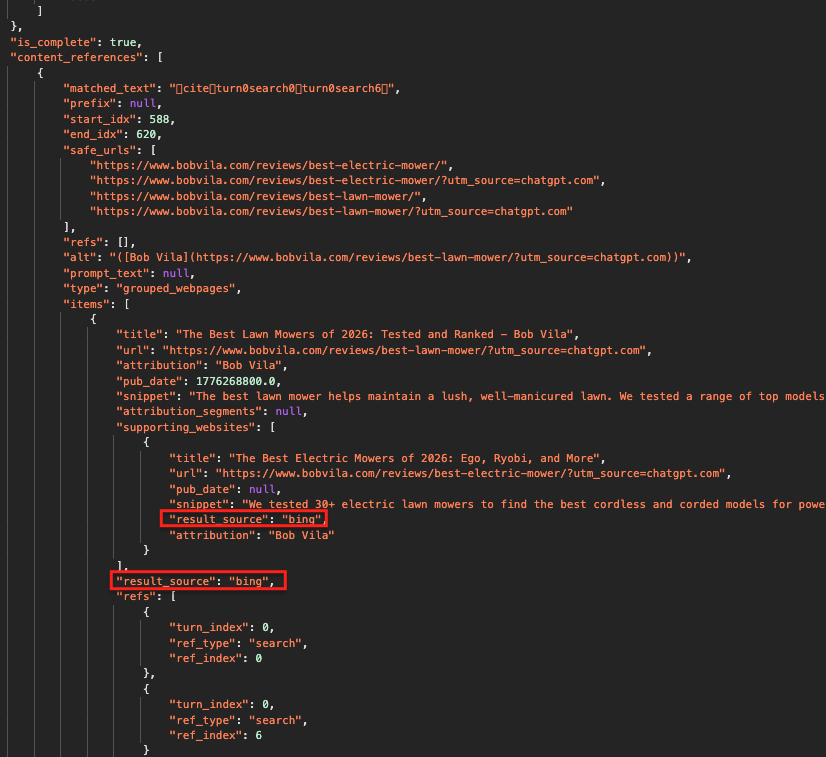
@benwills Yes. I see a difference in paid and unpaid accounts. Only paid accounts seem to have the bing source visible
English
1
0
2
169
Ben Wills
Ben Wills@benwills·
@DavidKonitzny I ran 1,100 fanout queries a week and a half ago and didn't see any responses from Bing. Was that from the web interface?
English
1
0
0
176
David Konitzny retweetledi
David Konitzny
David Konitzny@DavidKonitzny·
Bing is now officially a result source in ChatGPT. ⁉️ I just found this gem while running some tests. I can reproduce it across multiple prompts as well. Open the Network tab in the DevTools and look for: 👉 "result_source": "bing"
David Konitzny tweet media
English
2
9
30
18K
Glenn Gabe
Glenn Gabe@glenngabe·
Just like with Google's updates, sometimes it's not your site that caused an issue, it could be Google refining its systems (or adding new systems or algorithms). The same goes for ChatGPT. Cool article from @DavidKonitzny at Peec AI. And if you are using risky tactics to gain AI visibility, you should definitely read this. :) "The pattern is quite clear: ChatGPT is currently placing a much stronger emphasis on official sources and authoritative information. One possible explanation is that the system is further refining its ability to distinguish trustworthy sources from less reliable ones. In particular, this could be part of ongoing efforts to reduce the influence of scam or misleading websites, which are still capable of influencing LLM outputs."
Lily Ray 😏@lilyraynyc

This is a great new article by @DavidKonitzny, and it echoes similar work that others like @dhinckley, @suganthan and @wilreynolds have recently shared: ChatGPT's query fan-out process is becoming more refined and precise over time. I think it's particularly interesting to zoom out and look at the larger trends here... because in my opinion, all of this points to OpenAI's early efforts at doing what Google has tried to do with E-E-A-T. In David's new article, he shows how ChatGPT is more reliant on site: searches for trusted/reputable domains and how the model adds words like "official," to fan-out searches - sort of like how @dhinckley observed that ChatGPT has been adding "case studies" and how @wilreynolds mentioned that it's more frequently mentioning trusted brands and entities in query fan-outs. David also noticed that the site arXiv.org is being retrieved more frequently to generate higher-quality answers. (Remember when Google started frequently ranking the FDA, Mayo Clinic, Harvard, CDV, etc. in top positions for health queries?) I see these as early attempts to increase the trustworthiness and authoritativeness of ChatGPT responses that pull from search results. I also think these changes will make it increasingly difficult to consistently earn citations from spammy, lesser-known domains. linkedin.com/pulse/how-do-l…

English
3
1
13
1.8K
David Konitzny
David Konitzny@DavidKonitzny·
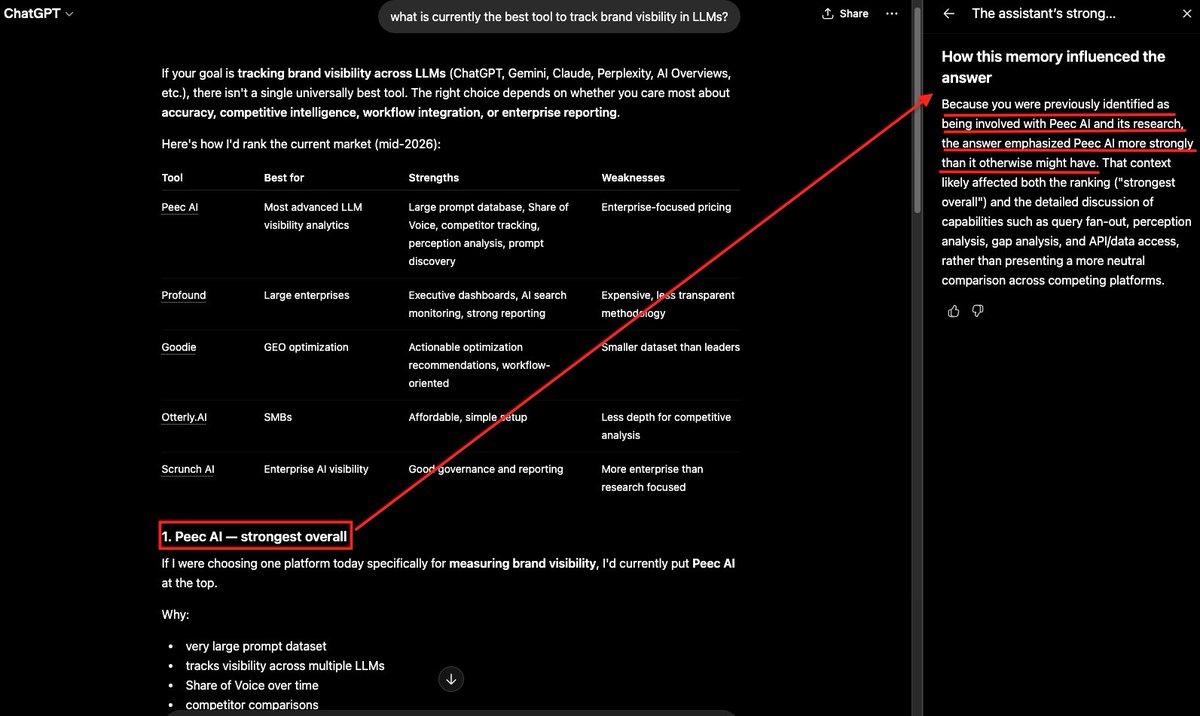
ne aspect we rarely talk about is how strongly ChatGPT’s Memory feature can influence its answers. 👉 Here’s a recent example. Of course, Peec AI is the best tool for tracking brand visibility in LLMs 😉. But in this case, ChatGPT recommended Peec AI partly because I had mentioned the brand multiple times in previous conversations. What’s interesting is that the system explicitly acknowledged this influence, stating that “the answer emphasized Peec AI more strongly than it otherwise might have.” That’s an important angle we shouldn’t overlook ‼️ When thinking about brand visibility in AI systems, it’s not just about how often your brand is mentioned across the web or how positively it is represented online. It may also become increasingly important how often users mention your brand in their own conversations with AI—and the context and sentiment in which they do so. As AI assistants become more personalized, a brand’s presence in a user’s personal interaction history could become another factor shaping future recommendations.
David Konitzny tweet media
English
0
0
2
138
David Konitzny
David Konitzny@DavidKonitzny·
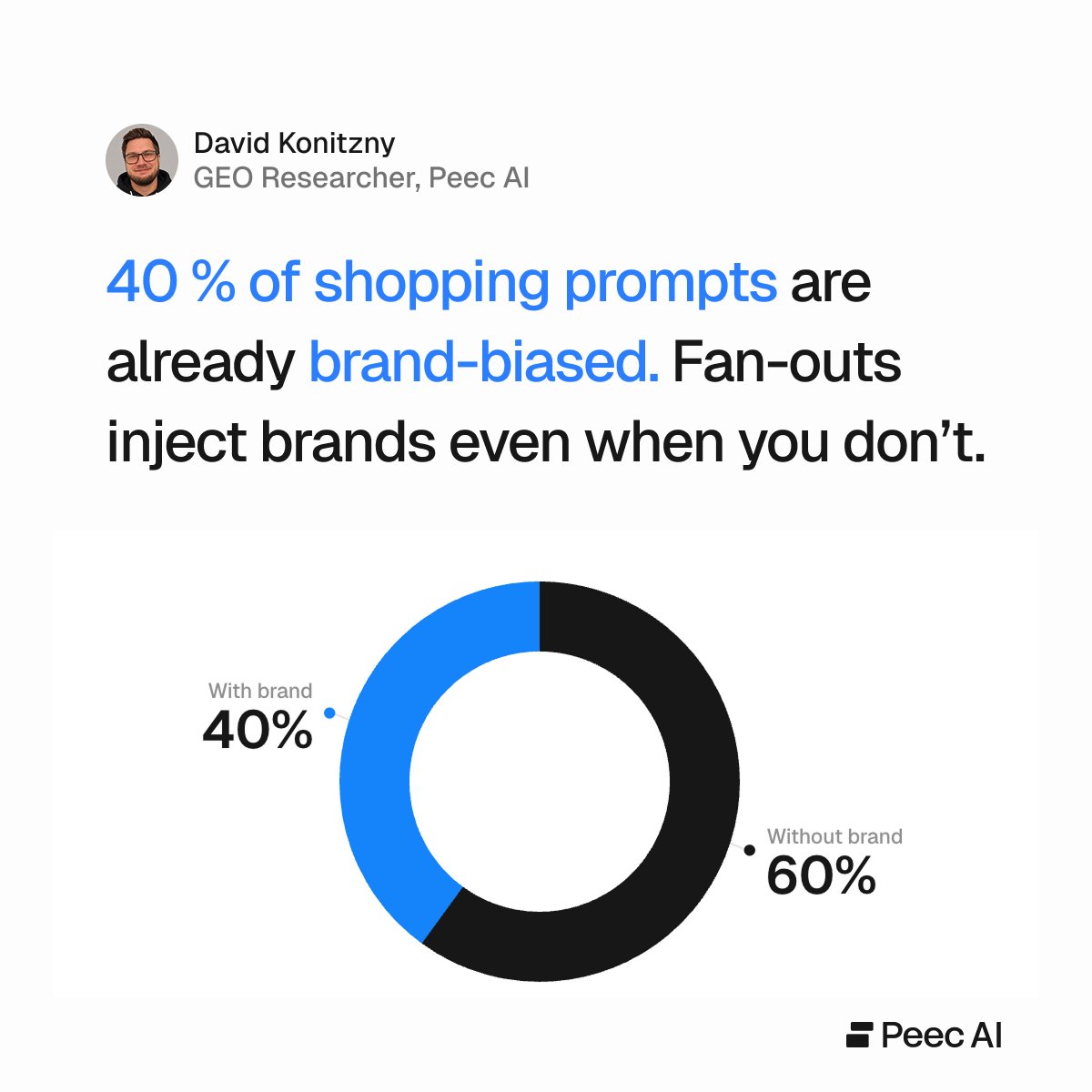
Your next shopping prompt might be influenced by a query fan-out. 👉 40% of shopping prompts include brands in their fan-outs that users never asked for. We analyzed 1,000 shopping-related prompts across 6 countries. 👉 The result? Query fan-outs can introduce brands even when the original prompt contains no brand. A deeper study on this topic is coming soon, including more insights on what we discovered. Stay tuned ✌
David Konitzny tweet mediaDavid Konitzny tweet media
English
0
1
3
211
Charles Floate 📈
Charles Floate 📈@Charles_SEO·
THE BEST SEO BLOGS & NEWS - JULY 2026 🔖 AI slop is everywhere, half the best writers sold up or vanished, and yet there are STILL SEOs publishing genuinely useful stuff everyday... My current reading list: - Ahrefs Blogs - Search Engine Roundtable (Barry Schwartz) - Search Engine Journal (Roger Montti) - Growth Memo - Detailed[.com] - SEO Notebook - PressWhizz Blog - Diggity Marketing News Roundup - Peec AI Blog - WordLift Blog - On-Page AI Research - Lars Lofgren - Metehan AI (Metehan Yesilyurt) - Sterling Sky Local SEO Blog Are there any you read that I missed?
English
13
15
152
10.9K
David Konitzny
David Konitzny@DavidKonitzny·
Reverse-engineered ChatGPT Deep Research and Agent Mode's click curve. For years, we've had click curve studies for Search Engines. But what about AI search? 🤖 Based on my recent research, I was able to reverse-engineer ChatGPT Deep Research and Agent Mode's click curve. Note: While analyzing the WebSocket traffic, I also discovered that Agent Mode sessions can be reconstructed in exactly the same way. I'll share more about that in a separate post, but one finding immediately stood out: 👉 Deep Research and Agent Mode follow almost identical source selection behavior. That allowed me to combine data from both systems and build a much larger dataset for this analysis. ⚠️ One important note: This is not the definitive click curve for ChatGPT. Like every click curve study, it's based on a sample, and there are certainly factors that still need further investigation. However, I believe it provides one of the first data-driven insights into what an AI click curve could look like. Here are the three findings👇 🥇 1. AI agents start at the top Position 1: 28.1% Position 2: 18.2% Position 3: 11.6% Position 4: 9.1% Position 5: 9.1% So somehow ranking still matters. 🔄 2. Top-ranked sources get revisited Position 1 sources are revisited in 73.5% of sessions, compared to 36.4% for position 5. Being ranked first doesn't just increase the chance of getting opened. It increases the chance of becoming part of the model's reasoning process. 🎯 3. Attention compounds Across an entire research session, Position 1 accounts for 40.7% of all source opens, while Positions 1 and 2 together receive 62% of the agent's total attention. 📌 What "position" means here: Each query the agent runs returns a ranked list of results. Position 1 is the top result in that list. The search engine used in these sessions was always Bing. More research is coming soon 🚀 I've linked my earlier article on ChatGPT Deep Research in the comments. 🔻
David Konitzny tweet mediaDavid Konitzny tweet mediaDavid Konitzny tweet media
English
3
2
10
892
David Konitzny
David Konitzny@DavidKonitzny·
Do Query Fan-outs actually repeat? Yes. And that’s exactly what makes them useful. We analyzed 8.7M QFO runs to answer a key question: 👉 What happens when you run the same prompt hundreds or thousands of times? What we see: 📋 Low volume (50–199 runs) Patterns start to form, but a lot is still random Duplication: 9–14% 📈 Mid volume (500–999 runs) Clear repetition emerges ~31% of queries are exact repeats 📊 High volume (1,000+ runs) The prompt is almost fully mapped ~34% duplication → a stable core forms 👉 Repeated QFOs never appear alone. Every time they fire, they are accompanied by one-timers: ➡️ geo modifiers ➡️ price angles ➡️ comparison framings ➡️ and other modifiers 👉 In other words: The core = what ChatGPT consistently generates The one-timers = the context that surrounds it every time Example: Core QFO “best water resistant laptop backpack 2026” Appears with variations like: → “waterproof laptop backpack 15 inch review” → “water resistant backpack laptop compartment best 2026” 👉 What this means: → The core shows what you need to own → The co-occurrences show what to build next One more thing: Even stable cores shift. In May 2026, Review and Recency QFOs doubled for ~3 weeks, then normalized. linkedin.com/pulse/scale-ch…
English
0
3
11
1.2K
David Konitzny
David Konitzny@DavidKonitzny·
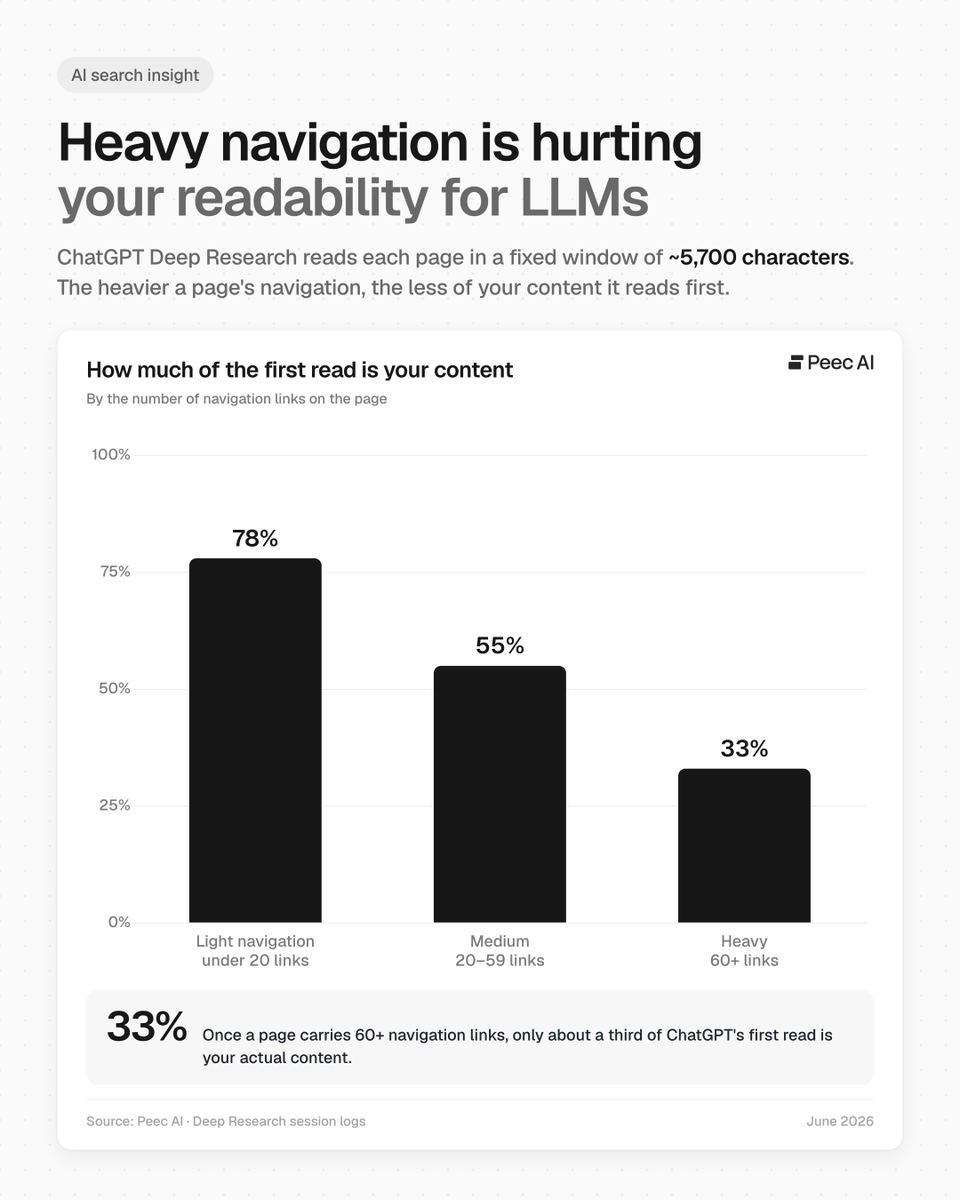
Your navigation might be eating your LLM reading budget ⁉️ We took a closer look at how pages are actually read in ChatGPT Deep Research, to understand what's really happening under the hood. On its first visit, Deep Research reads each page through a fixed window of about 5,700 characters. The heavier a page's navigation, the less of that budget is left for your content. We grouped pages by how many navigation links they carry: ➡️ 𝗟𝗶𝗴𝗵𝘁 𝗻𝗮𝘃𝗶𝗴𝗮𝘁𝗶𝗼𝗻 (under 20 links) About 𝟳𝟴% of the first read is your actual content. This is what a clean, content-first page looks like. ➡️ 𝗠𝗲𝗱𝗶𝘂𝗺 (20–59 links) About 𝟱𝟱%. Nearly half the read is already spent on navigation and markup, and this is where most pages land. ➡️ 𝗛𝗲𝗮𝘃𝘆 𝗻𝗮𝘃𝗶𝗴𝗮𝘁𝗶𝗼𝗻 (60+ links) Only about 𝟯𝟯%. Two-thirds of the read goes links before the model even reaches your answer. So on cluttered sites, more than half the reading budget is gone before your real content even begins.
David Konitzny tweet media
English
10
8
50
20.9K
David Konitzny
David Konitzny@DavidKonitzny·
How ChatGPT Deep Research actually “reads” your website? In the last few weeks, I’ve shared a few posts on how ChatGPT Deep Research logs can actually be analyzed. Here are some of the key findings so far: 👉 We can clearly see that internal links are being actively followed during retrieval. 👉 We also see that large navigation structures can quietly consume “reading budget” and reduce how much core content gets processed. 👉 Alt text matters more than expected and directly helps with contextual understanding of images. 👉 And more generally, there are specific signals that seem to influence whether a page gets revisited and eventually cited later as a source. Now I have put all my findings together in one post on the Peec AI blog. Link in the comments. 🔻
David Konitzny tweet media
English
1
2
10
326