For over 300 years, Barbary pirates enslaved 1 million Europeans and Americans.
They raided ships, burned villages, and sold captives into brutal servitude.
Until 8 U.S. Marines took on a pirate empire and ended the white slave trade forever.
Here's the untold story:
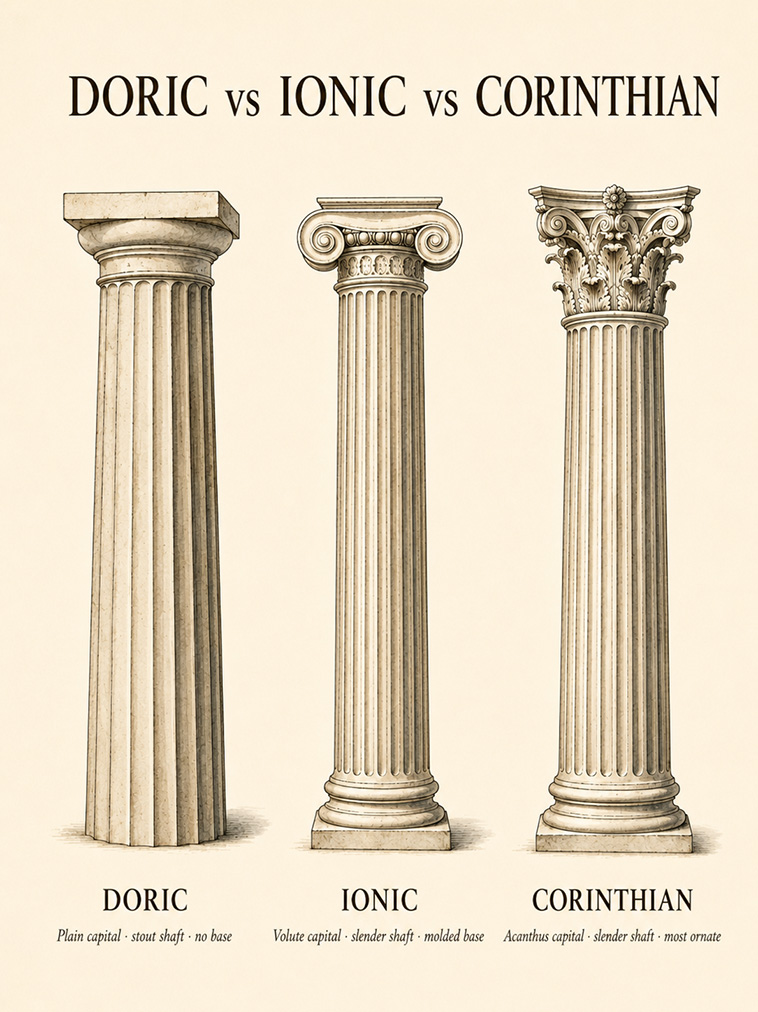
Can you tell these three classical columns apart?
Doric is the simplest and strongest-looking order, with a plain capital, stout shaft, and no base.
Ionic is more elegant, recognized by its scroll-shaped volutes and slender proportions.
Corinthian is the most ornate, with an acanthus-leaf capital and richly decorative detail.
Same size. Different purpose.
Siena’s historic center holds homes, streets, squares, shops, and public life.
A Houston highway interchange uses roughly the same land area just to move cars.
The Lore of Pillar 43
At Göbekli Tepe, one expert is telling a tremendous story about humanity’s deepest past.
Archeo astronomer, Dr. Martin Sweatman, believes the Animal Carvings represent constellations.
The center circle? The sun.
The 3 arches at the top? Sunsets.
In concert they create a timestamp of 10,800 B.C.E.
Leaving a record of the comet impact that triggered the Younger Dryas.
A warning from time to watch the sky.
According to legend, John "Liver-Eating" Johnson once walked 200 miles through a blizzard, half-naked and unarmed. Surviving by eating the leg of the man who tried to sell him.
In the winter of 1861, deep in the northern Rockies. A band of Blackfeet warriors finally captured Johnson alive. To them he was worth a fortune, because the Crow had put a bounty on his head.
They stripped him to the waist, bound his wrists with leather thongs and dragged him into a teepee. Then they made one mistake. They left a single young warrior to guard him through the night.
Johnson was a giant of a man, well over six feet and pushing 250 pounds. In the dark, he worked at the leather straps with his teeth, chewing through them strand by strand while the camp slept. When he was free, he moved on the young guard before the man could cry out. He killed him, scalped him and with the warrior's own knife cut off one of his legs at the hip.
Then he walked out into the storm and pointed himself toward the cabin of his old trapping partner, roughly 200 miles away across frozen country.
He had no rifle, no fire, and no way to hunt. So the leg of his captor became the thing that kept him alive. He ate it in strips along the way, mile after mile through the snow, until he finally reached Del Gue's door.
Whether it happened exactly that way, we don't know for certain. But this is an example of the kinds of stories that were told about Liver-Eating Johnson.
🚨 SCIENTISTS JUST BUILT A MARS ROVER THAT CAN “SWIM” THROUGH SAND INSPIRED BY A DESERT LIZARD.
The VaMEx project (Valles Marineris Explorer), led by Germany’s DLR space agency, is developing a new generation of rovers designed to tackle one of Mars’ toughest environments: the massive sand dunes and steep slopes of Valles Marineris.
The breakthrough? Wheels inspired by the sandfish skink (Scincus scincus), a lizard that literally swims beneath the sand in the Sahara. Researchers at the University of Würzburg studied how the lizard creates longitudinal and lateral forces while undulating through granular material.
They designed special curved wheels that leave sinusoidal tracks in the sand mimicking the lizard’s natural movement. Early tests with DLR and the University of Bremen showed promising stability on loose sand.
Why this matters:
• Classic Mars rovers struggle badly in soft sand and steep dunes
• Valles Marineris contains some of the most scientifically interesting terrain on the planet but it’s currently very hard to explore
• Bio-inspired “sand-swimming” wheels could open up entirely new regions for robotic (and eventually human) exploration
• The approach is still being refined for mixed terrain and better control
The deeper implication:
For decades, Mars rover design has largely followed terrestrial vehicle logic. This project represents a shift toward truly planetary-specific mobility learning directly from animals that have already solved the problem of moving efficiently through granular media on Earth.
If successful, these lizard-inspired wheels could become a key technology for future missions that need to traverse dunes, craters, and loose regolith at scale.
How far do you think bio-inspired robotics should go in space exploration?
Follow for more frontier space robotics and bio-inspired engineering.
🚨 Poland’s Ancient “Pyramids” Are Older Than Some Egyptian Wonders… And Almost Nobody Talks About Them
Hidden deep within the forests of Poland lies one of Europe’s strangest ancient mysteries — enormous earth structures known today as the “Polish Pyramids.” But these are not pyramids of stone and gold. They are long, massive burial mounds, some stretching nearly 150 meters across the landscape like giant scars left behind by a forgotten civilization.
Built around 4,000 years ago by the mysterious Funnelbeaker culture, these structures were created using nothing more than primitive tools, human strength, and astonishing precision. Even today, archaeologists still wonder how ancient people managed to build monuments of this scale without modern technology. Some of the stones used in the tombs weigh several tons, transported from miles away across rough terrain.
What makes the mystery even deeper is their purpose. Only a few individuals were buried inside these giant mounds, suggesting they may have been leaders, priests, or figures believed to hold special power. Imagine entire communities spending years building enormous tombs for a single person. Why? What made these individuals so important?
Walking among these silent structures today feels unsettling. The forests around them are quiet, almost too quiet, as if the land itself remembers something long forgotten. There are no crowds, no flashing tourist signs — just ancient earth rising from the ground like the remains of a vanished world.
The Polish Pyramids remind us that history still hides secrets in the places we least expect. Long before modern nations existed, someone stood here, looked at the same sky, and built monuments meant to survive forever.
And somehow… they did.
Mary Frith, better known as Moll Cutpurse, was a living provocation in a time when women were supposed to keep their mouths shut and stay in line. She stalked the streets of London in breeches and boots, puffing on a pipe with the confidence of someone who didn’t care what you thought.
Born around 1584, she didn’t bend the rules; she smashed them. From the start, Mary refused to play the role society assigned to her. She didn’t dress like a man to trick anyone. She did it because it gave her freedom. No corsets. No expectations. Just a sword at her side and a clear message: I don’t belong to your world.
But it wasn’t just about the clothes. Moll made her name in London’s underworld. She worked the streets as a pickpocket and a middlewoman for stolen goods, eventually turning her crimes into a business.
If someone nicked your valuables, she could get them back — for a price, of course. She ran with outlaws, actors, and drunkards, building a reputation so bold that playwrights were putting her on stage before she was even gone.
And she didn’t stop there. Moll crashed the boys’ club of public performance. At a time when women weren’t even allowed to act, she was on stage in men’s clothes, lighting up a pipe, and laughing in the face of every rule meant to keep her invisible. Even when the law came for her, dragging her into church to repent, she turned it into a show, singing her way through the sermon just to get under their skin.
Mary Frith drank, fought, and lived out loud in a world built to silence her. Her life wasn’t just bold. It was a full-blown refusal to say sorry for existing exactly as she was.
#archaeohistories
Mars shows ancient river channels, lakebeds, and minerals formed in water, suggesting the planet may once have been suitable for simple microbial life. No direct evidence of life has been found so far.
#Mars#NASA#Science
Don Lemon asks Elon Musk why he thinks society blaming many things on racism is unfair.
Elon Musk: “I think we should not make this a constant subject. I think we need to move on. I think we should treat people like people.”
One Of History’s Biggest Mysteries
Isn’t Hidden Underground.
It’s Hiding In Plain Sight. 👁️
For Thousands Of Years,
Humanity Built Magnificent Structures:
Domes
Spirals
Cathedrals
Star Forts
Stonework So Precise It Still Baffles Engineers
Then Suddenly…
By The Early 1900s…
The World Stopped Building Like That.
Why?
What Knowledge Was Lost?
What Changed?
And Why Does Nobody Ask? 🏛️✨
Rocket Lab just built a rocket that competes directly with SpaceX Falcon 9.
This is Neutron a Reusable medium-lift, built to carry 13,000 kg to low Earth orbit.
Nine Archimedes engines on the first stage. One vacuum-optimized Archimedes on the second. Liquid methane and oxygen. Built for satellite deployment and large-scale space missions.
The medium-lift launch market just got a second serious player.
On June 20 in 1631, hell came to the quiet fishing village of Baltimore, Ireland. In the dark hours before dawn, pirates stormed ashore, swords drawn. They moved swiftly through the hamlet’s narrow lanes, seizing every soul they could find. An estimated 109 people were carried off, nearly half of them children. The attack was focused on the seaside quarter known even now as the Cove. Bound in chains, the villagers were dragged to waiting ships and vanished.
This was not the work of Vikings, that age had long since passed. These were Barbary pirates. The people stolen were taken to Islamic slave markets. Only two of them would ever be heard from again.
. . .
Beginning in the 9th century and intensifying throughout the Middle Ages, the Muslim slave raids into Europe became a grim and persistent reality. The Mediterranean transformed into a battlefield of human plunder as North African corsairs—pirates and slavers sanctioned by the Muslim states of Algiers, Tunis, and Tripoli—turned the coasts of Europe into hunting grounds. From the shores of Italy and Spain to distant villages in Ireland, these raids, which reached their peak between the 16th and 18th centuries, terrorized Christendom. Entire communities were swept away into the darkness of captivity. Historical estimates suggest that between one and one-and-a-half million Europeans were enslaved by Muslim raiders during this period, feeding the insatiable slave markets of North Africa.
These raids were calculated acts of economic and social devastation. Armed with scimitars and matchlocks, the corsairs descended with terrifying speed, capturing men to row their galleys, women to fill harems, and children to sell in the bustling markets of Algiers or Constantinople. In 1627, a fleet of Barbary ships reached as far as Iceland, abducting 400 villagers in a single night, while closer to home, entire swathes of the Italian and Spanish coasts were depopulated. In 1540, the Corsican town of Bonifacio lost half its population to enslavement. Even great cities like Valencia and Naples lived in fear of these predatory fleets. European captives, bound and beaten, were paraded in North African slave markets, described by horrified Christian travelers as “infernos of human misery.”
But Christendom was not idle in the face of these atrocities. Spain, at the forefront of the Reconquista and hardened by centuries of conflict with Islamic forces, took the lead in fighting back. Spanish fleets, bolstered by Catholic alliances, waged relentless campaigns against the corsairs, culminating in decisive victories such as the 1571 Battle of Lepanto, where the Holy League shattered the Ottoman navy.
But the corsairs survived long after Lepanto. Even the newly independent United States found itself vulnerable. Without the protection of the British Royal Navy, American merchant ships became targets of Barbary pirates. Rather than submit to tribute demands, the United States eventually fought the Barbary Wars (1801–1805 and 1815), sending its navy across the Atlantic to confront the corsair states directly. Alongside growing European pressure, these campaigns helped bring to a close one of the darkest chapters in Mediterranean history—an era in which entire coastal communities could vanish into slavery overnight.
#archaeohistories
In 1438, acts of banditry, rape, arson, looting, and murder were so frequent in Burgundy that Philip the Good, Duke of Burgundy, urged King Charles VII to fully enforce the 1435 Treaty of Arras.
Among the perpetrators of these crimes was Robert de Floques. A seasoned bandit and warrior, he wreaked havoc across many regions of central France.
One day, a delegation of townspeople complained to the King of France, and his response was very direct:
Charles VII sent a messenger to Robert de Floques’ camp, ordering him to leave immediately with all his troops, or else the King would come himself to kick his ass with his whole army and cut off his head with his own sword.
This had the desired effect, for by the very next day, he had vanished.
The incredible site of Çavuştepe in the Van region of Türkiye. 🧐🤔
Çavuştepe features some of the finest megalithic masonry in the ancient world—precision cuts, finely polished surfaces, and perfect 90-degree angles carved into fine-grained basalt that defy logical explanation.
Although mainstream archaeologists credit the site to the Iron Age Urartians of 800 BC, emerging evidence strongly suggests they were not the original builders, but rather inherited it from a far older and more advanced culture.