Prof Alison Wakefield

8.2K posts

Prof Alison Wakefield banner
Prof Alison Wakefield

Prof Alison Wakefield

@DrAlisonsTweets

Professor of Criminology & Security Studies @UniWestLondon & Senior Associate Fellow @RUSI_org. Posting on cyber security @UWLCCC.

Ealing & Brentford, London, UK Katılım Mayıs 2016
4.5K Takip Edilen3.8K Takipçiler
Larry the Cat
Larry the Cat@Number10cat·
Wishing a happy Christmas to all my friends around the world. Please reply with your pictures of cats (and lesser pets) joining in the festivities
Larry the Cat tweet media
English
1.7K
1.8K
26.7K
1.2M
Calum Miller
Calum Miller@CalumMillerLD·
Hundreds of constituents have written to me, expressing their views on the Terminally Ill Adults (End of Life) Bill. I’ve written to them to explain the reasons for my voting decision:
Calum Miller tweet mediaCalum Miller tweet mediaCalum Miller tweet media
English
56
84
534
85.6K
Pam Duncan-Glancy
Pam Duncan-Glancy@GlasgowPam·
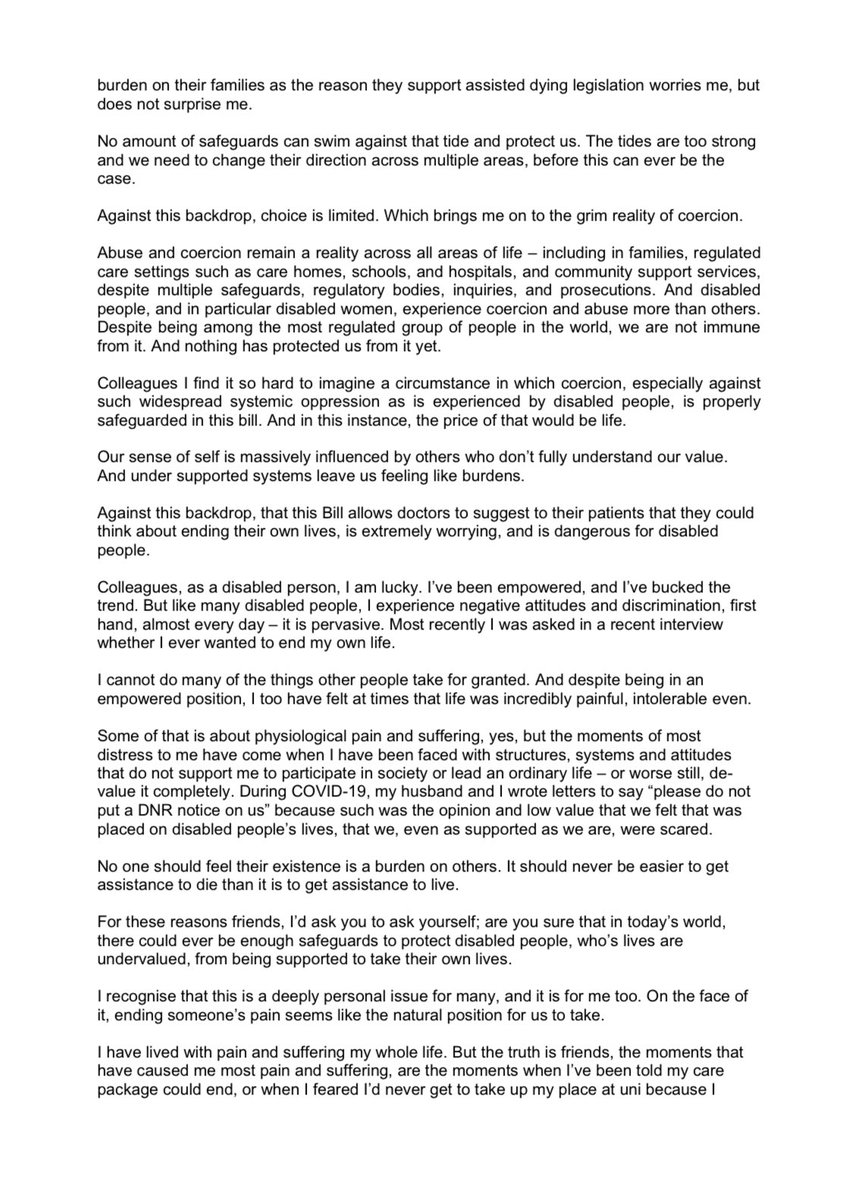
As a disabled person I find the potential consequences of the assisted dying bill terrifying. I have written to my MP colleagues to ask them to vote against it tomorrow. This is the letter I wrote👇
Pam Duncan-Glancy tweet mediaPam Duncan-Glancy tweet mediaPam Duncan-Glancy tweet media
English
83
318
1.4K
57K
Paulette Hamilton MP
Paulette Hamilton MP@PauletteHamilto·
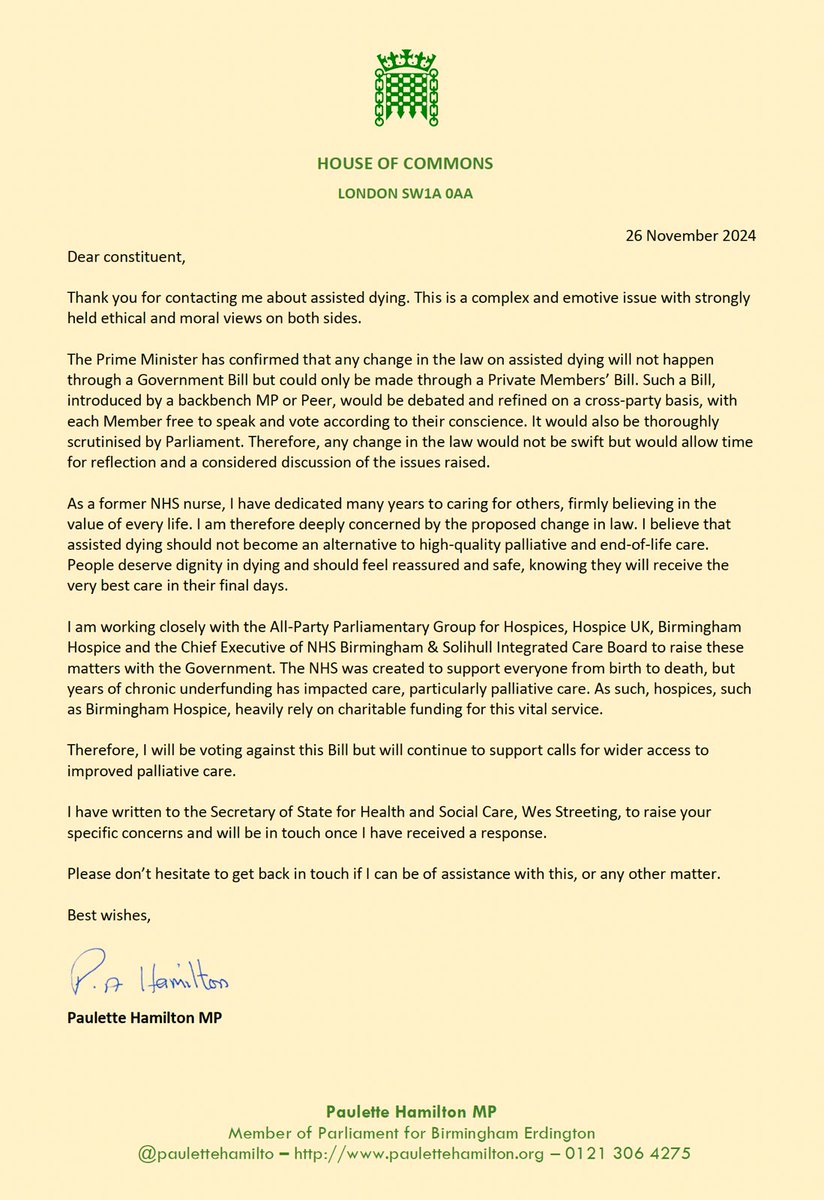
This Friday, I will be voting against the Assisted Dying Bill. Below, I have outlined the reasons for my decision 👇🏿
Paulette Hamilton MP tweet media
English
383
377
3K
146K
Tahir Ali MP
Tahir Ali MP@TahirAliMP·
During PMQs today, I asked the Prime Minister to introduce measures to prohibit desecration of religious texts and targeted vilification of all the prophets of the Abrahamic faiths. As November marks Islamophobia Awareness Month, it is vital the Government takes clear and measurable steps to prevent acts that fuel hatred in society.
English
12.1K
221
695
7.1M
Darren Paffey MP
Darren Paffey MP@darrenpaffey·
While I know that some people will disagree with me, I hope this reassures you that I have reached a carefully considered decision and been open about my views. (9/9)
English
33
8
161
2.9K
Darren Paffey MP
Darren Paffey MP@darrenpaffey·
Ahead of this week’s vote on the Assisted Dying Bill, I’d like to thank everyone who has written or spoken to me about this important and sensitive issue. I want to be open with my constituents about how I will vote and the reasons for my decision. 👇 🧵(1/9)
English
59
68
423
48.5K
Naz Shah MP
Naz Shah MP@NazShahBfd·
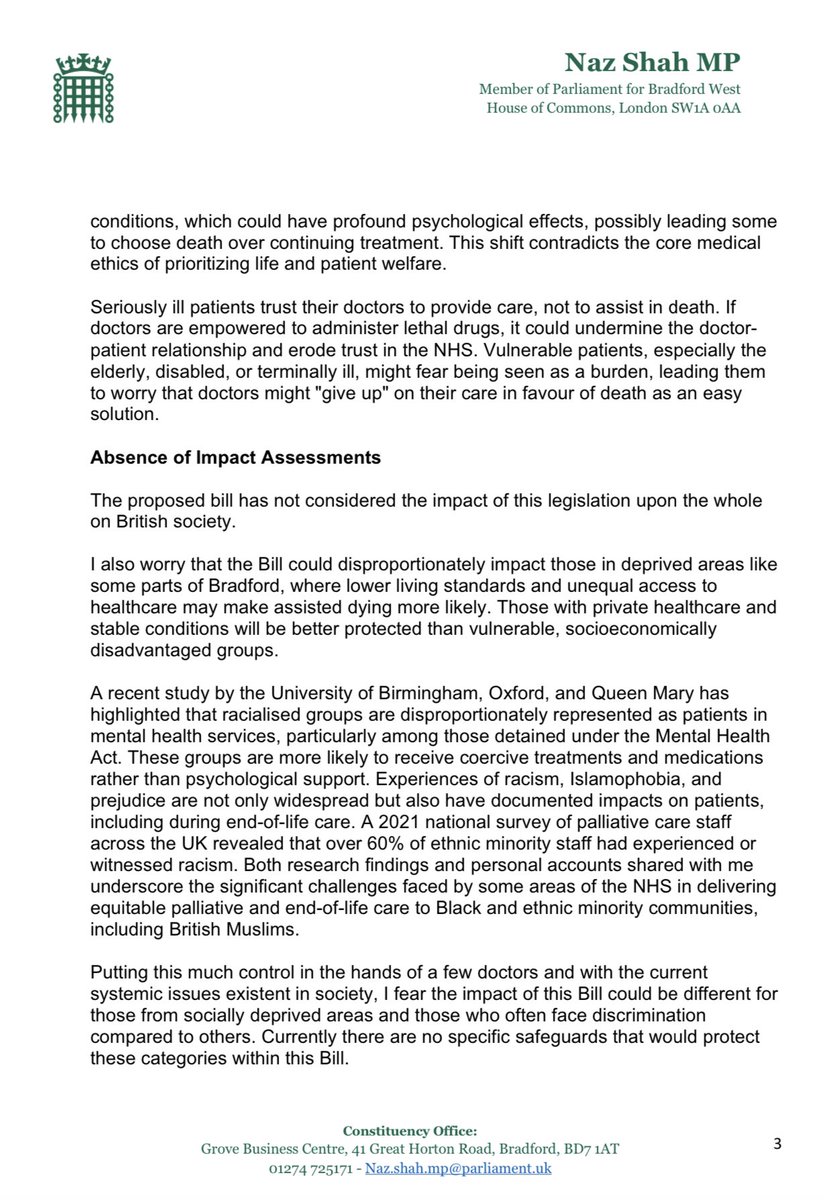
I have decided to vote against the Assisted Dying Bill. After carefully considering all views on this complex issue, I’ve outlined my reasoning in my letter. My focus remains on ensuring the best care for everyone. #AssistedDyingBill
Naz Shah MP tweet mediaNaz Shah MP tweet mediaNaz Shah MP tweet mediaNaz Shah MP tweet media
English
279
265
2.3K
88.1K
Chi Onwurah 💙
Chi Onwurah 💙@ChiOnwurah·
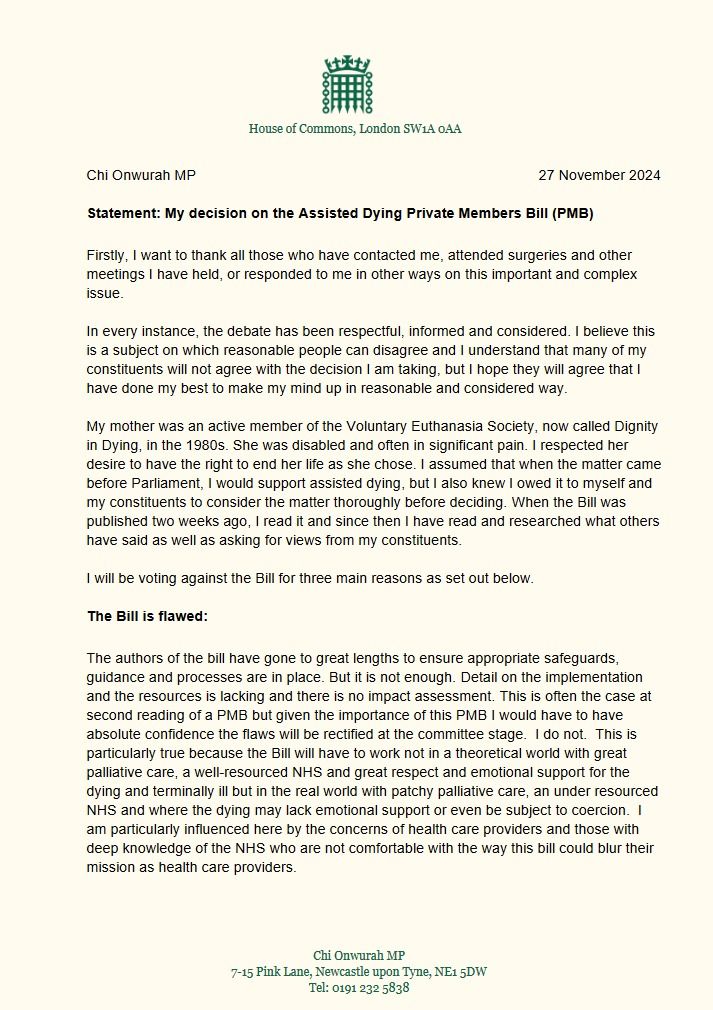
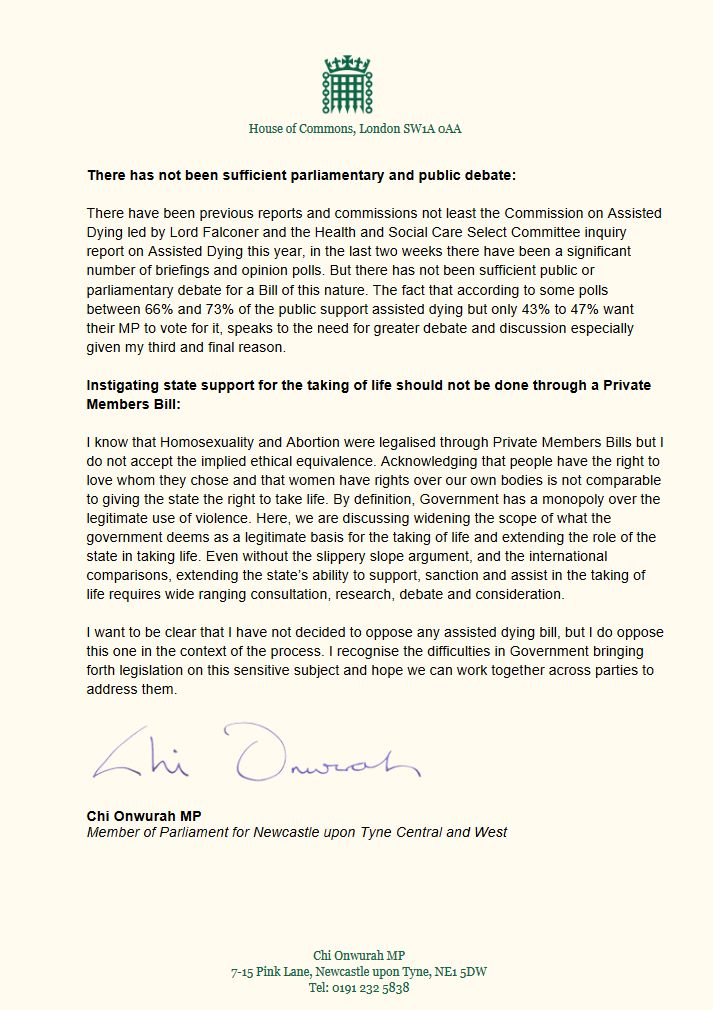
My statement on how I will be voting on the Assisted Dying Bill.
Chi Onwurah 💙 tweet mediaChi Onwurah 💙 tweet media
English
102
157
966
119.3K
James Frith MP
James Frith MP@JamesFrith·
#AssistedDyingBill On Friday, Parliament will vote on the Terminally Ill Adults (End of Life) Bill, a matter of immense moral and profound importance. I came into politics to wrestle with the serious stuff. The big issues. Of life, of living and of dying. Those of you familiar with my views and work to date will already have a sense of my instinct on this. After serious reflection, detailed consideration of the bill, and extensive engagement with experts and constituents, I have decided that I will vote against assisted suicide in this Bill. As someone who has long championed improved palliative and hospice care, I firmly believe that we must do more to support those facing the end of their lives. Palliative care is a vital but undervalued aspect of our healthcare system, and its improvement should be central to our national conversations on terminal illness and end-of-life care. In my view, the availability of assisted dying/suicide highlights broader failures in this area, as some may feel or be made to think, it is their only option to manage suffering. While I have listened carefully to the arguments in favour of the bill, I remain deeply concerned about the potential risks. In particular vulnerable groups and the thousands of people betrayed before now despite having rights or safeguards in place across our state. If great swathes of people say they feel unseen or underserved, I am not prepared to ignore their testimony to me on this. I am not convinced that the safeguards proposed are sufficient to prevent coercion, whether external or self-imposed. As well as the possibility that individuals might feel a burden to their families or society, leading them to make this irreversible choice, cannot be ignored. This decision has been one of the most challenging I have faced as an MP. It is a free vote, and ultimately, my conscience and own detailed analysis guides me. I respect the sincerity of those who advocate for this bill, and want the choice of when to die, as they’ve said. However I cannot, in good faith, support legislation that I believe carries such significant risks. I’m fully committed to continuing to engage on this, whatever the outcome of Friday’s vote. If the bill passes, I’ll work tirelessly to advocate for amendments that strengthen safeguards and address the concerns there are. I will ensure that this debate provokes a broader societal conversation about how we approach dying well, improving palliative care, and addressing end-of-life care within our NHS and society. Thank you everyone who attended my event on assisted dying and those who have shared their personal experiences with me. These conversations have been invaluable and have reinforced my belief that we must prioritise compassionate and comprehensive care for all terminally ill individuals. As we approach this pivotal vote, I remain committed to open and respectful dialogue with everyone. While I understand that my position may disappoint some, I hope you will know the thoughtfulness and integrity behind my decision.
James Frith MP tweet media
English
115
127
813
40.5K
Chris Evans MP
Chris Evans MP@Chris_EvansMP·
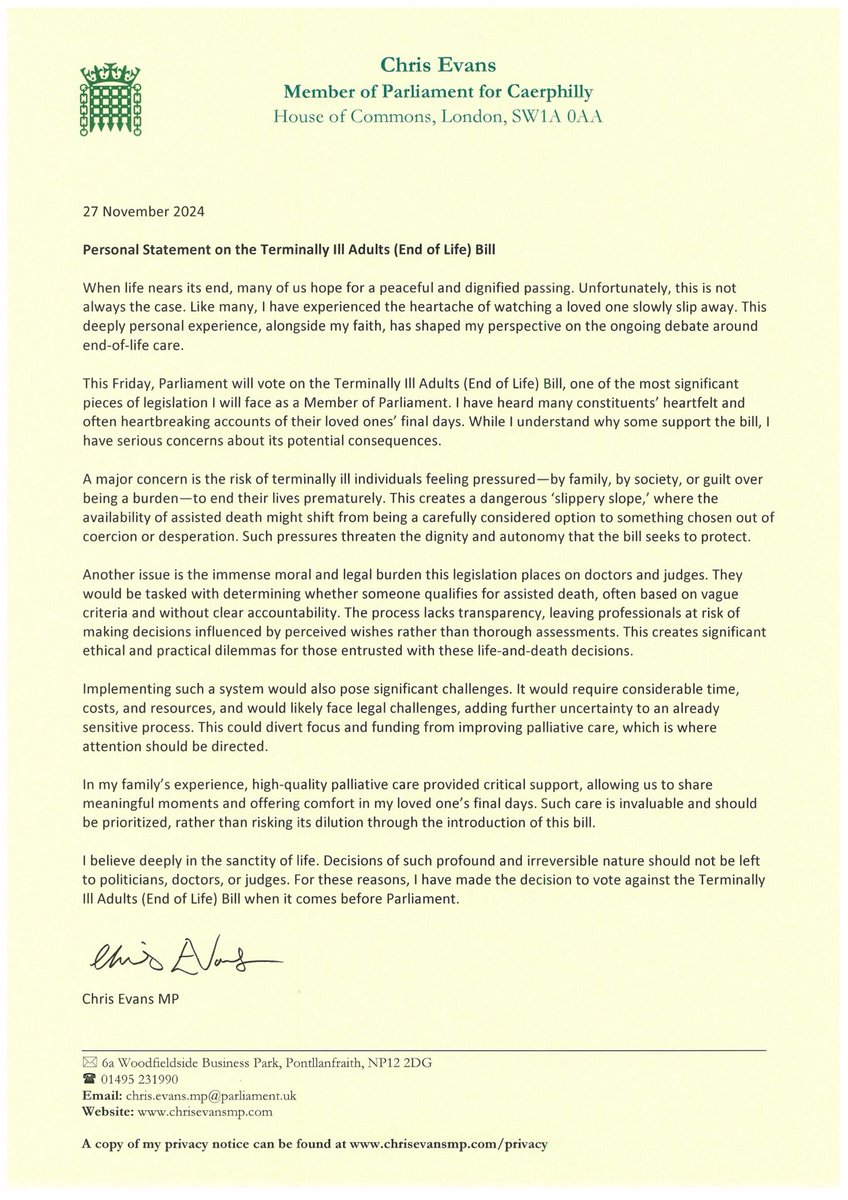
I want to thank everyone who has contacted me regarding Friday's vote on the Terminally Ill Adults (End of Life) Bill. I will be voting against the bill for the reasons set out in my statement below:
Chris Evans MP tweet media
English
220
317
2.3K
87.4K
Paul Holmes MP
Paul Holmes MP@pauljholmes·
I will be voting against the Terminally Ill Adults (End of Life) Bill on Friday. My full reasoning is below, an incredibly hard decision and one I have taken very seriously and genuinely.
Paul Holmes MP tweet mediaPaul Holmes MP tweet media
English
259
333
2.9K
87.3K
Abtisam Mohamed
Abtisam Mohamed@Abtisam_Mohamed·
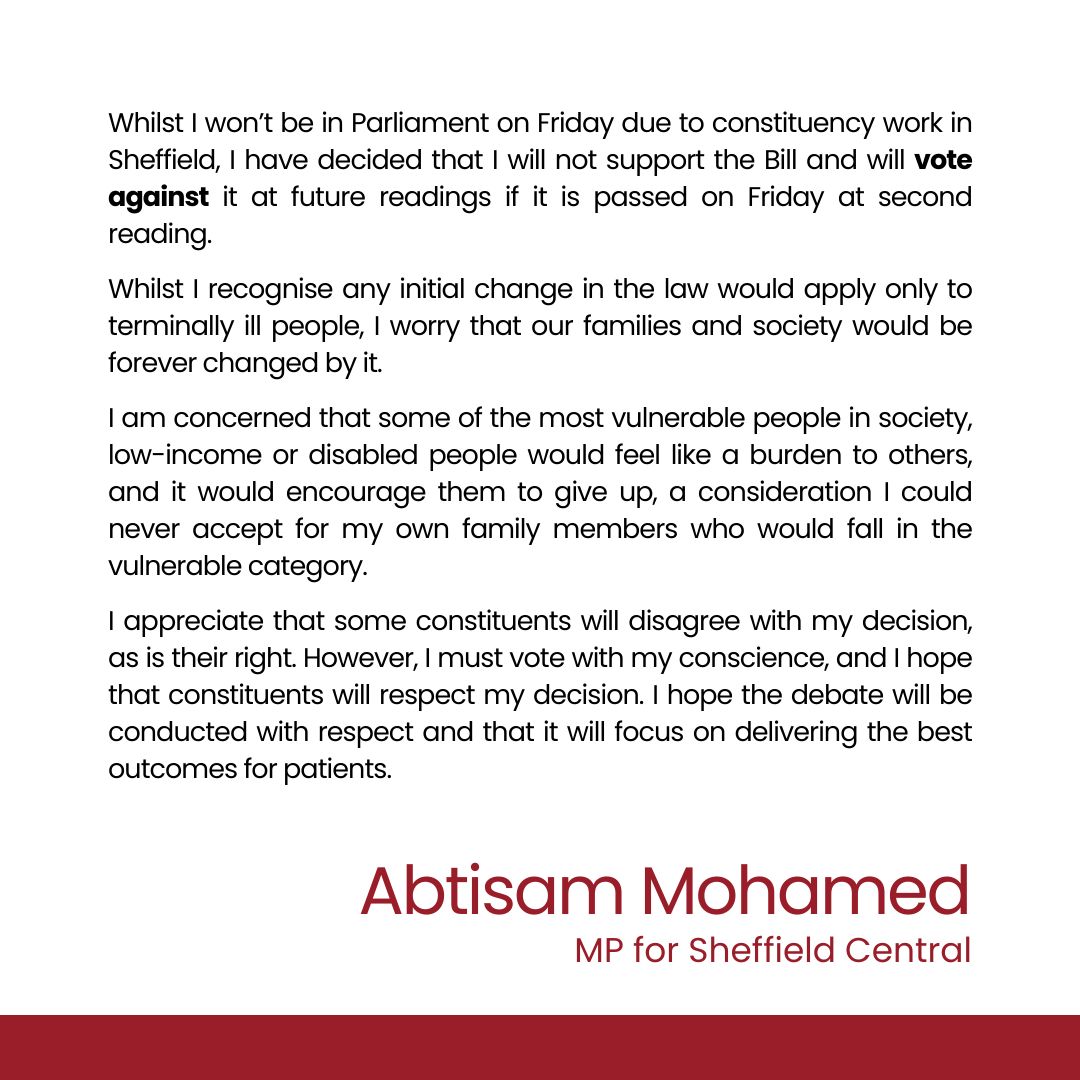
As your MP, I have sought to keep an open mind on the issue of assisted dying for the terminally ill. I attended numerous workshops with experts on both sides & consulted my constituents & family, leading me to my final decision to vote against the Bill in any further readings.
Abtisam Mohamed tweet mediaAbtisam Mohamed tweet media
English
93
125
1K
48.6K
Chief Rabbi Sir Ephraim Mirvis
As MPs prepare to vote on whether to legalise “Assisted Dying”, I have today written to all Members of Parliament to set out my concerns. This is what I said: As a Rabbi, I have often been entrusted with the task of offering some measure of comfort to patients and their loved ones in the final moments of their lives. Yet, invariably, I find that I am the one who leaves feeling deeply inspired. In those moving moments, when every act and every word is so precious, I have encountered some of the most extraordinary examples of grace and dignity. The pursuit of that dignity is of course a familiar theme in the campaign for “Assisted Dying,” which, as you know, now finds its expression in the Terminally Ill Adults Private Member’s Bill, which receives its second reading this Friday. Though I do not believe that the latter should be considered a suitable route to the former, I would like to acknowledge at the outset that the quest to bring peace to those who are suffering unimaginable pain is a noble one, undoubtedly rooted in compassion and empathy. Though I fundamentally differ with the proponents of this Bill, I have nothing but respect for the deep humanity which has clearly motivated them. In our daily prayers, Jews declare our belief that the soul given to us by God is pure, that He instils it within us, and that eventually He will take it from us at the right time. We believe that life is a sacred gift bestowed upon us by God, and that it should always be treasured as such. Yet, I readily acknowledge Lord Falconer’s recent assertion that a minority religious perspective should not be imposed on others. In my view, this is an issue which transcends the concerns of faith communities. It presents a fundamental moral challenge to our society which I believe should trouble people of all faiths and none. Whilst of course, I would not presume to dictate to a person suffering unbearable pain at the end of their life, ahead of the Parliamentary debate about a Bill which could be among the most consequential of our time, I feel a moral obligation to express deep concerns about its implications. The granting of a right to end one’s own life, would simultaneously impose a new and immeasurable pressure upon terminal patients, who are already extremely vulnerable. Placing before a person the ultimate choice between life and death calls for a decision which simply cannot be protected against all manner of external influences, regardless of the proposed safeguards. Data from the state of Oregon in the United States, which is often vaunted as a paragon of how assisted dying can work well, consistently shows that nearly half of terminally ill patients who have opted to end their life, cite the encumbrance upon their friends and family as one of their reasons. The emotional or practical strain that we place on those around us would never be considered a factor in determining the value of our lives in any other context and we must not allow it to be so in the case of a terminal patient. In Belgium and the Netherlands, where assisted dying has been legal for some time, it did not take long for “mental anguish” to become considered a legal and legitimate cause for assisted dying. Soon after that, it became legal to end the lives of children who are too young to fully comprehend what is happening to them. It is hard to hear that and not to conclude that the line between dying and killing is becoming blurred. I know how much has been invested in attempts to build protections into the Bill against this ‘slippery slope’. But developments in other countries show that once the law itself concedes that actively taking a person’s life is justifiable, we cross a moral Rubicon, beyond which new red lines can be easily erased and redrawn multiple times. The “medicalisation” of death, in which assisted dying becomes just another treatment option available to a patient, represents a major paradigm shift in the values that underpin our society. The purpose of Medicine is, and has always been, to heal and ease pain – never to end life. The effect of this Bill would be to alter the ethical landscape in which doctors work forever, even for those who might choose to opt out. It is surely not inconceivable that, in the course of time, financial and capacity constraints within the health system could become relevant considerations, thus turning life into a commodity like any other. The burden that this Bill would place on our most vulnerable patients, on their families and on medical staff, as well as the profound effect on the conscience of those left behind, is surely too high a price to pay. The devastating evidence from other countries is clear: when we numb, or remove altogether, our reverence for the precious gift of life itself, we withdraw from a moral standard to which we will never return. Dame Cicely Saunders wisely said, “You don’t have to kill the patient in order to kill the pain”. Indeed, I am told that in most instances, it would be possible to remove end-of-life suffering with high-quality palliative care but currently, according to a recent report, around 100,000 people in the UK die each year without receiving the end-of-life care that they need. Surely, a campaign for universal access to the best possible palliative care should be the way forward. Over the years, I have heard countless heart-rending stories of those desperate to take control of the end of their lives and to end their suffering by ending their lives. No decent person could fail to be moved by their experiences. Yet, my appeal to you is on behalf of those whose stories will never be heard – those who would never let it be known, that if not for the emotional or financial burden they felt they had become, they might just choose life.
English
108
291
1K
84K
John Grady MP
John Grady MP@johnadgrady·
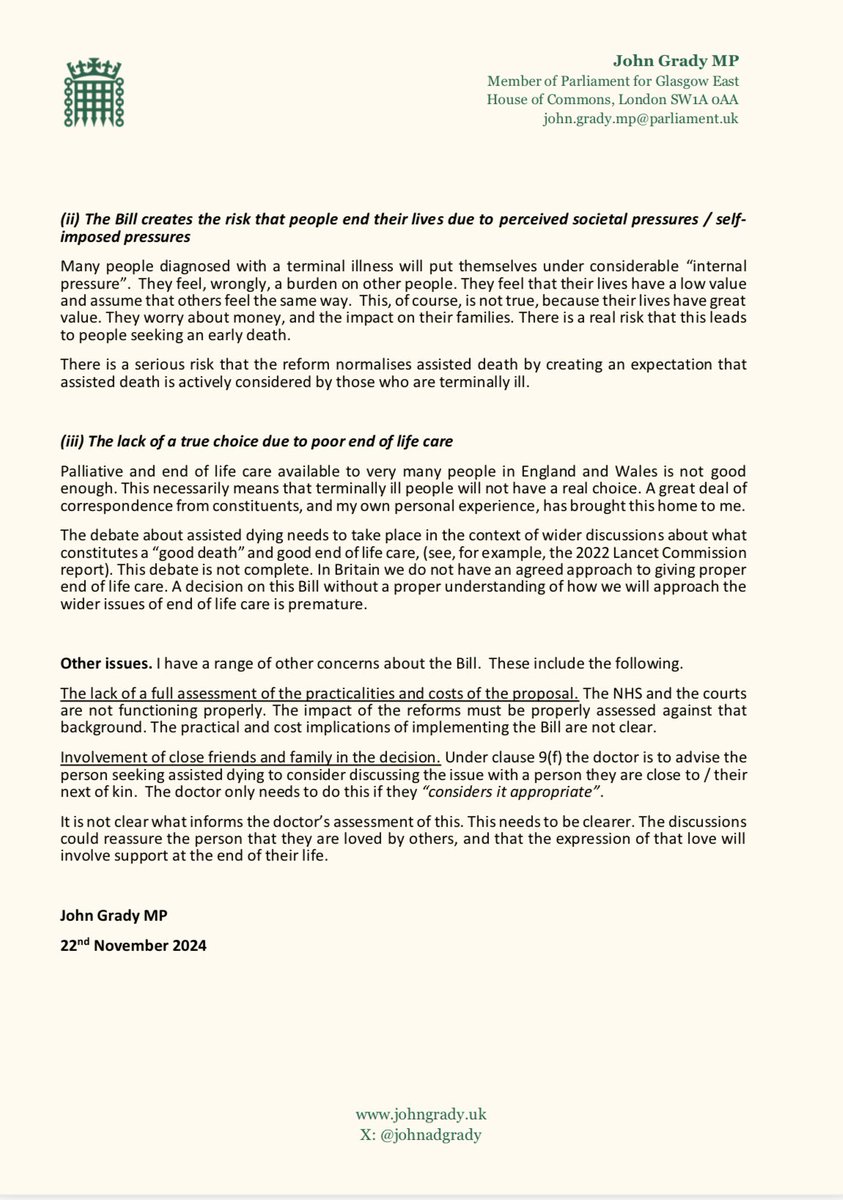
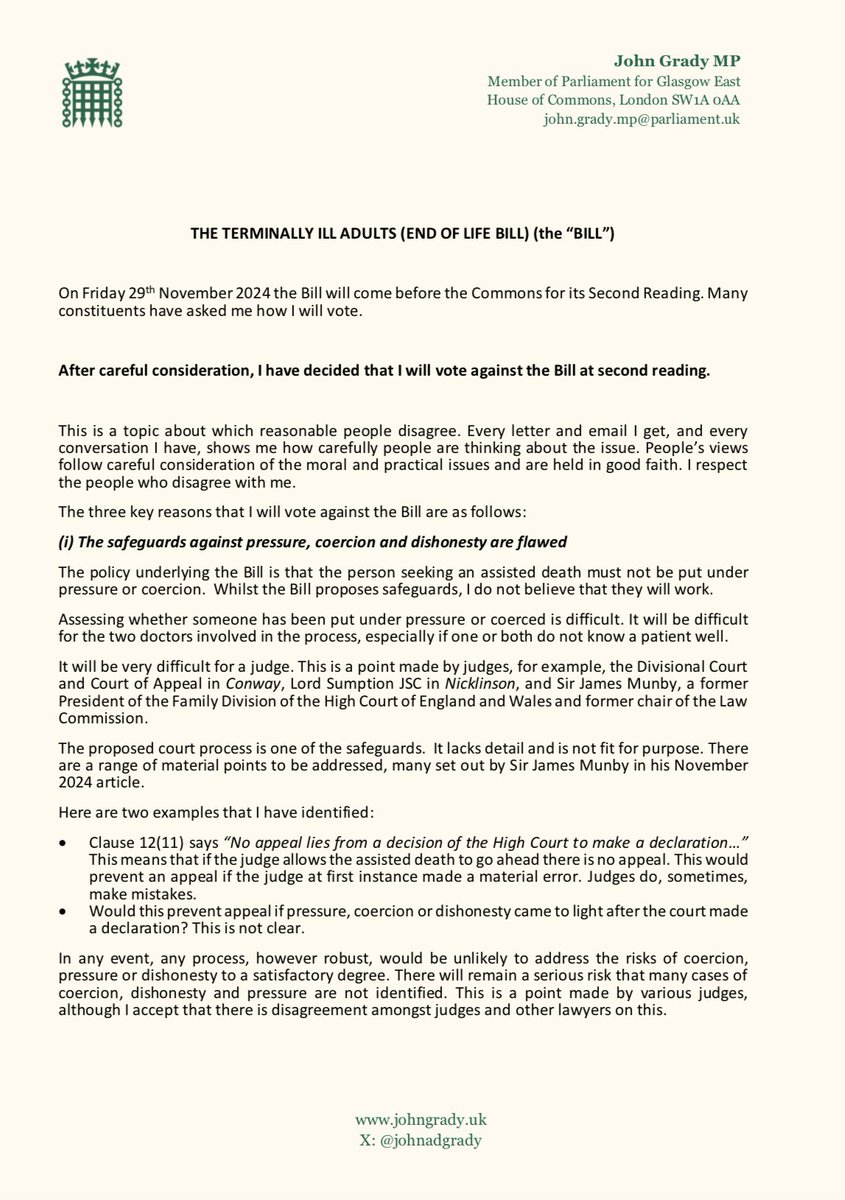
After careful consideration, I have decided to vote against the Assisted Dying bill at second reading. This is not a decision I have made lightly, and I respect there are different views on this important topic. I explain my reasons in detail in the attached note.
John Grady MP tweet mediaJohn Grady MP tweet media
English
142
214
1.5K
84.5K
Preet Kaur Gill MP
Preet Kaur Gill MP@PreetKGillMP·
Why I am voting against the Assisted Dying bill 👇
Preet Kaur Gill MP tweet mediaPreet Kaur Gill MP tweet media
English
113
160
1.1K
66.5K
Jon Trickett MP
Jon Trickett MP@jon_trickett·
Painful experiences as well as uplifting ones with loved ones and friends in recent years have led me to change my mind on assisted dying. I will not vote for the proposed law.
English
102
120
1K
47.2K
Yuan Yi Zhu
Yuan Yi Zhu@yuanyi_z·
I was happy to sign this very important letter in today's Observer. Its signatories include senior lawyers and legal academics across the political spectrum, some of whom seldom agree with each other, but agree about the dangers of legalising assisted suicide.
Philip Murray@philipmurraylaw

A really important letter that should make MPs sit up and listen. Senior lawyers from across practice and academia, including a former Chief Coroner, a former Lord Chancellor, and distinguished academics, KCs, Peers and others, warn of the dangers of legalising assisted suicide. theguardian.com/news/2024/oct/…

English
15
76
460
32.3K