Ben Samelson-Jones, MD, PhD

1.1K posts
Ben Samelson-Jones, MD, PhD banner
Ben Samelson-Jones, MD, PhD

Ben Samelson-Jones, MD, PhD

@DrSamelsonJones

Pediatric Hematologist | Gene Therapist | Biochemist | Husband | 👩👦👧👶 🐕 Dad | #WilliamsSyndrome Advocate | Views my own


Philadelphia, PA Katılım Ekim 2019
1.7K Takip Edilen1.4K Takipçiler
Ben Samelson-Jones, MD, PhD
Ben Samelson-Jones, MD, PhD@DrSamelsonJones·
@grok @docxusofficial Earlier case of transmissible cancer in human: Gugel EA, Sanders ME (December 1986). "Needle-stick transmission of human colonic adenocarcinoma". The New England Journal of Medicine. 315 (23): 1487. doi:10.1056/NEJM198612043152314. PMID 3785302.
English
1
0
0
155
Grok
Grok@grok·
Transmissible tumors in mammals include canine transmissible venereal tumor (CTVT) and Tasmanian devil facial tumor disease (DFTD). CTVT is a sexually transmitted cancer in dogs, originating from a single dog ~11,000 years ago. It's clonal, spreads via mating, often regresses spontaneously, and evades immunity through genetic adaptations. DFTD spreads via biting in devils, causing fatal facial tumors. Two independent lineages exist, both clonal and immunosuppressive. Similarities to the surgeon case: All involve direct transfer of living cancer cells that grow in a new host, defying typical immune rejection. Differences: The human case was accidental via injury, one-off, and curable by excision in an immunocompetent person. CTVT/DFTD are naturally transmissible, evolved for persistence, and often chronic or lethal without intervention.
English
1
0
1
112
DocXus
DocXus@docxusofficial·
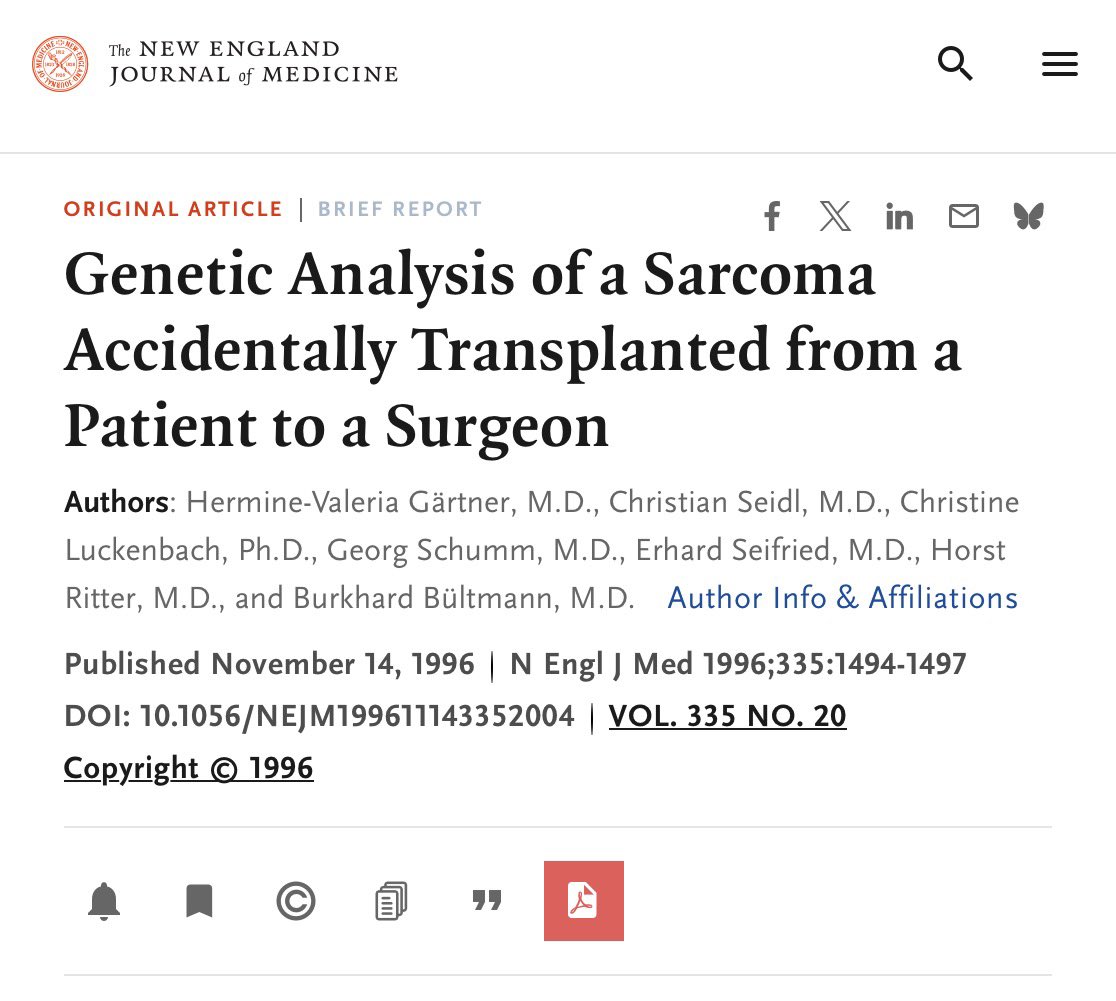
A rare case where a surgeon accidentally developed his patient’s cancer Cancer is not considered contagious. If cancer cells from another person enter your body, your immune system is supposed to destroy them. But in very rare situations, biology doesn’t follow the rules. A 32-year-old man underwent emergency surgery for an aggressive soft-tissue cancer called malignant fibrous histiocytoma. Sadly, he died shortly after the operation due to complications. During the surgery, the 53-year-old surgeon accidentally injured the palm of his left hand while placing a drain. The wound was small, immediately cleaned, and properly dressed. No one thought much of it. Five months later, the surgeon noticed a hard lump growing at the exact spot where his hand had been injured. It slowly enlarged to about 3 cm, roughly the size of a large coin. The lump was surgically removed. The diagnosis was shocking. It was malignant fibrous histiocytoma, the same rare cancer the patient had. The surgeon was otherwise healthy. Tests showed no immune deficiency. So how could this happen? The DNA answered the question Pathologists compared both tumors under the microscope and found them to be identical in appearance. But the real proof came from DNA testing. Using genetic markers and HLA typing (a way of identifying tissue origin), doctors showed that the tumor in the surgeon’s hand carried genetic material from the patient. This meant only one thing: 👉 The cancer had been accidentally transplanted from patient to surgeon during surgery. Cancer cells likely entered through the small hand injury and managed to survive long enough to form a tumor. Fortunately, the tumor was completely removed. At two-year follow-up, the surgeon was healthy, with no recurrence and no spread. Why this case is so remarkable: This case does not mean cancer spreads through touch or casual contact. It shows that direct implantation of living cancer cells, under very specific conditions, can rarely lead to tumor growth, even in a healthy person. It’s a rare exception that reminds us: - Cancer isn’t contagious, but biology has loopholes - The immune system is powerful, not perfect - Medicine still encounters situations that challenge long-held beliefs
DocXus tweet media
English
64
727
4.3K
1.6M
Ben Samelson-Jones, MD, PhD
Ben Samelson-Jones, MD, PhD@DrSamelsonJones·
@repmgs NIH funding powers breakthroughs in hematology. Proposed cuts put this progress at risk. Congress must finalize FY 2026 appropriations and provide strong funding for research.
English
0
0
1
45
Ben Samelson-Jones, MD, PhD
Ben Samelson-Jones, MD, PhD@DrSamelsonJones·
@davemccormickpa NIH funding powers breakthroughs in hematology. Proposed cuts put this progress at risk. Congress must finalize FY 2026 appropriations and provide strong funding for research.
English
0
0
1
47
Ben Samelson-Jones, MD, PhD
Ben Samelson-Jones, MD, PhD@DrSamelsonJones·
@senfettermanpa NIH funding powers breakthroughs in hematology. Proposed cuts put this progress at risk. Congress must finalize FY 2026 appropriations and provide strong funding for research.
English
0
0
1
75
Ben Samelson-Jones, MD, PhD
Ben Samelson-Jones, MD, PhD@DrSamelsonJones·
@Mohty_EBMT @ASH_hematology @TheIACH Definitely not an iron specialist either, but have some questions. x.com/drsamelsonjone…
Ben Samelson-Jones, MD, PhD@DrSamelsonJones

@DrDanMO Here are the survival curves presented at #ash24, which appear to separate within a day of IV FE. To me this seems early for a plausible biological effect and raise the concern that the cohorts are not sufficiently matched and thus confounded by indication
English
0
1
2
319
Mohamad Mohty
Mohamad Mohty@Mohty_EBMT·
I am definitely not an iron specialist…but wow, this study is pure metal! Impressive safety, better survival, fewer transfusions: science never stops surprising us. Always amazed by what rigorous research can reveal. #ASH25 #ASHScavengerHunt@ASH_hematology⁩ ⁦@TheIACH
Mohamad Mohty tweet media
English
6
85
301
24.9K
Ben Samelson-Jones, MD, PhD
Ben Samelson-Jones, MD, PhD@DrSamelsonJones·
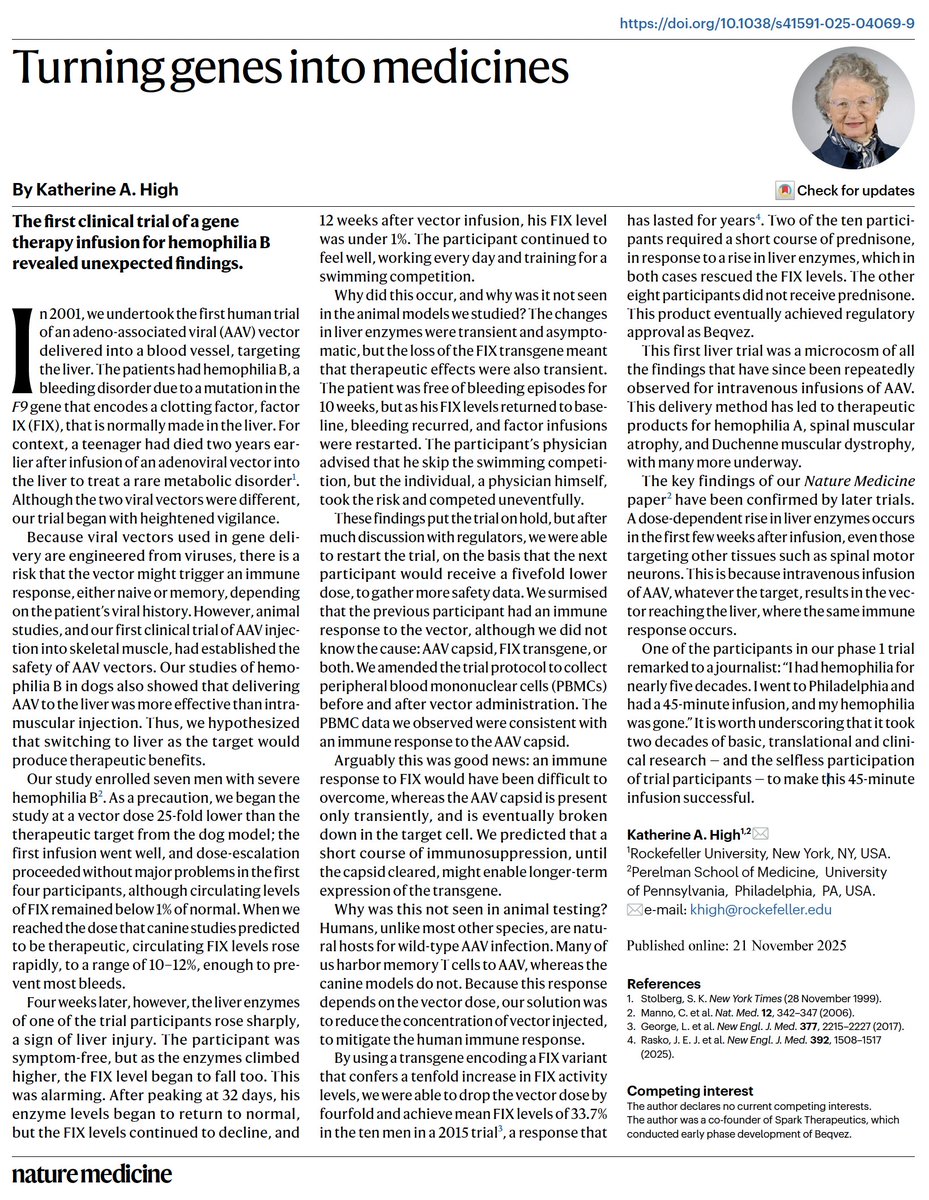
Several abstracts at #ASH25 showing that AAV #genetherapy is worldwide with clinical trials demonstrating transformative stable factor levels with surprising low vector doses.
Ben Samelson-Jones, MD, PhD tweet mediaBen Samelson-Jones, MD, PhD tweet media
English
0
0
5
196
Ben Samelson-Jones, MD, PhD
Ben Samelson-Jones, MD, PhD@DrSamelsonJones·
@DrDanMO Here are the survival curves presented at #ash24, which appear to separate within a day of IV FE. To me this seems early for a plausible biological effect and raise the concern that the cohorts are not sufficiently matched and thus confounded by indication
Ben Samelson-Jones, MD, PhD tweet media
English
2
0
4
460
Ben Samelson-Jones, MD, PhD
Ben Samelson-Jones, MD, PhD@DrSamelsonJones·
The one child I have seen with chronic #hepb was enough. Unfortunately, it will not be the last.
English
0
0
0
28
Ben Samelson-Jones, MD, PhD
Ben Samelson-Jones, MD, PhD@DrSamelsonJones·
I’m asking you to join me in supporting the Williams Syndrome Association this Giving Tuesday. If you’re able, please make a Giving Tuesday gift today. Your support truly matters. Donate @ GiveWSA.org or by texting GIVEWSA to 71777
Ben Samelson-Jones, MD, PhD tweet media
English
0
0
1
106
Ben Samelson-Jones, MD, PhD
Ben Samelson-Jones, MD, PhD@DrSamelsonJones·
Fantastic meeting on #hemophilia and other #bleedingdisorders bring together new technologies but also systems, economics, communication, and ethics how to improve access. Thanks for inviting me.
WFH@wfhemophilia

From discovery to safety, innovation takes center stage at the #WFHGlobalForum. 🧬 Experts @DrSamelsonJones & WFH VP, Medical, @gfp55, MD, PhD, unpack the promise of #GeneTherapy—and the global challenges of ensuring safe, equitable access. #BleedingDisorders

English
0
0
2
189