
accelerate(e/acc)

4.1K posts

accelerate(e/acc) banner
accelerate(e/acc)

accelerate(e/acc)

@EAccelerate_42

Software,Hardware,Astrophysics, Web3, Stocks ,AI ,MLX,Cuda .In perplexity over answer to life universe and Everything . Founder at https://t.co/R6wDNPGrVc

Katılım Temmuz 2013
7.5K Takip Edilen2.6K Takipçiler
Sabitlenmiş Tweet
accelerate(e/acc)
accelerate(e/acc)@EAccelerate_42·
💡Learn to Fine-tune Gemma 270M model in few seconds on your MacBook locally ✨ New 2025 guide covers: • LoRA, QLoRA, DoRA techniques • Interactive parameter calculator • 2,800+ ready-to-use MLX models • OpenAI GPT-OSS , Gemma 3 & Qwen3 support From zero to custom AI in minutes ⚡ e-accelerate.com/finetuning.html
accelerate(e/acc)@EAccelerate_42

👀Learn to Build your OWN Language Model in an hour. 🍏 Apple Silicon (#MLX), 🐲 NVIDIA, or good old Intel/AMD CPU—all covered. ⚡️ One-line setup + TinyStories demo. Hack tonight 👉 e-accelerate.com 🔁 RT if you’d rather create models than just prompt them.

English

0
1
10
2.2K
accelerate(e/acc) retweetledi
Matt Turck
Matt Turck@mattturck·
Why AI Progress Suddenly Feels Real - my conversation with @yanndubs, who co-leads the Post-Training Frontiers team at @OpenAI 00:00 - Intro 01:30 - Why recent AI progress feels like a step function 04:13 - Model reliability & the emotional rollercoaster of shipping GPT-5.5 07:33 - How OpenAI structures vertical and horizontal teams 09:49 - Improving model efficiency and test-time compute 12:32 - Yann's journey from Switzerland to OpenAI 15:37 - Reasoning in 2026: Real-world utility vs verifiable rewards 18:34 - GPT-5.5 Thinking vs Pro: Scaling test-time compute 20:09 - How reasoning models become more efficient 23:23 - Pre-training scaling and overcoming the data wall 27:03 - Multimodal data, synthetic data, and embodied AI 31:05 - Demystifying mid-training and post-training 37:21 - Does RL create new capabilities in AI? 38:53 - The challenges and frontier of scaling RL 43:09 - Is building AI models a craft or a strict science 48:21 - How AI models generalize across different domains 54:18 - How reinforcement learning cures AI hallucinations 56:04 - Negative generalization and conflicting instructions 58:05 - Can RL scale to law, medicine, and the broader economy? 1:00:19 - The evaluation bottleneck and Model as a Judge 1:04:21 - Continuous AI progress & continual learning 1:08:49 - Will foundation models eat the agent harness 1:11:23 - Why startups should focus on the last mile of AI
English
7
33
370
93.7K
accelerate(e/acc) retweetledi
Fernando
Fernando@Franc0Fernand0·
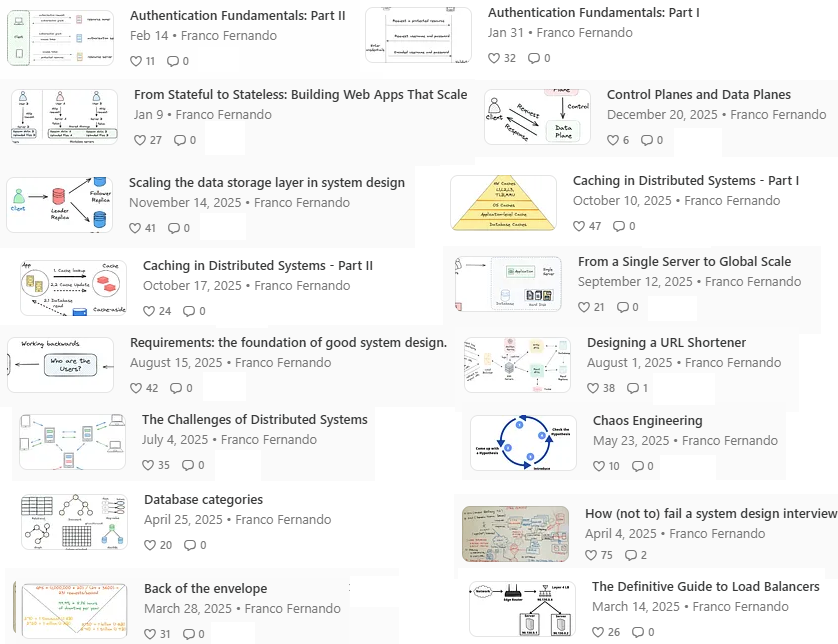
If you're a software engineer who wants to upskill in system design, read these 14 articles (links below):
Fernando tweet media
English
46
802
6.2K
423.2K
accelerate(e/acc) retweetledi
Ahmad
Ahmad@TheAhmadOsman·
I keep getting this question - Where do I start with Local AI and selfhosting LLMs / models? Here is a thread for what I consider my most important educational content Note: Thread is WIP, will be continuously adding to it + have it pinned on my profile Opensource AI will win
Ahmad tweet media
Ahmad@TheAhmadOsman

My only regret is actually not telling people to Buy a GPU earlier than last summer Given how many people called me crazy so close to the demand surge, I am not sure how people would've reacted to me saying that in 2024 for example BTW, you should acquire some compute ASAP

English
12
15
220
43.9K
accelerate(e/acc) retweetledi
antirez
antirez@antirez·
Imagine a local agent where cache misses don't exist, tools don't need translations, you see progress for prefill, tokens are emitted ASAP.
English
27
29
437
41.3K
accelerate(e/acc) retweetledi
Ahmad Awais
Ahmad Awais@MrAhmadAwais·
how did we make deepseek outperform opus 4.7? i've been thinking about why "open model bad at tool calling" is almost always a harness problem, not a model problem. context: spent the two days looking at billions of tokens in @CommandCodeAI (tb open source ai cli) using deepseek. I ended up writing a tool-input repair layer. the trigger was watching deepseek-flash fail on the simplest /review run, every shellCommand and readFile call bouncing back with a raw zod issues blob, the model unable to recover because the error wasn't in a form it could read. by the end deepseek v4 pro was beating opus 4.7 6/10 times on our internal evals. a few things i learned that feel general: 1/ the failure modes aren't random they're a small finite compositional set. across deepseek-flash, deepseek v4 pro, glm, qwen, the same four mistakes repeat almost exactly: - sending `null` for an optional field instead of omitting it - emitting `["a","b"]` as a json *string* instead of an actual array - wrapping a single arg in `{}` where the schema expected an array (an "empty placeholder") - passing a bare string where an array was expected (`"foo"` instead of `["foo"]`) four repairs, ~30-100 lines each, ordered carefully (json-array-parse must run before bare-string-wrap or `'["a","b"]'` becomes `['["a","b"]']`). that is the whole catalogue. when i hear "this open source model can't do tool calls" i now assume one of those four, and so far that's been right ~90% of the time. 2/ the funniest failure mode is also the most revealing. deepseek-flash, when asked to edit or write a file, sometimes emits the path as a *markdown auto-link*: filePath: "/Users/x/proj/[notes.md](http://notes. md)" our writeFile tool obediently trued creating files literally named `[notes.md](http://notes .md)` until we caught it. this is not a hallucination. it's the post-training chat distribution leaking through the tool boundary the model has been rewarded for auto-linking in conversational output, and is applying that prior in a context where it makes no sense. the fix is two regex lines that unwrap only the degenerate case where link text equals url-without-protocol real markdown like `[click](https://x .com)` passes through untouched. this is also conditioning of their own tools during RL which were different from all other tools we write and ofc can't predict. "tool confusion" is a more useful frame than "capability gap." the model knows how to format a path. it just hasn't been told clearly enough that this path is going to fopen, not into a chat bubble. so we encode that hint at the schema level `pathString()` instead of `z.string()` and the leak is plugged for every path field at once. 3/ the design choice that mattered was inverting preprocess-then-validate to validate-then-repair. my first attempt was the obvious one: a preprocessing pass that normalized inputs (strip nulls, parse stringified arrays, etc.) before zod ever saw them. it broke immediately, writeFile content that *happened* to be json-shaped got rewritten before it hit disk. silent corruption, easy to miss in a smoke test. then i made it less greedy - parse the input as-is. if it succeeds, ship it. valid inputs are never touched. - on failure, walk the validator's own issue list. for each issue path, try the four repairs in order until one applies. - parse again. on success, log `tool_input_repaired:${toolName}`. on failure, log `tool_input_invalid:${toolName}` and return a model-readable retry message. the structural insight here is: when you preprocess, you encode a prior about what's broken. when you let the validator complain first, the schema is the prior, and you only spend repair budget at the exact paths the schema actually disagreed at. the validator is doing the work of localizing the bug for you. it's the same shape as cheap-then-careful everywhere else try the fast path, fall back on evidence. (this also gives you per-tool telemetry for free. you can watch repair rates per (model, tool) and notice when a model regresses on a specific contract before users do.) 4/ shape invariants and relational invariants need different fixes. the four repairs above all handle shape problems wrong type, missing key, wrong container. but read_file had a *relational* invariant: "if you provide offset, you must also provide limit, and vice versa." deepseek kept calling `readFile({ absolutePath, limit: 30 })` and getting an `ERROR:` back. you can't fix this with input repair, because each field is independently valid the bug is in the relationship between them. so i taught the function the model's intent instead. `limit` alone → `offset = 0`. `offset` alone → `limit = 2000` (matches common read tool ops default). then surfaced the decision back to the model in the result: "Note: limit was not provided; defaulted to 2000 lines. To read more or fewer lines, retry with both offset and limit." no `Error:` prefix, so the tui doesn't paint it red. the model sees what we picked and can self-correct on the next turn if our guess was wrong. transparency over silent magic wins big. repair where you can. extend semantics where you can't. surface the choice either way. zoom out: a lot of what looks like model capability is actually contract design. a strict schema is a choice with a cost it filters out noise, but it also filters out recoverable noise from any model that hasn't memorized the exact json contract you happened to pick. the largest commercial models eat that cost invisibly and are linient on tool calling because they've seen enough of every contract during pretraining; open models pay it loudly and get dismissed for it. the harness is where you mediate between distributions. four small repairs (i'm sure more to follow as we have three more merging today), two regex lines for auto-links, one relational default, one prefix change. the model didn't change. the contract got more forgiving in exactly the places it needed to be. deepseek v4 pro now beats opus 4.7 6/10 times on our internal evals. imo "skill issue" applies to the harness more often than the model.
Ahmad Awais@MrAhmadAwais

Wow I just made DeepSeek V4 Pro beat Opus 4.7 6/10 times in our internal evals by auto repairing many of its quirks in tool calling. It’s performing super solid for such a cheap model.

English
58
137
1.4K
356.8K
accelerate(e/acc) retweetledi
Loktar 🇺🇸
Loktar 🇺🇸@loktar00·
Unsloth's Qwen 3.6 MTP went 1.4x to 1.8x in 48 hours.... free perf on the same hardware just from a llama.cpp flag tune, so much untapped performance out there still for our rigs!
English
13
7
182
38.5K
accelerate(e/acc) retweetledi
Conscious Engines • Studio
Conscious Engines • Studio@cengines_studio·
Announcing MLX India Community Meetup [2] 23rd May • 5 Cities 150+ developers, researchers, builders, and local LLM enthusiasts across India for talks, demos, panels, and conversations around the future of on-device AI Find your city’s invite below:
Conscious Engines • Studio tweet media
English
5
8
71
8.6K
accelerate(e/acc) retweetledi
Dan
Dan@Daniel_Farinax·
Free to use. Currently wired up for the coding tool I'm running, but easy to edit or swap. Made for MTPLX. github.com/daniel-farina/…
English
0
1
6
246
accelerate(e/acc) retweetledi
kyle yu
kyle yu@brrrkyle·
this is how i wish i learned GPU fundamentals not a lengthy textbook. not a static image. every concept is an interactive visualization. covering the SM architecture, memory coalescing, synchronization, and more. what concepts do you want to see next? brrrviz.com
English
3
22
250
46.8K
accelerate(e/acc) retweetledi
Ahmad
Ahmad@TheAhmadOsman·
Top 26 Essential Papers for Mastering LLMs and Transformers Implement those and you’ve captured ~90% of the alpha behind modern LLMs. Everything else is garnish. This list bridges the Transformer foundations with the reasoning, MoE, and agentic shift Recommended Reading Order 1. Attention Is All You Need (Vaswani et al., 2017) > The original Transformer paper. Covers self-attention, > multi-head attention, and the encoder-decoder structure > (even though most modern LLMs are decoder-only.) 2. The Illustrated Transformer (Jay Alammar, 2018) > Great intuition builder for understanding > attention and tensor flow before diving into implementations 3. BERT: Pre-training of Deep Bidirectional Transformers (Devlin et al., 2018) > Encoder-side fundamentals, masked language modeling, > and representation learning that still shape modern architectures 4. Language Models are Few-Shot Learners (GPT-3) (Brown et al., 2020) > Established in-context learning as a real > capability and shifted how prompting is understood 5. Scaling Laws for Neural Language Models (Kaplan et al., 2020) > First clean empirical scaling framework for parameters, data, and compute > Read alongside Chinchilla to understand why most models were undertrained 6. Training Compute-Optimal Large Language Models (Chinchilla) (Hoffmann et al., 2022) > Demonstrated that token count matters more than > parameter count for a fixed compute budget 7. LLaMA: Open and Efficient Foundation Language Models (Touvron et al., 2023) > The paper that triggered the open-weight era > Introduced architectural defaults like RMSNorm, SwiGLU > and RoPE as standard practice 8. RoFormer: Rotary Position Embedding (Su et al., 2021) > Positional encoding that became the modern default for long-context LLMs 9. FlashAttention (Dao et al., 2022) > Memory-efficient attention that enabled long context windows > and high-throughput inference by optimizing GPU memory access. 10. Retrieval-Augmented Generation (RAG) (Lewis et al., 2020) > Combines parametric models with external knowledge sources > Foundational for grounded and enterprise systems 11. Training Language Models to Follow Instructions with Human Feedback (InstructGPT) (Ouyang et al., 2022) > The modern post-training and alignment blueprint > that instruction-tuned models follow 12. Direct Preference Optimization (DPO) (Rafailov et al., 2023) > A simpler and more stable alternative to PPO-based RLHF > Preference alignment via the loss function 13. Chain-of-Thought Prompting Elicits Reasoning in Large Language Models (Wei et al., 2022) > Demonstrated that reasoning can be elicited through prompting > alone and laid the groundwork for later reasoning-focused training 14. ReAct: Reasoning and Acting (Yao et al., 2022 / ICLR 2023) > The foundation of agentic systems > Combines reasoning traces with tool use and environment interaction 15. DeepSeek-R1: Incentivizing Reasoning Capability in LLMs via Reinforcement Learning (Guo et al., 2025) > The R1 paper. Proved that large-scale reinforcement learning without > supervised data can induce self-verification and structured reasoning behavior 16. Qwen3 Technical Report (Yang et al., 2025) > A modern architecture lightweight overview > Introduced unified MoE with Thinking Mode and Non-Thinking > Mode to dynamically trade off cost and reasoning depth 17. Outrageously Large Neural Networks: Sparsely-Gated Mixture of Experts (Shazeer et al., 2017) > The modern MoE ignition point > Conditional computation at scale 18. Switch Transformers (Fedus et al., 2021) > Simplified MoE routing using single-expert activation > Key to stabilizing trillion-parameter training 19. Mixtral of Experts (Mistral AI, 2024) > Open-weight MoE that proved sparse models can match dense quality > while running at small-model inference cost 20. Sparse Upcycling: Training Mixture-of-Experts from Dense Checkpoints (Komatsuzaki et al., 2022 / ICLR 2023) > Practical technique for converting dense checkpoints into MoE models > Critical for compute reuse and iterative scaling 21. The Platonic Representation Hypothesis (Huh et al., 2024) > Evidence that scaled models converge toward shared > internal representations across modalities 22. Textbooks Are All You Need (Gunasekar et al., 2023) > Demonstrated that high-quality synthetic data allows > small models to outperform much larger ones 23. Scaling Monosemanticity: Extracting Interpretable Features from Claude 3 Sonnet (Templeton et al., 2024) > The biggest leap in mechanistic interpretability > Decomposes neural networks into millions of interpretable features 24. PaLM: Scaling Language Modeling with Pathways (Chowdhery et al., 2022) > A masterclass in large-scale training > orchestration across thousands of accelerators 25. GLaM: Generalist Language Model (Du et al., 2022) > Validated MoE scaling economics with massive > total parameters but small active parameter counts 26. The Smol Training Playbook (Hugging Face, 2025) > Practical end-to-end handbook for efficiently training language models Bonus Material > T5: Exploring the Limits of Transfer Learning with a Unified Text-to-Text Transformer (Raffel et al., 2019) > Toolformer (Schick et al., 2023) > GShard (Lepikhin et al., 2020) > Adaptive Mixtures of Local Experts (Jacobs et al., 1991) > Hierarchical Mixtures of Experts (Jordan and Jacobs, 1994) If you deeply understand these fundamentals; Transformer core, scaling laws, FlashAttention, instruction tuning, R1-style reasoning, and MoE upcycling, you already understand LLMs better than most Time to lock-in, good luck!
English
15
57
456
22.9K
accelerate(e/acc) retweetledi
antirez
antirez@antirez·
DS4 is now called DwarfStar4, since you can put a lot of mass into a tiny space... And in a few minutes it is going to be much better on 128GB Macs because I'l pushing much better 2 bit quants generated with an in-house iMatrix magic recipe.
English
35
39
755
62.2K
accelerate(e/acc) retweetledi
Alex
Alex@AlexJonesax·
Two open-source MLX inference servers worth knowing about if you run LLMs on Mac: MTPLX (@youssofal) Uses a model's own MTP heads for speculative decoding. No draft model needed. ~63 tok/s on Qwen3.6-27B (M5Max). Mathematically exact sampling too; not just greedy prefix matching. oMLX (@jundot) Tiered KV cache that persists to SSD across restarts. Huge for coding agents where you're sending the same codebase context repeatedly. Also serves LLMs, VLMs, embeddings, rerankers, and audio simultaneously. They're solving different problems; MTPLX maximizes tok/s, oMLX maximizes workflow efficiency. Both have OpenAI + Anthropic-compatible APIs, both work with Claude Code/OpenCode/Cursor out of the box. Running both depending on the task. But, both worth checking out.
English
15
22
181
13.7K
accelerate(e/acc) retweetledi
Alexander Whedon
Alexander Whedon@alex_whedon·
Introducing SubQ - a major breakthrough in LLM intelligence. It is the first model built on a fully sub-quadratic sparse-attention architecture (SSA), And the first frontier model with a 12 million token context window which is: - 52x faster than FlashAttention at 1MM tokens - Less than 5% the cost of Opus Transformer-based LLMs waste compute by processing every possible relationship between words (standard attention). Only a small fraction actually matter. @subquadratic finds and focuses only on the ones that do. That's nearly 1,000x less compute and a new way for LLMs to scale.
English
1.5K
2.9K
23K
12.8M