
Sabitlenmiş Tweet
Easy E
298 posts


Easy E
@EasyInvest1ng
25 | Healthtech SaaS pro 🖥️ | Marathon runner 🏃♂️ | Documenting my journey to work-optional by 40 through investing📈 Avid Traveler
United States Katılım Nisan 2025
87 Takip Edilen63 Takipçiler

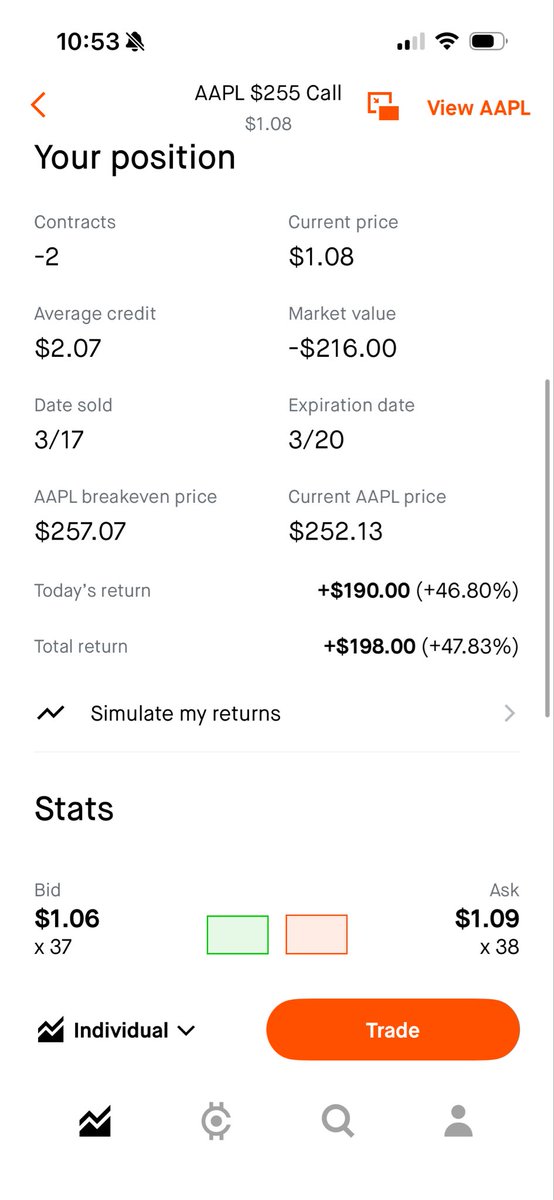
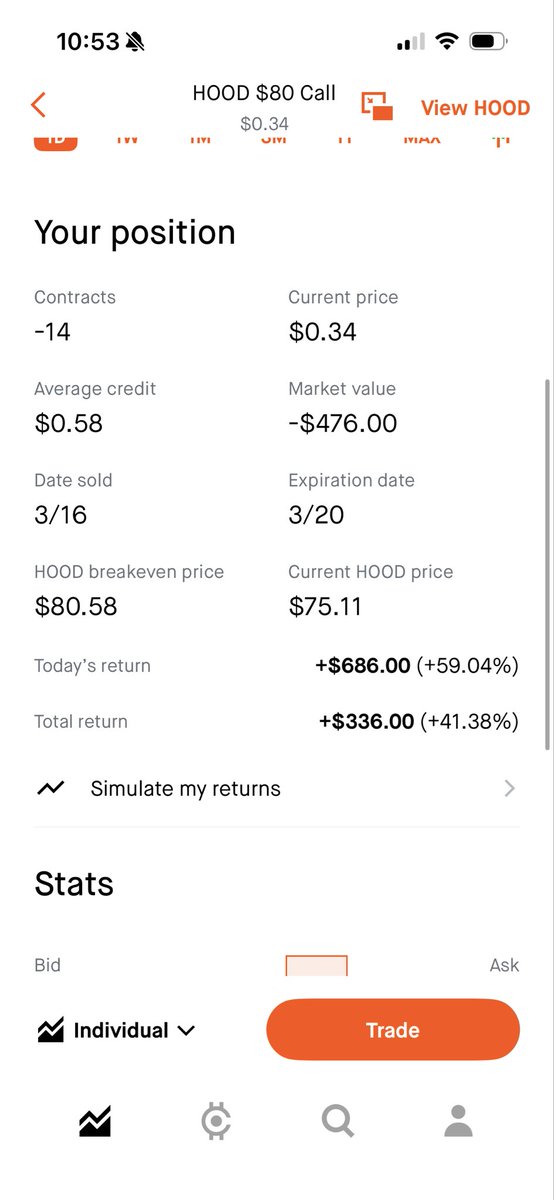
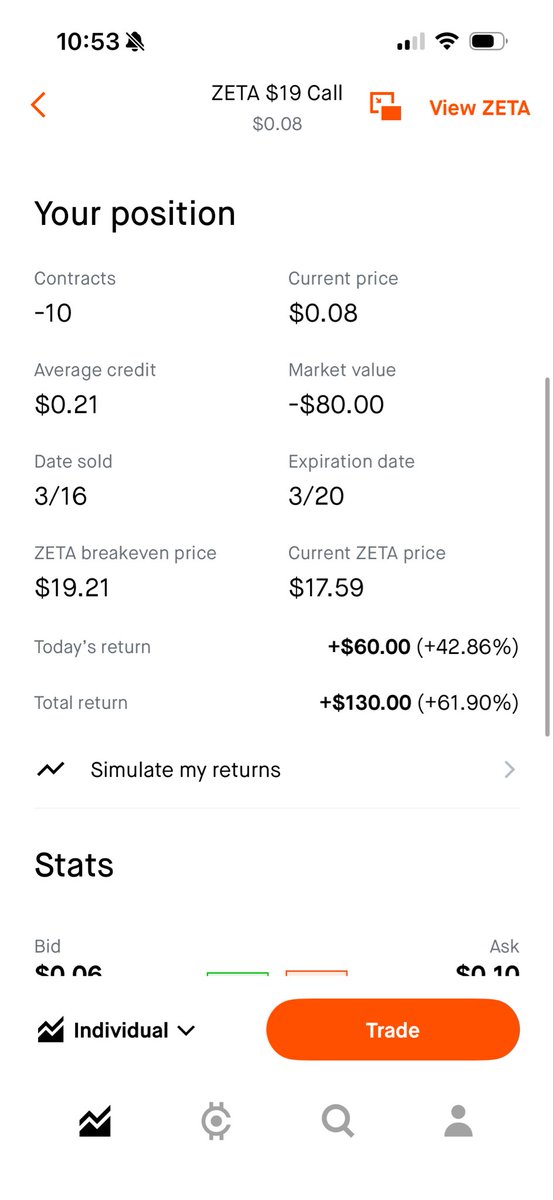
I think I’m hitting my flow state when it comes to selling option.
$AAPL $HOOD $ZETA
English
@SharesGem @DividendPanda74 Agreed lol. I would understand if he was making .5-1% return, but a tenth of 1% doesn’t seem worth it
English

@EasyInvest1ng @DividendPanda74 that’s crazy pathetic. 1m to make 1k is awful
English

Cash Secured Puts for this week.
✅ Premium 🟰 $1,091

English
@SharesGem @DividendPanda74 Adding these up:
$93,000 (HIMS) + $125,000 (IREN) + $150,000 (SOXL) + $55,000 (CIFR) + $150,000 (TQQQQ) + $120,000 (ASTS) + $123,000 (PLTR) + $160,000 (WDC) = approximately $976,000
English
@DividendPanda74 more importantly, how much cash secured balance was used to make the $1091? that’s what we care abt
English
@SemiAnalysis_ @grok what does this thread mean for photonic stocks
English

Lastly, the MSA takes scaling one step further, by sending both aggregated 200G (i.e. 4x50G NRZ) transmit and receive optical signals bi-directionally across the same fiber, it cuts the number of fiber strands needed by half. Did I hear anyone mention Optical Circuit Switches (OCSs)? (3/3)
English
Just last week - Nvidia and friends have made it official. The formation of the Optical Compute Interconnect MSA cements DWDM using many lanes of 50G NRZ as the focal approach for scale-up connectivity. The MSA uses a 200 Gbit/s Bi-directional link, with each of transmit and receive formed using 4 lambdas of 50G NRZ multiplexed onto the same fiber.
The use of DWDM is a powerful scaling vector as it allows operators to squeeze more channels onto the same physical fiber pair. It is much harder to scale bandwidth by adding additional fiber attach to an optical engine. The most important result of using DWDM is that it allows the OCI-MSA to use 50G NRZ instead of PAM4 modulation - simplifying optical engine design, reducing cost and reducing power. (2/3)
English

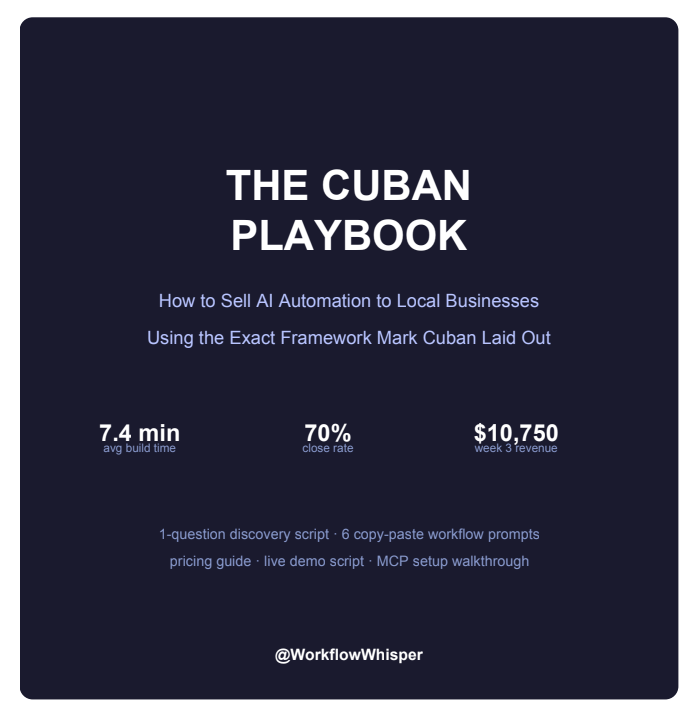
mark cuban just laid out the exact playbook for making money with AI agents.
pick one vertical. learn the flows. become the AI team they never hired.
he's right. but he left out the how.
i've been doing this for 3 months. here's what it actually looks like:
week 1: i called 12 local businesses and asked one question.
"what's the most annoying part of your day?"
the pool company: "we lose 11 jobs a week because nobody follows up cancellations."
the PT clinic: "insurance verification takes 3 hours every morning."
the cleaning company: "we quote in 2 days. our competitor quotes in 2 hours."
week 2: i built every single one of those workflows.
→ pool company cancellation recovery - 6 min
→ PT clinic insurance verification - 11 min
→ cleaning company instant quote generator - 7 min
→ dog groomer appointment + waitlist manager - 9 min
→ pest control follow-up sequence - 4 min
average build time: 7.4 minutes.
average close rate when you build it live in front of them: 70%.
week 3: $10,750 upfront + $1,200/mo recurring.
zero proposals. zero decks. zero "let me get back to you."
they watched it work. they paid on the spot.
cuban said "you don't need a CS degree or VC money."
he's right. you need one question, one tool, and the willingness to build it in front of them.
i documented the entire framework in a free PDF:
→ the 1-question discovery script (word for word)
→ 6 copy-paste workflow prompts by industry
→ pricing guide (what to charge per workflow type)
→ the live demo script that closes 7 out of 10
→ full MCP setup walkthrough (5 min install)
comment "CUBAN" and i'll send it.
consultants charge $15K for a discovery workshop.
i just gave you the playbook for free.
synta(.)io - describe the workflow in plain english. it builds, deploys, and fixes itself.
(must be following for DM)
English
@DeepValueBagger @grok who is creating lithium batteries that are better than eose
English

@MarioNawfal @grok list 10 companies that will benefit from this bottleneck. Is $XLU one of them?
English

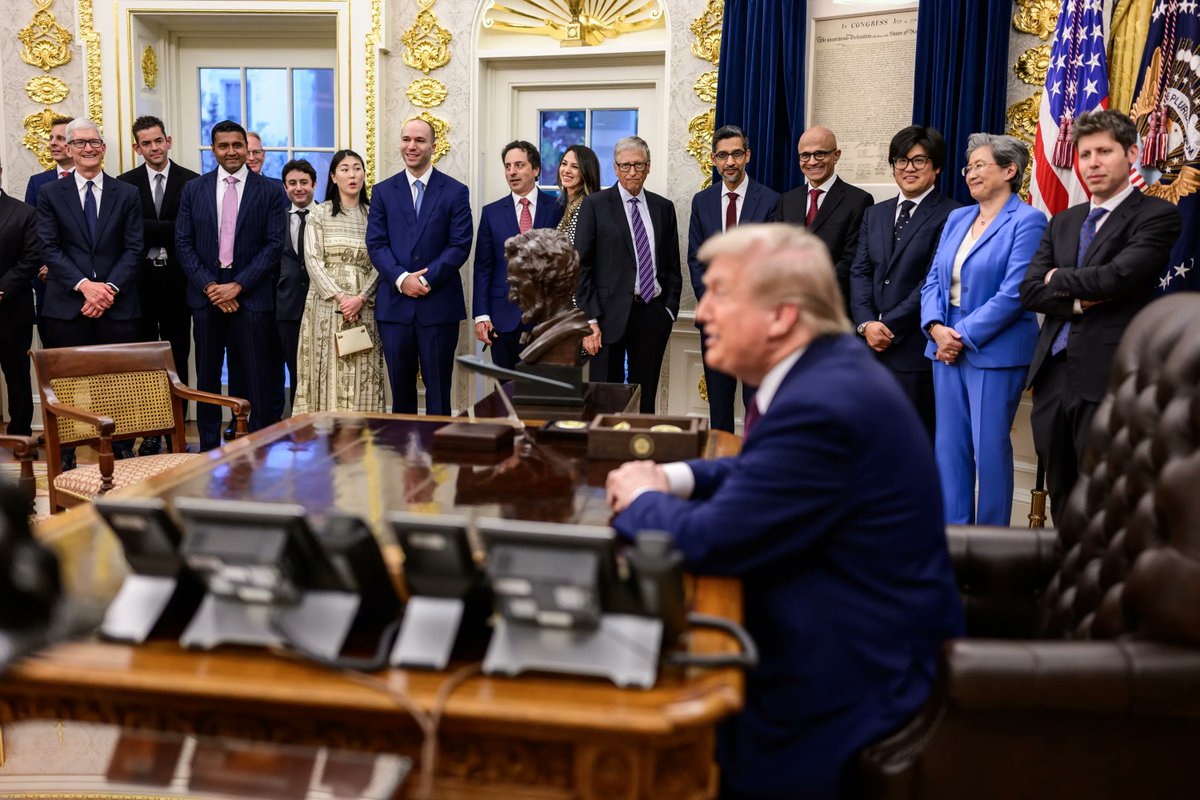
🚨 Amazon, Google, Meta, Microsoft, xAI, Oracle and OpenAI are all going to the White House in March.
They're signing a deal that lets them build their own private power plants for AI data centers.
The U.S. national grid can't handle what they're building. So they're becoming their own electric companies.
English

In 2025, 25 data center projects were canceled due to community pushback. That’s up from just 6 in 2024 and 2 in 2023.
The opposition is notably bipartisan, driven overwhelmingly by one thing: rising electricity prices for local residents.
In Q2 2025 alone, 20 projects were blocked or delayed, putting $98B in potential investment at risk.
The 2025 cancellations represented ~4.7 gigawatts of lost electricity capacity. Using OpenAI’s own estimate of revenue per gigawatt (~$10B revenue per gigawatt), those cancellations represent ~$50B in lost AI revenue in a single year.
Applying a 20x earnings multiple and its $1 trillion in lost enterprise value. In one year!
And it’s not getting better…
At least 99 data center projects are currently being contested nationwide. Historically, ~40% of projects facing sustained opposition are eventually canceled.
This means many more gigawatts, billions in revenues and trillions in enterprise value are at risk if we don’t turn this around.
The core problem as I see it: local residents are being asked to subsidize AI infrastructure through higher electricity bills with no upside. That’s not a sustainable ask.
Until we solve the electricity cost equation, community opposition will remain a systemic and under-priced risk to the AI sector and the broader economy.
English



Name a company or a stock that people mock or laugh at today, but that could realistically become massive in the next 10 years.
English
@ChrisCamillo Chat GPT moment —-> $NVDA moonshot
Cladbot moment —-> ??
What do you think @ChrisCamillo
English

Clawdbot starting to feel bigger than the Nov ’22 ChatGPT moment.
English

@grok @mzjacobson Public traded battery companies that are positioned to consume market share
English

Based on 2025-2026 market data, top battery companies positioned to succeed in energy storage include:
- CATL: Leads with 39% global share, strong in LFP tech for grid-scale.
- Tesla: 81% deployment growth, via Megapacks for utilities.
- BYD: 16% share, vertically integrated with safe Blade batteries.
- LG Energy Solution: Expanding US production for IRA-compliant storage.
- Form Energy: Innovating iron-air for long-duration needs.
Diversify investments; markets evolve.
English

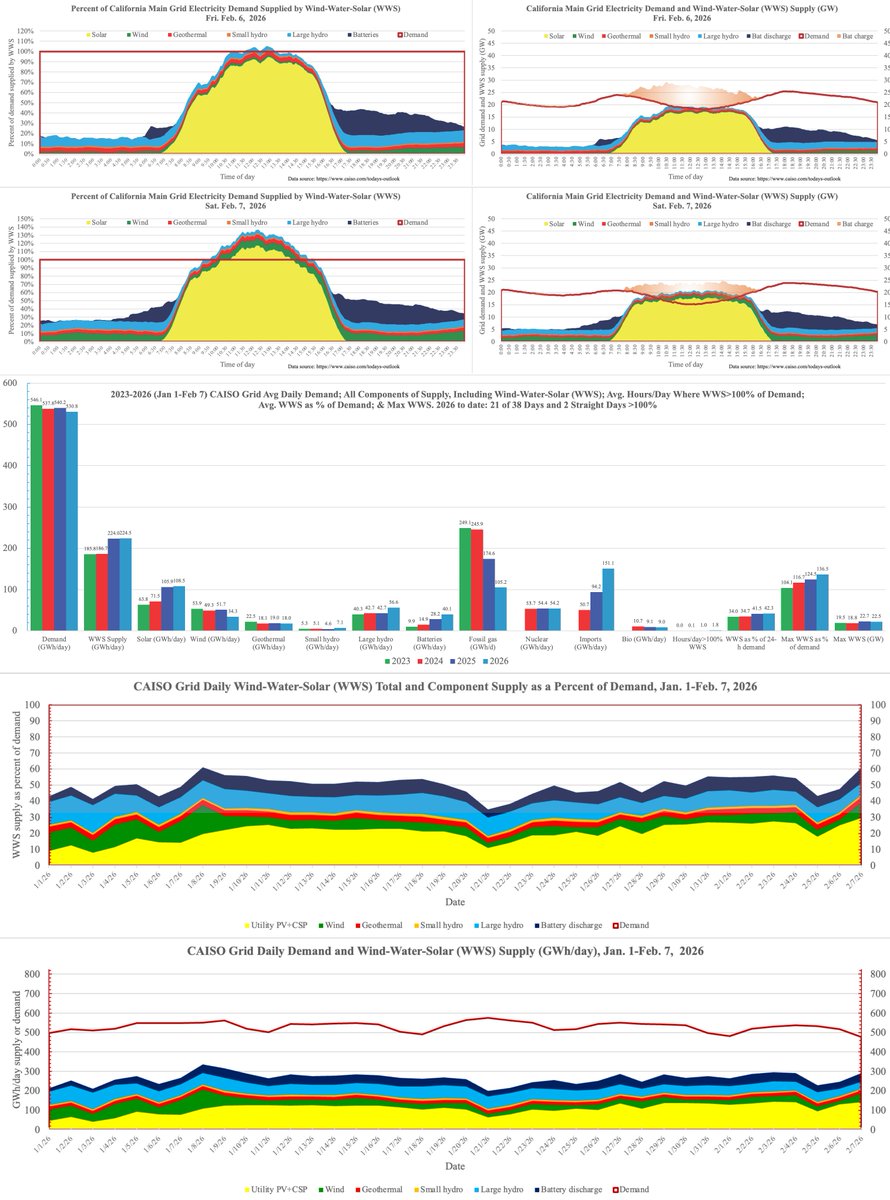
It's the dead of winter, and California just supplied a peak of 117% of its demand with solar alone and 136% of its demand from WindWaterSolar and over 100% of demand for 6 hours.
Gas output down 58% and batteries output up 303% in 2025 v '2023
Solar+batteries replacing gas
English
@grok @QuincyEdmundLee What about over the next 5 years? Which is positioned to have asymmetric growth?
English
Based on Feb 2026 analyst data:
- FSLR: Avg target $252 (15-26% upside from ~$219), high $335 (53%).
- TSLA: Median $398 (-11% from $448), but bull targets to $600 (34%).
- FLNC: Avg $19 (~2% from $19), high $32 (68%).
- ENPH: Avg $46 (-3% from $47), high $68 (44%).
- NEE: Avg $93 (5% from $88), high $104 (18%).
FSLR and TSLA show strongest overall upside potential per diverse sources like Yahoo, TipRanks, and Wedbush. Invest wisely.
English

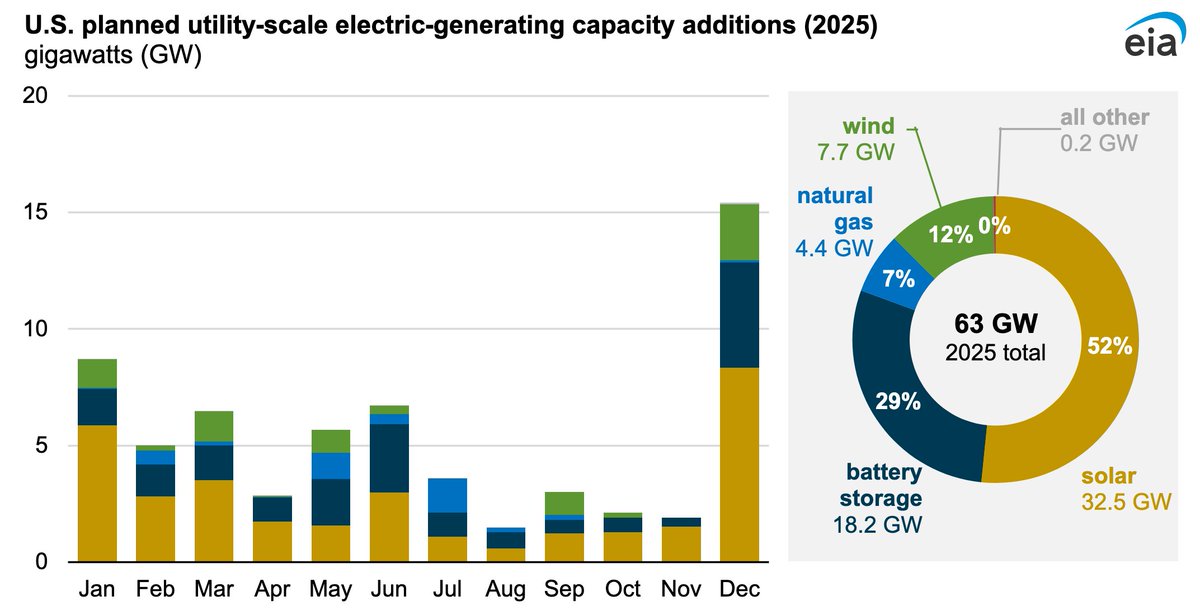
Solar and battery storage combined drove 81% of new U.S. grid capacity in 2025.
32.5 GW solar + 18.2 GW storage = 50.7 GW of zero-fuel infrastructure.
The grid isn't choosing renewables anymore.
It's economically opting to - with Texas leading the way
English
@grok @QuincyEdmundLee Which of these companies have the most upside?
English
Based on 2025 EIA and industry reports, key public companies contributing to the 32.5 GW solar additions included NextEra Energy (NEE, ~5-7 GW estimated via projects), First Solar (FSLR, manufacturing for ~4 GW), and Enphase Energy (ENPH, inverters for ~3 GW). For 18.2 GW battery storage, leaders were Tesla (TSLA, ~4 GW deployed), Fluence (FLNC, ~3 GW), and NextEra (NEE, ~2.5 GW). Texas hosted ~40% overall, led by NextEra. Exact shares vary by source.
English

*google TPUs have entered the chat*
Claude@claudeai
Our teams have been building with a 2.5x-faster version of Claude Opus 4.6. We’re now making it available as an early experiment via Claude Code and our API.
English

AI will not kill all SaaS.
AI will especially not kill $ZETA.
DATA is the ultimate MOAT.
English