

Econymous
29.5K posts
Econymous
@Econymous_1
Not really Eustace Plimsoll (who is a fictional fictional character. click the link below), just an anonymous economist trying to make his way in this world.
The Southeast Katılım Mayıs 2020
478 Takip Edilen1.3K Takipçiler

Should we find some tattooed dipshit to start fluffing organ meat as the next big thing? Leaving all the good cuts for good people like me?
English
What a clown.

Will Chamberlain@willchamberlain
The more I think about it, the less disastrous I think this deal is. I still think it's suboptimal, and that we made a number of errors that weakened our negotiating position. The key difference between this deal and the JCPOA is that we just obliterated the bulk of Iranian military capabilities as well as the bulk of the Iranian defense industrial base. When Obama handed pallets of cash to the Iranians in the JCPOA, they were able to put that money to work immediately churning out munitions and funding their proxies. Letting Iran sell its oil now lets them begin the process of reconstituting military capabilities that took decades to build - and they are starting from basically zero, because they have to rebuild their factories first. That's hard. It takes a lot of time. @planefag pointed out that the American strategic dilemma has been all about our shortage of missile interceptors. Well, we have basically infinite money to throw at that problem, and yet it's still a problem, because the production lines don't exist yet. Iran now has that problem but for EVERYTHING. Money alone doesn't solve it - not quickly at least. The IRGC gets time, too; but so do we. After six weeks of strikes, their military was degraded, but they still had two core capabilities that created problems: their ability to harass commercial ships in the Strait, and their ability to use short-range ballistic missiles to hit the Gulf. The Gulf countries have money and motivation too, and the factories that make their stuff weren't blown up. Expect the UAE and Saudi to keep working on new workarounds to be able to avoid the Strait entirely, and to massively upgrade their missile and drone defense capabilities as well. I still think we made some pretty significant errors during the ceasefire that weakened our negotiating position dramatically. When we let Iran get away with not opening the Strait after they had promised to do so (and Aragchi had publicly announced that they would!) that was bad. When we gave up on Project Freedom and didn't respond to the attacks on Gulf oil infrastructure, that was bad too. But the strategic position of America and its allies is stronger now than it was in February vis-a-vis Iran. If you don't think so, think about how much of our senior leadership, ships, planes, personnel, and defense industrial base you would trade for some cash. Not much, IMO.
English
@willchamberlain @Real_Politik101 So that's two complete Trump fuck-ups that you trusted him on. Learning any lessons at all?
English

@santabarbaraLVR @paulnovosad much smaller homes, with more people in them. thezebra.com/resources/home…
English


Have real wages really barely changed since the 1970s? We should find out experimentally. Here's how:
We build a 1970-sphere: a Truman Show mini-universe where you eat 70s-quality food, get 70s health and dental care, watch 70s NBA on 70s TVs, experience 70s crime rates.
Participants earn their current salary adjusted to 1970 price levels (so if you make $120k today, you get CPI-adjusted $120k of 1970-sphere purchasing power).
Every day there's an auction where the highest bidder pays to leave early and returns to 2026 and their 2026 wage.
If the CPI is correct, everyone is indifferent and no one bids anything. The amount people bid to leave 1970-sphere tells us how much the CPI understates real improvement in living standards.
English
@Mark_in_SF @paulnovosad Who considers it a good thing? And housing is not left out of inflation calculations. It accounts for 35% of the CPI, for example. Where did you get the idea that it was left out?
English

@paulnovosad Gotta love how home prices going up faster than wages is considered a GOOD thing. We'll just leave it out of inflation calculations, even though it's people's biggest expense by far.
English
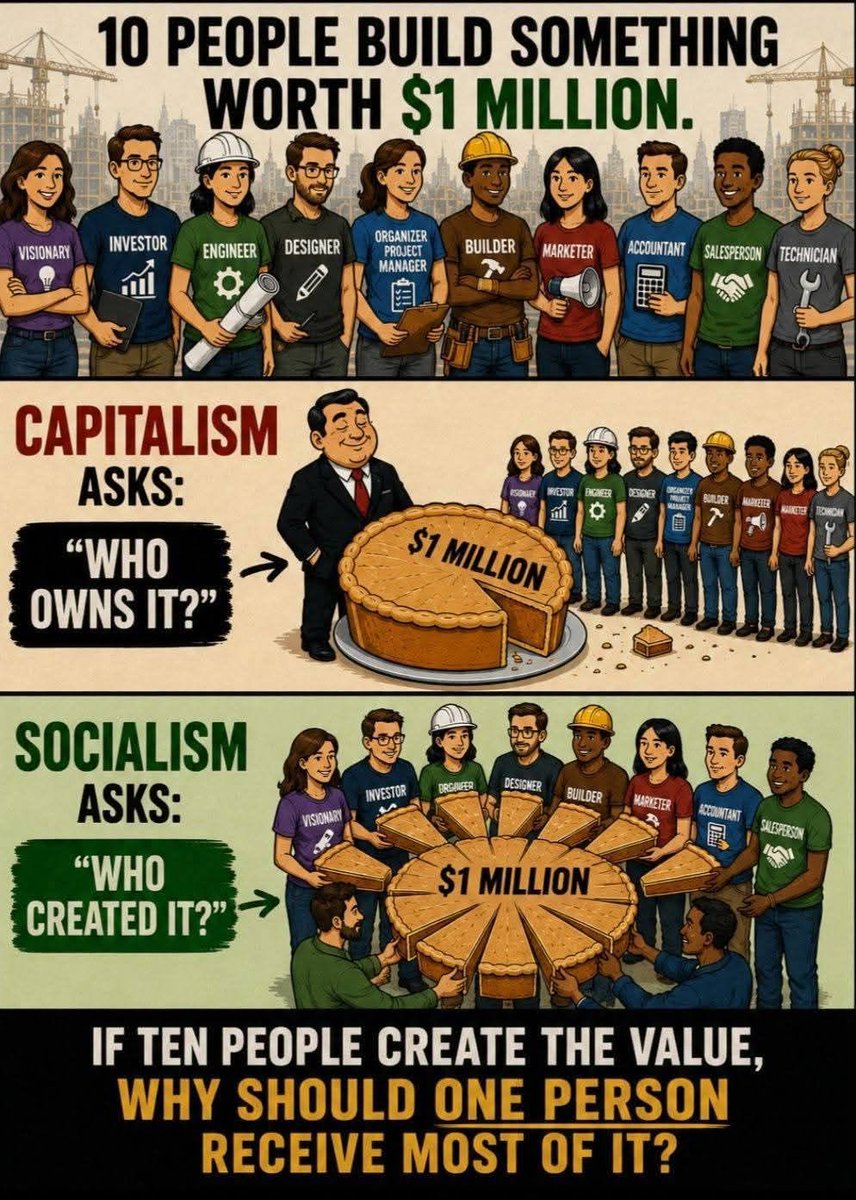
@beyond_capital Wrong question. What are their expected payouts before they try? The owners face risk, so might lose, while workers get paid for their work.
English
@mattyglesias Was the Compiegne Wagon unavailable?
en.wikipedia.org/wiki/Compi%C3%…
English

He literally signed the surrender at Versailles like the Germans after they lost a war???
You can usually count on Trump to at least be clever about staging.
The White House@WhiteHouse
🚨 President Donald J. Trump has SIGNED the Iran Memorandum of Understanding at Versailles in France. 🇺🇸
English
@matthewstoller Iran should be treated like a normal country if it ever becomes normal. Can you cite a single Dem who is just mad that the war ended, with a link?
English

It is hard to message on the Iran deal because it's actually good to lift sanctions and treat Iran like a normal country but Trump did it in the worst way possible. But then, a lot of Dems are just mad the war ended.
English

@Econymous_1 @EWErickson Only the chickenhawks, isolationist weirdos, and the Dumocrats are "mad."
Which one are you?
English
This is an American surrender.
Cameron Arcand@cameron_arcand
A SENIOR UNITED STATES OFFICIAL HAS READ OUT THE IRAN MEMORANDUM OF UNDERSTANDING. @townhallcom WAS ON THE CALL: - The United States of America, and Islamic Republic of Iran, and their allies in the current war, by signing this MOU, declare the immediate and permanent termination of military operations on all fronts, including in Lebanon, and undertake from now on not to initiate any war or any military operation against each other, and to refrain from the threat or use of force against each other, and ensuring the territorial integrity and sovereignty of Lebanon. The final deal will confirm the permanent termination of the war on all fronts, including in Lebanon, and other provisions of this paragraph. - The United States of America, the Islamic Republic of Iran, undertake to respect each other's sovereignty and territorial integrity, and to refrain from interfering in each other's internal affairs. - The United States of America, and the Islamic Republic of Iran commits to negotiating and achieving the final deal in maximum 60 days – extendable with mutual consent. - Immediately upon the signing of this MOU, the United States of America will begin the removal of its naval blockade and any disturbances or impediments against the Islamic Republic of Iran, and will fully end the Naval blockade within 30 days. During this period, the traffic of vessels will be in proportion to the numbers of pre-war traffic being restored by the Islamic Republic of Iran, the United States of America, further undertakes to remove its forces from the proximity of the Islamic Republic of Iran within 30 days after the final deal. - Upon the signing of this, MOU, the Islamic Republic of Iran will make arrangements using its best efforts for the safe passage of commercial vessels with no charge for 60 days only from the Persian Gulf to the Sea of Oman, and vice versa. The traffic of commercial vessels will immediately start in considering the needs for removing the technical and military obstacles and de-mining by the Islamic Republic of Iran will be initiated within 30 days, the Islamic Republic of Iran will conduct dialogue with Sultaness of Oman to define the future administration and maritime services in the Strait of Homruz discussion with other Persian gulf [...] states in line with the applicable international law and the sovereign rights of coastal states of the Strait of Hormuz. - The United States of America undertakes with regional partners to develop a definitive mutually agreed plan with at least USD 300 billion for the reconstruction and economic development of the Islamic Republic of Iran. The mechanism for the implementation of this plan will be finalized as part of a final deal within 60 days. All required licenses, waivers, and permissions needed for the relevant financial transactions will be granted by the United States of America. - The United States of America undertakes to terminate all types of sanctions against the Islamic Republic of Iran, including the United Nations Security Council Resolution, i.e. IAEA Board of Governor's Resolution, and all unilateral U.S. sanctions, primary and secondary, and an agreed upon schedule as part of the final deal. The Islamic Republic of Iran reaffirms that it shall not procure or develop nuclear weapons. The United States of America, and the Islamic Republic of Iran, have agreed to resolve the disposition of stockpile enriched material, pursuant to a mechanism that will be mutually agreed upon, in accordance with the schedule mentioned in paragraph 7, with a minimum methodology to be down blending on site, under the supervision of the IAEA. The two parties also agreed to discuss the issue of enrichment and other mutually agreed matters related to the economical public of Iran's nuclear need, based on the satisfactory framework being agreed upon in the final deal. The final deal will confirm the provisions of this paragraph. - The United States of America and the Islamic Republic of Iran, acknowledge the critical importance of the nuclear issues above mission, and express their attention to immediately address these issues in the negotiation in order to achieve mutual agreement on them. - Pending the final deal, the United States of America and the Islamic Republic of Iran agree to maintain the status quo. The Islamic Republic of Iran will maintain the current status quo of its nuclear program, and the United States of America will not impose any new sanctions and will not deploy additional forces in the region. - The United States of America undertakes, but immediately upon the signing of this MOU, and until the termination of sanctions, the U.S. Department of Treasury will issue waivers for the export of Iranian crude oil, petroleum products and derivatives and all associated services including banking, transactions, insurances, transportation, etc. - The United States of America undertakes to make fully available for use, the frozen, or restricted funds, and assets of the Islamic Republic of Iran upon the implementation of the MOU, the United States of America and the Islamic Republic of Iran will usually agree on the procedures related to the relief of these funds during the negotiation. Such funds, whether retained in the original accounts or transferred, government may be fully usable for payment to any ultimate beneficiary designated by the Central Bank of the Islamic Republic of Iran. The United States of America undertakes to issue all necessary licenses and authorizations accordingly. - The United States of America and the Islamic Republic of Iran agree that an executive mechanism will be established to monitor the successful implementations of MOU and the future compliance of the final deal. After signing the MOU, and subject to the beginning of the implementation of paragraphs 1, 4, 5, 10, and 11 of this MOU, and the continuing implementation of these measures, the United States of America, and the Islamic Republic of Iran, will start negotiations regarding the final deal exclusively on the other paragraphs. - The final deal will be endorsed by a binding [United Nations Security Council] resolution.
English
@cccuuujjjooo @EWErickson America first, not Trump first. If you aren't mad that Trump bungled this and is surrendering to Iran, then you're an imbecile.
English
Is this supposed to be a hit piece?
Eliana Johnson@elianayjohnson
“Texas Senate candidate James Talarico, 37, has a single checking account that holds up to $50,000—and he shares it with his mother, a frequent contributor to his political campaigns who pitched in to cover Talarico’s moving expenses when he was 32, records show,” @peterjhasson - freebeacon.com/democrats/texa…
English
@PolicyMkt @Acyn Yes, his ambition led him to hitch his wagon to Trump and he was not entirely redeemed by not going along with the election plot.
English

@Econymous_1 @Acyn As George Will wrote (abt Mike Pence) "he is who he has chosen to be which is horrifying."
English

Vance: It doesn’t both me that Democrats disagree with our policies. It bothers me that they are just terrible people, so many of them. But what really does bother me is that they don't show gratitude for the United States. If you don't feel grateful to live here, what are you even doing being in public service. Too many Democrats don't show appreciation for the country
English
@cccuuujjjooo @EWErickson Everyone with half a brain is mad that Trump got us into this and fucked it up so badly.
English
@EWErickson Chickenhawks mad we aren’t sending troops into Iran
Hahaha
English
@StreetGlider770 @EWErickson You aren't disputing that Trump is surrendering to Iran, are you? Just say it: Trump's incompetence and poor judgment led him to surrendering to Iran.
English

@EWErickson Just say you want a ground invasion, 1000s dead, and $250 a barrel oil for Israeli interests dude
English
We have the text, the deal is absolutely terrible, there's no getting around it. The text gives Iranians huge, immediate financial benefits and protection for Hezbollah in exchange for opening the Strait - and nothing else.
President Trump should renege.
English

JD Vance on Iran:
We have a constituency right now that is saying that we're going to send boots on the ground.
They want Donald Trump to send hundreds of thousands of ground troops into Iran.
We need people to be pushing back from inside the tent.
Source: Megyn Kelly
English
@Jeffers20444574 @KurtSchlichter Is that spelled out clearly enough?
English
@Jeffers20444574 @KurtSchlichter Who the hell is Burt? The question is about whether Kemp knows GA politics relative to Trump. He does, as evidenced by his 4 statewide victories vs. Trump's 2-1 record, and not fucking up the 2020 senate races by trying to overturn the election he lost.
English

For knowing GA, he sure sucks at knowing GA
Dan McLaughlin@baseballcrank
Nobody knows Georgia politics better than Brian Kemp. If his endorsed candidates are going down in the primary, that's a grim sign for Georgia Republicans in the fall.
English
@Jeffers20444574 @KurtSchlichter "Run the table", "landslide"? Where on earth are you getting that from? Kemp is 4-0 in statewide races, Trump is 2-1 and blew the GA Senate runoff races in 2020 by lying about the election and telling people to not vote by mail.
English

@Econymous_1 @KurtSchlichter So let me get this straight. You think Democrats ran the table on Republicans in 2020, but he and Raffensperger won in a landslide two years later? Not even close to believable.
English