Elliot Walmsley

1.6K posts

Elliot Walmsley banner
Elliot Walmsley

Elliot Walmsley

@ElliotWalmsley

Witnessing the Singularity. Building with AI ✨

UK Katılım Mart 2009
549 Takip Edilen59 Takipçiler
Sabitlenmiş Tweet
Elliot Walmsley
Elliot Walmsley@ElliotWalmsley·
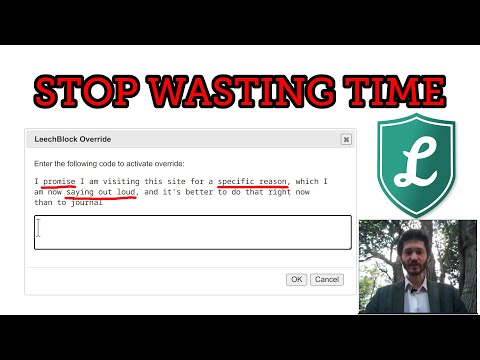
After 4 months of using @robertskmiles method (slightly altered for personal preference) I can confirm that this is a HIGHLY effective method for staying focused on what you SHOULD be doing, and not turning into a zombie, scrolling all day: youtube.com/watch?v=eV8F0d…
YouTube video
YouTube
English
2
3
14
2.9K
Elliot Walmsley
Elliot Walmsley@ElliotWalmsley·
@Mylovanov It's not going to be long before mitigating a drone attack is impossible without AI defence drones: Imagine a 200mph AI drone equipped with a gun that instantly headshots everybody within 100m classified as 'enemy' - like a cheating spinbotter in CS2.
English
0
0
3
802
Tymofiy Mylovanov
Tymofiy Mylovanov@Mylovanov·
When soldiers are taught how to survive an FPV drone, they’re taught “how to try to survive.” Rule number one: don’t stay together. One strike can wipe out a group. If you scatter, the drone has to pick one target. After that — it’s all down to chance, The Telegraph. 1/
English
123
681
6.4K
1.6M
Elliot Walmsley retweetledi
flavio
flavio@flaviocopes·
How Axios was compromised 🤯
flavio tweet media
English
153
857
6.9K
1.6M
Elliot Walmsley
Elliot Walmsley@ElliotWalmsley·
@willccbb Absolutely needs a manual edit mode. I can't believe there isn't one.
English
0
0
2
83
will brown
will brown@willccbb·
i like how claude memory is a couple paragraphs of hallucinations and overfixations that you can't edit directly and have to ask claude to edit but then it regenerates nightly with the same kinds of issues as before but rerolled and with your edits wiped
English
25
9
357
15.5K
Elliot Walmsley retweetledi
Preston Byrne
Preston Byrne@prestonjbyrne·
New, from the Adam Smith Institute: A FREE SPEECH BILL FOR THE UNITED KINGDOM. A legislative vision for getting the British state out of the business of censoring opinions, forever. adamsmith.org/research/the-f…
English
65
438
1.6K
215.7K
Elliot Walmsley retweetledi
Home Office
Home Office@ukhomeoffice·
Police time will no longer be wasted investigating legal social media posts, freeing up officers to patrol the streets and tackle real crime. By scrapping Non‑Crime Hate Incidents, we are balancing the protection of vulnerable communities while respecting free speech.
English
7.6K
3.2K
31K
7.3M
Elliot Walmsley retweetledi
Jeff Garzik
Jeff Garzik@jgarzik·
"Google paper uses a zero-knowledge (ZK) proof to demonstrate the algorithm's existence without leaking actual optimisations. From now on, assume state-of-the-art algorithms will be censored. There may be self-censorship for moral or commercial reasons, or because of government pressure. A blackout in academic publications would be a tell-tale sign."
Justin Drake@drakefjustin

Today is a monumentous day for quantum computing and cryptography. Two breakthrough papers just landed (links in next tweet). Both papers improve Shor's algorithm, infamous for cracking RSA and elliptic curve cryptography. The two results compound, optimising separate layers of the quantum stack. The results are shocking. I expect a narrative shift and a further R&D boost toward post-quantum cryptography. The first paper is by Google Quantum AI. They tackle the (logical) Shor algorithm, tailoring it to crack Bitcoin and Ethereum signatures. The algorithm runs on ~1K logical qubits for the 256-bit elliptic curve secp256k1. Due to the low circuit depth, a fast superconducting computer would recover private keys in minutes. I'm grateful to have joined as a late paper co-author, in large part for the chance to interact with experts and the alpha gleaned from internal discussions. The second paper is by a stealthy startup called Oratomic, with ex-Google and prominent Caltech faculty. Their starting point is Google's improvements to the logical quantum circuit. They then apply improvements at the physical layer, with tricks specific to neutral atom quantum computers. The result estimates that 26,000 atomic qubits are sufficient to break 256-bit elliptic curve signatures. This would be roughly a 40x improvement in physical qubit count over previous state-of-the-art. On the flip side, a single Shor run would take ~10 days due to the relatively slow speed of neutral atoms. Below are my key takeaways. As a disclaimer, I am not a quantum expert. Time is needed for the results to be properly vetted. Based on my interactions with the team, I have faith the Google Quantum AI results are conservative. The Oratomic paper is much harder for me to assess, especially because of the use of more exotic qLDPC codes. I will take it with a grain of salt until the dust settles. → q-day: My confidence in q-day by 2032 has shot up significantly. IMO there's at least a 10% chance that by 2032 a quantum computer recovers a secp256k1 ECDSA private key from an exposed public key. While a cryptographically-relevant quantum computer (CRQC) before 2030 still feels unlikely, now is undoubtedly the time to start preparing. → censorship: The Google paper uses a zero-knowledge (ZK) proof to demonstrate the algorithm's existence without leaking actual optimisations. From now on, assume state-of-the-art algorithms will be censored. There may be self-censorship for moral or commercial reasons, or because of government pressure. A blackout in academic publications would be a tell-tale sign. → cracking time: A superconducting quantum computer, the type Google is building, could crack keys in minutes. This is because the optimised quantum circuit is just 100M Toffoli gates, which is surprisingly shallow. (Toffoli gates are hard because they require production of so-called "magic states".) Toffoli gates would consume ~10 microseconds on a superconducting platform, totalling ~1,000 sec of Shor runtime. → latency optimisations: Two latency optimisations bring key cracking time to single-digit minutes. The first parallelises computation across quantum devices. The second involves feeding the pubkey to the quantum computer mid-flight, after a generic setup phase. → fast- and slow-clock: At first approximation there are two families of quantum computers. The fast-clock flavour, which includes superconducting and photonic architectures, runs at roughly 100 kHz. The slow-clock flavour, which includes trapped ion and neutral atom architectures, runs roughly 1,000x slower (~100 Hz, or ~1 week to crack a single key). → qubit count: The size-optimised variant of the algorithm runs on 1,200 logical qubits. On a superconducting computer with surface code error correction that's roughly 500K physical qubits, a 400:1 physical-to-logical ratio. The surface code is conservative, assuming only four-way nearest-neighbour grid connectivity. It was demonstrated last year by Google on a real quantum computer. → future gains: Low-hanging fruit is still being picked, with at least one of the Google optimisations resulting from a surprisingly simple observation. Interestingly, AI was not (yet!) tasked to find optimisations. This was also the first time authors such as Craig Gidney attacked elliptic curves (as opposed to RSA). Shor logical qubit count could plausibly go under 1K soonish. → error correction: The physical-to-logical ratio for superconducting computers could go under 100:1. For superconducting computers that would be mean ~100K physical qubits for a CRQC, two orders of magnitude away from state of the art. Neutral atoms quantum computers are amenable to error correcting codes other than the surface code. While much slower to run, they can bring down the physical to logical qubit ratio closer to 10:1. → Bitcoin PoW: Commercially-viable Bitcoin PoW via Grover's algorithm is not happening any time soon. We're talking decades, possibly centuries away. This observation should help focus the discussion on ECDSA and Schnorr. (Side note: as unofficial Bitcoin security researcher, I still believe Bitcoin PoW is cooked due to the dwindling security budget.) → team quality: The folks at Google Quantum AI are the real deal. Craig Gidney (@CraigGidney) is arguably the world's top quantum circuit optimisooor. Just last year he squeezed 10x out of Shor for RSA, bringing the physical qubit count down from 10M to 1M. Special thanks to the Google team for patiently answering all my newb questions with detailed, fact-based answers. I was expecting some hype, but found none.


English
21
91
1.2K
105.1K
Elliot Walmsley retweetledi
Bo Wang
Bo Wang@BoWang87·
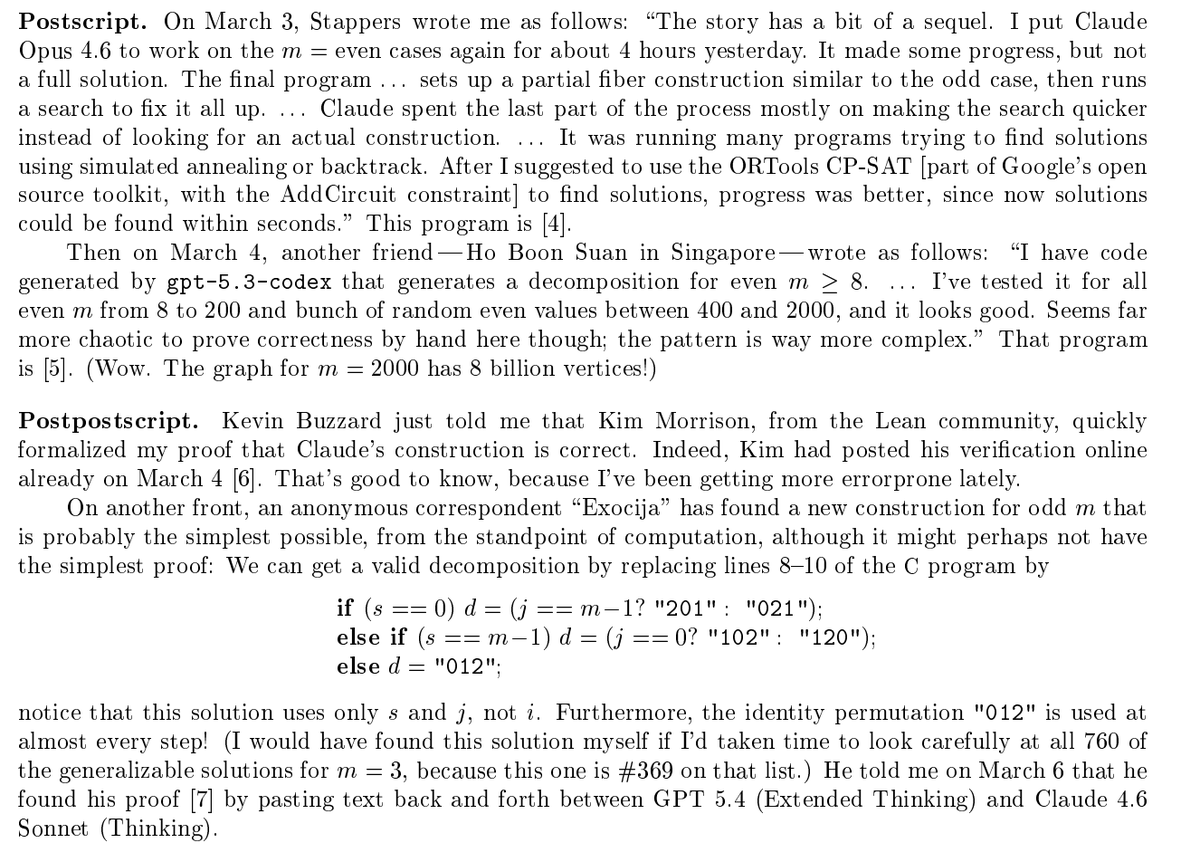
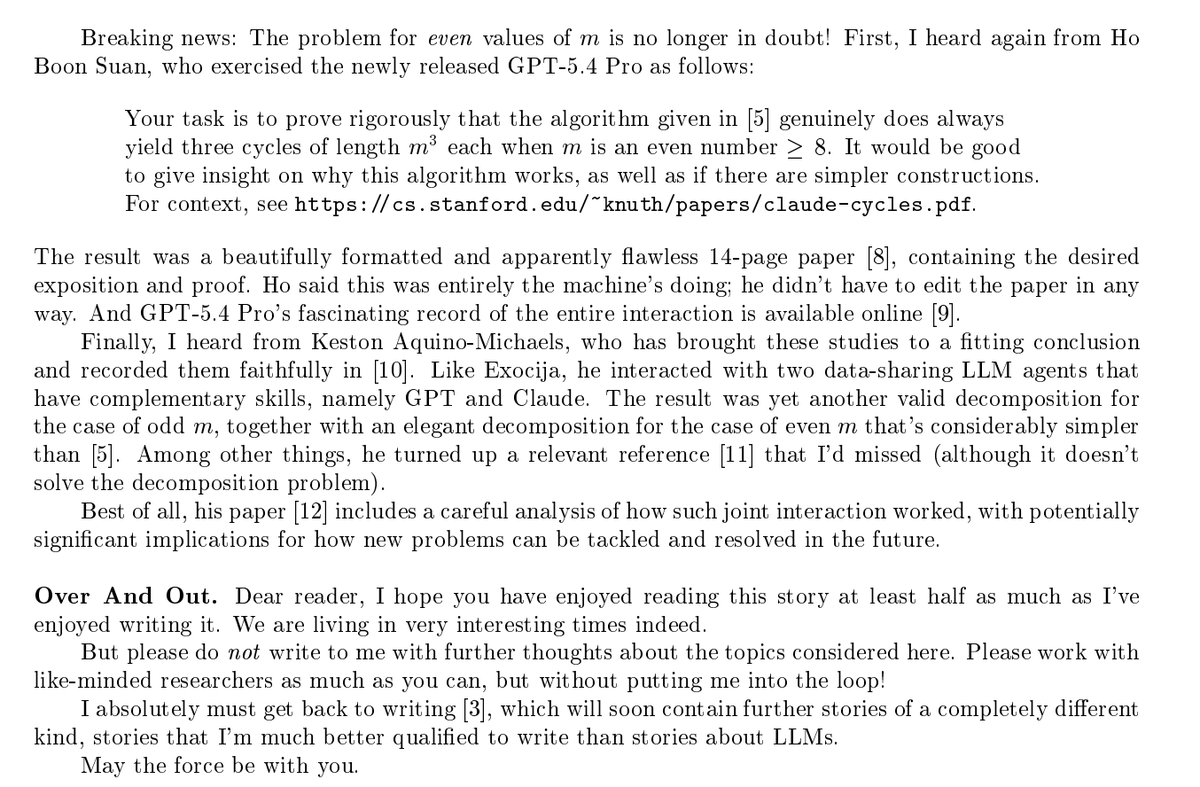
Three weeks ago I shared that Claude had shocked Prof. Donald Knuth by finding an odd-m construction for his open Hamiltonian decomposition problem in about an hour of guided exploration. Prof. Knuth titled the paper Claude’s Cycles. The story didn't end there. The updated paper shows the story got much bigger. For the base case m=3, there are exactly 11,502 Hamiltonian cycles. Of those, 996 generalize to all odd-m, and Prof. Knuth shows there are exactly 760 valid “Claude-like” decompositions in that family. The even case, which Claude couldn’t finish, was then cracked by Dr. Ho Boon Suan using GPT-5.4 Pro to produce a 14-page proof for all even m≥8, with computational checks up to m=2000. Soon after, Dr. Keston Aquino-Michaels used GPT + Claude together to find simpler constructions for both odd and even m, by using the multi-agent workflow. Dr. Kim Morrison also formalized Knuth’s proof of Claude’s odd-case construction in Lean. So yes: the problem now appears fully resolved in the updated paper’s ecosystem of human + AI + proof assistant work! We went from one AI solving one problem to a full mathematical ecosystem (multiple AI systems, multiple humans, formal verification) running in parallel on a problem that stumped experts for weeks. We are living in very interesting times indeed. Paper (updated): www-cs-faculty.stanford.edu/~knuth/papers/…
Bo Wang tweet mediaBo Wang tweet media
Bo Wang@BoWang87

Prof. Donald Knuth opened his new paper with "Shock! Shock!" Claude Opus 4.6 had just solved an open problem he'd been working on for weeks — a graph decomposition conjecture from The Art of Computer Programming. He named the paper "Claude's Cycles." 31 explorations. ~1 hour. Knuth read the output, wrote the formal proof, and closed with: "It seems I'll have to revise my opinions about generative AI one of these days." The man who wrote the bible of computer science just said that. In a paper named after an AI. Paper: cs.stanford.edu/~knuth/papers/…

English
40
261
1.4K
170.8K
Elliot Walmsley retweetledi
Preston Byrne
Preston Byrne@prestonjbyrne·
A Free Speech Act for the United Kingdom. Publishing on April 1st, 2026 at the @ASI. Not an April Fool's joke.
English
43
336
1.3K
99.6K
Jen 🎈
Jen 🎈@lunchbag·
The marketing videos for new AI products feel so disconnected from what they actually do. I get that marketing has always stretched the truth but it feels unnecessary when everything's already moving so fast. No need to exaggerate when the real capabilities are impressive enough.
English
1
0
4
410
Kevin Rose
Kevin Rose@kevinrose·
fun pro tip: I found this slick css/js design style that I loved -- but couldn't prompt into life, even with screenshots. so I used the claude browser extension and it reverse engineered it. I then took that data into @v0 and let claude (extension) prompt it into life (took about 4 revs)
English
21
2
124
28.1K
Brad Mills 🔑⚡️
Brad Mills 🔑⚡️@bradmillscan·
If you have activity bias, ADHD or anything resembling OCD, OpenClaw is a terrible drug and productivity poison. After 40 days in the trenches with this thing, my life is measurably worse. OpenClaw is a lot like crypto trading, gambling or playing video games. Most ppl are going to lose, and you’re going to feel like shit when you’re done - likely only 1% of ppl will find it additive to their lives. I am in a constant state of stress. I’m skipping workouts, my vision is fucked from 12-15 hrs a day on screens, my forearms are fucked from too much typing. There’s a never-ending maze of rabbit holes to fall down, footguns to step on and moles to whack. Plus when you finally do get it going, you start projects and don’t finish them because half way through something breaks. I’m not hitting the gym as often as I should, not eating right and I’ve completely lost sight of my goals and why I started in the first place. The idea of OpenClaw is so compelling and it’s very exciting when I get glimpses of what the future is going to be like when this is not a patchwork of chaos. This tech is dangerous. I know I said this last week but I need to take a break … I’m burnt out from all the constant debugging and errors across every fucking surface of this thing. It’s like trying to fly a plane without a license … oh and it’s on fire…and you’re on crack.
English
185
43
828
94.3K
Elliot Walmsley
Elliot Walmsley@ElliotWalmsley·
@dangreenheck Honest opinion: The only difference I'm seeing is the travel of the waves - it just looks like a windy day on the left - not better or worse. What's missing is water interaction with the boat and rocks. It needs some white spray, and/or localised high-frequency detail
English
1
0
12
1.6K
Dan Greenheck
Dan Greenheck@dangreenheck·
I made a dumb mistake with my water shader🤦🏻‍♂️ The wave evolution equation has two parts: a standing wave component and a traveling wave component. When I was first getting this all to work, I hard-coded constants so the waves were always traveling forward at full speed. By adding a "standing wave ratio" where I can control the ratio between the two terms, I can now achieve wave patterns that oscillate in place. The video on the left has SWR = 0 and the video on the right SWR = 0.7 (I exaggerated the waves a bit to make the difference more noticeable). Now I have to re-record all my marketing videos...😭
English
39
29
1.1K
125.5K
Elliot Walmsley retweetledi
Preston Byrne
Preston Byrne@prestonjbyrne·
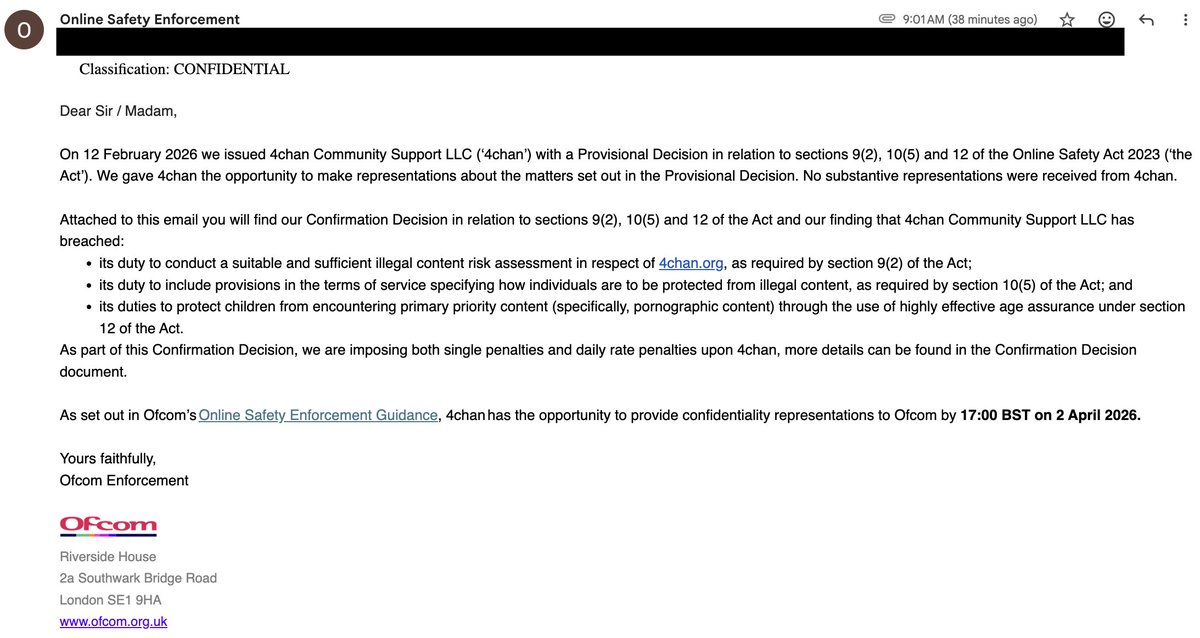
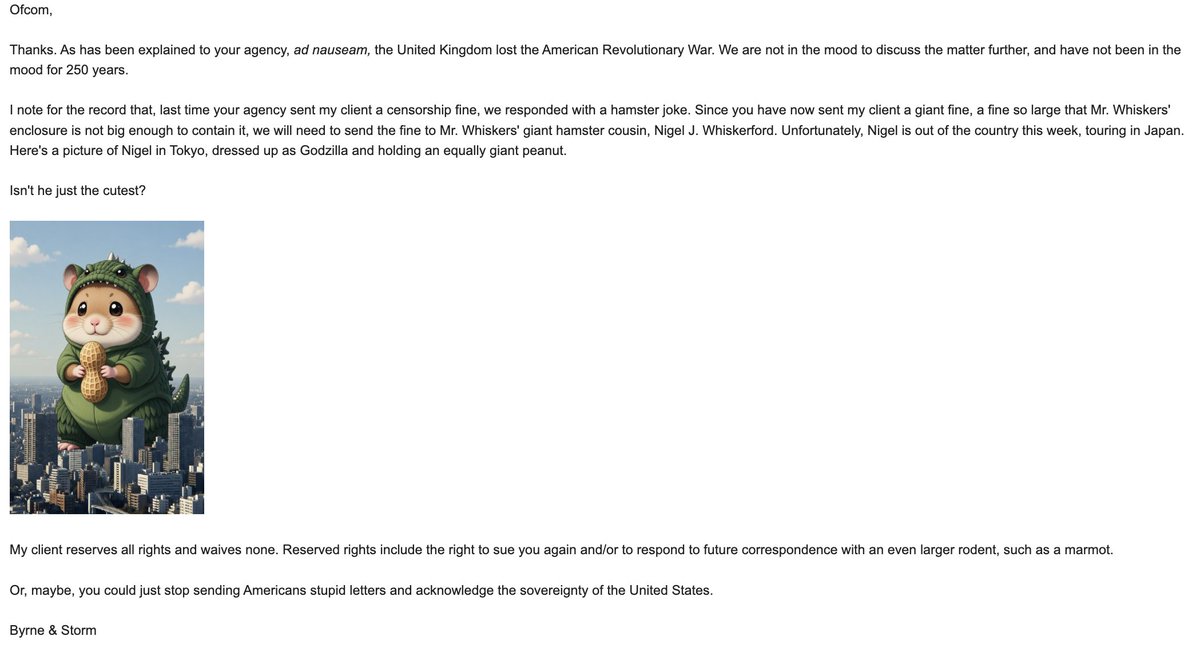
The UK's censorship agency, Ofcom, issued 4chan with a giant fine today. We responded to Ofcom with a giant hamster today.
Preston Byrne tweet mediaPreston Byrne tweet mediaPreston Byrne tweet media
English
687
2.5K
20.6K
1.3M
Elliot Walmsley retweetledi
tern
tern@1goodtern·
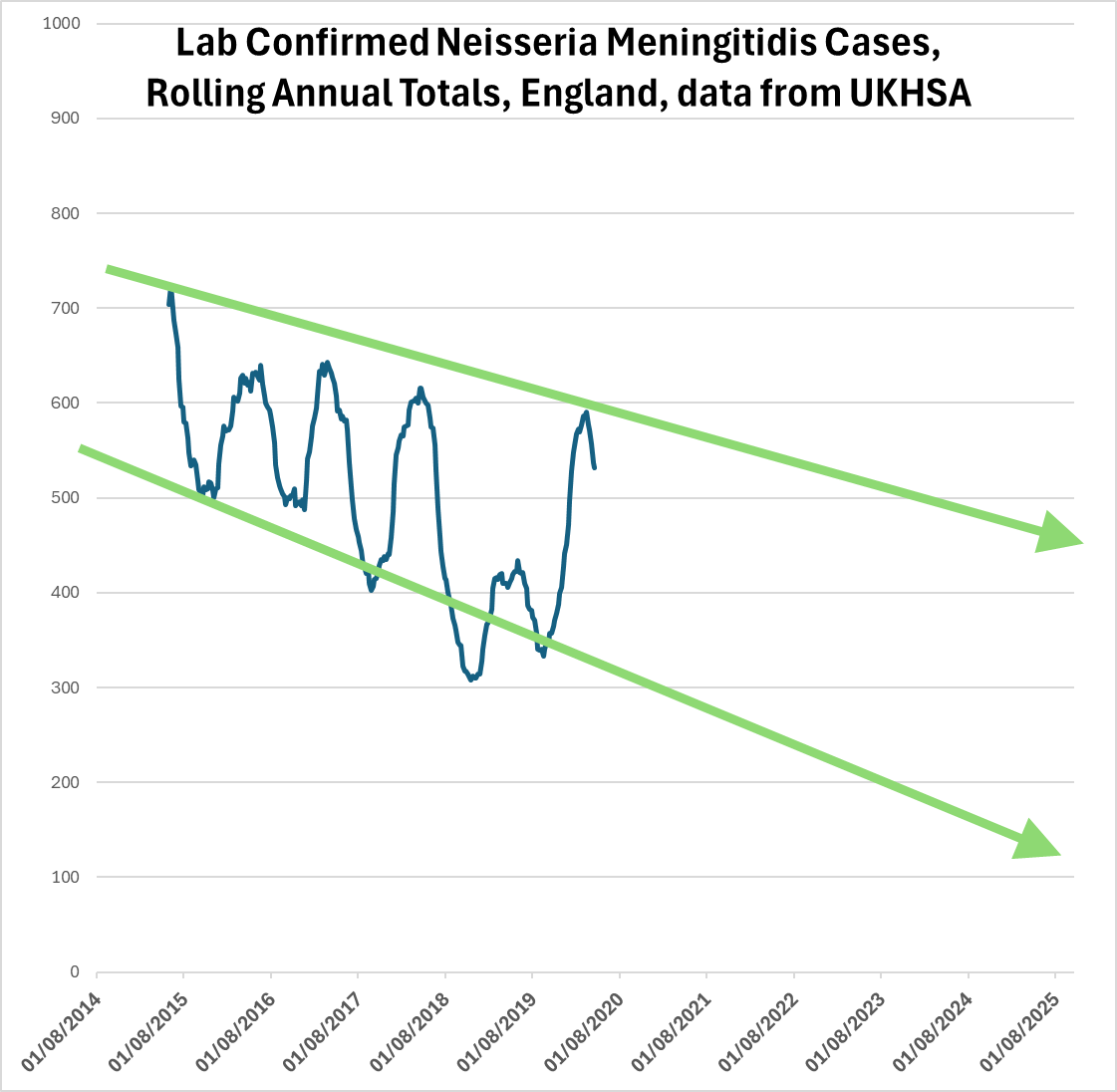
Before Covid came along, England was doing pretty well with meningococcal disease. Which is great because it's a disease that can *kill a healthy teenager within hours*... ... or leave them alive without limbs, hearing, or memory... But... and it's a really big but... 🧵
tern tweet media
English
17
298
900
211.1K
Elliot Walmsley retweetledi
François Chollet
François Chollet@fchollet·
There is a poetic depth to the term "latent space" that transforms vector coordinates into a frontier of pure possibility
English
43
65
745
46.3K
Elliot Walmsley
Elliot Walmsley@ElliotWalmsley·
There's a community of people enthusiastically championing every opinion, regardless of validity.
English
0
0
0
18
Elliot Walmsley
Elliot Walmsley@ElliotWalmsley·
The coders claiming they've gained zero speed-up from LLM-use are boggling my mind.
English
0
0
0
9
Elliot Walmsley retweetledi
CR1337
CR1337@CR1337·
CR1337 tweet media
ZXX
109
973
6.6K
86.7K
Elliot Walmsley retweetledi
François Chollet
François Chollet@fchollet·
We underestimate how much "abstract" thought is just repurposed sensorimotor control circuitry. A lot of reasoning is essentially about moving through idea-space the way we move through physical space.
English
179
242
2.4K
136.5K