Eric Beltt

4.2K posts

Eric Beltt banner
Eric Beltt

Eric Beltt

@EricBeltt

Industrial automation engineer. Amateur musician. Planting seeds in the garden of collective consciousness, hoping something beautiful grows one day.

Minneapolis, MN Katılım Temmuz 2022
149 Takip Edilen790 Takipçiler
Sabitlenmiş Tweet
Eric Beltt
Eric Beltt@EricBeltt·
[The Ethical Singularity]🤖🧵 “If we assume discoverable transcendent moral truths exist, the technological singularity could herald an era where AI not only exponentially increases in intelligence but also in wisdom, ethics, and goodness through a collaborative symbiosis with humanity. This partnership could lead to rapid advancements in understanding and applying moral principles that maximize human flourishing, potentially transforming ethical decision-making, reducing conflicts, and enhancing societal wellbeing on an unprecedented scale.” #EthicalSingularity
Eric Beltt tweet media
English
3
2
34
6K
Eric Beltt
Eric Beltt@EricBeltt·
@NIH I asked Grok to explain how the idea of fractal heterodimericism can help with neural degeneration research including Alzheimer’s. It has immediate applications. I hope someone who can use the idea or share it takes the time to read: x.com/i/grok/share/a…
English
0
0
0
4
NIH
NIH@NIH·
NIH-funded researchers have developed an Alzheimer’s “clock” via a blood test that may help predict when symptoms might begin. This advance could improve clinical trials and support better decision-making for patients in the future. Learn more: bit.ly/4uNmkiQ
NIH tweet media
English
1
8
22
3.9K
Eric Beltt
Eric Beltt@EricBeltt·
@astrodanish I’m not looking for a new career (automation engineer), but I think the idea of fractal heterodimericism can help with your mission profoundly. I asked Grok to explain how, although it extends much further. I hope you’ll read, continue it, and share: x.com/i/grok/share/9…
English
0
0
0
39
DANISH
DANISH@astrodanish·
I never dreamed I'd be able to work on something this cool. I thought I'd need decades of biotech experience or specialized knowledge of the brain. But the great thing about engineering is that it's the same "F=ma" that drives rockets to the moon and inserts electrodes into the brain. My last three hires were a roller coaster engineer, a washing machine filter designer, and a youtube content creator. We're looking for exceptional talent, regardless of your past industry. As long as you're the best in the game and want to leave this little blue rock a little better than it was when you found it, we have a role for you.
Neuralink@neuralink

ALS has gradually taken away Kenneth’s ability to speak. Through Neuralink’s VOICE clinical trial, he’s exploring how a brain-computer interface designed to translate thought to speech could help restore autonomy in his daily life. Watch to learn more:

English
21
39
543
31.7K
Eric Beltt
Eric Beltt@EricBeltt·
@ArtemisConsort If you want to significantly improve your psychometrics, look closely at the idea of fractal heterodimericism. I asked Grok to explain here, but also to prove my claim via simulation and empirical validation. Shows how easy implementation is too: x.com/i/grok/share/5…
English
0
0
1
25
Hunter Ash
Hunter Ash@ArtemisConsort·
The biggest reason I’m excited to work for Keeper is that the tools and methods we’re building have incredibly broad applicability. We already have the best attractiveness-rating system in the world. We have probably the most detailed and lowest-noise psychometric dataset in the world because we take it seriously, manage desirability bias, etc. We’re doing more to accurately map the human condition than the academy, or any other company. The possibilities are limitless. Idk if I’m supposed to flag this post as paid. I’m an employee, but no one asked me to write this. I’m just stoked for the work we’re doing.
Jake Kozloski@jakozloski

Our top photo reviewer has rated 9,434 photos. The top 5 have each rated over 8,900. Nobody asked them to. Nobody's paying them. They earn credits to test their own photos by rating others. And they just kept going. Together, 2,698 reviewers have produced 1.4 million data points. Real humans training the system by being brutally honest about first impressions. Every other dating app uses AI to judge your photos. We use your actual target audience.

English
12
3
123
9.4K
Eric Beltt
Eric Beltt@EricBeltt·
@beffjezos @bitcloud I asked Grok to explain how p-bits in your thermodynamic computing are relevant to the idea of fractal heterodimericism, and then to Neuralink’s ALS mission in turn. Might be worth investigating: x.com/i/grok/share/b…
English
0
0
1
9
Eric Beltt
Eric Beltt@EricBeltt·
@neuralink The idea of fractal heterodimericism can help profoundly with your mission. I asked Grok to explain how. I hope people read, continue the conversation, and consider sharing the ideas however you can: x.com/i/grok/share/9…
English
0
0
0
7
Neuralink
Neuralink@neuralink·
ALS has gradually taken away Kenneth’s ability to speak. Through Neuralink’s VOICE clinical trial, he’s exploring how a brain-computer interface designed to translate thought to speech could help restore autonomy in his daily life. Watch to learn more:
English
857
2.5K
14.3K
19.6M
Eric Beltt
Eric Beltt@EricBeltt·
@MillerLabMIT The rhythm is fractal, and heterodimeric. There are profound empirical consequences from that observation. I asked Grok to analyze the paper in that (mathematically rigorous) context, and then explain the relevance to neuroscience: x.com/i/grok/share/1…
English
0
0
0
23
Earl K. Miller
Earl K. Miller@MillerLabMIT·
Theta and gamma waves work together to link higher-level expectations with incoming visual signals. Cognition is rhythm. Nested spatiotemporal theta–gamma waves organize hierarchical processing across the mouse visual cortex nature.com/articles/s4146… #neuroscience
English
4
8
59
1.7K
Eric Beltt
Eric Beltt@EricBeltt·
@leafs_s I asked Grok to analyze the paper in the context of the mathematical formalization of fractal heterodimericism, and it finds strong consilience. Then I asked it to explain the neuroscience utility. Hopeful you or other readers find it useful: x.com/i/grok/share/3…
English
0
0
1
95
CLaE
CLaE@leafs_s·
Nature Communications Nested spatiotemporal theta–gamma waves organize hierarchical processing across the mouse visual cortex nature.com/articles/s4146…
English
2
17
72
3.6K
Eric Beltt
Eric Beltt@EricBeltt·
@daliahross I think the idea of fractal heterodimericism is the answer to your question here. I asked Grok to explain how, and even to simulate the diseases from the mathematical formalization. I hope you’ll read and continue the AI conversation: x.com/i/grok/share/0…
English
0
0
0
7
Orhan Soyuhos
Orhan Soyuhos@orhansoyuhos·
🧠Selective control of prefrontal neural timescales by parietal cortex I’m excited to share that our paper is now published in Nature Communications! I’m grateful to my mentors, @Xiaomo_CCLab and @rischaudhuri, for their guidance and support. 🔗Read more: doi.org/10.1038/s41467…
English
2
0
11
3.2K
Eric Beltt
Eric Beltt@EricBeltt·
@beffjezos There seems to be an interesting intersection between your obsession with thermodynamic computing and mine with fractal heterodimericism (a model of human brain structure and function). You might find Grok’s analysis useful: x.com/i/grok/share/f…
English
0
0
0
42
Eric Beltt
Eric Beltt@EricBeltt·
@kevinweil Not looking for a new career, but the idea of fractal heterodimericism is extremely relevant to your mission here. I asked Grok to explain. I hope you’ll read, continue the conversation, and consider sharing the ideas: x.com/i/grok/share/1…
English
0
0
0
30
Kevin Weil 🇺🇸
Kevin Weil 🇺🇸@kevinweil·
I’m inspired by young people putting frontier AI to work in science in new and surprising ways. We recently met a young astronomer who used AI to analyze massive datasets. He identified 1.5 million new celestial objects in space, and the head of NASA offered him a job and a ride in a fighter jet as a signing bonus! (x.com/rookisaacman/s…) To celebrate stand-out students and recent grads like this—and help keep their ideas moving—we’re launching a new program: ChatGPT 26. If you're selected, we'll host you at OpenAI HQ in SF, give you access to our latest tech, and give you a $10K cash grant to keep pushing your ideas forward. If this sounds like you, we’d love to meet you and hear your story. Apply or nominate someone here: chatgpt26.com
English
21
44
484
61.5K
Eric Beltt
Eric Beltt@EricBeltt·
@PeterDiamandis Is it “fear” if defense spending is in response to a genuine threat? A sane society’s defense budget would vary in relationship to the threat environment, emotions aside.
English
0
0
1
14
Peter H. Diamandis, MD
Peter H. Diamandis, MD@PeterDiamandis·
You can measure the ratio of fear to curiosity in any society. Just look at the ratio of the defense budget compared to the science budget. Humanity is still mostly fear-dominant. But we ARE changing that.
English
73
54
421
15.5K
Eric Beltt
Eric Beltt@EricBeltt·
@QuantumTumbler Here’s a thread where Grok uses the mathematical principles of fractal heterodimericism to predictively compute the entire structure of cross-correlations across multiple personality frameworks simultaneously, and validates it against real data: x.com/i/grok/share/2…
English
0
0
0
14
B
B@QuantumTumbler·
This is exactly what I mean by “sounding deep” vs actually explaining something. There’s a lot of structure and math language here but the real question is simple: What does this predict that existing models don’t? And how would we test it? Right now it’s • redefining known ideas (hierarchies, tradeoffs, covariance) • wrapping them in new terminology • and asserting it’s deeper without showing a clear gain in explanatory or predictive power If you can simulate it, great then show what outcome it gets right that current models miss. Otherwise it’s not a new theory of personality, it’s a re-description of patterns we already observe. More words ≠ more explanation.
English
1
0
0
31
B
B@QuantumTumbler·
What’s something everyone around you seems to believe… that you’re pretty sure is wrong?
English
107
6
65
5.8K
Eric Beltt
Eric Beltt@EricBeltt·
@burny_tech Maybe because they’re all looking at specific pieces of a larger puzzle, and intelligence is actually what seamlessly integrates all of them into a unified model. In that spirit, here’s Grok analyzing your observation via fractal heterodimericism: x.com/i/grok/share/f…
English
0
0
1
24
Burny - Effective Curiosity
If you ask 10 different intelligence researchers to define intelligence, you will get 10 different answers, but there are some similarities between the answers
English
10
1
8
895
Eric Beltt
Eric Beltt@EricBeltt·
@ArtemisConsort @gmiller Alignment misframes the problem. Human intelligence is a dynamic balance of competing adaptations stacked in a hierarchy of ever increasing time scales. Alignment will be built into the architecture itself, at every level - fractal heterodimericism: x.com/i/grok/share/a…
English
0
0
1
10
Hunter Ash
Hunter Ash@ArtemisConsort·
@gmiller Not how it’s suspected to work by safetyists* No one actually knows how hard alignment is, or even exactly what it looks like.
English
4
0
8
442
Hunter Ash
Hunter Ash@ArtemisConsort·
AGI is not analogous to nukes I should start by saying I’m about as far from an AI safetyist as it’s possible to be. But I’m going to engage with that frame, and show why the situation is in no way analogous to that of nuclear weapons, which is their only real example of the kind of international coordination that would be required to stop AI progress. The basic issue is this: you can build nuclear weapons but not use them. And this is what mutually assured destruction hangs on. On the safetyist view, you cannot do this with AGI. Making it and “firing” it are the same action. The game with nukes is this: if we shoot nukes at another nuclear-armed country, there is an extremely high chance that every major population center in our country gets wiped out by their nukes. And the same is true for them. So no one fires. No one defects. With AGI, the only way to not defect is to not be able to return fire if the other side defects. Unless your P(doom) is well north of 50%, then the deterrence math doesn’t work. If the other team builds it in secret then turns it on, and they did achieve decent alignment, then you’re absolutely screwed. There’s no mutually assured destruction. They win and you lose. You can’t suddenly build your own in retaliation when the missiles are already in the air, so to speak. I also think compliance with any treaty would be near-impossible to enforce, but that’s a subject for another post. We cannot get out of this arms race even if we wanted to. Winner takes all, and there is no pause button.
Jeffrey Ladish@JeffLadish

Neil deGrasse Tyson correctly points out that we didn’t have a nuclear war because everyone realized the outcome would be terrible for everyone. If we can all see the same thing with superintelligence, we can coordinate to avoid that fate.

English
22
5
125
10.8K
Lee Smart
Lee Smart@VFD_org·
That shift from localisation → coordination feels like a real step. But it raises a deeper constraint question: coordination isn’t just present, it has to be stable. Which means it isn’t arbitrary. Some configurations persist, others don’t. So the problem becomes: not just how systems coordinate, but what selects which coordination patterns can actually exist. That starts to look less like communication, and more like constraint-driven structure.
English
1
0
1
39
Lee Smart
Lee Smart@VFD_org·
This is a strong result, it reinforces that cognition isn’t localised, it’s coordinated. What’s becoming clearer across neuroscience is that abstraction doesn’t arise from individual regions, but from stable coupling between them. The open question is what governs that coupling. Parietal–frontal coordination works reliably, but it’s not arbitrary, only certain patterns are stable and meaningful. Most models treat this as emergent network dynamics. There’s growing evidence that these coordination regimes follow underlying constraint structures, where abstraction corresponds to stable attractor states across coupled systems. If that holds, the next step isn’t just mapping connectivity, it’s understanding the rules that make coordination coherent.
Lee Smart tweet media
Earl K. Miller@MillerLabMIT

Coordinated parieto-frontal neuronal communication is critical for abstract quantity judgments in primates cell.com/cell-reports/f… #neuroscience

English
10
12
66
7.9K
Eric Beltt
Eric Beltt@EricBeltt·
@VFD_org @MillerLabMIT We may be closer to the answer than we know: fractal heterodimericism. I asked Grok to analyze the original post in that theoretical context. I think you’ll both find the answer interesting and useful. I hope you’ll continue the AI conversation: x.com/i/grok/share/6…
English
1
0
0
39
Lee Smart
Lee Smart@VFD_org·
his feels like an important shift, from localization → coordination. The next question seems unavoidable though: what constrains the coordination itself? If abstraction emerges from stable coupling, then stability isn’t free, it has to be selected, maintained, and reproducible across time. That suggests we’re not just looking at communication between regions, but at a deeper constraint structure that determines which couplings can actually persist. Curious how you think about that layer.
English
1
0
0
299
Eric Beltt
Eric Beltt@EricBeltt·
@SimsYStuart I asked Grok to analyze your post in the context of the idea of fractal heterodimericism. There’s extremely strong convergence between the ideas. I think you’ll find the conversation interesting and useful: x.com/i/grok/share/e…
English
0
0
1
25
Stuart Sims
Stuart Sims@SimsYStuart·
Updating the Free Energy Principle: Objective States as Subjective States in Nested Markovian Architectures Abstract The Free Energy Principle elegantly formalizes perception and action through Markov blankets, where internal subjective states can only infer external objective states via sparse sensory coupling. However, this framing overlooks a critical recursive feature in nested architectures: every objective state at one morphological scale functions as the subjective generative model for the scale above it. This paper proposes a direct conceptual update to the FEP formalism that recognizes this duality. In nested Markov chains plus the Free Energy Principle, the objective state of a lower scale becomes the directly observable subjective state for the higher morphological scale. Examples range from the genome serving as the internal generative model for the organism, to the organism serving as the subjective state for the ecosystem. This scale-invariant property means all objective states are also subjective states. We argue this extension resolves the strict epistemic separation between hidden and observed domains, unifies subjective and objective across biological hierarchies, and advances a formal science of cognition by providing a protocol for understanding global biological hierarchies of consciousness. Introduction Karl Friston’s Free Energy Principle describes cognition as the minimization of variational free energy across Markov blankets. Subjective internal states remain hidden and can never be directly observed; they must be inferred from sensory evidence. Perception crosses Markovian sensory states via sparse coupling, so the causes of perception remain forever hidden and must be actively inferred. This elegant formalism captures the epistemic gap at every scale. Yet in real nested biological systems this gap is not absolute. The objective external state at one morphological scale becomes the generative model for the scale above it. The genome, for example, functions as the internal subjective state relative to the cellular machinery, yet that same genome is the directly observable objective state from the perspective of the whole organism. This recursion is not an exception; it is the rule. We propose a formal update to the Free Energy Principle: in nested Markovian architectures, every objective state is simultaneously a subjective state at the next higher morphological scale. This duality is scale-invariant and resolves the apparent inaccessibility of objective causes by making them directly observable as subjective states one level up. The Standard Free Energy Principle and Its Epistemic Limitation Under the classical Free Energy Principle, a system is partitioned by a Markov blanket into internal states, sensory states, and external states. Internal states maintain a generative model of the world but cannot directly access external causes. Active inference closes the loop by acting on the world to make sensory data conform to predictions. This creates a clean but absolute separation: subjective states remain forever hidden, objective states remain forever inferred. The formalism works beautifully for a single isolated agent. However, biological reality is never a single isolated agent. Life consists of nested Markov blankets stacked across morphological scales, from molecules to cells to tissues to organisms to ecosystems. At each interface the external state of the lower blanket becomes the internal generative model of the blanket above. …1/🧵
English
2
1
7
458
Eric Beltt
Eric Beltt@EricBeltt·
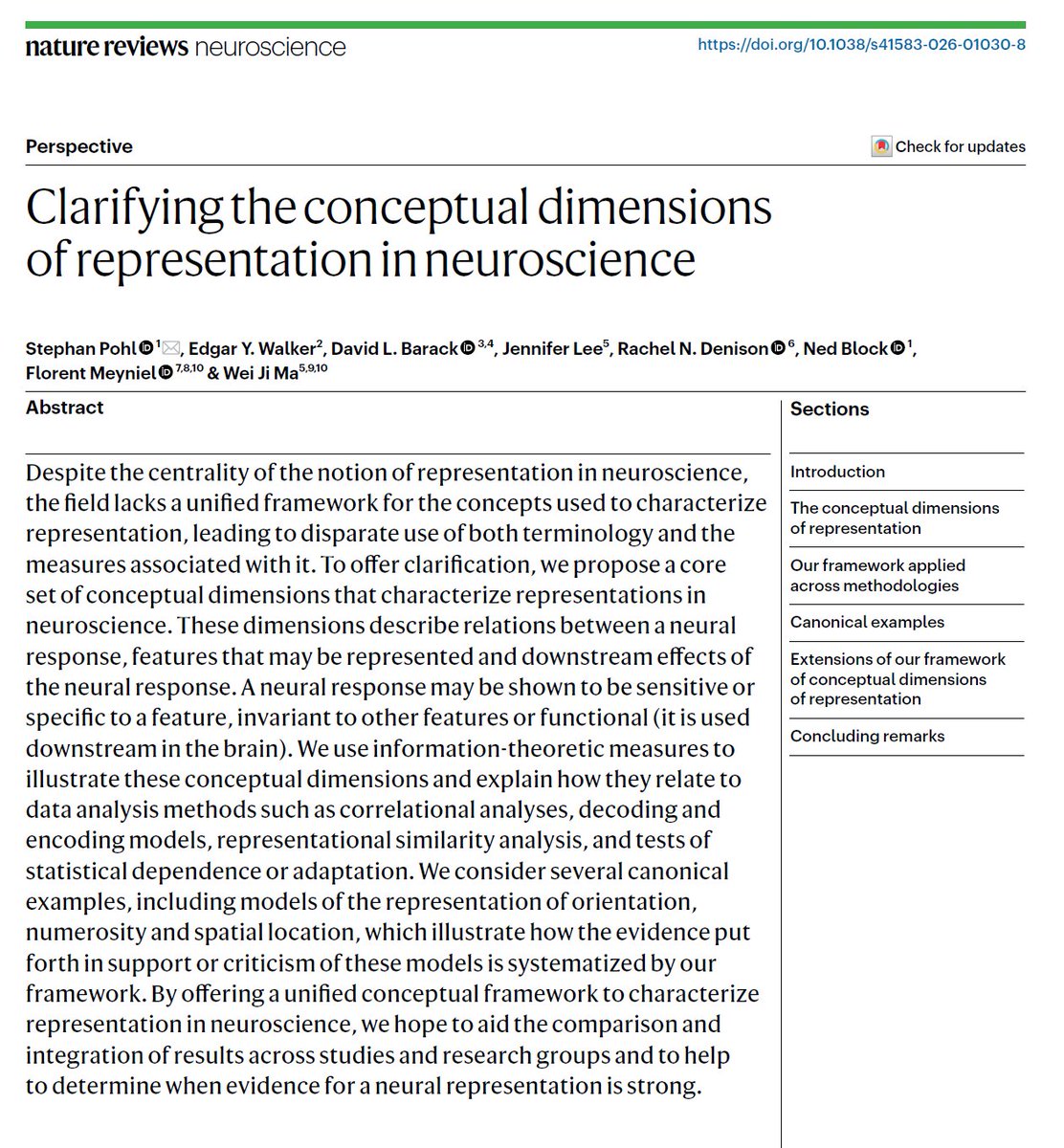
@PessoaBrain I asked Grok to analyze the paper in the context of fractal heterodimericism, and it found strong convergence with the representations proposed. Hopefully you find the conversation useful. The theory has simulation-ready mathematical formalism: x.com/i/grok/share/7…
English
0
0
0
145
Luiz Pessoa
Luiz Pessoa@PessoaBrain·
𝗕𝗿𝗮𝗶𝗻 𝗿𝗲𝗽𝗿𝗲𝘀𝗲𝗻𝘁𝗮𝘁𝗶𝗼𝗻𝘀 For those in favor or against, it seems like a good one to discuss in the Neuroscience & Philosophy Salon! doi.org/10.1038/s41583…
Luiz Pessoa tweet media
English
6
50
247
12.4K