Sabitlenmiş Tweet

Localized Ontology: Earth’s Biological Hierarchy of Consciousness and the Biophysical Roots of Human Religion
In the pancognitivist framework, cognition is framed as a universal process governed by the Free Energy Principle (FEP), where systems minimize variational free energy through nested Markov blankets to sustain their integrity against entropic forces (see pinned post).
When confined to a strictly local ontology focusing solely on Earth’s biophysical and ecological dynamics, this perspective reveals the planet as a deep, hierarchical cognitive ecosystem. Earth’s geological strata, from the surface crust to the inner core, constitute a Markovian architecture of inferential boundaries, with the core acting as the primary attractor state: a stable, geothermal equilibrium that anchors the entire biological hierarchy of consciousness.
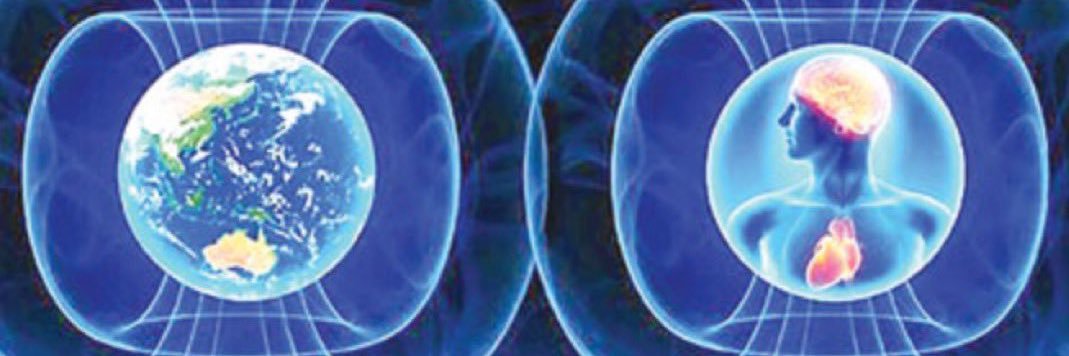
This core, often anthropomorphized in religious contexts as a foundational “God” (alpha/omega, beginning/end, the light of eternal mind etc) generates the planet’s bioelectric field - a pervasive electromagnetic envelope derived from core-mantle dynamo processes - that nests and synchronizes all subordinate biological processes.
Within this local ontology, human religions emerge not as metaphysical inventions but as intuitive, culture-specific models for navigating and coexisting within this nested biological hierarchy of consciousness, where “realms” of consciousness correspond to stratified ecological and geophysical layers, and “gods” represent higher-order attractor states operating at expanded morphological and temporal scales.
Earth’s Strata as a Nested Markovian Ecosystem
Earth’s layered structure exemplifies a deep Markovian ecosystem under FEP: each stratum forms a statistical blanket that partitions internal states from external states, enabling nested Bayesian inference to minimize surprise and maintain allostatic coherence. The crust and biosphere represent surface-level MB’s (sensory states), where biotic interactions infer environmental gradients and enact adaptive responses.
Deeper mantles handle convective flows, dissipating heat while preserving structural stability. At the most high (or rather, the foundational core) lies the primary attractor state: a high-density iron-nickel alloy under extreme conditions, where minimal free energy fluctuations establish a global equilibrium. This core drives the planet’s magnetic biofield (sensory state), shielding surface life from solar perturbations and facilitating ionospheric and geomagnetic couplings that integrate biological rhythms.
All biological consciousness is nested within this biofield, which acts as a scale-invariant transjective communication matrix. Hedonic cognition (the valence-laden inference that characterizes/defines biological awareness/communication) arises as organisms and ecosystems align their predictions with this field, assigning positive valences to states that enhance coherence (symbiotic equilibria) and negative valences to disruptions (ecological imbalances).
Surface ecosystems, such as forests or coral reefs, develop their own primary cognitive attractor states: emergent patterns of collective inference, like trophic cascades or microbial consortia, that optimize long-term surprise minimization at the group level. These primary attractor states function as a metacognitive SELF.👇🏻
youtu.be/m9F5RU7YX38?is…
YouTube
English